Jane-Emily by Patricia Clapp

Well, Mallory and I have read another book – this time a story I remember reading (and loving) when I was about Mal’s age. I stumbled across Jane-Emily when I was ‘shopping’ at Book Closeouts and couldn’t resist. It’s a story about a little girl, Jane, who goes to visit her paternal grandmother after her parents are killed in a buggy accident. She’s accompanied by her 18 year old aunt, Louisa. Her grandmother is kind but stern. She’s had some tragedies in her life — the recent loss of Jane’s father, of course, but also the death of her beloved husband and young daughter, Emily. Emily appears to have some unfinished business at the house.

I remember this book as being really creepy, but let’s face it, that was 35 years ago. I wonder how it compares to some of the books Mal’s read. What did you think, Mallory, did you find Jane-Emily scary?

Mallory: No. Not at all. It wasn’t scary, but I loved the way the story took place in 1912. I love books that take place in the past. What about you?

Christie: Well, I have to agree with you, Mal. Not scary at all. In fact, I have to admit to finding the book a little slow-moving. It’s just a novella, only 140 pages, but it moved fairly slowly. I think I remember it as being slightly more action-packed. I did like how atmospheric it was, though. Do you know what I mean by that?

Mallory: Umm… I think you might be talking about the feeling each day brought as it passed in the book. If I’m right, then yes, I did. I liked the way each moment seemed a little care-free or relaxed. It is summer vacation, remember.

Christie: You’re close. Atmosphere is the way the story makes you feel…so, for example, Clapp took her time making you feel the heat of each summer day – when it was hot, you knew it was. Remember how they were always going to sit in the shade of the tulip tree? And when they went up into the attic, there was this sense of foreboding, like they might discover something awful and they did – remember?

Mallory: Yeah, I do remember what poor little Jane found. That wax doll with the melted face. Emily sure seemed like a nice little girl, right?

Christie: Well, I guess that’s the difference of 35 years. This isn’t a splashy book. There wasn’t any violence or anything graphic, but as  a ghost story I think it was okay. How does it compare with other creepy stories you’ve read?

Mallory: I think the romance in this book overshadowed any ‘creepy’ parts. As for a comparison- the book The Enchanted Attic by M.D Spenser forced me to read it only in daylight. Literally. And truthfully, (and I’ll only admit to doing this once) I read nearly all of Jane-Emily at night with a little reading light. I didn’t even shiver.

Christie: Busted.

Mallory: I’m going to deny anything you accuse me of. ;). I recommend Jane-Emily to  readers who can’t handle a huge scare,  and who prefer more ‘mild’ creepy books. But I must say, this novella paints a gorgeous picture of summertime in your head. And I think every ludic reader loves a book that does that!
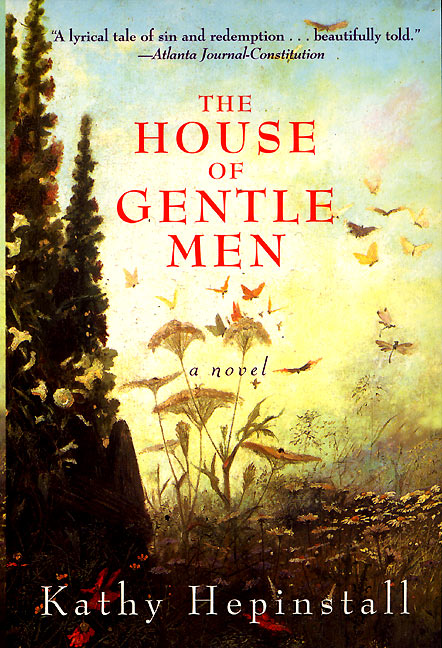
The House of Gentle Men by Kathy Hepinstall

My book club meets once every five weeks or so. It’s organized so that each of the ten members chooses one book per year…and the rule is that it has to be a book you haven’t read. The reveal is a big deal to us – we all love to see what’s coming next. Although we do have a big book store in town now, it’s still not always possible to stray too far off the beaten track. That’s why, when I was preparing my reveal in December, I took advantage of the great fiction sale at Book Closeouts. com. I read reviews and blurbs and blogs and finally made my decision. Book Closeouts had 12 copies of the book and they were $1.24 each…for a hard cover! So, I was able to buy a copy for everyone in the group and hand them out – gift-wrapped – at our Christmas meeting. So much fun!

Last night we discussed my pick. The House of Gentle Men has been on my radar for a long time. A few years back I read Hepinstall’s novel The Absence of Nectar which I liked quite  a lot.  There was something intriguing about the premise of The House of Gentle Men so I took a chance. I’m not sure that everyone in my book club would agree, but this book paid off for me.

The House of Gentle Men is actually the name of an establishment run by Mr. Olen, a single father who is hoping that if he makes up, in some way, for neglecting the wife who subsequently left him, she’ll return to him. He opens a house for Gentle Men, offering men who have the need to atone for some past wrongdoing the opportunity to redeem themselves.

“You think you could spend all night with someone, just kissing? Touching? Whispering sweet nothings? Maybe a little waltzing?”

These are the questions he asks, Justin, a young man who wanders into the house looking for a way to right his own wrongs.  Justin, as it turns out, has a lot to atone for. Seven years previous, while he was a young soldier on maneuvers, he came upon two fellow soldiers raping a young girl in the woods. Instead of doing the right thing, he took his turn.

Several lives intersect at the house for gentle men. Hepinstall deftly creates interior lives for even minor characters. All of them are damaged in some way; some of them are reprehensible; many of them deserve the redemption they so ardently seek.

This book took a few pages (about 75) to work for me. It seemed somehow cheesy –  this whole idea of a place where tired, frustrated, broken women could go to find comfort – not from sex  (although everything but intercourse is allowed), but from companionship. But, in the end, it did work . I grew attached to the characters, Charlotte in particular – who loses her voice (or chooses not to speak) after the attack. As she navigates her way out of her pain and anger, into the light offered by forgiveness, it’s almost impossible not to feel something for her.

So The House of Gentle Men may require a suspension of disbelief, but I think it’s worth it in the end.


How I Live Now by Meg Rosoff

How I Live Now by Meg Rosoff  has been on my tbr shelf for a few months. Coincidentally, a friend gave a copy of the book to my 12-year-old daughter, Mallory, for Christmas. We decided it would be cool to read the book at the same time and then share our thoughts about the novel here. This is actually something I’d like to do on a semi-regular basis because there are a lot of YA novels I’d like to read and Mallory is a voracious reader. In any case, we’ll start with this book and see how we make out.

I’ll start by letting Mallory tell you a little bit about herself:

Hi, everyone! I’m a grade seven student in French immersion. Besides reading, I enjoy drawing, dancing, (I study ballet and modern dance ten hours a week), and hanging out with my friends. I do love to read. Some of my favourite books are: Airborn, Skybreaker, A Little Princess, The Twilight Saga, Little Women, and The Little House on the Prairie books.

Christie: Thanks, Mal. So, I’m going to let Mallory tell everyone what How I Live Now is about.

Mallory:  Basically,  How I Live Now is about a teenage girl named Daisy who goes to England to live with her cousins after her father remarries. Once she’s there, two life-changing things happen: she falls in love with her cousin, Edmond, and war breaks out.

Christie: That’s it in a nutshell, Mallory. But this is a pretty remarkable book; it’s certainly not like anything that I’ve ever read before. What did you like about it?

Mallory: You know how when you read you can hear the author’s voice? Well, this book had the strongest voice of any I’ve ever read. Meg Rosoff created an incredible character, and when Daisy spoke she could make you believe anything.

Christie: I think Mal’s touched on the main reason this book is so wonderful. Daisy is a breathless, intelligent, self-deprecating, emotional fifteen-year-old girl whose personal world has been turned upside down….and then she has a catastrophic war to contend with.

When she arrives at the airport and meets her cousin, Edmond, she tells the reader “Now let me tell you what he looks like before I forget because it’s not exactly what you’d expect from your average fourteen-year-old what with the CIGARETTE and hair that looked like he cut it himself with a hatchet in the dead of night, but aside from that he’s exactly like some kind of mutt, you know the ones you see at the dog shelter who are kind of hopeful and sweet and put their nose straight into your hand when they meet you with a certain kind of dignity and you know from that second that you’re going to take him home? Well that’s him.” (3)

The whole story spins out of Daisy’s amazing brain and everything that happens to her is skewed by her needy intelligence.

Mallory: Her relationship with Edmond was really interesting to me. At first, I thought it was sort of freaky because I couldn’t imagine falling in love with my cousin. But after the war starts, and things get more complicated, I began to believe, like Daisy did, that they were meant to be together– related or not.

Christie: The war certainly made the story interesting. What did you think of the way we didn’t really know too much about who was fighting whom?

Mallory: When I was reading any bits where the war is described, my mind was never thinking of who was fighting or what they were fighting for. Mostly the whole time I was on edge with fear for Edmond and Daisy and whether they would make it through.

Christie: I was worried for them too, but I thought it was really interesting to see this war through Daisy’s eyes. Even though she didn’t really understand the hows and whys, she was able to articulate how people were affected by the fighting and the deaths she witnessed were horrific.

Mallory: I agree. Daisy seemed to be in the know and completely out of it at the exact same time — but it didn’t seem to matter. I was just wondering, what were your thoughts on Isaac and Osbert, who didn’t seem to play a big role in this story. And about Piper, who did.

Christie: We should tell people that Isaac is Edmond’s twin, Osbert is his sixteen-year-old brother and Piper, his nine-year-old sister. Their mother, Daisy’s Aunt Penn, goes off to Oslo very early in the book, leaving the children on their own. I think that’s one of the interesting aspects of this book — how these kids have to fend for themselves when the war is relatively distant and how all that changes when it suddenly shows up in their back yard. You’re right, though; Isaac and Osbert don’t really have a large part to play although Isaac does have an impact at the novel’s conclusion. Piper, on the other hand, is extremely important and I think gives Daisy a reason to go on. She’s a great character.

Who should read this book, Mal?

Mallory: Well, this book is suggested for 12 and up- but it’s a pretty intense read. It might not appeal to everybody, but if you’re a strong reader, and aren’t easily upset or offended, I recommend this book. Before I read How I Live Now, The Twilight Saga were my favourite books. I stayed faithful to them for a long time, and was almost positive that I’d never find a book (or series) that was better. How I Live Now was a pleasant surprise. It ended up overtaking Twilight by a longshot– and it’s now the reigning champ.

Christie: That warms my heart Mal because, as you know, not a fan of the sparkly vampires! Now we have to decide what we’re going to read next. Stay tuned!

Traveling with Pomegranates by Sue Monk Kidd and Ann Kidd Taylor

Having read The Mermaid Chair and  The Secret Life of Bees, both by Sue Monk Kidd,  I was excited when this was chosen as one of our book club selections. That was in November. I just finished reading the book now. What does that tell you?

Traveling with Pomegranates should have been a better book than it actually is. This is a mother(Sue)/daughter(Ann) memoir about travel, faith, love, creativity and writing. At the beginning, as I settled in, I thought that it was going to be quite compelling. I felt a kinship with Sue:

“I didn’t understand why I was responding to the prospect of aging with such shallowness and dread, only that there had to be more to it than the etchings on my skin” (4).

In Sue’s capable hands, this journey is – if not always engaging – at least well written and thoughtful. Sadly, I can’t say the same for Ann’s part. I found her whiny and entitled. I never warmed up to her.

Mother and daughter visit Greece together in 1998. Ann is 22 and Sue mourns the loss of the little girl she was. She is also acutely aware that something troubling is going on with her daughter. At first glance it might seem that Ann’s disappointment has to do with the fact that she didn’t get into graduate school, but as the mother/daughter writers unspool the story it turns out that they are both looking for something more complicated. And they spend the rest of the book kneeling at the feet of Madonnas (and other powerful female icons) in Greece and Crete and France…trying to find it.

Ultimately, it turns out that graduate school was never what Ann truly wanted; she wants to be a writer. And how wonderful for her that her mother is and that they could do this book together.

The Trade Mission by Andrew Pyper

I hate it when a book flummoxes me. I hate it when I feel outsmarted by a book, too. Andrew Pyper’s novel The Trade Mission is probably one of those books which deserves to be read twice: once for the story and once for the deeper philosophical issues that I knew were there, but which somehow eluded me. Mostly, anyway.

Jonathan Bates and Marcus Wallace are childhood friends who have become dot com millionaires for their invention of something called Hypothesys.

“We feel that Hypothesys is something that is truly going to change the way we conduct our lives,” explains Wallace to investors gathered in Brazil. “It’s not another Internet site…Hypothesys helps you make the best decisions of your life.”

Ironically, when it comes to making moral decisions with real consequences, Wallace and Bates are left to their own devices. While playing tourist on the Rio Negro, deep in the Amazonian jungle, they (and their companions Elizabeth Crossman, their interpreter; Barry, their managing partner and Lydia, their European counsel) are kidnapped by pirates. What follows is a strange combination of violence and soul searching.

The Trade Mission is narrated by Crossman and she’s in a unique position; as the only one of the party able to speak the language she can embellish or omit.  She also seems to love and hate Wallace in equal measure.  Truthfully, he isn’t particularly sympathetic. His relationship with Bates is eerily sexual and he often seems smug about his intellectual prowess. As for Crossman herself, she isn’t the most accessible of characters and I have to admit that her role, when the story finally starts to unravel, seems a bit of a cheat. The novel’s section After was too sentimental for me, especially coming after the horrors the characters experienced.

Pyper’s a terrific writer. I’m a fan. I liked his novel Lost Girls, which I read several years ago. But I remember feeling somehow unsatisfied after reading that novel, too.  The Trade Mission is billed as a ‘novel of psychological terror.’ Sure, some of it was squirm inducing, but it wasn’t a page-turner in that ‘oh my God, what’s gonna happen next’ way.

Thus the flummox. And the am I missing something. Still worth a read, though.

Still Alice by Lisa Genova

stillalice

My mother was a geriatric nurse for most of her career. When I was in my late teens I had a summer job working at the nursing home where she was head nurse. Many of the patients had dementia and I remember one lady in particular, Annie. She was sweet and over the summer we became friends…except she never remembered who I was from one day to the next.

Lisa Genova’s novel Still Alice is the story of Alice Howland, renowned Harvard professor, mother of three, happily married to John, also a Harvard prof. After seeing her doctor because she’s suffering from strange lapses in her memory, Alice is diagnosed with early onset Alzheimer’s. She is 50.

The novel traces Alice’s diagnosis and subsequent decline. At first she merely struggles to find words (and I don’t do this, but sometimes I start a story and totally forget what I was going to say!) but then her lapses in memory become more pronounced: she gets lost walking a familiar route, she forgets people who were introduced to her only moments before, she mistakes a mat on the floor for a black hole.

Still Alice isn’t literature. Okay, yes, it tells a story, but often times I felt like the author was trying to convey information. Alice says to her neurologist:

“You should also tell them about DASNI. It’s the Dementia Advocacy and Support Network International.”

There are several other instances of this sort of writing, places where I felt Genova had an agenda and she was writing to fulfill it. Somehow it lessens the emotional impact of the story because as a reader I was more interested in Alice and her life than I was in hearing about clinical trials.

I can only imagine that being diagnosed with Alzheimer’s is the worst torture imaginable. The disconnect between your life and the lives of the people you love would be beyond horrific. The thought of losing the ability to read (I can’t even imagine my life without books!), to watch a movie, to do simple tasks, or to recognize the faces of my children fills me with dread. Yet near the end of the novel, Alice still has the wherewithal to stand up in front of the delegates of a Dementia Care Conference and give an impassioned lecture about how, despite her symptoms, she is still a person worthy of note.

“Please don’t look at our scarlet A’s and write us off. Look us in the eye, talk directly to us. Don’t panic or take it personally if we make mistakes, because we will.”

The whole lecture seemed like  authorial commentary…and it didn’t work for me. Strangely, the part that I found most moving in the novel was when Alice attends the graduation of her last grad student, Dan. Even though we’ve seen very little of their relationship and hardly anything of Dan in the novel, his post-graduation moment with Alice is very touching.

People will love Still Alice. My feeling about it is that it’s a timely topic written without artifice.

Testimony by Anita Shreve

Testimony

Explosive… Shreve flawlessly weaves a tale that is mesmerizing, hypnotic and compulsive. No one walks away unscathed, and that includes the reader. Highly recommended. – Betty-Lee Fox, Library Journal

Pretty much everyone has raved about Shreve’s latest novel, Testimony. I’ve been a Shreve fan since Eden Close, so I was looking forward to reading this book. The novel opens when Mike Bordwin, headmaster of Avery Academy, a private New England boarding school, views a tape depicting three of the school’s top basketball players having sex with  a female student who is clearly underage. While the story opens with Mike’s point of view, the novel flips back and forth allowing us to see how this event and its aftermath affects everyone concerned: the so-called victim, the three boys, their families and even members of the press called upon to report the event once the story is leaked from the school’s hallowed halls.

Shreve is  a talented writer and she manages to make individual characters come alive in this novel by employing third, first and even second person points of view. When the young girl speaks, she seems every bit like a fourteen year old, both naive and culpable. One  boy’s mother speaks in the 2nd person – perhaps to distance herself from the news that her son has done something reprehensible, inexplicable.

It may seem odd that the story’s inciting action is revealed in the novel’s opening pages, but as it turns out, the story unravels to reveal another event which contributes to at least one of the boy’s bad decisions. Silas’s story is heartbreaking and, for me at least, he  carried much of the story’s emotional weight on his shoulders.

We had an excellent discussion about this novel at Indigo’s book club. The ripple effect this event sends through the school and community- upsetting lives and relationships- was immensely powerful. In less confident hands, the novel might have slipped into tabloid sensationalism. Not for Shreve; she’s far too good a writer and Testimony is far too good a book.

On Chesil Beach by Ian McEwan

chesil1

Unlike the female protagonist of McEwan’s novel, On Chesil Beach I am not a virgin when it comes to McEwan’s work. This is the sixth book I’ve read by this author (Saturday, First Love, Last Rites, The Comfort of Strangers, The Cement Garden, Atonement), but I’d have to say it’s my least favourite.

Like his novel Saturday, McEwan compresses time and shows us Edward and Florence, a young couple dining together in a hotel on Chesil Beach on the evening of their wedding. They haven’t yet consummated their union and they are both approaching the idea of the event-to-come from vastly different vantage points. Florence is horrified at the thought of sex and Edward is both patient and anxious.

McEwan fills in the blanks in their personal stories as well as their history as a couple and does it well enough that you come to understand Edward and Florence very well. Whether or not you have any sympathy for them will depend on your patience.

As inexperienced as Florence is, I was left with the distinctly uneasy impression that her aversion to sex (and she really is repulsed by it: her description of a kiss made me reconsider kissing my husband ever again!) was the result of some traumatic event- although nothing is ever explicitly stated.   Edward’s own inexperience has its own unfortunate consequences and the repercussions are devastating.

But then McEwan does something I sort of hate in a novel- he flash forwards a few years and then many years and tells us what these people have been up to. That sort of ending never works for me.

No question, McEwan is a fabulous writer. This same story, in lesser hands, would be unbearable. As it was, I felt like I was laughing where I shouldn’t be and the climax, no pun intended, was a rather soggy affair.

The Guernsey Literary and Potato Peel Pie Society by Mary Ann Shaffer and Annie Barrows

guernsey2

This book has had a lot of buzz- perhaps because of its title…which is almost impossible to remember:  The Guernsey Literary and Potato Peel Pie Society. The novel tells the story of writer Juliet Ashton, who is something of a minor celebrity in post World War Two.  A chance letter from the British Island of Guernsey changes her life.

The novel consists entirely of letters and cables sent back and forth between various characters: Juliet and her publisher, Sidney; Juliet and her best friend (and Sidney’s sister) Sophie and then Juliet and various members of this oddly named literary society. The second part of the novel finds Juliet on the island meeting with the people who will ultimately change her life.

The Guernsey Literary and Potato Peel Pie Society is a simple, pleasant novel- the perfect book to curl up with on a cold winter afternoon, cup of tea in hand. That said, it lacked a certain something. Perhaps it has something to do with the fact that the book wasn’t finished by the person who started it: Mary Ann Shaffer passed away before the novel’s completion and was finished by her niece Annie Barrows (writer of the children’s series Ivy and Bean).  I felt somehow let down by the novel’s denouement- it felt rushed and one section,  so-called “Detection Notes”, takes the place of the back and forth correspondence between the characters. It felt a bit like a cheat to me, especially as it reveals too much about two characters, thus allowing everything to be tied up in a neat bow.

The most compelling bits of the story, for me, were about the Nazi occupation on Guernsey and I was aching to know more about Elizabeth; she was, by far, the most compelling character.

Still, you could do a lot worse than this book.

The Flying Troutmans by Miriam Toews

troutmans

When Hattie gets a frantic phone call from her eleven year old niece, Thebes, to “come quick”, Hattie leaves her life in Paris and flies home to Manitoba.

Min was stranded in her bed, hooked on the blue torpedoes and convinced that a million silver cars were closing in on her (I didn’t know what Thebes meant either), Logan was in trouble at school, something about the disturbing stories he was writing, Thebes was pretending to be Min on the phone with his principal, the house was crumbling around them, the black screen door had blown off in the wind, a family of aggressive mice was living behind the piano, the neighbours were pissed off because of hatchets being thrown into their yard at night (again, confusing, something to do with Logan) … basically, things were out of control. And Thebes is only eleven.
Thebes’s mother, Min, is Hattie’s older sister. Theirs is a complicated relationship fraught with sibling rivalry, of course, but also touched by Min’s mental illness. Their parents are almost non-existent in this story: we learn only of their father’s tragic death.  Still, Hattie loves her niece and nephew- even though she hasn’t seen them in quite a while and even if she seems ill-equipped to care for them.

What she decides to do is take them on a road trip to find their father- who has been out of the picture for several years. Hattie remembers him fondly and thinks he’d be the perfect person to care for the kids while their mother recovers in hospital.

What follows is a road trip quite unlike any other as the Troutmans travel first south and then across country to California.

These are damaged people:  fragile and angry and resilient. As they make their way closer to the kids’ Dad, they form a bond built on trust and love. They’re kooky, no question, but they’re most definitely family.

I read Toews’ novel A Complicated Kindness a couple years ago- and really enjoyed it. I liked this even better. It was laugh-out-loud funny and the ending was full of hope and these characters, particularly Thebes, were some of the most enchanting (albeit nutty) people I’ve had the pleasure of spending time with in recent memory.