Darkness Bound by Larry Brooks

Two strangers meet. A woman without inhibitions…a man without limits…for a private game between two consenting adults.

Yeah, so it’s obvious why I chose this book- but it didn’t turn out to be the book I expected. Instead of a book filled with kinky sex, this turned out to be a well-written crime story, filled with lots of twists and turns. Dillon Masters and his wife, Karen, separate. Dillon’s a stock broker with a penchant for kinky sex– something his wife doesn’t exactly share. So, when the mysterious woman of his dreams – a woman who seems to know all his dark desires– walks into his life, he can’t resist indulging in his fantasies. Turns out that this ‘Dark Lady’ is far more dangerous than Dillon had first giddily anticipated.

Lucky for the reader, though, Dillon’s no slouch– he’s able to more than hold his own with her and Darkness Bound turns out to be not so much a book about naughty sex, as a cat and mouse thriller where the players try to outmaneuver each other.

I read it in an afternoon and had a ball.
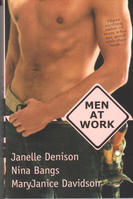
Men at Work by Denison, Bangs, Davidson

So this book was on the display of books that have been reduced; I can never walk by that display. I always have to buy something. Sometimes I luck out. I found Denise Mina that way. All I can say about Men at Work is that it only cost $4.99– and it was worth about one third of that because the second and third stories were so bad, I couldn’t even finish them.

So, yeah, this book is supposed to be “three sizzling tales of men who are good with their hands.” Okay– what?

If you can believe it, there’s actually a review.

Trust me– if you’re looking for smut I can recommend some great stuff. I can’t recommend this.

Taming the Beast by Emily Maguire

A thought-provoking and searing first novel. -The Age

Sarah Clark is a smart kid. That’s what we’re told, anyway. By the time she turns fourteen she’s read every one of Shakespeare’s plays and sonnets, and then the works of Donne, Marlowe, Pope and Marvell. At fourteen she meets the English teacher, Daniel Carr, who will change her life.

“For the entire forty minutes of his first class he spoke about why Yeats was relevant to Australian teenagers in the year 1995. In the second class, Sarah put up her hand to make a comment on something he said about ‘Hamlet’. When he called on her to speak, she started and could not stop. She stayed in the classroom all through lunch, and when she re-emerged into the sunlight and the condescending stares of the schoolyard cliques, she was utterly changed.”

It’s not a huge leap to believe that a meeting of the minds turns to a meeting of the flesh. But their sexual affair is not quite the same as the poetry they’ve discussed– it’s raw, aggressive often brutal. The obvious questions to ask would be: is this abuse? (Clearly he’s breaking the law based on his position and the difference in their ages.) But Sarah has a penchant for this sort of sex, it seems.

And when Carr is forced to choose between Sarah and his wife and children, he chooses the latter– leaving Sarah to drift through the next eight years of her life in a haze of alcohol, drugs, and sex with hundreds of men.

Until Carr re-enters her life.

This is not a love story. Watching Sarah move through her days (and nights) is like peering through the windows of a car wreck. The characters are almost despicable– and so as I was reading, even when things were particularly horrible, I kept thinking –you know what, you guys deserve each other.

Saturday by Ian McEwan

I am not a McEwan newbie. Saturday is the 4th of his books I have read and, thus far, my least favourite. But even though I didn’t love this book, I would still have to praise McEwan’s ability to write. If I have a criticism of Saturday it’s that it’s over-written. That may be the fault of McEwan’s decision to set the novel in one day in the life of neurosurgeon, Henry Perowne.

Saturday is Henry’s favourite day. He plays squash, does some shopping and on this particular Saturday– anticipates the homecoming of his daughter, Daisy. But, of course, this Saturday isn’t going to be like all the others. He awakens in the middle of the night and watches from his bedroom window as a plane– streaming fire, cuts across the sky to (crash, he assumes) land at Heathrow.

This event wouldn’t be the cause of so much concern if this story wasn’t set post 9/11 and on the very day when hundreds of thousands on people are set to march in London’s streets to protest the war against Iraq.

As Henry sets out to accomplish his long list of things to do before his daughter arrives he gets into a minor fender bender that will propel (although not quickly) the book towards its denouement. Whether or not you find the ending, or the book for that matter, satisfying, will depend on how much you care for Henry and the minutia of his Saturday.

Carrie’s Story by Molly Weatherfield

Man, it’s hard to find good porn. And I was hopeful about this book, I truly was. Apparently I have been spoiled by the Internet, though. Or perhaps I am just more perverse than I thought I was. Perhaps, five years ago this book would have shocked me…or made me hot. But…now?

Carrie’s Story is exactly what the title says it is: Carrie’s account of being a sexual slave to Jonathan, a rich, good-looking guy with a penchant for having his shoes licked and beating Carrie’s perfect ass.

Carrie’s a smart cookie. She analyzes every little thing that happens to her and makes no apology for the fact that s/m turns her on. And, to her credit, Weatherfield doesn’t make any apology for it either. She acknowledges that whatever floats the boat between consenting adults– even if that means acting like a pony– is fine by her. And she writes about it intelligently.

But for me it was just so-so in the erotic department. I guess I just like my porn to be, well, pornier.

Sweetness in the Belly by Camilla Gibb

British born, Canadian-raised writer Camilla Gibb’s stunning new novel Sweetness in the Belly divided my book club. I was among those who loved it. The book tells the story of Lilly, born to hippie parents and brought up as a Muslim, after their death, in the city of Harar. Her story is told by layering her young years in a politically charged Ethiopia with her life as a nurse in London. It’s a fascinating picture of a world torn apart by poverty and prejudice and by Lilly’s own beliefs. It is also a love story as we wait with Lilly to learn the fate of her lover, Aziz.

I know nothing of the politics of Ethiopia under Emperor Haile Selassie. I know very little about the Muslim religion, but Gibb’s beautiful prose and attention to detail (she conducted fieldwork in Ethiopia for her PhD in social anthropology) makes this book a page-turner. The characters are complex and interesting and the day-to-day struggles of the women, in particular, are riveting. I was both gutted and elated by book’s end.

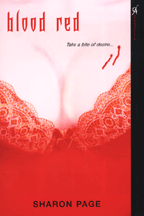
Blood Red by Sharon Page

Sharon Page’s book Blood Red is basically 347 pages of sex scenes linked together by a plot that is so nonsensical, I stopped paying attention to it.

Althea Yates is a vampire hunter in England circa 1818. For a while now she’s been having these strange and highly erotic dreams and she is shocked when, one night at the inn where she and her father are staying, one of the men in her dreams (there’s two, naturally) shows up.

He’s Yannick. A perfect specimen. But drat, he’s a vampire.

His brother, Sebastien (known as Bastien in the novel) is also a vampire. Together they are known as The Demon Twins. And once Althea and her father release Bastien from his tomb, where he’s been languishing these last ten years, he and Yannick set about introducing virginal (but up for just about anything) Althea to the delights of the flesh.

Yannick and Bastien aren’t like any vampires I’ve ever encountered. Soulless they may be, but they never kill for food, they can shoot bolts of coloured energy from their hands and they have a reflection. Apparently they have a few other vampire tricks up their sleeves, too.

Reading Blood Red was like eating a bowl of chips– absolutely no redeeming nutritional value, but tasty enough.

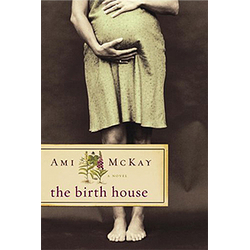
The Birth House by Ami McKay

One of the first books I read this year and easily the best novel I encountered in 2006, this account of a midwife in turn-of-the-(20th)-century Nova Scotia is everything a novel should be: funny and tragic, joyful and sorrowful, filled with rich, carefully drawn characters and experiences that linger long in the mind.

The Birth House
spent most of the year on bestseller lists and marked the arrival of a splendid new talent. I can’t wait to see what Ami McKay does next.
– Robert Wiersema, for the Vancouver Sun.

Ami McKay’s book The Birth House is a natural selection for book clubs. Set in rural Nova Scotia circa the First World War, it tells the story of Dora Rare, the “only daughter in five generations of Rares.” Dora is a smart girl who spends much of her time with Miss B, the area midwife. Miss B is part-healer and part-witch and Dora learns much under her tutelage.

Truthfully, it took me a while to get settled into Dora’s quiet world, but the book’s charms are undeniable. For one thing, Dora is utterly likeable. She is kind and sensible and although she is young, she is no shrinking violet. McKay does a wonderful job of creating a world far removed from technology and the horrors of the war, but certainly not immune to either. For example, Dora’s faith in midwifery is tested (as is the faith of all the women of her community) when Dr. Thomas arrives in the area and sets up a hospital, offering women pain-free births. And when the Halifax Explosion of 1917 happens, Dora rushes off to help and is forever changed by the experience. Scots Bay isn’t modern and McKay paints a riveting picture of poverty and backwoods thinking.

But the book isn’t without a sense of humour either. Dora’s marriage to town hunk, Archer, necessitates a visit to Dr. Thomas where he diagnoses her with “neurasthenia” and prescribes treatment using the Swedish Movement Health Generator. I dare you to keep a straight face.

The Birth House isn’t a flashy book, but it’s a book that will resonate with readers, particularly women, and I heartily recommend it.

Twilight by Stephanie Meyer

“Propelled by suspense and romance in equal parts, this story will keep readers madly flipping the pages of Meyer’s tantalizing debut.” – Publishers Weekly

I picked up Twilight by Stephenie Meyer despite the fact that it is geared for a teenage reader. How could I resist this?

About three things I was absolutely positive. First, Edward was a vampire. Second, there was a part of him- and I didn’t know how dominant that part might be- that thirsted for my blood. And third, I was unconditionally and irrevocably in love with him.

This is the story of 17 year old Isabella (Bella) who moves to Forks, Washington to temporarily live with her father, Charlie, the local Chief of Police, while her mother goes off to Florida with her new husband. Bella hates Forks; her childhood memories of the place include the devastating end of her parents’ marriage.

At her new school she gets her first glimpse of the Cullens, their faces “so different, so similar… all devastatingly, inhumanly beautiful.” She is particularly taken by Edward Cullen, who turns up in her Biology class and also turns out to have taken an immediate and hostile dislike to her.

But Edward is hiding a dark secret. And, of course, Bella is drawn to him– moth to flame.

There are, of course, lots of vampire stories out there. But I have to say that I liked this one quite a lot, even though it was rather tame. (As it would be given that it was written for teens.)

Bella is a smart, likeable character and Edward is haunted and beautiful– perhaps too perfect. The prose is clear and straightforward and the story (all 498 pages of it) moves along at a good clip.

You begin these sorts of stories with a willingness to suspend disbelief anyway. And my view of vampires is coloured by my love of those in the Jossverse. Although Edward (and the vampire mythology employed here) is quite unlike any I’ve ever read about– he was a seductive character.

And apparently the book has legions of fans…there are lots of sites dedicated to Edward and Bella.

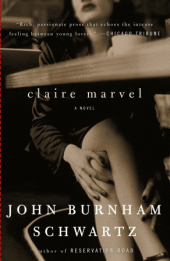
Claire Marvel by John Burnham Schwartz

A few year’s back I read Jonathan Burnham Schwartz’s devastating novel Reservation Road and was really impressed. So I was really looking forward to reading Claire Marvel. The book’s opening lines: “There was before her and now there is after her and that is the difference in my life” promised great things– but I’m not sure Schwartz actually delivers.

The book is narrated by Julian Rose, a grad student at Harvard who meets and falls immediately in love with Claire Marvel during a rainstorm. The book traces their relationship through all the requisite romantic obstacles and I suppose I can fairly say that the only thing that prevents this book from being totally been there, done that is the quality of Schwartz’s prose.

As Julian chases and abandons and chases and abandons the love of his life, we are never really certain of her and, in fact, even though the book is named after her– we really come to know very little about Claire as a person.

Members of my book club loved this book…but I found it somehow unsatisfying.