Lola Nox is the daughter of acclaimed horror film director Nolan Nox. It’s just been the two of them since Lola’s mother, Lorelei, disappeared without a trace. Lola likes to think that nothing can spook her, but one night she comes home and discovers her father lying in a pool of blood. As he recovers, Lola is sent to Harrow Lake to stay with her maternal grandmother.
Harrow Lake is where her parents met and also the place where Nolan filmed his most famous movie, Nightjar. It’s a weird town which depends on its celebrity for revenue, hosting a week-long festival each summer to give fans of the film the opportunity to check out the locations. The man who picks Lola up at the airport tells her to “never go into Harrow Lake woods on a moonless night, or the trees might mistake you for one of their own.”
All sorts of weird things start happening to Lola in Harrow Lake. First her suitcase disappears and she has to go around town dressed in the costumes her mother wore in the movie. There’s no cell service or working landline. The townsfolk are strange, although she does meet Cora and Carter, a brother and sister whose mother was once friends with Lorelei. If things are off-kilter for Lola, they’re even more wackadoodle for readers.
Harrow Lake is haunted by Mister Jitters. Cora tells Lola that
Mister Jitters lived alone out in the woods with no family, no friends – kind of an outcast nobody wanted to know unless they were in the market to buy what he was selling, you know? He hid his moonshine in the underground tunnels that run all around the lake, but he got caught in a cave-in when the land shifted in twenty-eight.
Apparently Mister Jitters survived by eating human flesh “so he started hunting for people to drag back to his lair to eat.” This legend is legitimized by the fact that every so often, people go missing in Harrow Lake.
There’s a lot going on in Kat Ellis’ book. Family drama and secrets, repressed memories, and imaginary friends who may not be all that imaginary are just a few of the elements that ramp up the tension. It’s a lot, I have to admit, and some of the time I wasn’t even sure I knew exactly what was going on. Lola is a character to root for, though, and the book is definitely a fun read if you are a fan if things that literally go bump in the night.
Vladimir, Julia May Jonas’s much-lauded debut novel, tells the story of an unnamed English professor at a small college in upstate New York. She and her husband John cohabitate in a house filled with the detritus of a long marriage, of “times passed and things seen.” Their academic lives are winding down; John has recently been suspended for a series of accusations about sexual misconduct with former students. Their adult daughter lives in the city.
While I wouldn’t call the narrator happy, she has carved out a life for herself. She forgives her husband’s transgressions believing that the accusations against him demonstrate a “lack of self-regard these women have – the lack of their own confidence.” She and John have had a long-standing arrangement: they can sleep with other people without acrimony.
Her life begins to unravel a little with the arrival of celebrated novelist Vladimir Vladinski, the new young professor who has come to teach at the college. Her attraction to him is immediate.
I wanted to be intimate with him, so deeply intimate, from that moment that I saw him with his legs crossed in the reflection of the window. It was as if an entirely new world had opened up for me, or if not a world, a pit, with no bottom – a continual experience of the exhilarating delirium of falling.
The narrator’s infatuation is problematic and not just because of their age difference: she is 58 and he is 40. He is married with a young daughter, too. His wife, Cynthia, is a brilliant, albeit troubled, writer. None of this impedes the narrator’s fantasies, though. She imagines scenarios where Vladimir returns her feelings; they are physically and intellectually aligned.
But the narrator also realizes that she is perhaps past the point where she is sexually alluring.
…as I looked in the bathroom mirror at the webbing around my eyes, my frowning jowls, and the shriveled space between my clavicles, I felt desperation at the idea that I would never captivate anyone ever again. A man might make a concession for me based on mutual agreeability, shared crinkliness, but he wouldn’t, he couldn’t, be in my thrall.
The narrator’s obsession with Vladimir deepens and about three quarters of the way through the novel the story takes a weird left turn. I am not sure I was 100% on board with the last quarter of the book, but it in no way undermined my enjoyment of the book overall. It has interesting things to say about academia, desire, family and marriage and female agency. It is also beautifully written and as a woman of a certain age not too far removed from the narrator, I felt seen on many levels..
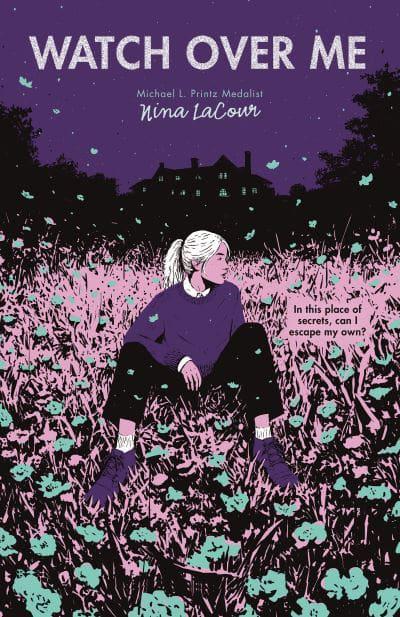
Watch Over Me is quiet – which is exactly what I said about Nina LaCour’s book We Are Okay In this award winning YA novel, LaCour tells the story of eighteen-year-old Mila who has recently aged out of the foster care system, but is offered the opportunity to remake her life as an intern at a farm in Northern California. She’s told
“Quite a few people have turned it down. And some people haven’t known what they were getting into and it hasn’t worked out. You need to want it. It’s a farm. It’s in the middle of nowhere – to one side is the ocean and in every other direction is nothing but rocky hills and open land. It’s almost always foggy and cold and there’s no cell service and no town to shop in or meet people…”
The farm is owned by Terry and Julia, an older couple who have fostered dozens of young people including Nick Bancroft, a former resident who now interviews prospective residents and who tells her that the farm “becomes home if you let it.”
It sounds sort of perfect to Mila, though, a place to take a breath and think about what might happen next. She will be teaching a nine-year-old with a traumatic past and helping out with the farm’s booth at the local farmer’s market.
Once at the farm, she meets her fellow interns, Billy and Liz, and her new student, Lee, with whom she forms an immediate bond. Mila finds comfort in the farm’s structure and in Terry and Julia, who are patient and kind. There is a kind of magic in working hard and being with these people.
But there are also ghosts – figurative and literal.
The ghost hovered in place on the moonlit field. It lifted its arms to the sky and spun in a slow circle. A girl, I thought, by the way she moved. And, in spite of myself, I was mesmerized.
This is not the first ghost Mila has ever seen, and it’s not the only ghost on the property. But Watch Over Me isn’t a ghost story, per se. It is a story about one girl’s path to healing, the memories which haunt her, and finding a place to belong in the world. It’s a beautifully written book and, strangely, a page-turner, too. (Not that those two things are mutually exclusive.) And that cover!
I wanted to like this novel way more than I did. I kept waiting for the story of Eleanor Bennett to be more than what it appeared to be, but that never happened.
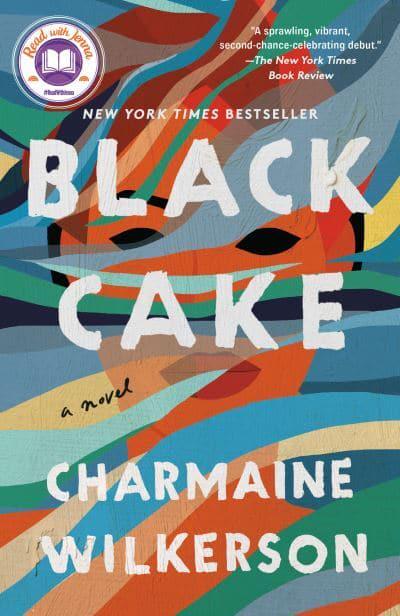
When their mother dies, adult siblings Byron and Benny reunite (after a years-long estrangement) to bury her, but also to listen to the recording she left for them, which recounts the story of a girl named Covey.
B and B, I know, I need to explain why you never knew any of this. But it won’t make any sense if I don’t start at the beginning.
…
You children need to know about your family, about where we came from, about how I really met your father. You two need to know about your sister.
Sister?! This revelation is shocking to the siblings. Over the course of an afternoon, Benny and Byron listen to their mother’s voice and readers will be taken on a journey that spans decades.
This isn’t only about your sister. There are other people involved, so just bear with me. Everything goes back to the island and what happened there more than fifty years ago. The first thing you need to know about is a girl named Covey.
My main problem with Black Cake is that it is all tell. I never felt as though I was inhabiting any of these character’s lives. I was told what I needed to know before being shuffled off to the next character/scene -and there are a lot of characters and a lot of moving parts in this story. (And at almost 400 pages…) The story itself was interesting and the writing was fine, but I just never settled into the narrative. Maybe that’s a me thing because the accolades are numerous and who am I to disagree?
Ultimately, this is a story about family and the secrets we sometimes keep from them. Benny and Byron really shouldn’t have been so surprised that their mother had a life before they came along. Don’t we all keep secrets from the people we love to some degree? Wilkerson also offers some commentary about racism and the environment (Byron is an ocean scientist, so there’s lots of talk about the health of our oceans) that feel less organic and more didactic. Then there are all the convenient plot – I won’t call them twists – contrivances.
This is a debut novel, and it’s an ambitious one. It didn’t necessarily work for me, but so what? Loads of people love it and it’s definitely worth a read.
I am not really a straight-up romance reader and if I do read them, I tend to like them angsty rather than sunny and sweet. Talia Hibbert’s first YA novel Highly Suspicious and Unfairly Cute definitely falls in the sweet category, but I am okay with that because this book is as charming as heck.
Seventeen-year-olds Celine Bangura and Bradley Graeme can barely stand the sight of each other. The two are classmates at Rosewood Academy, a school somewhere near Nottingham, England. Celine makes TikTok videos about UFOs and vaccines and has amassed a bit of a following. Brad is a football (aka soccer) player who hangs with the cool kids. Celine makes her disdain for Brad well known from the start.
People like them — “popular” people who think sports and looks and external approval are a valid replacement for actual personality — ironically don’t have the social skills to deal with anyone outside their golden circle. I should know.
Celine has “always believed he is fake and false and entirely made of earth-destroying plastic“.
Brad’s feelings regarding Celine are equally disdainful. She’s a “terrible, horrible person who I absolutely can’t stand.”
It wasn’t always been this way, though. Their mothers are besties and so were they until they were fourteen. Then something happened and now the two give each other the evil eye and if they do have to talk it’s only to trade pointed barbs.
An accident puts them in each other’s orbit again and then they both end up going for the same scholarship, which requires them to participate in a two-part survival course. Neither of them is particularly interested in the great outdoors, but both of them would benefit from the money for different reasons.
Celine is competitive and driven, especially by her need to shame her father who “ditched [her] for his second family ten years ago and [she hasn’t] seen him since.” Brad’s family could afford the tuition, but the scholarship means that he could afford single accommodations, which is something Brad desperately wants for reasons I won’t spoil here. Suffice to say, these teenagers — besides being really smart and funny — have baggage and secrets they are keeping from themselves, their families and even each other. They have built walls around themselves in order to protect themselves from the rough weather known as adolescence.
Highly Suspicious and Unfairly Cute is definitely tropey. There’s enemies-to-lovers, and close proximity, for sure. But in every other way, this is a refreshing, funny and sweet story of two teenagers trying to figure out what they want their lives to look like. I absolutely adored both of the main characters. Their banter was often laugh-out-loud funny and even though I knew what the outcome of this whole thing was going to be right from the very start I was delighted to go along for their swoony ride.
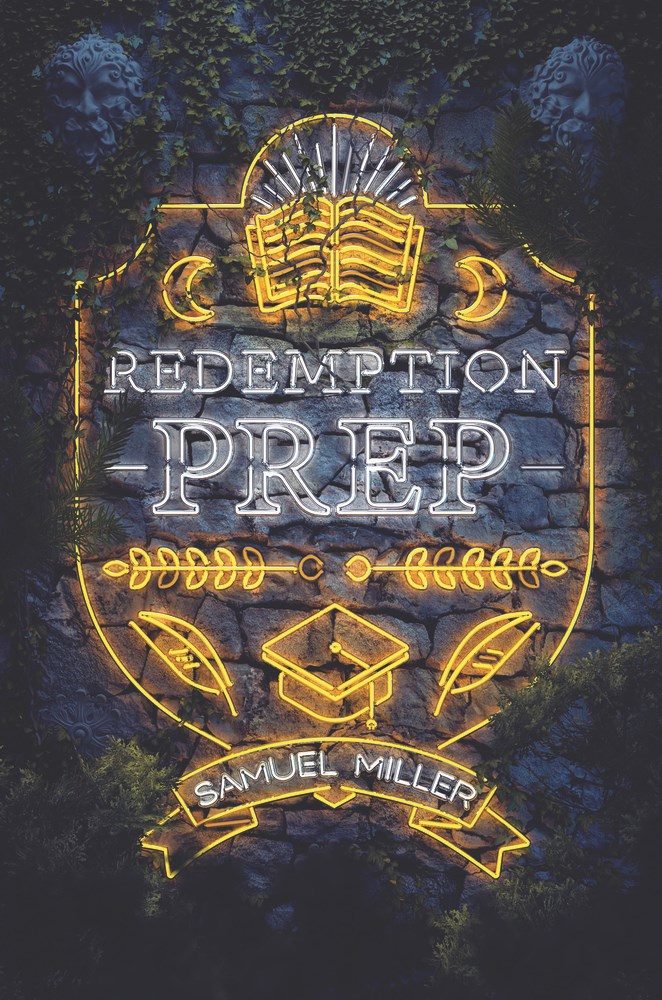
Like Samuel Miller’s debut novel, A Lite Too Bright, Redemption Prep doesn’t give up its secrets willingly. I think was about two thirds of the way through this thoughtful, intelligent mystery before I felt as though I was on semi-firm ground. And even then…
Redemption Prep is a private high school deep in the woods in Utah. Students have been told that “recruitment was incredibly selective, that [they’d] been chosen because of [their] accomplishments.”
Miller’s novel focuses on three of these students: Evan, Aiden and Neesha. Besides all being students at Redemption, they have another thing in common: Emma. When the novel opens, Emma has disappeared. Aiden is her star-basketball-player boyfriend; Neesha is her roommate and Evan is the boy who watches her every move.
As the school scrambles to locate Emma, it is clear that each of the students associated with her have their own concerns. Neesha, for example, is worried that Emma has disappeared because of the drugs she was selling for her. Aiden has been worried that Emma was going to break up with him and that her disappearance might have something to do with that; she’s certainly been acting strangely over the past couple of weeks. Evan is convinced that something more complicated, or perhaps even sinister, is going on.
Something is definitely not quite right at Redemption Prep. For one thing, no one is allowed to miss Mass. Ever. (Even though a high proportion of the student body is not Christian.) For another thing, there are a lot of maintenance workers at the school, and it soon becomes apparent that they aren’t your run-of-the-mill janitors. Then there’s the school’s head instructor, Dr. Richardson, a formidable leader with whom one does clearly not want to mess.
Eventually, despite their differences, Aiden, Evan and Neesha – along with a couple of their classmates, Zaza and Peter – form an alliance. Despite the school’s claims to the contrary, they are convinced that something nefarious is going on at Redemption Prep. They’re not wrong.
There is a lot going on in this book. It’s definitely well-written, but I do think it’s a little slow-going until it hits about the 3/4 mark, and then things really speed up. The ambiguous ending wasn’t wholly satisfying, but I still enjoyed the book overall.
Everyone should have a guncle (gay uncle/ GUP/gay uncle Patrick) like Patrick. He’s the single, but not by choice, good-looking, middle-aged — well, 43 — famous former star of a sitcom, The People Upstairs, which ran for nine seasons and provides him with more money than he needs. He’s even won a Golden Globe. He currently lives in a swanky part of Palm Springs, spending his days doing exactly what he wants — which is mostly avoiding his agent and trying to stay out of the public eye.
Then his sister-in-law, Sara, dies. Although Patrick hadn’t seen her in a while, they’d once been close. In fact, he knew her before his brother Greg did. Patrick races to the East coast to be with his family and it’s then that Greg tells him that he’s an addict and he needs Patrick to take care of the children for the summer while he goes to rehab in California. It has to be Patrick and not their older sister, Clara, who takes them because as Greg explains “The only way this is going to work, the only way I’m going to be able to do this, is if I know they’re nearby. They’re my strength.”
Patrick isn’t exactly father material, but he loves his brother and he loved Sara and so he agrees to take nine-year-old Maisie and six-year-old Grant back home with him. Thus begins a summer of healing, not just for the kids but for Patrick, too, who is still mourning the loss of his partner, Joe.
Understandably, Maisie and Grant are shell-shocked by the loss of their mother, but they are also children who need daily care and attention. They ask irritating questions, have peculiar eating habits, and need his undivided attention. In the early days, Patrick imagines scenarios that would allow someone else to take over the caretaking duties he feels ill-prepared to manage on his own. But as the summer goes along, the three fall into a rhythm that is endearing and frequently funny.
The Guncle is not without its charms, for sure. If it was perhaps a tad schmaltzy, it can certainly be forgiven. It tackles the difficult subject of grief, manages to ring true regarding sibling relationships, even the prickly ones, and ultimately lands on the side of family is everything. It was an enjoyable read.
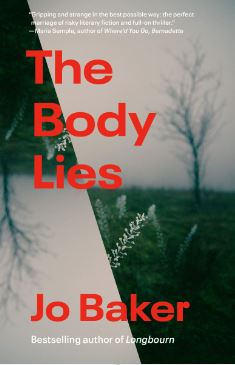
Jo Baker’s novel The Body Lies opens with two acts of violence, a body curled up in the snow “her skin blue-white, dark hair tumbled over her face” and then our unnamed narrator being attacked on her walk home, a man telling her “what he’d like to do to me” and then attempting to do it. These two seemingly unrelated events do click together eventually, but Baker’s novel goes beyond straight-up thriller.
Three years after the attack, the narrator, a novelist with one published book, has taken a job as a creative writing instructor at a small university in the north of England; London is a city where she no longer feels safe. She believes she and her son, Sammy, with whom she was pregnant when the man assaulted her, can have a more peaceful life outside of the city. Her husband, Mark, doesn’t want to give up his teaching job, so they decide to maintain two households until they can work out a better arrangement. She and Sammy rent a little house, Gill House, with a “view of open fields, a derelict barn, pylons, woodland and sky.”
The narrator feels slightly overwhelmed at work where she is offering a graduate writing class, as well as being tasked to do other jobs left by the professor who’d previously taught writing but who was now on sabbatical in Canada. She is, as it turns out, the sole creative writing instructor.
There are six students in her graduate class, including “the good-looking almost-ugly guy with the cigarettes and the scar through his eyebrow.” That’s Nicholas Palmer, a young writer who is “interested in pushing the form, pushing [his] writing as far as it will go.” Nicholas is talented and problematic. He claims to only write the truth, and soon the narrator starts to recognize herself in some of the pages Nicholas turns in.
The Body Lies has elements that make it very much a thriller: a man lurking outside of Gill House in the dusk, Nicholas’s murky past and suspect mental health, the isolated locale including lack of cell service. The novel is more ambitious than that, though, offering commentary on university politics, the way women are used as props in fiction, and how violence against them is often used as entertainment. This is a literary novel that is both beautifully written and unputdownable.
When Tyler Feder was nineteen, her much-adored mother died of cancer. Feder recounts her relationship with her mother, her mother’s brief illness and death, and the stages of guilt that follow in her beautiful graphic memoir Dancing at the Pity Party.
A mother-daughter relationship is special. I was very close to my mother and felt bereft when she died of lung cancer in 2006. I was 45 and had two young children and a flailing marriage. My mom was always in my corner. I am the oldest of four kids and being the only girl made our relationship extra special. (I know my brothers would all say they had a special relationship with mom — she was that kind of mother.)
Me -in the ugly sweater – with my brothers (L-R) Tom, James and Mark, and my parents Ed and Bobbie circa 1974. My mom did that weird “faux wood” look on the cupboards behind us.
My mom, Bobbie, was a tiny woman – 96 pounds soaking wet – who loved AM radio, instant coffee, really bad white wine, sappy movies, cooking, cheap shoes, and Tai Chi. You only had to meet her once to be considered part of the family. She loved to laugh and didn’t mind being the butt of the joke, and she often was. She made and kept friends easily because she was thoughtful and kind and generous with her time. She was a wonderful grandmother for the short time my children had her in their lives. We lived close enough to each other that my kids could go down to her house on their own from a very young age. She’d drop anything to make cookies or watch a show or go for a walk. Having her so close was handy because I am squeamish and she was a nurse. On more than one occasion she’d come running after I called and said “There’s blood.” She fixed scraped knees, and torn clothes, and broken hearts. She made perfect poached eggs and lasagna and chocolate cake with boiled icing. Following in the tradition of her mother, Sunday dinner was usually at Mom’s. There could be six people or sixteen or twenty-six; it never mattered because she could cook for all of us and never break a sweat. I miss her wise counsel, her steadfastness, and her unwavering support, even when I screwed up.
So, Feder’s memoir about her mother resonated with me. Her mom is carefully rendered, a warm and complete human being with a crazy fixation on eyebrow maintenance, distinctive spiky handwriting and “smiley brown eyes.” Feder herself is the oldest of three girls and, as I well know, being the oldest comes with both perks and hardships. By the time her mom’s health problems announce themselves, her prognosis is dire. Like my mom, Mrs. Feder died very quickly. There is hardly any time to process the illness, let alone the loss.
I found Dancing at the Pity Party to be funny and heart-wrenching in equal measure. Other than the fact that Feder is Jewish and so the customs surrounding grief and mourning are different from my own essentially atheist views, there was little in this memoir that wasn’t familiar to me. Her mother’s physical decline, the spread of the disease, the toll chemo took, the often inappropriate jokes and laughter contrasted with the grief and despair: all of it is part and parcel of what cancer steals from us, and weirdly, gives to us.
I think Feder’s memoir will certainly speak to anyone who has lost someone they’ve loved to cancer. Although it has been many years since my mom died, I found Dancing at the Pity Party cathartic, humourous, and honest. I think anyone who has ever been in Feder’s shoes will find something of themselves in these pages.
It is also a wonderful reminder that our loved ones never really leave us. I send Christmas cards by the dozens because I watched my mother do it year after year, including a little family update with each card she sent to the many people she knew from the many moves we’d made as I was growing up. I now host Sunday dinner – though not nearly as often as my mom did – and I feel her with me every time I pull a turkey from the oven or make Washington Pie. I love the family stories we tell around the dinner table, each of us remembering something different about our mom/sister/grandmother. I love sappy movies, (I can’t watch Dirty Dancing without thinking abut her), and Gordon Lightfoot. I get my work ethic from her. Whenever I say “Age is just a number” I think of her. She used to say that energy couldn’t be created or destroyed. She had the most positive energy of anyone I ever met, even when life was serving her a shit sandwich.
She is with me, I know. I hope Feder feels like her mother is with her, too. In any case, she has written a beautiful tribute to her and I highly recommend others read it.
I can’t remember the last time I read a book with a protagonist as distinctive as Cricket Cherpin, the seventeen-year-old narrator of Scott Blagden’s debut YA novel Dear Life, You Suck. Some reviewers have compared Cricket to Holden (Caulfield, The Catcher in the Rye) and I guess I can see it, but I found Cricket less navel-gazey and more sympathetic than Holden, although I guess that might just be a function of context.
Cricket has lived at the Naskeag Home for Boys in Maine since he was eight. The way Cricket describes it, “It was a minimum-security facility, so the joint looks more like a mansion than a penitentiary, but you’ll never catch me calling this jailhouse home.” More often than not, Cricket refers to it as “Prison.” The Home is run by Mother Mary, a formidable figure; “She’s a presence. A planet. She has her own gravity.” Cricket has a million names for Mother Mary: Mother Mary Mockery. Mother Mary Mushroom Cloud. Mother Mary Mafia. You get the picture.
Cricket’s mouth often gets him into trouble. So do his fists. Caretaker, the actual caretaker at the home, has been teaching Cricket to box for years, but he only uses his fists to protect the Little Ones — the younger boys who live at the home — and the weaker students at school. Cricket won’t start a fight, but he is certainly capable of ending it.
There are clues that Cricket has had it tough. When his flakey English teacher, Moxie Lord, asks her students to write a letter to anyone they “have beef with but ain’t ever had the nads to tell”, Cricket writes a letter to life. When Ms. Lord actually takes Cricket’s letter seriously, it compels him to dig a little deeper and in doing so he starts to unearth his trauma.
What are the prospects for a foul-mouthed, quick-tempered, irreverent teenager? Cricket might not think he has much going for him or much to look forward to beyond taking a more active role in his BFF’s drug business, but there are more people in Cricket’s corner than he realizes.
Sure, the story isn’t new, but Cricket’s distinctive voice, and good heart make Dear Life, You Suck, a total winner in my book.







 The Ludic Reader