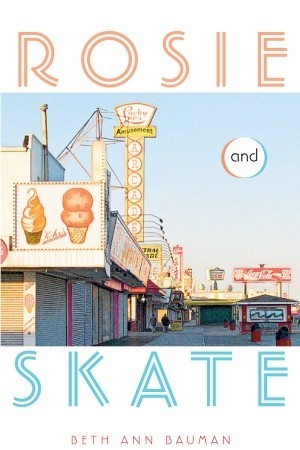
Rosie & Skate – Beth Ann Bauman

Sisters Rosie, 15 and Skate, 16, share the narrative in Beth Ann Bauman’s YA novel Rosie & Skate. They live in a crumbling house on the Jersey Shore. Well, Rosie lives there with her cousin, Angie. Skate lives at her boyfriend’s house with his mother, Julia. The sisters’ father is currently in jail for committing petty crimes while under the influence, although Rosie insists that her father is “a nice drunk.”

Bauman’s novel follows the sisters as they navigate their relationship with their father (Rosie is hopeful and forgiving; Skate has given up on her father and doesn’t believe he will ever get better), and each other. Skate is clearly the more worldly of the two: her older boyfriend, Perry, is in his first year at Rutgers and Rosie hasn’t even been kissed. Over the course of a few weeks, though, each of the girls will encounter unforeseen challenges that will push them along the path to adulthood.

Rosie & Skate is one of those quiet books where not much happens, but it still feels packed. I suppose that’s because when you are a teenager everything feels momentous. Who is guiding these girls? Who can they turn to but each other when things go off the rails — as they so often have in their lives.

There are no bad actors in this novel, even Rosie and Skate’s dad is searching for answers as to why he can’t seem to stop drinking. Rosie and Skate have their own way of coping and they certainly make mistakes, but anyone who was ever a teenager will recognize themselves in some of the questionable decisions the sisters make.

Ultimately, though, Rosie & Skate is a hopeful book about family, particularly found family, and spending time with these sisters is time well-spent.

I Capture the Castle – Dodie Smith

I Capture the Castle has been on my physical book shelf for at least twenty years. I have always meant to read it because it’s just one of those books that I felt like I should read. In her article “Why I Capture the Castle has gained a secret cult of book lovers”, Constance Grady writes “I Capture the Castle is that kind of book. It’s not quite famous, even among Smith’s works (her most famous title would be 101 Dalmatians), but for a certain kind of reader — mostly women, mostly bookish — it is perfect. Once you read it, you fall in love with it, and from then on you’re part of a secret club, self-selecting and wildly enthusiastic.” (Vox)

The novel’s narrator, 17-year-old Cassandra Mortmain, lives with her family (her father, his much younger second wife, Topaz; older sister, Rose; younger brother, Thomas, and Stephen, son of their deceased housekeeper) in a crumbling old castle in rural England. They leased the castle – crumbling though it was – when they weren’t quite so financially destitute. Cassandra’s father had written a successful book, Jacob Wrestling, a “mixture of fiction, philosophy and poetry.” The book was very successful, “particularly in America, where he made a lot of money by lecturing on it, and he seemed likely to become a very important writer indeed.” Then he stopped writing and with no income, the family fell on hard times.

The novel takes the form of Cassandra’s journal, which she writes in a short hand that no one can read but her. In it she recounts encounters with people from the village, the Vicar and Miss Marcy, the local school teacher/librarian, chief among them. She talks about her relationships with her siblings and father and stepmother. She writes about food – or lack thereof. She struggles with the awareness that Stephen has developed feelings for her.

He grows vegetables for us and looks after the hens and does a thousand odd jobs – I can’t think how we should get on without him. He is eighteen now, very fair and noble looking but his expression is just a fraction daft. He has always been rather devoted to me; father calls him my swain.

The minutiae of Cassandra’s daily life is not as dull as you might think. It’s the 1930s and it’s wonderful to read about a much simpler time and place. The castle itself, though falling down and without modern conveniences, is as romantic as you might imagine. And things don’t stay bucolic for long, anyway. Simon and Neil Cotton, American grandsons of the deceased owner of the castle, arrive and shake things up for the Mortmains.

Dodie Smith is probably best known for writing 101 Dalmatians, and while everyone has certainly heard of that story, it feels lovely to now be among the special group of women who have spent time with Cassandra. She is intelligent, kind and self-deprecating and watching her negotiate her growing feelings for one of the Cotton brothers is sheer delight. I Capture the Castle is charming, beautifully written and well worth your time. Make a cup of tea, eat a scone and sink into its myriad pleasures. It will not disappoint.

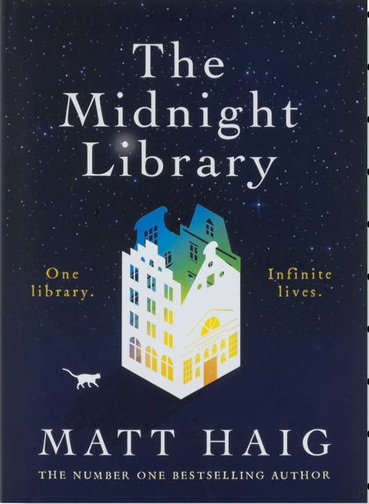
The Midnight Library – Matt Haig

Nora Seed, the protagonist of Matt Haig’s novel The Midnight Library, wants to die. She’s just been fired from her job at a music store, she is estranged from her brother, the only remaining member of her immediate family, and her cat has died. What has she got to live for, really? So she takes too many antidepressants and ends up – well, in the Midnight Library.

The librarian (who just happens to have been the librarian at Hazeldene School back when Nora was a kid) tells her

“Between life and death there is a library […] And within that library, the shelves go on forever. Every book provides a chance to try another life you could have lived. To things how things would be different if you had made other choices…Would you have done anything different, if you had the chance to undo your regrets?”

There’s a bunch of mumbo-jumbo and quantum physics and philosophy and stuff about “sliders” (others, like Nora, who are dipping in and out of “lives less traveled”), but ultimately, Nora gets to choose new lives until she settles on a life she actually wants to live.

First, though, she has to tackle her Book of Regrets. That’s a brick of a book where “Every regret [she has] ever had, since the day [she was] born, is recorded.” All those regrets are bound to wear a person down, right?

I know people will lap The Midnight Library up like it’s the most perfect bowl of ice cream on the planet. And why not? It’s easy enough to read; the plot is straightforward despite the fact that Nora can cast off undesirable lives like unwanted coats. She eventually realizes what I could have told her in about thirty seconds: no life is perfect. The perfect life is the life – the one and only life – you’ve got. If only Nora had realized that, y’know, before she swallowed the pills.

There was no emotional punch for me. Nora was okay. The rest of the characters were okay. The writing was okay. It was all…okay. Well, perhaps a bit twee, really. I’d suggest that if you want to read something that really encourages you to consider the value of every day of your life, you read (or even better, watch) Thornton Wilder’s Pulitzer Prize winning play Our Town.

The Reunion – Guillaume Musso

There must be something about fall that has me reading these thrillers about reunions. In this latest outing, The Reunion (translated from the French), Guillaume Russo spins the story of successful novelist Thomas Degalais who returns to  Côte d’Azur to attend his 25th high school reunion. He’s nervous about coming home; there are secrets buried at Lycee International Saint-Exupery. Literally.

First, there’s the unsolved disappearance of Thomas’s popular classmate, Vinca Rockwell, thought to have run off with her philosophy teacher, Alexis Clement.

They were last seen the following day in a hotel in the seventh arrondissement near the Basilica Saint-Clotilde. After that, all trace of their presence in Paris was lost. They never reappeared, never contacted friends or family. They quite literally vanished.

That, at least, was the official version.

Clearly, there is more to the story than this. Thomas was in love with Vinca, and when he arrives back in his home town, long-held secrets start to spill out. Reunited with his besties, Maxime and Fanny, Thomas starts to pull at the threads of his memories. And that, right there, is a can of worms.

Then, there’s the body buried in the gym walls (not a spoiler; it’s revealed in the blurb), a body which may at long last be discovered as the gym is due to be demolished. Who is it? Who committed the crime? Worry not, all is revealed quite quickly, but this reveal is only the tip of the iceberg.

The Reunion flashes back and forth between now, at the reunion, and then, back before Vinca went missing. There is A LOT going on in this novel. Too much, I’d say; I never felt really invested in any one thing because I didn’t feel like I knew any of the characters (or liked any of them) well enough to care. Yeah, sure, it all ties together but it didn’t feel satisfying.

Maybe it’s because it’s a translation – which regular readers (do I actually have any of those?) will know, I often find stilted and stodgy. Loads of critics thought it was the BEST BOOK EVER. I found it kind of slow-moving, until it wasn’t, but so much was packed into the last 40 pages, I just found it all sort of…ridiculous. Apparently, a limited TV series is in production. That might be okay. For me, though, the book was just sort of meh.

Alone – Cyn Balog

Cyn Balog’s YA novel Alone is the story of sixteen-year-old Seda who lives with her mother and four younger siblings in Bismarck-Chisholm House or, as she calls it, Bug House. Seda’s mother is a former Boston College professor who is currently writing a book, her father is MIA and her siblings are two sets of twins aged six and four. Seda was a twin, too, but her brother Sawyer was absorbed into her own body in the womb, or so says family lore.

For years Bug House was run as a “Murder” house, where patrons could stay in one of eighteen guest rooms and had the daylights scared out of them. It’s an isolated spot; the nearest store is twenty miles down the mountain. Seda, our narrator, laments the isolation, the loss of her life in Boston, her father’s disappearance from her life, her mother’s kookiness, the fact that there’s no cell service, and just the general creepiness of Bug House.

All that changes though when a freak snow storm ushers in a handful of strangers, three boys and two girls.

The other members of his group are beautiful, yes, but he – with his thick mop of hair spilling out of the openings of the hockey mask and big heavily-lidded brown eyes – is godly. He’s the kind that always gets it last and worst in slasher films, just before his smart and sassy girlfriend-heroine saves the day.

Alone amps up the creepy house narrative with an unreliable narrator, a house full of secrets and a scavenger hunt game that quickly goes off the rails. There’s enough twists and turns and things that go bump in the night to make any fan of horror movies or scary stories happy. I did find that it got off to a slow start, but once it got going it was an enjoyable page-turner.

In My Dreams I Hold a Knife – Ashley Winstead

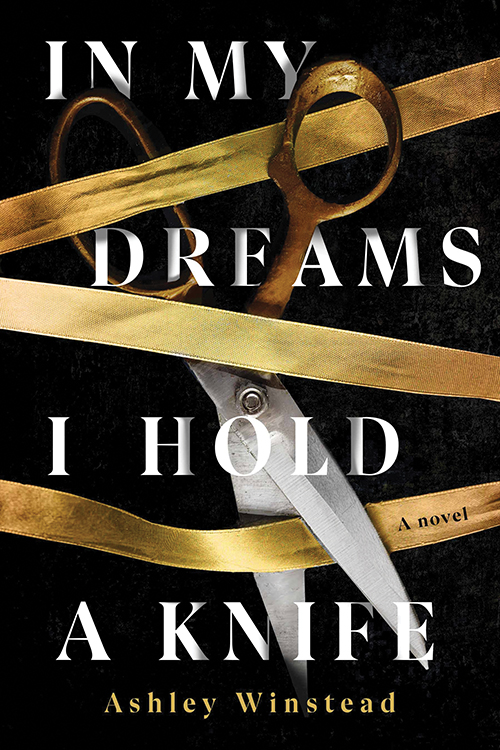
There seems to be a lot of novels out there about college reunions these days. Must be a millennial thing. I was excited to read Ashley Winstead’s debut In My Dreams I Hold a Knife because I love the title and that cover. Sadly, I am ambivalent about the book as a whole. I am not going to say I didn’t like it because I was wholly invested for the first third and still hanging in there for the second, but by the last third I was just….nope.

Jessica Miller is headed back to Duquette University to attend her ten-year class reunion. She is keen to show her former gang, collectively known as the East House Seven, that she has made it.

I wanted them to see perfection. I ached for it in the deep, dark core of me: to be so good I left other people in the dust.

The East Coast Seven are “the people responsible for the best days of [Jessica’s] life, and the worst.” She’d met them all early in freshman year, and they’d bonded instantly. There’s Jack (“an eighteen-year-old Mr. Rogers”), Heather ( “the confident blonde”), Coop (hot in a “one-time, get-the-bad-boy-out-of-your-system kind of way”), Mint (“the most beautiful boy” Jess had ever seen) , Frankie (“tall and broad…in a way that screamed athlete”), and Caro (“small and olive-skinned and pretty”).

Fast-forward a decade though and she’s really only speaking to Caro, her bestie, and Jack. Going back to Duquette means seeing Mint (her boyfriend through college) and Coop (the boy she actually loved) again. One is married to another girl, and one is engaged to Caro. As if this drama isn’t enough, this reunion has the potential to stir up the unsolved murder of Heather, who was savagely stabbed to death senior year.

So – there are lots of things I did like about this book. First of all, I am all about angst and the relationship between Jessica and Coop has that in spades. Although I am long past my university days, I do enjoy books set on college campuses. Heather’s unsolved murder has lots of potential for red herrings and such and, of course, who doesn’t love a story where people are reunited after a trauma? I also thought the writing was quite good – no quibbles with that.

The novel flips back and forth between then and now. We get glimpses of the East House Seven at various points during the four years of college, but mostly through Jess’s eyes. Towards the end, we do see certain events from the 3rd person perspective of some of the other characters. These sections felt mostly expository because they were things Jess couldn’t possibly have known, but the reader had to be told in order for the narrative to make sense.

I was wholly invested at the start. It started to unravel, though, when Eric Shelby, Heather’s younger brother, confronts the group at the reunion. He’s determined to reveal who is responsible for his sister’s death – something the police hadn’t been able to do. As each character is accused and their closely-held secrets start spilling out, the book started to lose momentum for me. I think part of the issue might have been that Winstead just tried to cram way too much into the book, and none of these “secrets” had any room to breathe. Part of the problem might have been the first person narration. It’s limiting because we only know that character’s perspective and of course, in a book like this, you have to wonder how reliable the narrator actually is. The denouement just felt sort of ridiculous – lots of shouting, and running.

All of that said, though, I would 100% read something else by Winstead. Despite the fact that In My Dreams I Hold a Knife didn’t quite work for me, it was brimming with potential and I suspect that her next offering will be awesome.

The Missing Season – Gillian French

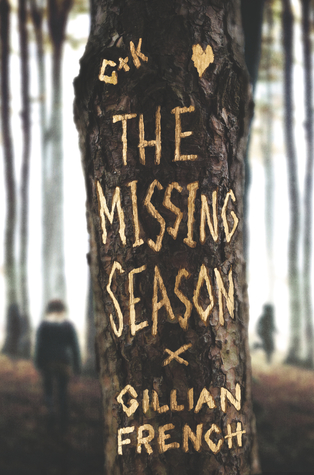
My first novel by YA writer Gillian French was The Lies They Tell and I loved it. The Missing Season was also a great read, especially the last third or so when the action ramped up.

Clara and her parents move to Pender, Maine, where her father has been hired to help with the demolition of the town’s paper mill. Clara is used to being the new girl, but she’s a senior now and hoping that maybe they could stay put.

Pender is a hick town, but it’s also a town with a seam of darkness running through it. For one, several teens have gone missing. Then, there’s the “Mumbler” a legendary boogey man.

Clara meets Bree and Sage, who introduce her to some other people who hang out at the local skate park including Sage’s boyfriend, the larger-than-life, Trace, and Kincaid, who has “the most incredible face.” It seems that life in Pender might be okay, until the attraction she feels for Kincaid turns out to be mutual and Bree’s feelings get hurt.

The Missing Season is really a teen drama wrapped up in a creepy All Hallows’ Eve package. Clara and her new friends get up to no good, but these are mostly harmless pranks. Clara tries to navigate the tricky waters of being the new girl, wanting desperately to be a part of something bigger than herself. Kincaid is secretive and despite their attraction, Clara never really knows what he’s really thinking. Ahhh, high school relationships.

When a girl on the periphery of their group goes missing, though, things start to get real. Maybe the warnings to “Fear Him” actually have some validity. About two thirds of the way in, when Clara suddenly finds herself in danger and another girl goes missing, The Missing Season really takes off. Clara is a likable heroine who demonstrates grit when needed, making her someone readers will surely root for.

The Night She Disappeared – Lisa Jewell

It takes a skilled writer to successfully plot a novel with a million moving parts and Lisa Jewell (The Girls in the Garden, I Found You, Watching You, The Family Upstairs, Invisible Girl ) always makes it seem so easy. Her latest novel, The Night She Disappeared flips back and forth in time, and between characters and tells the riveting tale of one mother’s desperate search for her nineteen-year-old daughter, Tallulah.

Tallulah and her boyfriend, Zach, and their baby son, Noah, live with Tallulah’s mom, Kim. Zach has only recently become a part of the family again; when Tallulah told him she was pregnant he didn’t believe her, but now they are trying to make a go of it. When the novel opens, Zach and Tallulah are heading out for a much-deserved break to celebrate the end of term for Tallulah’s college course and, unbeknownst to her, a surprise proposal. But they don’t come home.

A year later, Sophie Beck and her partner, Shaun Gray, move into a little cottage on the grounds of Maypole House, the private school where Gray is to be the new headmaster. They’ve given up their London lives, but Sophie hopes that this change will suit them. She’s a writer of cozy crime novels and the last thing she is expecting is to discover a mystery in her own back garden, but that’s what happens. Someone has left a sign “Dig Here” and when she does, Sophie finds an engagement ring and, putting her detective skills to work, she discovers that the ring was purchased by Zach.

Then there’s Scarlett Jacques, the enigmatic girl from Tallulah’s school. She was the last person to see Tallulah and Zach alive. They’d been with her and some other friends at Dark Place, her family’s home. The house is

a hodgepodge of disparate architectural styles, blended almost seamlessly together across three wings, set around a central courtyard. The sun sparkles off the diamonds of leaded windows on the left wing and larger Victorian casement of sash windows on the right. It should be a mess, but it’s not; it is exquisitely beautiful.

It seems as though Tallulah and Zach have vanished into thin air, a notion Kim simply cannot accept. They would never leave their son, but it isn’t until Sophie discovers the ring that some new information shakes loose. All the while, Jewell reveals the secrets characters have been keeping, revealing complex interior lives.

Like all Jewell’s novels, The Night She Disappeared is twisty-turny, well-written and loads of fun to read. I always keep a stock of unread novels by her on my shelf because nothing beats a book slump like Lisa Jewell.

It Sounded Better in My Head – Nina Kenwood

Nina Kenwood’s YA debut It Sounded Better in My Head wasn’t even on my radar when I recently picked it up at the bookstore. It was a William C. Morris Debut finalist and had excellent reviews from School Library Journal and Bookpage (I trust those sort of endorsements over author plugs, tbh) so I bought it. It might have languished with all the other unread books in my class library, but I picked it up to read and honestly couldn’t put it down.

Eighteen-year-old Australian, Natalie, is waiting for her university admission results and planning her future with her besties Zach and Lucy, when her parents announce that they are separating. Worse, they knew this was coming and had neglected to tell her for ten months. Some almost-adults might take this in their stride, but it knocks Natalie sideways because she likes solid plans and the status quo. That’s how her world works.

Or that’s how it has worked ever since she hit puberty and her body betrayed her.

I went from being a straight up-and-down stick figure to a scribble of hips, stomach, breasts, thighs and stretch marks. I didn’t even know stretch marks were a thing.

[…]

But the stretch marks were nothing compared with the pimples. A regular scattering of pimples at first, and then more, and more. Then pimples that turned, almost overnight, into deep, cystic acne. […] It’s gross. I was gross. I woke up thinking that every day for a long time.

I suspect we can all remember the awkwardness of being a teenager, of comparing yourself to others, and Natalie spends most of her early teens friendless and hiding out. At thirteen, she becomes “Reluctant Natalie. Anxious Natalie. Bitter Natalie. Neurotic Natalie.” At fifteen, though, after medication clears up her skin a little and her mother convinces her to attend a creative writing camp, she meets Lucy and Zach.

It’s still hard for Natalie to put herself out there, but all that is about to change when Zach’s older brother, Alex, and his friend, Owen, invite her to a party and Natalie surprises herself by accepting. When Alex and Natalie find themselves in a dark alley because of a game of Spin the Bottle, Natalie finds herself in uncharted water.

And the whole thing is sheer delight. Honestly, I loved Natalie. Let’s face it, it’s only as an adult looking back that your teen years seem even mildly awesome. The best years of your life, my ass. I suspect Natalie speaks for a whole bunch of teens who breathe a sigh of relief when Friday night rolls around. For Natalie it meant that she didn’t “have to go outside or see anyone other than [her] parents for the next two whole days.”

Over the course of just a few days, Natalie’s life is upended, but sometimes that’s what needs to happen in order to get the life you want.

Highly recommended.

Shuggie Bain – Douglas Stuart

Douglas Stuart’s debut Shuggie Bain won the 2020 Booker and was nominated for many other prizes and awards. For good reason. Stuart’s novel traces the life of Hugh “Shuggie” Bain from childhood until he’s sixteen and it’s a doozy.

Shuggie’s mother, Agnes, is central to this story. She’s thirty-nine and lives in a flat with her parents and “to have her husband and three children, two of them nearly grown, all crammed together in her mammy’s flat, gave her a feeling of failure.” Agnes’s endless struggles with men and alcohol are central to Shuggie’s story. His older brother and sister, Leek and Catherine, are far more jaded about their mother’s problems than Shuggie, who is much younger and much more hopeful that Agnes will get better.

When Big Shug, a philandering cab driver, finds a house for them outside of Glasgow, Agnes swells with hope. But when she sees their new home, surrounded by “huge black mounds, hills that looked as if they had been burnt free of life […] the plainest, unhappiest-looking homes Agnes had ever seen” she no longer views the move as a step in the right direction for her marriage. She and her children are isolated from the support system of her parents, and Big Shug essentially walks out on them, too.

Agnes is one of the most fascinating characters I have encountered in a long time. While it is certainly true that she is a hopeless drunk, she is also charming and intelligent. Despite the ways in which she neglects her children, particularly Shuggie, she loves them. Douglas’s novel gives readers plenty of reasons to admire Agnes, even as we watch her sink further and further into the bottle. It is much easier to hate Big Shug because he deliberately abandons his family and does it in such a way as to cause the most damage.

The novel is bookended with Shuggie at sixteen, living in a bed-sit and fending for himself. If you ever want to understand how a person comes to be where they are, examine their childhood. For better or worse, there’s no escaping the influence our families have on us. Shuggie does his best to look out for his mom, especially after Catherine leaves to get married and Leek is finally put out (and can I just say for the record that I LOVED Leek. There’s a scene when he escapes to the top of a hill with his sketchbook that broke my heart.) Shuggie is too young to realize what his older siblings already know: nothing he can do will save Agnes. But that doesn’t stop him from trying.

Although you might think that a book about an alcoholic living in Glasgow (the setting for so much despair in the 1980s due to Thatcher’s economic policies) would be relentlessly grim, it isn’t. These characters are resilient and determined and so lovingly rendered, they will find a place in your heart.

Apparently, Stuart’s manuscript was turned down 32 times! Imagine. If you haven’t yet read the book, I urge you to give it a go. Stuart is a born story teller and this is clearly a story that needed to be told.

Highly recommended.