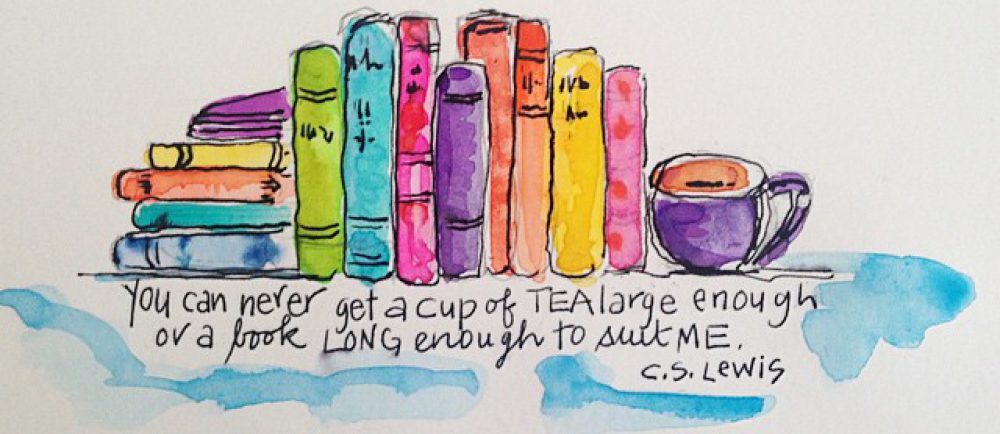
Considering books w/ thanks to @suchabooknerd & @ShelfAwareness

I followed a tweet to Such A Book Nerd‘s post answering these questions, which she got from Shelf Awareness. I can never resist a good meme.

On your nightstand now:

Kelly Creagh’s fabulous YA novel, Nevermore (which I am thoroughly enjoying.)

But my bedside table (actually a hope chest) is  home to a big pile of books – some of them waiting to be read, some half read, some destined for my Book Graveyard. They include:

The Flight of Gemma Hardy (which I hope to read in the next few days as Margot Livesay will be reading at The Lorenzo Society  on November 9.); Midnight is a Lonely Place – Barbara Erskine; Juliet – Belinda Seaward; Pharos – Alice Thompson; The Night Bus – Janice Law; The God of Small Things – Arundhati Roy; The Essential 55 – Ron Clark; The Tarnished Eye – Judith Guest; When I Was a Loser – John McNally; Girls in White Dresses – Jennifer Close; The Savage Garden – Mark Mills; The Hand That First Held Mine – Maggie O’Farrell and The Golden Book of Bovinities, the latest book of poetry by my dear friend, Robert Moore. Yeah, I have a small problem.

Favorite book when you were a child:

I have a lot of favourite childhood books. Going WAY back: Uncle Wiggly, which I remember my mom reading to my brothers and me. I was a huge Bobbsey Twins fan. I always got a couple new books for birthdays and Christmas. I loved Trixie Beldon. I loved A Little Princess by Frances Hodgson Burnett

Your top five authors: (subject to change, of course)

I love Carolyn Slaughter, Helen Dunmore, Helen Humphreys, Thomas H. Cook, and Lisa Reardon

Book you’ve faked reading:

Sometimes I just say…I read it a long time ago; I don’t really remember it. Ha!

Book you’re an evangelist for:

Sorry – I pimp lots of books.

The Knife of Never Letting Go – Patrick Ness (so far I have two girls in my grade ten class reading through the Chaos Walking Series)

The Book of Lost Things – John Connolly

The Book Thief – Marcus Zusak

Book you’ve bought for the cover:

While I do enjoy a good cover, it’s rarely the sole reason I buy a book. There are too many books I want to read (too many on my physical shelves waiting to be read) to waste a purchase on a pretty cover.

Book that changed your life:

Jane Eyre changed my reading life at a young age, but lots of other books have impacted me in positive ways. For example, Carolyn Slaughter has written a couple books – The Banquet & The Story of the Weasel – which showed me a fearlessness that has stayed with me. And the book I’ve  reread the most, Velocity by Kristin McCloy, continues to speak to me in ways I can’t explain.

Favorite line from a book:

I love this line from Thomas H. Cook’s novel Breakheart Hill: This is the darkest story that I ever heard, and all my life I have laboured not to tell it.

And from Velocity:  Sometimes in my dreams you rise up as if from a swamp, whole, younger than I remember, dazzling, jagged, and I follow you into smoky rooms, overwhelmed by the sense of being in the presence of an untamed thing, full of light, impossible to control.

I would quote more, but the question asks for a line, so I’ll resist.

Book you most want to read again for the first time:

Jane Eyre – but it’s been so long since I first read it, that it would probably feel like the first time.

If you could encourage any beginning writer, what would you say?

Just write. Don’t edit yourself; don’t second guess yourself; don’t censor yourself; be fearless.

If you answer this meme, be sure to let me know; I’d love to read your answers.

#WhatIwrite and #whyIwrite it

The National Writing Project is once again sponsoring the Why I Write project. If you are at all connected to social media, you’re likely aware of this initiative. Professional and amateur writers are posting their responses to the question using hashtags #whatiwrite, #nwp and #dayonwriting.

As a teacher, I believe wholeheartedly in getting students to write. Getting them to believe in the value of the written word is often slightly more problematic. But of course, they don’t realize how much real-world writing they actually do: the texts, the blogs, the emails, and the FB status updates are all examples of writing and have as much value as the literary essay my grade ten students are currently writing.

I’ve been a life-long writer. Ever since I figured out my parents’ little blue Brother typewriter and could start typing out my stories, I’ve been hooked on words. I love their power and their potential to create a world; I love the music they can create, the emotional impact they can have. Even when they frustrate me, I love them.

Like many teens, I wrote a lot of sappy poetry in high school. I wrote short stories about boys who broke my heart. I wrote hundreds of letters to pen pals all around the world. Perhaps I wouldn’t have considered those letters ‘real writing’ back then, but each epistle honed my ability to commit thoughts to paper coherently and creatively.

When I graduated from high school, my parents gave me an electric  typewriter. Don’t mock me; it was 1979. That thing weighed about 50 pounds and the correction cartridge was bigger than an 8-track, but still – I felt I now had the potential to write the next great Canadian novel. Because that’s what I wanted: to be a writer.

Oh, I know.

Still…I do write. A lot. I’ve written hundreds of pages of fan fiction. I’ve written dozens of newspaper articles. I’ve written feature stories for magazines. I’ve written half of a really dumb novel. (And rewritten that half a zillion more times.) I have close to four hundred posts here at The Ludic Reader. I am inching up on 1000 tweets.

I do love that the Internet offers writers the opportunity to share what they’ve written. Community is important. But even without it, I think I’d still write. It helps, sometimes, to just listen to my thoughts and then try to sort them out on paper – or in cyberspace. Writing gives me the opportunity to be more than I am.

The Year of Magical Thinking – Joan Didion

Joan Didion’s well-regarded memoir The Year of Magical Thinking recalls the year following the death of her husband and writing partner John Gregory Dunne. Didion and Dunne were married for 40 years and were literary royalty. They counted many other famous writers and celebrities among their friends. It would seem that theirs was a charmed life. John Gregory’s famous brother, Dominick, writes about his brother’s death here.

“Life changes fast. Life changes in an instant,” Didion writes. And while we certainly all know this is true, Didion experiences it first hand at a particularly trying point in her life.

She and her husband have just returned from the hospital where their only daughter Quintana is recovering from a particularly virulent flu. They’ve just sat down to dinner  when Didion looks up from her salad and sees him slumped over the table.

I have no idea what subject we were on, the Scotch or World War One, at the instant he stopped talking.

I only remember looking up. His left hand was raised and he was slumped motionless. At first I thought he was making a failed joke, an attempt to make the difficulty of the day seem manageable.

I remember saying Don’t do that.

As it turns out, Dunne had a bad heart and was living on borrowed time. None of that lessens the shock of his sudden passing for Didion. Although her prodigious skill with the written word is apparent in this memoir, her grief over the loss of her husband is as raw for her as for any of us. Death is the great equalizer. Didion is forced to come to terms with Dunne’s death even as she continues to deal with her daughter’s illness. (In a sad post script, Quintana died just a couple years later from the complications of her illness. There has also been some speculation that Quintanta died, ultimately, of acute pancreatitis caused by alcoholism. She was just 39.)

In the early days after Dunne’s death, Didion tries to keep it together. She keeps expecting Dunne to walk through the door; she continues to store information to share with her husband at a later date. She says: “Of course I knew John was dead…Yet I was myself in no way prepared to accept this news as final: there was a level on which I believed that what had happened remained reversible. That was why I needed to be alone…I needed to be alone so he could come back.”

The Year of Magical Thinking is not a romantic memoir. Didion, despite her sorrow, turns a clear, at times even dispassionate, eye on the nature of grief. She’s been trained to do that, of course. Does it lessen the impact of the story she has to tell? Not really. But was I as emotionally engaged as I thought I would be. Not really.


With apologies to @Robby_Benson

Ah, Robby. He of the soft voice, the blue, blue eyes, the abs. It’s true, I loved you BIG when I was a teenager and you were on the cover of Tiger Beat. When my friends were lining up to see Annie Hall, I was waiting to see One on One. Again. Robby was a huge star in the 70s (starring in 15 movies!) and I was a moon-eyed teen in the 70s and thus we were a match made in celluloid heaven.

But then Robby grew up and so did I. He went on to a career behind the camera (he’s directed hundreds of sitcom episodes including Ellen and Friends ) and he was the voice of the beast in Disney’s Beauty and the Beast, has taught Film Studies at the University of South Carolina and NYU and has written a couple books.

That brings me to my apology. I am sorry to say that Benson’s first novel, Who Stole the Funny? has ended up in my Book Graveyard. I tried, really. Even though when I bought the book – at least three years ago, so you can see that it has languished on my tbr shelf for a while – I didn’t figure it would be my cup of tea, I had to buy it. For old time’s sake.

With a career as long and varied as Robby’s, I have no doubt the novel is authentic (and perhaps even authentically funny), but I just didn’t get it. And yes, it’s true, a handful of pages is probably not a fair shake…but just, no.

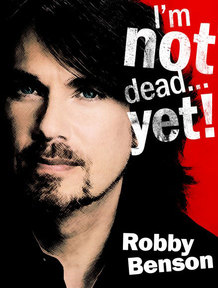
That said, Robby has a new book out, I’m Not Dead…Yet. This book seems more my cup of tea – it’s a medical memoir which recounts the story of Robby’s four (count ’em) open heart surgeries. Although this is not a subject with which I have much personal experience, I would be interested in hearing about his journey. So, I am willing to give Robby Benson, author, another try.

In the meantime, there’s always RobbyBenson.com

The Day I Killed James – Catherine Ryan Hyde

People die of love.

Eighteen-year-old Theresa believes this to be true, or at least she claims she does in Catherine Ryan Hyde’s YA novel, The Day I Killed James. We meet her at the beginning of her therapy sessions with Dr. Grey. She doesn’t like him very much.

I’ve thought about dumping him and getting  somebody else, but that would be the easy way out, which I’m not entirely sure I deserve.

So why is Theresa in therapy? Well, James, the buff boy next door – who has been trying to get her attention forever – ends up dead after she takes him to an end-of-year party in an effort to make her boyfriend, Randy, jealous. It isn’t until weeks after his death that Theresa can admit to perhaps liking him…just a little bit.

If I had felt it any more strongly, I might have cracked like a china cup. It was like a pressure inside me, like an old steam boiler, and I just lay there hoping it would hold. Hoping I would hold.

Theresa isn’t a horrible person and taking James to the party to make Randy jealous isn’t the worst thing she could have done, but the aftermath of that event sends Theresa off on a journey of self discovery that is actually long overdue.  Theresa has some things to work out and while James might be the catalyst, some of her problems pre-date him.

I didn’t like the beginning of The Day I Killed James very much. The story is told mostly as a series of journal entries prescribed by Dr. Grey. Things improve a little bit in the novel’s second part. Theresa is now Annie and she’s left home not so much to sort out her life, but to escape it. She soon discovers that it’s almost impossible to avoid all human contact. Her sudden ‘relationship’ with a precocious eleven-year-old girl named Cathy ups the ante a little – but also seems slightly forced.

However, when all is said and done, I think teens will quite like the story of what it means to love and how important it is to take care of each others’  heart.

Stitches – David Small

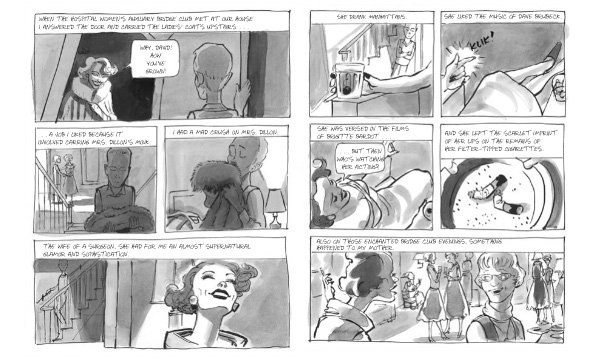
I am not a graphic novel aficionado, but David Small’s Stitches  has been on my tbr radar for a while. Small’s memoir of growing up in 1950’s Detroit with an older brother, a radiologist father and a bat-shit crazy mother (although the discovery of her secret life makes her a tad more sympathetic) has won a slew of accolades and was a finalist for several major awards including the National Book Award.

I can’t comment on the quality of the art – or how it compares to the art of other graphic novels because I don’t have any frame of reference. All the pictures are simple and black and white, but they were very effective drawings.

The story of David’s life begins at six. The reader learns a little bit about his family, his absent father, his cold and distant mother.  Memoirs aren’t meant to dissect an entire life; rather, this is the story of one life-altering moment. A growth on David’s neck, discovered when he is 11, must be removed. The diagnosis: a cebaceous cyst. It takes David’s parents three and a half years to organize the surgery – not just one operation, but two. When David wakes up from the second operation, he discovers that his vocal chords have been severed and he is, for all intents and purposes, mute.

I read Stitches in an afternoon. It’s a sad tale, made darker because of the author’s muted drawings. For anyone wondering whether it is possible to have a worthwhile life after a craptastic childhood, Stitches is proof-positive.

Ashes – Ilsa J. Bick

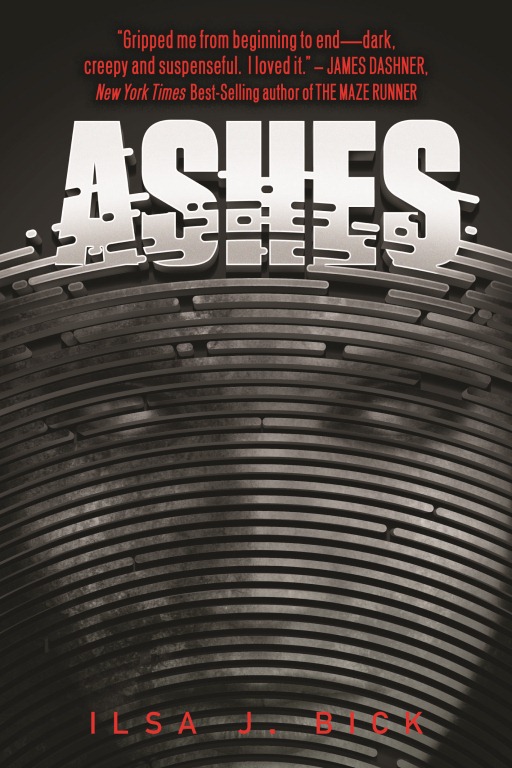
We learn quite a lot about the feisty heroine, Alex, in the prologue of Ilsa J. Bick’s dynamite YA novel, Ashes. She’s stubborn. Aunt Hannah tells us that. “…once you’ve made up your mind, there’s no talking to you,” she says. She’s seventeen. And  she has “a brain tumor the size of a tennis ball” lodged in her head.

Alex is on the run, sort of. She’s decided not to do any more of the experimental  treatments for her brain tumor – so she’s left her Aunt Hannah and headed to Waucamaw Wilderness in Michigan to clear her head and scatter the ashes of her parents, who had been killed in a helicopter crash.

Alex is enjoying the solitude of the woods until Jack, his granddaughter, Ellie and their dog Mina happen by. Ellie is eight and is clearly not happy to be tramping through the woods. By page 25, Jack is dead and Alex and Ellie are running for their lives.

By page 72 both Alex and the reader know they aren’t in Kansas anymore. When she and Ellie stumble into a camp site, this is what Alex sees:

The boy and girl were eating. Stuffing their faces, actually. Splashes of blood smeared their mouths and dripped over their chins like runny clown’s makeup. With a grunt, the boy plunged his fist into the woman’s abdomen and rooted around before coming back up with a drippy fistful of something liverish and soft enough that Alex could hear the squelch as the meaty thing oozed between his fists.

It’s a waking nightmare. But these flesh eating teens aren’t the only thing Alex has to contend with. For one thing, she’s completely cut off from the rest of the world. She is quickly running out of supplies. Winter is coming.

This is one of those no-holds-barred works of fiction that teens will love. I think boys will especially love it because it really has a gross-out factor.  As the story went on, it did make me think about Patrick Ness’s novel The Knife of Never Letting Go a little. Like that book, Bick’s novel stretches out beyond the confines of teen against supernatural/fantasy/strange forces/etc and starts to tackle some other questions. What does it mean to be free? for example.  Who is trustworthy and how can we be sure they don’t just have a personal agenda? Ashes has a crazy mythology: part religious fanaticism, part survival of the fittest.

As Alex tries to figure out what has happened to the world…and herself (because she isn’t the same anymore either). Bick continues to introduce new perils and characters and we must decide — as must Alex– whether or not we can trust them.

Ashes is the first book in a trilogy and I will definitely be continuing on with the series. Bick’s writing is crisp and fast-paced. Alex is a great character — smart and resourceful. Although the book is written in the third person, it’s a limited point of view so it feels like first person narration. You really do see everything through Alex’s filter.

And holy-ol’-cliffhanger. Great book!

The Fault in Our Stars – John Green

Late in the winter of my seventeenth year, my mother decided I was depressed, presumably because I rarely left the house, spent quite a lot of time in bed, read the same books over and over, ate infrequently, and devoted quite a bit of my abundant free time to thinking about death.

Meet Hazel. She’s got cancer. It started as thyroid cancer, but now it’s in her lungs. There is no cure, but there is this miracle drug, Phalanxifor (Green points out in his acknowledgements that it’s a made up drug.), and although Hazel’s lungs are practically useless and she has to be hooked up to her oxygen tank all the time, she does okay. Except for, you know, the depression. Or whatever.

Her parents insist that she go to the  cancer survivor’s support group meeting – which she had grown to “to be rather kicking-and-screaming about” – and it is there that she meets Augustus Waters.  He’s in remission after losing his leg below the knee from “a little touch of osteosarcoma.” Her immediate reaction: he’s hot. From this point on, I flew through the pages of  John Green’s YA novel The Fault in Our Stars, alternately laughing and crying.

Telling you much more about the plot won’t actually do the book any justice. Besides, it isn’t so much about what as it is about to whom. The Fault in Our Stars is driven by the magic that is Hazel and Augustus.

Their relationship begins over an exchange of books (be still my heart). Hazel lends Augustus her favourite novel,  An Imperial Affliction, the story of Anna, a girl with a rare cancer of the blood. But, Hazel says:…

it’s not a cancer book, because cancer books suck. Like, in cancer books, the cancer person starts a charity that raises money to fight cancer, right? And this commitment to charity reminds the cancer person of the essential goodness of humanity and makes him/her feel loved and encouraged because s/he will leave a cancer-curing legacy. But in AIA, Anna decides that being a person with cancer who starts a cancer charity is a bit narcissistic, so she starts a charity called The Anna Foundation for People with Cancer Who Want to Cure Cholera.

Hazel has some unanswered questions about An Imperial Affliction. She has tried for months to get in touch with the book’s author, Peter Van Houten. When Augustus actually makes contact with Van Houten, it sends the pair on the trip of a lifetime.

But much of that is plot and while the story might be predictable in many ways, there is nothing ordinary about this novel. Nothing. Hazel has been sick for a long time; she has already come to terms with her mortality. What she doesn’t know how to do is live. Augustus is the perfect antidote to her doldrums, beautiful and funny.

And make no mistake – this book is funny. These kids know how to laugh at themselves. When  Isaac, another member of the support group, loses his remaining eye to cancer he says: ” …people keep saying my other senses will improve to compensate, but CLEARLY NOT YET. Hi, Support Group Hazel. Come over here so I can examine your face with my hands and see deeper into your soul than a sighted person ever could.”

As if navigating the thorny path to adulthood weren’t difficult enough, the teenagers in this book must also contend with bodies that have forsaken them.  It is also heartbreaking to watch Hazel’s parents try to protect their daughter, even when they know they can’t. As a mom myself, I can only imagine how horrific it must be to care for a terminally ill child.

Augustus sums it up best: “…the thing about pain…it demands to be felt.”

Absolutely my favourite book this year.

A Spell of Winter – Helen Dunmore

I read Helen Dunmore’s novel With Your Crooked Heart many years ago and I’ve been a fan ever since. Dunmore’s prose is like poetry, every sentence a perfect balance between beauty and truth. Winner of the 1996 Orange Prize, A Spell of Winter is the fourth novel I’ve read by her, and I have also read her collection of short stories, Ice Cream.

A Spell of Winter concerns the lives of Cathy and Rob, siblings who live in a crumbling manor house in England.  Their guardian is their maternal grandfather, “the man from nowhere”, and through Cathy’s eyes he is seen as stern and unsympathetic.

When A Spell of Winter begins Rob is nine and Cathy, our narrator, is seven. They are on their way, with Miss Gallagher, to visit their father in the sanatorium. It’s a traumatic visit –and also marks the last time the children will see their father alive.

The children’s lives are isolated and insular. Cathy remarks:

I look at the house, still and breathless in the frost. I have got what I wanted. A spell of winter hangs over it, and everyone has gone.

Perhaps it is isolation, perhaps it is abandonment, but eventually Cathy and Rob cross the line. Their story reminds me of another pair of British siblings who become lovers: Cathy and Christopher, protagonists of Carolyn Slaughter’s magnificent novel Relations (also published as The Story of the Weasel.) With a huge house to creep around in and no one to pay attention to them except Kate, their trusted servant, Cathy and Rob fall into a strange spell of their own.

A Spell of Winter has many of the gothic hallmarks: the gloomy dwelling, a sense of mystery, a distressed heroine. As long as Cathy and Rob are isolated, they manage to sustain their relationship. But like winter, it can’t last. Eventually, the real world seeps in in ways both expected and unexpected.

I loved A Spell of Winter. It’s not a ‘love’ story in the way Relations is. I wasn’t rooting for Cathy and Rob. I was rooting for Cathy. She is abandoned many times during her life, but her resilient nature, whether through necessity or tenacity, keeps her going.  The language is beautiful. And the story despite its dark subject matter, is brimming with the promise of spring.


Drowning Anna – Sue Mayfield

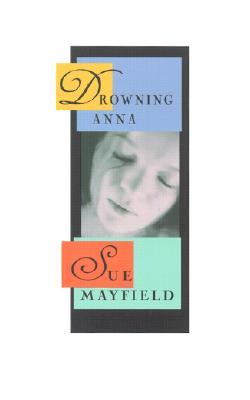
When Anna Goldsmith moves to Yorkshire from the south of England, she finds the transition difficult – that is until Hayley Parkin, the most popular girl at school, takes Anna under her wing. Sue Mayfield’s YA novel Drowning Anna unspools the story of Anna’s relationship with Hayley, which deteriorates almost as quickly as it began.

As Melanie explains:

Hayley Parkin goes off people. I don’t know why. Perhaps she gets bored with them. Perhaps she runs out of things to buy them. Perhaps she can’t stand competition. She doesn’t seem to need a reason. She drops people.

Drowning Anna combines third person narration with Melanie’s reflections and entries from Anna’s journal. From all these different points of view, we come to understand what has driven Anna to such a commit such a drastic act. Anna is a very relateable character. She’s smart, athletic, musical and attractive – but she’s also 14 when the story starts and given to bouts of self-doubt. Hayley Parkin is not the only thing wrong with her life: her teacher-mother is stressed out and moody, her doctor-father is never home; her older brother, Tom, is busy with his own life and doesn’t always live up to expectations – meaning there is extra pressure on Anna.

None of that explains, however, why Hayley decides to focus so much malevolent energy on Anna. She starts small by ignoring her, but it doesn’t take long for the harassment to extend to mimicking her accent (which, granted, means less in a Canadian context but having lived for a time in the UK, I understood this as a tool of torture), isolating Anna and actually physically hurting Anna.

Hayley, it seems, has a lot of charisma. The other students want to be in her orbit, but it feels sort of like, “keep your enemies closer.” We don’t ever get a clear understanding of why Hayley is so hateful, but it hardly matters. At the end of the day, Hayley will have to live with her choices.

Mayfield really captures the very particular cruelty of teenage girls. Anyone who has ever been bullied will see themselves in Anna Goldsmith.