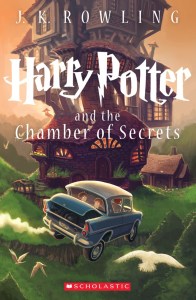
Harry Potter and the Chamber of Secrets – J.K. Rowling

I wish I had jumped on the Harry Potter broomstick a little earlier, and certainly way before I’d watched the films a gazillion times withharry-potter-new-chamber-of-secrets-cover-630 my kids. But I didn’t. I did, however, promise my daughter that I would read the series this summer. I actually made the promise on CBC radio so I feel extra obligated to make an attempt. I actually read Harry Potter and the Philosopher’s Stone out loud to a grade nine class a couple years back and I certainly enjoyed reading it. Now I’ve finished Harry Potter and the Chamber of Secrets and I enjoyed reading that, too. Problem is, I keep seeing the movie in my head, although I guess that’s not the worst thing that could happen when reading a novel.
We join Harry once more at the home of his aunt and uncle, Vernon and Petunia Dursley. They haven’t changed a bit since we met in them in the first book. If possible, Uncle Vernon is perhaps even more odious. Harry is feeling particularly miserable because he hasn’t heard from either Ron or Hermione all summer long. Life is pretty grim and he can’t wait to get back to Hogwarts.

Harry is trying to stay out of everyone’s way when he enters his bedroom and is startled by a “little green creature on the bed [with] large, bat-like ears and bulging green eyes the size of tennis balls.” Meet Dobby, the house-elf.

Like all of Rowling’s characters, Dobby is fully realized and it’s almost impossible not to fall in love with him straight away. One of Rowling’s many strengths is her ability to make her characters gloriously human (or, non-human, but also amazingly well-drawn). Because I knew it was coming, I waited through the whole book for Dobby to be freed from servitude and I loved the written version as much as I loved the on-screen version.

Back at Hogwarts, there are strange and scary things happening in the castle and once more Harry, Ron and Hermione are called upon to figure out how to stop evil in its tracks. That part of the mystery wasn’t so interesting to me since I already knew how it would all turn out.

The part of Harry Potter and the Chamber of Secrets I enjoyed the most was Gilderoy Lockhart, the new Defense Against the Dark Arts tutor.

Although I loved Kenneth Branagh’s portrayal of the narcissistic Lockhart, he was so much funnier in the book.

And then there’s Dumbledore’s famous line, which when I finally came to it, gave me the warm fuzzies and reminded me of why these characters will endure. After all the fuss in the Chamber of Secrets and Harry’s own bouts with self doubt, Dumbledore reassures Harry that “It is our choices, Harry, who show us who we truly are, far more than our abilities.”

Truer words.
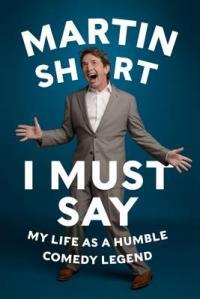
I Must Say – Martin Short

I think it’s probably un-Canadian not to like Martin Short. He (and his alter egos) has been making me laugh for at least 30 years, so I was really looking forward to reading his memoir I Must Say. Just the title  alone conjures up an image of Ed Grimley, the horn-haired, high-waisted-pant wearing, triangle-playing nerd who coined the phrase.

Short was born in Hamilton, Ontario, the youngest of five. His father,  Charles, an 20604377executive at the steel plant, and his mother, Olive, a classically trained violinist created a family environment that nurtured  his offbeat creativity from an early age.
Outside, on Whitton Road, normal Canadian childhoods were taking place, with kids playing hockey in the streets until darkness fell and the streetlights came on. Inside, little Marty was snapping his fingers and  singing, “Weather-wise, it’s such a cuckoo- daaay!”

Despite his artistic leanings, Short hadn’t planned on a career in show business and he credits Eugene Levy with encouraging him to try out for a Toronto-based production of Godspell. It was 1972 and Short had just graduated from McMaster University. His intention was to do social work, but he said he’d give the acting thing a year. We all know how that turned out.

I Must Sayis a chatty, name-dropping memoir that is both fun to read (mostly because you’ll know virtually every single name Short drops; it’s a veritable who’s who of Canadian comedy royalty) and also illuminating. Short makes us laugh — well, he makes me laugh at any rate– but his life has not been without its tragedies. He lost his older and much admired brother, David, when he was just twelve. He was young when both his parents died. And I read about the death of his wife of 36 years, Nancy, with a lump in my throat.

Other bits of the book are laugh-out-loud funny, especially when you are familiar with Short’s iconic characters including Lawrence Orbach, Franck from Father of the Bride  and my personal favourite, the ill-prepared, self-important, overweight celebrity interviewer, Jiminy Glick. I could watch Jiminy interview celebs for hours and pee my pants laughing every single time.

I don’t read a lot of memoirs and certainly don’t care that much about the cult of celebrity to read those written by the rich and famous, but Short gets a pass because I have loved him for many years. Whenever I need a pick-me-up, he’s my go-to guy. I was happy to ‘read’ that despite his Rolodex of famous friends he’s a pretty down-to-earth guy — a creative, smart and self-deprecating man who often had painful bouts of self-doubt. If you have any love for SCTV, SNL or The Three Amigos, I Must Say is an enjoyable way to spend a handful of hours.

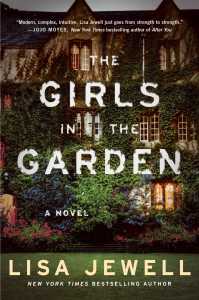
The Girls in the Garden – Lisa Jewell

Although I have hundreds of books waiting for me on my tbr shelf, I can’t seem to stop buying new books whenever I am at the bookstore, which is – let’s face it – often. There’s been all these suspense thrillers out there like I’m Thinking of Ending Things and The Widow and Twisted River  and The Crooked House which I seem to be drawn to like the proverbial moth to the flame. Maybe it’s because it’s summer and I just like to read something that’s fun, I dunno. But I have no trouble ignoring the huge catalogue of back-listed books I have waiting to be read and, instead, buy the shiny new books.

the-girls-in-the-garden-9781476792217_hrThe Girls in the Garden is one of those books. Although it turned out to be not the book I thought it would be, it was a great read nonetheless.
Clare has moved to a small enclave somewhere in urban London. Virginia Park is “formed in the space between a long row of small, flat-fronted Georgian cottages on Virginia Terrace and a majestic half-moon of  stucco-fronted mansions on Virginia Crescent, with a large Victorian apartment block at either end.” She and her children, eleven-year-old Pip and twelve-year-old Grace are recovering from a horrible incident involving Clare’s husband, Chris. (And again, what is it with book blurbs getting it wrong? The back cover says Pip is older, but she’s not.)

From the outside, Virginia Park seems like a miracle of a place. In the boundary formed by the buildings is a beautiful park which Pip describes in a letter to her father as being “like Narnia.”

…there are all these pathways and little tucked-away places. A secret garden which is hidden inside an old wall covered with ivy, like the one in the book. A rose garden which has bowers all the way around and benches in the middle. And then there’s a playground, too.

It’s a place of magic for the girls and a place for Clare to catch her breath. Except, of course, the magic is short-lived.

Adele also lives in Virginia Park with her husband, the handsome and slightly oily Leo, and their daughters Catkin, Fern, and Willow. The girls are home-schooled and the family leads a slightly bohemian life. Soon, Clare and her girls are brought into the welcoming embrace of Adele’s family. (Okay, maybe the girls aren’t 100% welcoming; you know how kids are.)

Tyler, another pre-teen who lives in one of the flats and her best friend, Dylan, the beautiful thirteen-year-old boy who also lives at the park, round out the gang that Grace and Pip find themselves hanging around with.

The Girls in the Garden reads like a thriller. The novel begins with the discovery of Grace’s unconscious and bloody body being discovered by her sister in the rose garden and then backtracks to unspool the story, mainly from the point of view of Clare, Adele, and Pip.

Jewell cleverly manipulates the reader into imagining a variety of very plausible scenarios before the story takes an unexpected (but not unbelievable) turn, ultimately making The Girls in the Garden less of a thriller and more of a domestic drama. But really, is there anything more thrilling than that? Isn’t it absolutely true that we never really know people, even those closest to us?

I thoroughly enjoyed this book.

The Crooked House – Christobel Kent

I can certainly see why Christobel Kent’s novel The Crooked House has drawn comparisons with the British mystery Broadchurch. Like that story, Kent’s novel takes place in an isolated village (in this case, Saltleigh) and concerns a horrific crime which has rippled out into the community.

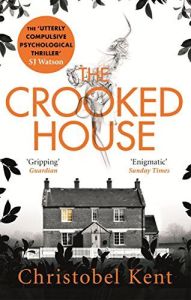
Alison used to be Esme and when she was fourteen her entire family was slaughtered. 748d3761900605840ce32be83a67d549Since that horrible night, Alison has flown under the radar. She lived first with her aunt in the south and then, after school, she moved to London where she worked in publishing, and where she met Paul. Paul is older, in his forties, and a professor. They had “Long, lazy conversations about books and movies and work, eating dinner at his big wooden table, or leaning against each other on his old sofa.” Alison likes him, so when he asks her to accompany him to Saltleigh to attend the wedding of a former girlfriend, she can’t seem to refuse even though she hasn’t been back since the crime.
Saltleigh is the same as Alison remembers. The smells, the colours, the landscape, and the memories of living there with her older brother, younger twin sisters, and her parents are palpable. On the first morning, while Paul sleeps on, Alison answers the memories and goes to her childhood home.

The house was boarded and derelict, weathered plywood splintered and graffitied at each window and the purple spikes of some plant sprouting above the lintel over the front door. The little enclosed yard behind where they had hidden and whispered and left secret messages. Thirteen years.

Despite the fact that she has spent the last thirteen years trying to forget, the memories have been triggered by coming back and she can do nothing but follow where they lead. What really happened that night?

The Crooked House was clearly a big hit in the UK. My version was covered with praise — a combination of praise from other authors, which is always suspect to me, and from the press.  Good Housekeeping said it “Demands to be read in one sitting.” I think that might actually be wise advice because although I did like this book (it’s clever, smart and well-written), I found it really disjointed. It shifts time periods all over the damn place and there are loads of characters and subplots (all relevant, mind you) to keep track of. If I managed to read without interruption, I easily settled into the book’s rhythms. but it definitely wasn’t a book you could pick up on the fly.

I think this book would make an excellent mini-series or movie. Get on that, would you, BBC!

The Interrogation – Thomas H. Cook

My love affair with Thomas H. Cook goes back several years when I stumbled upon his novel Breakheart Hill in a secondhand bookstore. Since then I have read several of his books including Instruments of Night, The Chatham School Affair, Places in the Dark, Evidence of Blood, The Fate of Katherine Carr, Master of the Delta, Red Leaves and The Cloud of Unknowing. Geesh, that’s a lot of books by one author!  In my reading life perhaps Stephen King is the only author I’ve read more of. (Yes, I am ending that sentence with a preposition; sue me.)

Cook is a prolific writer (he has over 30 novels to his credit) and has won many awards including the Edgar and the Crime Writers’ Association Duncan Laurie Award, yet you’d be lucky to find any of his novels on the shelves at your local bookstore – trust me, I look.  So how come he isn’t as well known as other authors writing in the same genre? Unless you’ve read him, or are a super mystery novel aficionado, you may have never even heard of him. How come? Ali Karim asked the same question for an article in January magazine.

I buy his books whenever I find them and I hang on to them, usually until I can replace the one I am about to read with a new one. I like to have one waiting in the wings for the next time I need a fix.

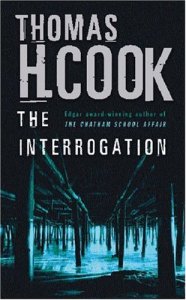
Albert Jay Smalls is an odd little man who lives in a drain pipe in a local park. He’s been 237180arrested for the murder of a little girl. The problem is there’s no evidence and no witnesses and so the police can only hold him for twelve hours before they have to cut him loose. Thomas Burke, the chief of police ( a man with his own troubles) sends  his two best interrogators into the room to get a confession from Smalls.
The Interrogation is the story of those two cops, Norman Cohen and Jack Pierce. Each man has a heart full of demons (Cohen is haunted by his experiences in war; Pierce’s young daughter was a murder victim), but they are tenacious and accomplished interrogators. Since the story is set in 1952 they have to rely on the evidence they gather the old-fashioned way: visiting crime scenes, talking to people, chasing leads. There’s no Google and everything takes time and time isn’t on their side.

As Cohen and Pierce question Smalls and try to follow a breadcrumb trail, the reader will try to determine Smalls’ guilt or innocence too. Make no mistake, Cook’s novels are mysteries and half the fun is trying to figure out whodunit, but that’s not the only thing Cook’s got going on.

As with every single Cook novel I’ve read – his characters are really dynamic. You believe them from the minute they open their mouths. They have complicated interior lives. His heroes are always men trying to do the right thing – even when they can’t. Minor characters, like garbage collector Eddie Lambrusco, are equally well-drawn. Cook can create empathy with just a few word as he does when we watch Eddie handle his father’s watch and thinks

a laborer’s timepiece with its chinks and scratches and slightly skewed hands that circled turgidly around the yellowing dial. After a lifetime, he thought, this.

There are a lot of father/child motifs in The Interrogation –  dads who are helpless to save their children; dads who do everything for them; dads estranged from their children. It’s a theme Cook visits often and yet he always seems to have fresh things to say about the topic.

And like with virtually every Cook novel (I almost said book there and then thought better of it) I’ve read, the story’s resolution will be a surprise. It won’t feel like a cheat, either…because with Cook the clues always exist.

If you like mysteries that are thoughtful, intelligent and well-written – try to get your hands on Thomas H. Cook. You will not be disappointed.

Summer Reading 2016

Listen here.

So – it’s summer. I’ve got all this free time stretching out in front of me and all I can think about is – what am I going to read? It’s the perfect time to make a dent in my tbr pile and yet I keep buying more books. Ridiculous. I do have a reading plan and an anti-gravity deck chair…and an awesome new deck, so I thought I’d talk a little bit about what’s on tap for  my summer reading.

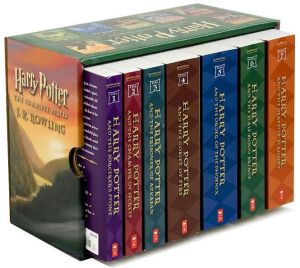
First of all, I promised my daughter, Mallory,  I’d read the complete Harry Potter series, which is 4224 pages. Yikes. I’ve actually read the first book and I’ve seen all the movies multiple times.

9780545162074_p0_v2_s1200x630Here’s a funny thing. The first Harry Potter book came out the year Mal was born and probably when she was about two I started to read it to her and I just couldn’t finish it. I just didn’t like it and she was too young. She was probably in middle school when she started reading the books on her own and I think she’s read the series a half dozen times or so. I subsequently fell in love with J.K. Rowling’s adult books, The Casual Vacancy and the Cormoran Strike books which she wrote as Robert Galbraith. (I’ve only read the first, The Cuckoo’s Calling.) I also think Rowling is an amazing human being – she gives away scads of  money, crazy amounts. Anyway, I will definitely be tackling Harry Potter this summer.
Here’s another book I should have read, but haven’t – A Moveable Feast, Ernest Hemingway’s memoir of the time he spent living in Paris in the 1920s. I would say, generally speaking, that I am not a fan of Hemingway. I understand his place in the literary canon, but just not my cup of tea. Then I read The Paris Wife by Paula McLain. It’s a fictional account of Hemingway’s first wife, Hadley Richardson, and their time spent in Paris surrounded by the literati of the day: Gertude Stein, F. Scott Fitzgerald, Ezra Pound. I mean, you can’t really call yourself a literature lover and not be a little bit intrigued by those people. I highly recommend The Paris Wife and after I finished it,  I bought A Moveable Feast and my friend Karen has chosen Hemingay’s novel For Whom The Bell Tolls as our summer book club on FB. So, looks like I’ll be reading two Hemingways this summer.

Then – on top of all this, I am going to try to make some room to read some fun stuff. I started Martin Short’s memoir I Must Say a couple nights ago. I’ve been a life-long fan and I can hear all his voices – Ed Grimley and Jiminy Glick –  in my head.

I also have a couple thrillers on my bedside table, Christobel Kent’s The Crooked House, for example.

Speaking of thrillers, if anyone out there is looking to read a highly unusual thriller I can recommend M. R. Carey’s The Girl With All the Gifts. It’s a zombie apocalypse novel – not normally my cup of tea, but definitely worth checking out, especially if you like to read the book before you see the movie. Carey is quite a well-known writer of comic books, The X Men and Lucifer. The book takes place in the U.K. and concerns a heavily guarded compound where ten-year-old Melanie and other “hungries” are studied in the hopes of finding a cure for the world’s zombie problem. It’s quite a big problem, actually. Melanie is a wonderful character and the novel is action-packed, smart and kinda sad, too.

What are you planning to read this summer?


I’m Thinking of Ending Things – Iain Reid

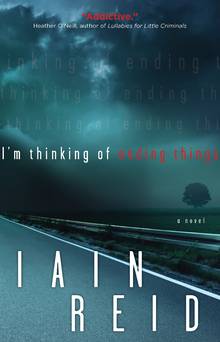
Um. WTF? So, I saw I’m Thinking of Ending Things at the book store. Sounded good. Bought it. Read it straight through. Listened to author Iain Red talk about it on CBC Radio. You were no help at all, by the way, Iain, so I am going to work on the premise that I know what happened. Kinda. Sorta.

Im+Thinking+of+Ending+ThingsThe unnamed narrator and her boyfriend, Jake, are on their way to visit Jake’s parents for the very first time. Their relationship is new, but already the narrator is “thinking of ending things.”  It’s not that she doesn’t like Jake. They met at a party and she tells us “He wasn’t the first guy I noticed that night. But he was the most interesting.”

On the long, snowy drive to Jake’s family home Reid’s characters exchange awkward conversation about, among other things,  secrets, space, and memory. She remarks, “Part of everything will always be forgettable. No matter how good or remarkable it is. It literally has to be. To be.”

The journey also gives her an opportunity to catalogue her relationship with Jake. She mentions the way he chews, the toothpaste lingering on the corner of his mouth, his “jagged cheekbones.”  The narrator comments that “Individually, we’re both unspectacular.” But that isn’t exactly true.

When the narrator and Jake finally arrive at the family farm, it’s isolated and creepy. A tour of the outbuildings reveals dead lambs “Limp and lifeless, stacked  up outside against the side of the barn.” They visit empty pigpens and the chicken coop before the narrator catches a glimpse of a “gaunt figure, standing, looking down at us.” Don’t go in that house is probably what you’re thinking. You wouldn’t be wrong because from this point on I’m Thinking of Ending Things takes a turn off awkward street onto sinister avenue.

Jake’s parents are strange. His dad is “reserved, borderline standoffish.” Jake’s mom smiles a lot and is wearing “so much makeup I find it unsettling.” Dinner conversation is bizarre. Jake contributes nothing; “I have never seen Jake so singularly focused on his plate of food.”

A surreptitious tour of the house reveals a basement that Jake had claimed was not used, but which the narrator reveals is “not true at all.”  She discovers a disturbing painting and a bookshelf filled with pages and pages of equally disturbing drawings.

And all this would be enough to make your skin crawl, but Reid’s novel is not nearly as straightforward as this. For instance, the narrator has been receiving strange phone calls from someone she refers to as “The Caller.”  When she doesn’t answer, he leaves her strange, cryptic messages: “I feel a little crazy. I’m not lucid” says the first. The narrator also refers to a childhood memory of being watched through her bedroom window. Trying to figure out how these elements play into Reid’s narrative is half the fun of this puzzle of a book. Or half the frustration, depending on how you look at it.

By the novel’s conclusion, I thought I’d figured out what was going on. I actually thought I’d figured it out by page 88. If I’m right, I’m Thinking of Ending Things is a trippy, creepy thriller that pushes lots of suspense-thriller boundaries. It also has something to say about  identity and memory. Even if I’m not right – and we’ll never know because, hello – spoilers – it’s still a great book.

Highly recommended.


Twisted River – Siobhan MacDonald

I was that customer at Indigo a couple weeks ago when I sent  Matt and Jerrod looking25810336 for a book that I described as “blue” and “used to be on the front table.” Yep. So ridiculous, right, thinking that those descriptors would help them locate a book in a store filled with books. Talk about the proverbial needle in a haystack. Strangely enough, I found it on my own in the mystery section – although the book’s cover is definitely not blue.  (And it might have helped if I’d remembered the keys on the cover.)

Kate and Mannix O’Brien and their children Izzy and Fergus, and Hazel and Oscar Harvey and their children Elliot and Jess, are the central characters in Siobhan MacDonald’s novel Twisted River. We meet them separately, the O’Briens in their house in Limerick, Ireland and the Harveys in their Manhattan apartment. Each family has their own domestic rhythms and  difficulties. For example, Fergus is being bullied at school. Hazel is lying to her children – and herself – about her damaged cheekbone and her eye which “had swollen a mix of red and purple.” Mannix and Oscar each have work-related troubles. Then there’s Mannix’s brother Spike, a nightclub owner who’s mixed up with a local crime family.  When the families’ crises reach a boiling point, the moms take matters into their own hands and arrange a vacation. Using a house swap site they connect and swap houses; the O’Briens head to New York and the Harveys to Limerick, Hazel’s place of birth.

And a family vacation sounds great – except the novel starts with Oscar stuffing the body of a woman into the trunk of a car. (Not a spoiler – the novel’s opening line is “She would never have fit as neatly into the trunk of his own car.”) From that compelling opening line, the story weaves past and present, revealing secrets and lies.

Twisted River is twisted, all right. It’s really one of those books where things are not entirely as they seem. MacDonald’s layered narrative reveals characters and their motives with slippery-eel finesse. I didn’t feel duped by MacDonald’s  plot as much as I did by the novel’s kind of fallen souffle ending.  But as  far as being a page-turner, yes, I turned the pages.


The Girl With All The Gifts – M.R Carey

Joss Whedon (Buffy the Vampire Slayer, Angel) called The Girl With All The Gifts “Heartfelt [and] painfully human.”   Without really knowing I was buying a zombie book, I picked up M.R. Carey’s novel  a few weeks ago  and finally settled down to read it.  I am not a huge fan – or even a fan at all really – of zombies. I am, however, a fan of Joss Whedon, and an endorsement from him is enough for me to read outside of my comfort zone. Zombies, unlike vampires (Joss Whedon’s vampires at any rate), are just not sexy, and while I am still not a fan of zombie novels, I did really like this book.

17235026Melanie is ten. She lives at some sort of army base, dubbed ‘Hotel Echo’ in an area of the U.K. known as region 6. The base is about thirty miles north of London, and just beyond that is Beacon. Welcome to life since the Breakdown.

Most of region 6 is clear, but the only thing that keeps it that way is the burn patrols, with their frags and fireballs. This is what the base is for, Melanie is pretty sure. It sends out burn patrols, to clear away the hungries.

Melanie is not an ordinary girl. For one thing, she is kept locked in a cell. For another, she and the other children at Hotel Echo exist on a diet of grubs.  Every morning, she is strapped, wrists, ankles and neck, into a chair and taken, along with the other children,  to the classroom where their teacher – usually Helen Justineau – teaches them. Those are Melanie’s favourite days because when Miss Justineau is teaching “the day is full of amazing things.” The children learn math and spelling; sometimes they are read to. Melanie is keen to learn as much as she can, but it’s difficult to know just what the lessons are for because as Mr. Whitaker (another one of the teachers) explains “None of this stuff matters anymore…it’s irrelevant. It’s ancient history! There’s nothing out there any more. Not a damn thing. The population of Birmingham is zero.”

Dr. Caldwell also lives at Hotel Echo. She’s busily working on a cure for the infection that causes people to become ‘hungries’ (and you’d be right in thinking that what they’re hungry for is humans). She sees the children as test subjects, nothing more. Helen Justineau strenuously disagrees with Caldwell’s methods and the relationship between the two women is fraught with ethical disharmony.

When Hotel Echo is attacked by junkers (violent scavengers taking advantage of the chaotic state of the world) Justineau, Caldwell and Melanie end up on the run with two soldiers, Parks and Gallagher.

I don’t really have a frame of reference for a zombie apocalypse book. I don’t watch The Walking Dead, which I have been told is really good, but really gory. I read and loved Courtney Summers’ This Is Not a Test, but despite the fact that it’s a zombie novel it is zombie-lite compared to The Girl With All The Gifts. So I don’t have any preconceived zombie notions, not like when I read vampire fiction and get all annoyed when they sparkle.

But make no mistake, The Girl With All The Gifts is more than a zombie novel. It’s a novel that asks us to consider what makes us human and whether or not we can be more than our nature allows. Caldwell views Melanie as a test subject, someone with the biological potential to save the world. Justineau views Melanie as a little girl. Parks views Melanie as a monster. They are all right. And wrong. The journey they take together will horrify and break the hearts of any reader prepared to go with them.

Highly recommended.

Read it before the movie comes out!


The Vanishing Act of Esme Lennox – Maggie O’Farrell

Maggie O’Farrell’s novel The Vanishing Act of Esme Lennox is the story of sisters Euphemia (Esme) and Kitty and while the novel’s first line announces that the story begins “with two girls at a dance”, the story really begins in India, where Kitty and Esme live with their parents. There, one hot afternoon, Esme, aged four and a half,  recalls an insect getting caught in her ear and letting “out another piercing shriek.” She staggers around the lawn until the insect crawls out of her ear. “Could this be her earliest memory?” she wonders. “It might be. A beginning of sorts – the only one she remembers.”

250729This is also the story of Iris, Kitty’s granddaughter, owner of a small vintage clothing store, and half-heartedly involved with a married man.

The narrative jumps around a lot: present day, India,  Edinburgh in the 1930s after Esme and Kitty and their parents return from India. To confuse matters even more, Kitty now suffers from dementia and her fragmented thoughts are part of O’Farrell’s narrative. If it sounds complicated, it’s actually not.

The main part of the story is Esme’s. The psychiatric hospital where she has spent the last sixty years of her life is closing and she needs to be moved. Kitty clearly can’t care for her – she’s in a nursing home herself. It falls to Iris to look after a woman she’s never met and knows nothing about. When Iris finally meets her great aunt, she seems quite sane.

Iris had, she realises, been expecting someone frail or infirm, a tiny geriatric, a witch from a fairy tale. But this woman is tall, with an angular face and searching eyes. She has an air of slight hauteur, the expression arch, the eyebrows raised.

Esme is a fascinating character and her story is both heartbreaking and compelling. She is a victim of the time, of family tragedy and the will of others, yet she remains somehow sane. She wanted an education, but her parents wanted her to make a good marriage.  The circumstances of her incarceration are revealed to the reader through the novel’s layered narrative and it’s more than enough to keep you turning the pages.

However, I do feel there was more to be said. I was particularly drawn to Iris’s story and her relationship with her brother, Alex, and that felt (in some ways) like another book entirely. Some people probably won’t like the way The Vanishing Act of Esme Lennox finishes, but I didn’t mind how it ended. I think my overall reaction to the book was that it was lightweight despite the novel’s more serious themes. Easy to read, sad, but somehow sort of superficial.