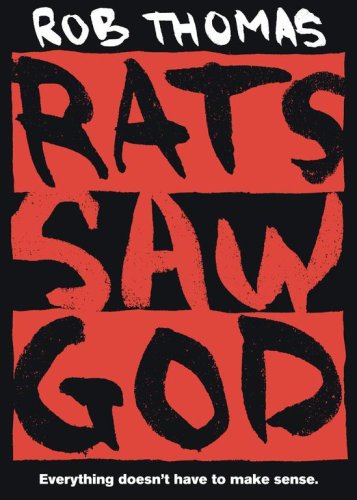
Rats Saw God – Rob Thomas

ratsRob Thomas shares his name with the lead singer of Matchbox 20, and although they are both writers, this Rob Thomas is better known for his television show Veronica Mars than his hit songs.

Rats Saw God is a Catcher in the Rye-esque coming of age novel about Steve York, a high school senior who ends up in his guidance counselor’s office trying to explain why he’s flunking out when his SAT scores are through the roof. The fact that he’s regularly stoned might also be a contributing factor, but in any case, Steve finds himself sitting with Mr. DeMouy being offered a cup of tea. DeMouy tells him that at the end of the semester he’ll be one English credit short.  DeMouy makes him an offer: write 100 typed pages – about anything. If he does that, DeMouy will make sure Steve graduates.

When Mom and the astronaut called Sarah and me into our Cocoa Beach, Florida (see I Dream of Jeanie) dining room to tell us they were getting a divorce, I admit I was shocked. I suppose I should have seen it coming, but the warning signs had been such a part of the status quo.

Thus begins Steve’s paper. It’s the story of his junior year. After the divorce, he moves with his dad, “that barely animate statue,” to Houston and his sister, Sarah, twelve at the time, moves to San Diego with her mom. In the summer, they swapped. Steve and his father have an estranged relationship:

He would leave for work before I woke but would provide a list of chores by the sink, paper clipped to a ten-dollar bill, which was to provide me both lunch and dinner.

At school, Steve befriends Doug, a skateboarder, and that friendship leads him to Dub, and the people who eventually become GOD, the Grace Order of Dadaists.  Dadaists, Steve explains ” were painters, writers, sculptors in the twenties who believed in art without coherent meaning. Nothing they did had to be justified. The more abstract, the weirder something was, the better.”

Rats Saw God is funny and smart  and it is a delight to watch Steve try to figure out the world, even when he has to face the truth that sometimes people will disappoint you. Of course, sometimes they’ll surprise you, too.
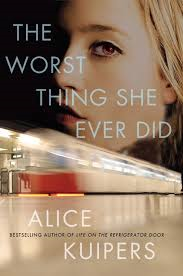
The Worst Thing She Ever Did – Alice Kuipers

worstthing Sophie releases the details of the worst thing she ever did through journal entries and this turns out to be a blessing and a curse in Alice Kuiper’s second YA novel, The Worst Thing She Ever Did. It’s a blessing because we get to hear Sophie’s authentic teenage voice and a curse for the same reason. Teenagers are, by definition, insular and of course no where is this made more apparent than in the pages of a teenager’s diary.

Sophie is keeping this journal at the request of her therapist, Lynda, who tells her that “Writing in here will help you remember.” Sophie doesn’t want to remember, though, and The Worst Thing She Ever Did  takes its own sweet time revealing what it is Sophie is so desperately trying to forget. I’m not suggesting that Sophie’s tragedy is not worth the effort, just that Sophie often teeters on the edge of coming across more like a petulant child than the survivor of a horrific act of violence.

But maybe that is part of what would make this story so compelling to young adults. I think they will recognize themselves in the pages of Kuiper’s novel. Here is a girl who is living her life. Her sister, Emily, is home from art school and Sophie doesn’t varnish their sibling relationship. Sometimes Emily really pisses her off. Sometimes Sophie feels like Emily is the favourite child. Mostly though, Sophie misses her older sister and it is clear that something horrible and unspeakable has happened.

Sophie’s mother is coping with the loss as badly as Sophie is, but the two of them don’t talk about it. In fact, sometimes they “circled each other like cats.” Sophie pretends not to hear her mother crying. There is no joy in the house they share.

There’s no joy for Sophie at school, either. Everything is different. “Everything going on around me – the others, the noise, the ring of the bell to get to class – was so loud it gave me a headache.” Sophie’s best friend, Abigail, has moved on.  Sophie tries to navigate the aftermath of the tragedy (which is only alluded to until almost the end of the novel) and work her way through being a teenager with varying degrees of success. There’s school to contend with and fractured friendships and boys – one boy in particular – and her mother. All of these elements would have been enough for a YA novel and a half, but Kuipers ups the ante here.

If some of the reconciliations seem a tad trite at the novel’s end (I wasn’t really fussy about the subplot concerning Abigail), they don’t really detract from the story’s larger theme: healing takes time. Kuiper’s is a lovely writer and although my feelings about The Worst Thing She Ever Did are similar to my feelings about 40 Things I Want To Tell You, I still think Kuipers is worth checking out.