The End of the Alphabet by CS Richardson

Richardson’s first novel is a slim 139 page contemplation on how one would spend the remaining days of a relatively uneventful life. Ambrose Zephyr is diagnosed with an unnamed incurable disease on his 50th birthday. After the initial shock wears off he embarks on a whirlwind trip with his wife, Zipper. (Don’t even ask about the ridiculous names.) He decides to visit one place for each letter of the alphabet. A is for Amsterdam and so on.

My book club was divided down the middle on this one. Some of the women really loved it. They thought Richardson’s pared down, choppy prose suited the story- giving it an urgency which was mirrored by Ambrose’s desperate attempt to pack as much into his remaining days as he could. Others, like myself, thought the book failed to connect the reader with Ambrose. How can you care about someone you know so little about?

Before publishig this first novel, Richardson was an award-winning book designer.

The White Iris by Sandy MacDonald

This book was chosen for our book club last month…and the woman who chose it was quite sure that she’d win ‘best book’ this year with this comical look at three eccentric women in rural Nova Scotia.

The White Iris was written by lawyer Sandy MacDonald and after reading it (well, trying to read it) I would humbly suggest that he not give up his day job. The story is hardly the sparkling and witty examination of environmental issues it claims to be. For me- it was a diatribe of a novel peopled by stock characters, pedestrian prose and enough lifeless filler for three novels.

Worst book I’ve read this year.

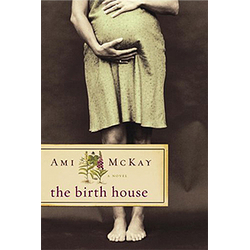
The Birth House by Ami McKay

One of the first books I read this year and easily the best novel I encountered in 2006, this account of a midwife in turn-of-the-(20th)-century Nova Scotia is everything a novel should be: funny and tragic, joyful and sorrowful, filled with rich, carefully drawn characters and experiences that linger long in the mind.

The Birth House
spent most of the year on bestseller lists and marked the arrival of a splendid new talent. I can’t wait to see what Ami McKay does next.
– Robert Wiersema, for the Vancouver Sun.

Ami McKay’s book The Birth House is a natural selection for book clubs. Set in rural Nova Scotia circa the First World War, it tells the story of Dora Rare, the “only daughter in five generations of Rares.” Dora is a smart girl who spends much of her time with Miss B, the area midwife. Miss B is part-healer and part-witch and Dora learns much under her tutelage.

Truthfully, it took me a while to get settled into Dora’s quiet world, but the book’s charms are undeniable. For one thing, Dora is utterly likeable. She is kind and sensible and although she is young, she is no shrinking violet. McKay does a wonderful job of creating a world far removed from technology and the horrors of the war, but certainly not immune to either. For example, Dora’s faith in midwifery is tested (as is the faith of all the women of her community) when Dr. Thomas arrives in the area and sets up a hospital, offering women pain-free births. And when the Halifax Explosion of 1917 happens, Dora rushes off to help and is forever changed by the experience. Scots Bay isn’t modern and McKay paints a riveting picture of poverty and backwoods thinking.

But the book isn’t without a sense of humour either. Dora’s marriage to town hunk, Archer, necessitates a visit to Dr. Thomas where he diagnoses her with “neurasthenia” and prescribes treatment using the Swedish Movement Health Generator. I dare you to keep a straight face.

The Birth House isn’t a flashy book, but it’s a book that will resonate with readers, particularly women, and I heartily recommend it.

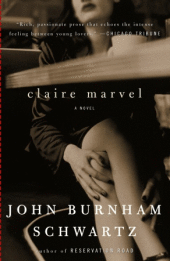
Claire Marvel by John Burnham Schwartz

A few year’s back I read Jonathan Burnham Schwartz’s devastating novel Reservation Road and was really impressed. So I was really looking forward to reading Claire Marvel. The book’s opening lines: “There was before her and now there is after her and that is the difference in my life” promised great things– but I’m not sure Schwartz actually delivers.

The book is narrated by Julian Rose, a grad student at Harvard who meets and falls immediately in love with Claire Marvel during a rainstorm. The book traces their relationship through all the requisite romantic obstacles and I suppose I can fairly say that the only thing that prevents this book from being totally been there, done that is the quality of Schwartz’s prose.

As Julian chases and abandons and chases and abandons the love of his life, we are never really certain of her and, in fact, even though the book is named after her– we really come to know very little about Claire as a person.

Members of my book club loved this book…but I found it somehow unsatisfying.

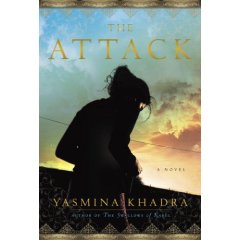
The Attack by Yasmina Khadra

Yasmina Khadra’s novel The Attack set off a firestorm of debate at book club. The novel follows the journey of Muslim surgeon Amin Jaafari, a naturalized citizen of Tel Aviv. He shares his life with the love of his life, Sihem. It isn’t giving anything away to say that Amin’s wife turns out to be a suicide bomber, detonating herself in the middle of a restaurant filled with school children. The novel then follows Amin’s journey from denial and disbelief to acceptance, if not of his wife’s actions then at least of the motivation behind the attack.

I didn’t like the book. The problem for me is that the character of Sihem is never humanzied. She is “the creature I loved most in the world.” Anything we learn about her, we learn through the eyes of the extremists with whom she had aligned herself behind her husband’s back. He doesn’t understand and neither did I. Mostly I felt as though I was getting a lecture about the very messy and complicated and, clearly, emotional landscape of the Middle East.

Still, the book led to a great, and often heated, discussion– if that’s your thing.

The Memory Keeper’s Daughter by Kim Edwards

Everyone is raving about Kim Edwards’ book, The Memory Keeper’s Daughter. The Library Journal said “first time novelist Edwards  has written a heart-wrenching book, by turns light and dark, literary and suspenseful. A natural for book discussions groups; recommended.”

The Memory Keeper’s Daughter follows the lives of Dr. David Henry and his wife Norah at the beginning of their married lives. It is 1964 and Norah is pregnant. She delivers twins, a boy first and then a girl with Down syndrome. David makes the decision to keep the little girl a secret, handing her to his nurse, Caroline, with instructions to take her to an institution– not an uncommon thing for the time when babies born with Down weren’t expected to live long or healthy lives. This decision shapes all the characters in the book in unexpected and complicated ways.

I didn’t like the book, but I was in the minority when we discussed it at book club. The characters– all of them– are chilly people and it was very hard to find their emotional center. But not everyone agreed with me. Most of the women in my group felt enormously sorry for Norah, who didn’t have a chance to say goodbye to her daughter and who suffered enormously because of the secret her husband kept from her. The guilt of his decision haunted and shaped David, who already had some serious issues. Their marriage was irreparably damaged; Norah’s relationship with her son, Paul, was tentative.

The book was easily 100 pages too long.

Still, many people will love this book. Just not me.

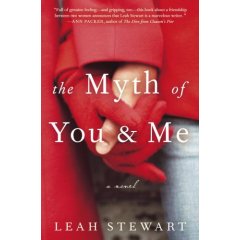
The Myth of You and Me by Leah Stewart

Library Journal said this book was “incandescently beautiful [with] passages about the challenges awaiting young women as they come of age. The story, filled with secrets and treasures, is a well executed, compelling look at attraction, love and trust.”

Poppycock, I say. Yes, this was my book club selection. You have no idea how I stress (in a good way) about which book to choose. The way our club is organized allows for each member to host once a year– meaning we choose the book, lead the discussion and feed everyone. So, with only one choice a year, you want to get it right. Well, I do.

The book I wanted to pick was Envy by Kathryn Harrison, but given that people were going to have to read it (partly at least) over the holidays, I thought it might be wiser to choose something a little less heavy. Which lead me to The Myth of You and Me.

The book is a light-weight look at the friendship between Cameron and Sonia, who meet the summer they are 15. Narrated by a soon-to-be-thirty Cameron, the novel traces– through flashbacks– their friendship, their personal histories, the men they love but I was never convinced of any of it and that may have to do with my lukewarm feelings about Cameron herself.

Early on in the book we learn that Cameron and Sonia have parted company. Some horrible event caused the unresolved rift in their friendship, but when Cameron’s employer Oliver Doucet dies, he leaves her with one last task: find Sonia. The rest of the book sees Cameron on a journey to find Sonia and deliver a mysterious package.

Despite my reservations, Stewart makes several observations about friendship and relationships which I thought were really interesting and which I hope will lead to some good discussion when my book club meets.  I have a feeling people will be divided on this one. As for me–I had a mostly tepid reaction to the book.

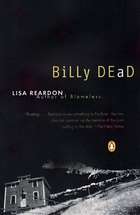
Billy Dead by Lisa Reardon

Lisa Reardon’s book, Billy Dead, earned copious praise when it was published in 1998 and it deserves the honors. Years after I first read it, I keep thinking about the story’s flawed and difficult characters, siblings Billy, Ray and Jean. The story is narrated by Ray and it’s a story of poverty, abuse, and redemption. It’s unflinching, too; Reardon doesn’t gloss over any of the details and it is for perhaps this reason that the book was highly regarded by critics. Alice Munro (perhaps the greatest writer of short stories ever) said: “Billy Dead is a brave, heart-wrenching debut. I couldn’t look away.”

I chose it for my book club several years ago… and no one liked it. Truthfully, the book probably isn’t for everyone: it’s graphic and violent. But the characters are so compellingly real and their journey is so honest, they’ll make an indelible impression on you. Really.

To save you from signing up, here’s a review from the NY Times

Lisa Reardon’s first novel, Billy Dead, instantly brings to mind Dorothy Allison’s Bastard Out of Carolina. Both depict poor, rural white families in which innocent lives are ravaged by brutality and incest. But Billy Dead, if you can believe it, is even more harrowing, and while Reardon possesses enough skill to render any awful act believable, she does so at the expense of the book’s frail beauty. When you finish reading it, you’re left with a crowd of horrific images that overwhelm what the story is finally about: the redemptive power of love, no matter how unconventional.

Unlike Allison’s child narrator, the speaker in Billy Dead, Ray, is an adult who has the language and sexual knowledge to describe the family’s heinous history in graphic detail. Of the three Johnson children, who grew up in Michigan, Ray was clearly the least equipped to shoulder abuse; as a man, he is helpless and dazed, given to hallucinations and physical self-torture. He lives in a perpetual cringe, shrinking from memories that constantly threaten to unravel him. But when he learns that his beastly older brother, Billy, has been sadistically murdered, Ray can’t help flashing back to his freakish family life, a three-ring circus of savagery in which the siblings all take turns in the spotlight.

Ray and Billy have a little sister, Jean, who not only suffers her father’s beatings as they do but also endures sexual abuse at the hands of all her menfolk. But she is a mean, tough kid — qualities that meek, sensitive Ray admires. When Jean is only 7, Billy and Ray force her to perform fellatio on them, an act that belies Ray’s affection for Jean and underscores his fear of Billy. A few years later, she pounces on her opportunity for revenge: as Ray, now 14, lies weak in bed with chickenpox, she burns his sores with a cigarette while bringing him to orgasm with her other hand. ”Do you love me?” she asks, grinding the hot cigarette into his wounds. ”Are you sorry?” He appears relieved to submit to Jean’s punishment; he is also in awe of her spitefulness.

Ray and Jean remain allies in their house of horrors. After his senior year, Ray spends the summer working in another town; Jean, now 16, joins him. Away from their tormentors, they become lovers, and, impossibly, you find yourself actually rooting for them. It’s a credit to Reardon’s writing that their romance seems right and tender. But everything goes wrong when they return home to find that the whole town knows about them. In a flash of possessiveness, Ray turns on Jean, and the two remain estranged until Billy’s death years later — an event that prompts Ray to seek her out again. Whoever got Billy ”must have been even meaner than him. Only one person I know like that,” Ray says as he begins a delirious search for the love of his life, his baby sister.

Billy Dead is quite well written, but its literary merits are diminished by the relentlessness and intensity of its atrocities. Billy throws a cat against a wall for fun, breaking its neck, and his father then chops the dying pet’s head off with a shovel; after Billy molests her, Jean hangs his dog from a tree and beats it to death with a baseball bat; during one particularly violent episode of rape, Jean nearly bites her father’s penis off. Still, all this excess isn’t just sensationalism, and most of these scenes seem warranted by the larger story. Indeed, this is an extremely powerful novel, but whether you want to read it depends on your stomach for human — or, better said, subhuman — ugliness.
-By LAURA JAMISON

The Gardens of Tokyo by Kate Walbert

“Kate Walbert’s fine, delicate prose captures voices that we don’t hear much anymore…The Gardens of Kyoto is a ghost story, a mystery, a love story.” – Amy Bloom

I read about The Gardens of Kyoto by  Kate Walbert on a ‘Top Ten’ list and chose it for my book club a couple years ago. Many of the members of my book club weren’t enamored with the book, but I was smitten from the book’s opening line: “I had a cousin, Randall, killed in Iwo Jima.”

The story seems simple enough. The novel’s narrator, Ellen, comes of age around the time of World War II and recalls her life and her relationship with Randall some forty years later. Her story makes for compelling reading. But it isn’t just Ellen’s story to tell– she inherits Randall’s diary and a book called The Gardens of Kyoto and we get a glimpse of several other lives.

Walbert’s book is marked by gorgeous prose and a fully realized sense of place. I found the book wholly satisfying, heartbreaking, and emotionally resonant.