The Story of My Face by Kathy Page

An elegantly compelling story of how a young girl’s obsession forever changes the lives of those around her…a disciplined exploration of the complexity of human motivation and our need for redemption. – Lynne Van Luven, Vancouver Sun

Kathy Page’s The Story of My Face is at once compelling and confounding. Page is a skilled enough writer that you are pulled into the mysterious events surrounding Natalie’s disfigurement– the cause and extent of which you learn little about until the book’s final pages– from the beginning. But the central event of Natalie’s life is buried in adult-Natalie’s search for meaning and understanding.

We meet Natalie Baron as an adult on her way to Finland to research Tuomas Envall, the leader of a strict religious sect. Natalie’s own connection to the cult comes in the form of Barbara Hern, her husband, John, and son, Mark. These three people have important roles to play, particularly Barbara for whom Natalie has a possessive affection.

Page weaves past and present together, but for me– the story was at its most compelling during the time Natalie is with the Herns on a retreat with other members of this religious sect.

The story of what happens to her face is actually not as startling as how she impacts the lives of the Hern family, most specifically Barbara.

Saturday by Ian McEwan

I am not a McEwan newbie. Saturday is the 4th of his books I have read and, thus far, my least favourite. But even though I didn’t love this book, I would still have to praise McEwan’s ability to write. If I have a criticism of Saturday it’s that it’s over-written. That may be the fault of McEwan’s decision to set the novel in one day in the life of neurosurgeon, Henry Perowne.

Saturday is Henry’s favourite day. He plays squash, does some shopping and on this particular Saturday– anticipates the homecoming of his daughter, Daisy. But, of course, this Saturday isn’t going to be like all the others. He awakens in the middle of the night and watches from his bedroom window as a plane– streaming fire, cuts across the sky to (crash, he assumes) land at Heathrow.

This event wouldn’t be the cause of so much concern if this story wasn’t set post 9/11 and on the very day when hundreds of thousands on people are set to march in London’s streets to protest the war against Iraq.

As Henry sets out to accomplish his long list of things to do before his daughter arrives he gets into a minor fender bender that will propel (although not quickly) the book towards its denouement. Whether or not you find the ending, or the book for that matter, satisfying, will depend on how much you care for Henry and the minutia of his Saturday.

Sweetness in the Belly by Camilla Gibb

British born, Canadian-raised writer Camilla Gibb’s stunning new novel Sweetness in the Belly divided my book club. I was among those who loved it. The book tells the story of Lilly, born to hippie parents and brought up as a Muslim, after their death, in the city of Harar. Her story is told by layering her young years in a politically charged Ethiopia with her life as a nurse in London. It’s a fascinating picture of a world torn apart by poverty and prejudice and by Lilly’s own beliefs. It is also a love story as we wait with Lilly to learn the fate of her lover, Aziz.

I know nothing of the politics of Ethiopia under Emperor Haile Selassie. I know very little about the Muslim religion, but Gibb’s beautiful prose and attention to detail (she conducted fieldwork in Ethiopia for her PhD in social anthropology) makes this book a page-turner. The characters are complex and interesting and the day-to-day struggles of the women, in particular, are riveting. I was both gutted and elated by book’s end.

Rise and Shine by Anna Quindlen

Anna Quindlen’s book Black and Blue, was the first novel my book club ever read together- almost eight years ago now. I remember liking it quite a lot, so when her novel Rise and Shine was chosen for last month, I was quite happy.

Until I started reading.

Meghan and Bridget are sisters living in New York City. They couldn’t be more opposite. Meghan is the famous host of a morning TV show, Rise and Shine, and her sister, Bridget, the dowdier and less confident one, is a social worker. You can already see where this is going, can’t you?

Although Meghan seems to have it all- a wonderful husband and a fabulous son, both of whom Bridget adores, there are cracks in her seemingly perfect life and one day she utters something wholly inappropriate on live television and her world comes crumbling down. And the problem with the book is  I could care less.

What follows is 269 pages of Meghan and Bridget trying to sort through their personal baggage and come to terms with each other on a different level. And all of that was okay- not great, but okay…until the last 50 or so pages when Quindlen does what I hate….takes all the lives she’s dangled in front of us and propels them into the future giving us the ‘happily ever after’ she so clearly thinks they deserve.

Ugh.

The End of the Alphabet by CS Richardson

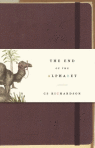
Richardson’s first novel is a slim 139 page contemplation on how one would spend the remaining days of a relatively uneventful life. Ambrose Zephyr is diagnosed with an unnamed incurable disease on his 50th birthday. After the initial shock wears off he embarks on a whirlwind trip with his wife, Zipper. (Don’t even ask about the ridiculous names.) He decides to visit one place for each letter of the alphabet. A is for Amsterdam and so on.

My book club was divided down the middle on this one. Some of the women really loved it. They thought Richardson’s pared down, choppy prose suited the story- giving it an urgency which was mirrored by Ambrose’s desperate attempt to pack as much into his remaining days as he could. Others, like myself, thought the book failed to connect the reader with Ambrose. How can you care about someone you know so little about?

Before publishig this first novel, Richardson was an award-winning book designer.

The White Iris by Sandy MacDonald

This book was chosen for our book club last month…and the woman who chose it was quite sure that she’d win ‘best book’ this year with this comical look at three eccentric women in rural Nova Scotia.

The White Iris was written by lawyer Sandy MacDonald and after reading it (well, trying to read it) I would humbly suggest that he not give up his day job. The story is hardly the sparkling and witty examination of environmental issues it claims to be. For me- it was a diatribe of a novel peopled by stock characters, pedestrian prose and enough lifeless filler for three novels.

Worst book I’ve read this year.

The Birth House by Ami McKay

One of the first books I read this year and easily the best novel I encountered in 2006, this account of a midwife in turn-of-the-(20th)-century Nova Scotia is everything a novel should be: funny and tragic, joyful and sorrowful, filled with rich, carefully drawn characters and experiences that linger long in the mind.

The Birth House
spent most of the year on bestseller lists and marked the arrival of a splendid new talent. I can’t wait to see what Ami McKay does next.
– Robert Wiersema, for the Vancouver Sun.

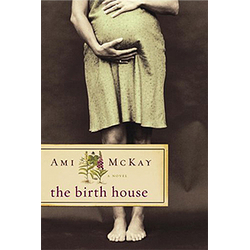
Ami McKay’s book The Birth House is a natural selection for book clubs. Set in rural Nova Scotia circa the First World War, it tells the story of Dora Rare, the “only daughter in five generations of Rares.” Dora is a smart girl who spends much of her time with Miss B, the area midwife. Miss B is part-healer and part-witch and Dora learns much under her tutelage.

Truthfully, it took me a while to get settled into Dora’s quiet world, but the book’s charms are undeniable. For one thing, Dora is utterly likeable. She is kind and sensible and although she is young, she is no shrinking violet. McKay does a wonderful job of creating a world far removed from technology and the horrors of the war, but certainly not immune to either. For example, Dora’s faith in midwifery is tested (as is the faith of all the women of her community) when Dr. Thomas arrives in the area and sets up a hospital, offering women pain-free births. And when the Halifax Explosion of 1917 happens, Dora rushes off to help and is forever changed by the experience. Scots Bay isn’t modern and McKay paints a riveting picture of poverty and backwoods thinking.

But the book isn’t without a sense of humour either. Dora’s marriage to town hunk, Archer, necessitates a visit to Dr. Thomas where he diagnoses her with “neurasthenia” and prescribes treatment using the Swedish Movement Health Generator. I dare you to keep a straight face.

The Birth House isn’t a flashy book, but it’s a book that will resonate with readers, particularly women, and I heartily recommend it.

Claire Marvel by John Burnham Schwartz

A few year’s back I read Jonathan Burnham Schwartz’s devastating novel Reservation Road and was really impressed. So I was really looking forward to reading Claire Marvel. The book’s opening lines: “There was before her and now there is after her and that is the difference in my life” promised great things– but I’m not sure Schwartz actually delivers.

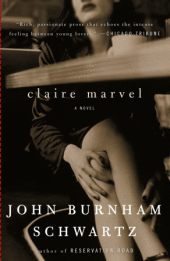
The book is narrated by Julian Rose, a grad student at Harvard who meets and falls immediately in love with Claire Marvel during a rainstorm. The book traces their relationship through all the requisite romantic obstacles and I suppose I can fairly say that the only thing that prevents this book from being totally been there, done that is the quality of Schwartz’s prose.

As Julian chases and abandons and chases and abandons the love of his life, we are never really certain of her and, in fact, even though the book is named after her– we really come to know very little about Claire as a person.

Members of my book club loved this book…but I found it somehow unsatisfying.

The Attack by Yasmina Khadra

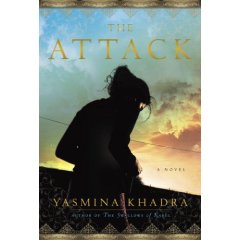
Yasmina Khadra’s novel The Attack set off a firestorm of debate at book club. The novel follows the journey of Muslim surgeon Amin Jaafari, a naturalized citizen of Tel Aviv. He shares his life with the love of his life, Sihem. It isn’t giving anything away to say that Amin’s wife turns out to be a suicide bomber, detonating herself in the middle of a restaurant filled with school children. The novel then follows Amin’s journey from denial and disbelief to acceptance, if not of his wife’s actions then at least of the motivation behind the attack.

I didn’t like the book. The problem for me is that the character of Sihem is never humanzied. She is “the creature I loved most in the world.” Anything we learn about her, we learn through the eyes of the extremists with whom she had aligned herself behind her husband’s back. He doesn’t understand and neither did I. Mostly I felt as though I was getting a lecture about the very messy and complicated and, clearly, emotional landscape of the Middle East.

Still, the book led to a great, and often heated, discussion– if that’s your thing.

The Memory Keeper’s Daughter by Kim Edwards

Everyone is raving about Kim Edwards’ book, The Memory Keeper’s Daughter. The Library Journal said “first time novelist Edwards  has written a heart-wrenching book, by turns light and dark, literary and suspenseful. A natural for book discussions groups; recommended.”

The Memory Keeper’s Daughter follows the lives of Dr. David Henry and his wife Norah at the beginning of their married lives. It is 1964 and Norah is pregnant. She delivers twins, a boy first and then a girl with Down syndrome. David makes the decision to keep the little girl a secret, handing her to his nurse, Caroline, with instructions to take her to an institution– not an uncommon thing for the time when babies born with Down weren’t expected to live long or healthy lives. This decision shapes all the characters in the book in unexpected and complicated ways.

I didn’t like the book, but I was in the minority when we discussed it at book club. The characters– all of them– are chilly people and it was very hard to find their emotional center. But not everyone agreed with me. Most of the women in my group felt enormously sorry for Norah, who didn’t have a chance to say goodbye to her daughter and who suffered enormously because of the secret her husband kept from her. The guilt of his decision haunted and shaped David, who already had some serious issues. Their marriage was irreparably damaged; Norah’s relationship with her son, Paul, was tentative.

The book was easily 100 pages too long.

Still, many people will love this book. Just not me.