
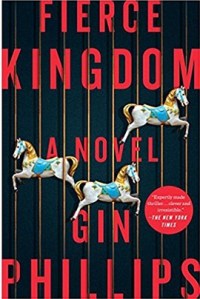
 Joan and her four-year-old son Lincoln are enjoying a late afternoon in the zoo when Gin Phillip’s novel Fierce Kingdom begins. It’s almost five o’clock and they are in the Dinosaur Discovery Pit playing with Lincoln’s menagerie of action figure heroes and villains.
She and Lincoln come here sometimes after she picks him up from school – they alternate between the zoo and the library and the parks and the science museum – and she steers him to the woods when she can. Here there are crickets, or something that sounds like crickets, and birds calling and leaves rustling but no human sounds except for Lincoln calling out his dialogue.
With only a few moments left before the zoo closes, Joan and Lincoln make their way to the exit. Joan has a moment of prescience when she imagines “camping in the zoo overnight, maybe even intentionally hiding back there, going to visit the animals in the pitch-black of midnight.” They are almost at the exit when Joan notices the bodies (at first she thinks they are toppled over scarecrows, but no…) and the man in dark clothes, carrying a rifle. Joan grabs Lincoln and they run. For the next three hours the pair are trapped in the zoo with armed men intent on killing them – and anyone else they find.
The scariest thing about Fierce Kingdom is probably that in the current climate it’s not such a far-fetched premise that innocent people are gunned down in what is supposed to be a safe place. I live in Canada and we don’t have the same love affair with our firearms as Americans do, but even so, it’s hard not to be paranoid about being at the wrong place at the wrong time. Joan might have taken Lincoln to any one of their regular spots – but today they are at the zoo.
Joan’s number one priority is to get them to safety and for a big chunk of the novel they hide out in an old porcupine enclosure “deep in the twists and turns of the primate house. It does not look fit for humans, and that is what strikes her as perfect about it.” Everything Joan does, every decision she makes, is about protecting Lincoln, and her ingenuity and bravery will likely strike a chord with anyone who has kids. Well, with anyone, really, who has a desire to live.
Phillips keeps the focus – for the most part – on Joan and Lincoln, but she does introduce a handful of other characters (Kailynne, a teenager who works in a concession stand; Margaret Powell, an older school teacher; Robby Montgomery, a young man with a connection to the shooters), which keeps the narrative from being too insular.
As Joan works to keep Lincoln safe, she ponders the peculiarities of motherhood…the myriad of ways that harm might come to our children. As any parent knows, you can’t think about that stuff or you’ll go crazy; you’d never let your children leave the house.
Fierce Kingdom is a book about what it means to be a parent wrapped up in a page-turning thriller.
 There’s no arguing with the fact that Ian McEwan is an astoundingly good writer. I have read enough of his books over the years to know that I like him, even when he’s hard work. (I have read
  Back when Stephen King was writing a column for Entertainment Weekly, he recommended Sandra Brown’s novel Hello, Darkness as a must-read book for that year. It was part of a Top Ten list and I thought, okay, I’ll give it a go. I bought it; I read it, and I was sort of ‘meh’ about the whole thing. Thus, when Brown’s newest suspense thriller Seeing Red was chosen as the first selection for my book club’s 2017-18 year I was not overly excited. Perhaps it’s unfair, but after reading only one book I sort of considered Brown a grocery store author….not that that means anything really: she’s written 68 novels, sold 80 million copies and been on the New York Times Bestseller list 30 times.
 Not a Sound is a straight-up mystery and while it was easy enough to turn the pages – I didn’t particularly enjoy reading the story because…well, mostly for a whole lot of niggly reasons.
 deftly that you hardly notice the machinations. Her novel Commonwealth, the story of the intersecting lives of two families, might have crashed and burned in less talented hands, but Patchett moves these people backwards and forwards in time without seeming to break a sweat.
 Their lives intersect when Louise meets David at a bar and they share a ‘moment’ and then she discovers he’s her new boss and then she bumps into Adele (literally) in the street. Louise is charmed by Adele who seems wholly glamorous and somehow innocent. Adele takes Louise on as a project, encouraging her to quit smoking and join the gym. Soon the women are sharing a close friendship which is complicated by the fact that Louise is in love with David and pretty soon the two have moved from the ‘moment’ to a full-on relationship.
 I have been in a bit of a reading slump this year – which seems like a ridiculous thing to say considering we are only two months in. The first couple of books I read at the start of 2017 were lackluster at best, and I just haven’t been able to find my reading groove. Peter Swanson’s The Kind Worth Killing may have actually changed all that.
 didn’t like it, I would normally just donate it to goodwill. Zoe Whittall’s The Best Kind of People comes with Heather Reisman’s money back guarantee, though. Reisman is the CEO of Indigo, Canada’s largest book retailer. If she endorses a book with her Heather’s Pick sticker and you don’t like it, you can return the book – no questions asked – for a full refund. So, that’s where The Best Kind of People is going.
 her best friend, Eli. She and Eli are students in Colorado and one stormy night they attend a party and Charlie is there, too, his flight delayed because of the storm.
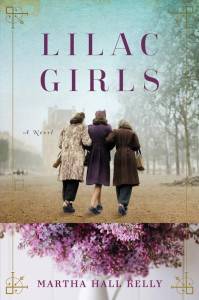 Kelly’s novel tells the story of three very different women: New York socialite Caroline Ferriday, Polish teenager, Kasia Kuzmerick and German doctor Herta Oberheuser. It is 1939 and the one thing these women have in common is Adolf Hitler.
 The Ludic Reader