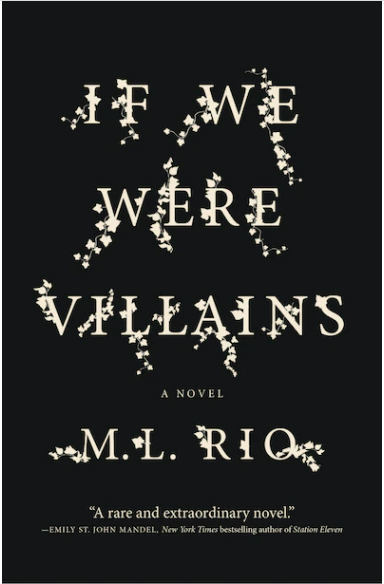
If We Were Villains – M.L. Rio

I would put M.L. Rio’s 2017 debut If We Were Villains in the ‘dark academia’ category. For me, that’s a book about students in a sort of gothic university setting where dark deeds are done. Donna Tartt probably deserves the credit for writing the quintessential novel in this milieu, The Secret History, a book I read when it first came out and intend to re-read this summer because I recommend it all the time, but have very little memory of the book’s details.

When If We Were Villains begins, Oliver Marks is just being released after spending ten years in prison. He makes a deal with Joseph Colborne, the detective who arrested him but never really believed he was guilty, to finally tell the story of what really happened at Dellecher Classical Conservatory in Broadwater, Illinois, where Oliver had been one of the seniors in the acting department.

There were seven of us then, seven bright young things with wide precious futures ahead of us, though we saw no further than the books in front of our faces. We were always surrounded by books and words and poetry. all the fierce passions of the world bound in leather and vellum.

Dellecher is a weird, isolated school – kind of a given in books of this type. The seven main characters live together in “what was whimsically called the Castle.” They are as eclectic a bunch as you’d expect acting students to be; almost every type you could imagine is represented. They are serious ‘actors’ and at Dellecher, the only playwright they ever study is Shakespeare. Indeed, the seven of them often converse with each other using only words written by the Bard. A Shakespeare scholar might be able to parse the significance of the lines that are spoken; I felt lucky to merely recognize some of them.

Oliver unspools the story of what happened at Dellecher and, in doing so, reveals the dark underbelly of friendship, jealousy, violence, and love that simmers beneath the surface of this close-knit (proximity, not affection necessarily) troupe of players. I can’t say they were a particularly likeable group, but I guess that doesn’t really matter. They’re actors, and by definition we can’t really know who they are beneath the stage make-up. That works in the novel’s favour, really, because when the crime for which Oliver is later incarcerated is committed, the players (let’s call them that instead of friends) have to put on the greatest performance of their lives.

I enjoyed this novel, but I wouldn’t call it a page-turner. It requires something of its readers: attention must be paid. It is structured in five acts, the ending is ambiguous (although I have my suspicions) and, like any great play, it gave me a lot to think about.

Well worth your time.

One True Loves – Taylor Jenkins Reid

So I will preface my thoughts about Taylor Jenkins Reid’s 2016 novel One True Loves by saying that Daisy Jones & the Six was one of my favourite reads last year. It had all the things: humour, nostalgia, angst. It was my first book by Jenkins Reid and so I knew I would be dipping into her back list and that is how I ended up with a copy of One True Loves.

One True Loves sounded totally like my jam because there is nothing I like more than people who love each other but can’t be together (Buffy/Angel, Sid/Vaughn after Vaughn thinks Sid is dead and marries she who will not be named). In this story, Emma Blair lives with her older sister, Marie, and their parents in Acton, Massachusetts where they own a bookstore called Blair Books.

One day at a swim meet, Emma sees Jesse Lerner, high school swimming star and the boy Emma develops a crush on that lasts until the night at a senior year party where they finally speak to each other. The connection is instant and before you can say “I love you”, they are actually saying “I love you.” And that’s pretty much my problem with the entire book.

Fast forward several years and Jesse and Emma have settled — after years of traveling the world — in Los Angeles. Emma is a travel writer; Jesse works as a production assistant on wildlife documentaries. Then, just before their one year anniversary, Jesse takes a job in Alaska and the helicopter he is on crashes.

Emma’s grief is all consuming. She demonstrates this by climbing up onto her roof with a pair of binoculars to watch the sliver of ocean she can see, sure that she will see Jesse trying to make it home to her. Eventually, though, she decides to return to Acton and takes a job at Blair Books, something she swore she would never do. Then, she runs into Sam Kemper, the other boy from high school whom she’d friend-zoned. Suddenly she has feelings for Sam. I say suddenly because all the relationships in this novel are sudden and soul-mate deep. The pronouncements would be so much more effective if I actually felt as though I got to know any of these characters on anything more than a superficial level.

We don’t see Jesse and Emma struggle. We don’t see any of their travels or any of their growing up. They come face to face at a party in their senior year, then they hide in the bushes when the cops come to bust it up and then they are revealing their innermost selves to each other — and I get it, sometimes chemistry just knocks the wind out of you. Emma explains her feelings like this:

I was madly in love with him and had been for as long as I could remember. We had a deep meaningful history together. It was Jesse who had held my hand when my parents were furious to find out I’d never sent my application to the University of Massachusetts, and in doing so, had forced their hand to send me to California. It was Jesse who supported me when they asked me to move home after we graduated, Jesse who dried my tears when my father was heartbroken that I would not come home to help run the store. And it was also Jesse who helped me remain confident that, eventually, my parents and I would see eye-to-eye again one day.

The boy that I first saw that day at the swimming pool had turned into an honorable and kind man. He opened doors for me. He bought me a Diet Coke and Ben & Jerry’s Chunky Monkey when I had a bad day. He took photos of all the places he’d been, all the places he and I had been together, and decorated our home with them.

And this is the problem with One True Loves: it’s all tell. I never felt invested in these characters and their story because I never really spent any time with them. They are all nice people, but the tension which should develop when Jesse is returned from the dead (not a spoiler, the book blurb tells you) never actually materializes. By this time, Emma and Sam have met, fallen in love and are engaged. What’s a girl to do?

Nice guy Sam is teary-eyed, but stoic about this situation, but he loves Emma and her happiness is all that matters to him. There’s no real angst here because Emma’s feelings for both of these handsome, kind, lovely men (c’mon, really?!) are kinda equal. Like, toss a coin equal. There’s no downside to ending up with either of them.

One True Loves is easy to read, but utterly forgettable. It does not, however, put me off Jenkins Reid. I have Malibu Rising on my bedside table and I am very much looking forward to it.

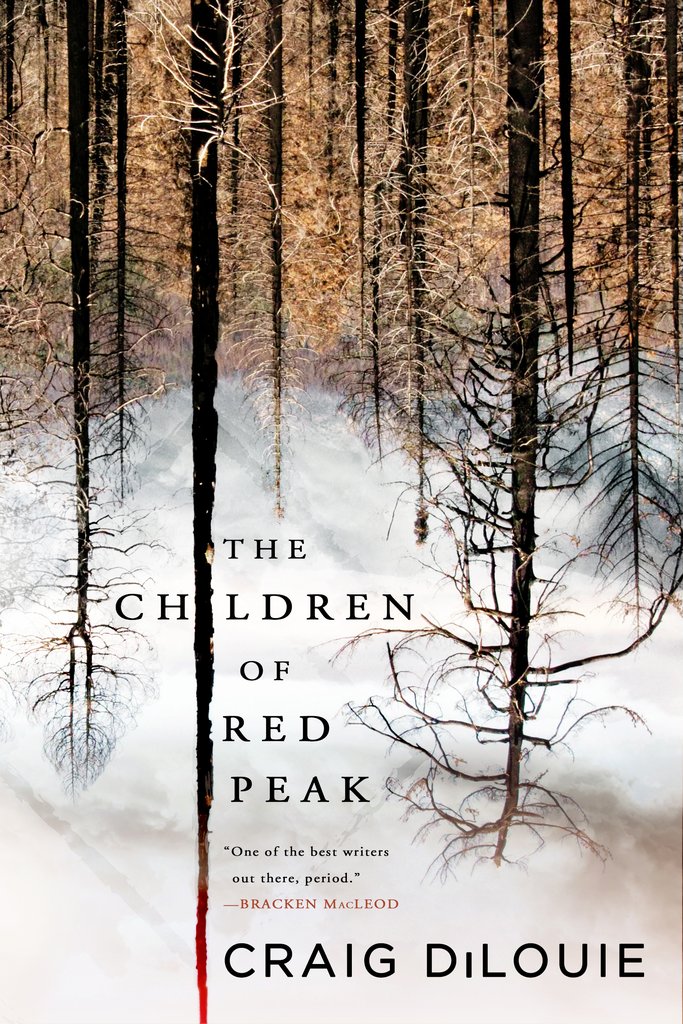
The Children of Red Peak – Craig DiLouie

Despite the assertions that Craig DiLouie’s novel The Children of Red Peak is a “genuinely unsettling psychological horror novel” and “a chilling tale of horror”, I wouldn’t call this book horror or even psychological suspense. It’s really more a family drama, a story of the after effects of trauma. Make no mistake, though, the trauma is real.

Deacon, Beth and David have reunited to attend the funeral of their childhood friend, Emily, who has taken her own life. These four, along with David’s older sister, Angela, were the only survivors of a terrible mass suicide which took place on Red Peak. But before Red Peak, there was Tehachapi, which is where David and Angela’s mother takes them after her husband leaves them because “Everybody at the community lives in harmony with each other and God. I want to be surrounded by people who love me no matter what and won’t hurt me just because they can.”

Sounds ideal, which is the appeal of most cults, I guess. Angela and David are skeptical, but David eventually settles into life in the valley where isolation from society, and a steady diet of hard work, fresh air and religious doctrine from the leader of the Family of the Living Spirit, Jeremiah Peale, slowly wins him over.

The Reverend founded the Family after the 9/11 attacks, which he interpreted as a sign. History was coming to an end, and Jesus was on his way back after being gone two thousand years. He didn’t know the exact time and date of Christ’s return, only that he was certain it would happen. After all, Jesus had promised he’d come back, it said so right in the Bible, and the Bible never lied.

DiLouie wisely flips between past and present, and in doing so strings out the mystery of what happened to the Family. We see the bond forged by the main characters when they were kids and we see what their lives have become as adults (Deacon is a musician who writes his trauma into his songs; Beth is a psychologist; David helps people exit cults; Angela is a cop). It is apparent though that these adults all suffer from PTSD, which they cope with by either starting their day with a glass of Cab Sav or ignoring their past completely. Emily’s suicide, though, necessitates a return to the time and place where all was lost.

Cults are fascinating, and the Family is no different. It’s a doomsday cult and when Jeremiah visits Red Peak and comes back to the valley with news that the end is nigh, his followers are excited at the prospect of eternal life. This is what they’ve been longing for. I think the novel does a good job of examining the religious doctrine and hysteria that might cause this wholesale belief in an afterlife. I did think that there might be something else going on at Red Peak that was never really explored, and so for that reason I found the novel’s dénouement sort of anti-climactic.

So, while not a horror novel and not – for me at least – scary, I still found The Children of Red Peak a quick and interesting read with characters I did care about.

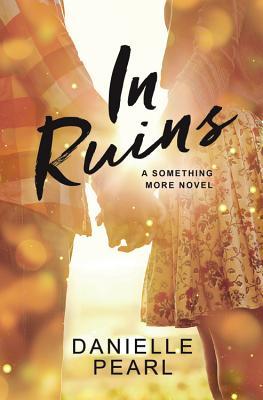
In Ruins – Danielle Pearl

Carleigh (Carl) and Tucker have been friends since they’ve been kids. Then they fell in love. Now they’re barely speaking. This is the narrative of Danielle Pearl’s New Adult (but we’ll talk about that later) novel In Ruins. Told in the voices of both Carl and Tuck, the novel unravels scenes from the pair’s childhood, their tentative relationship, and their love story, but it leaves the details of their breakup — something big, something Carl feels she’ll never be forgiven for — until near the end.

The story begins when Carl starts her first year of college. Carl is feeling unsettled about being at school, mostly because Tuck is also there (on a lacrosse scholarship – I guess lacrosse is cool in the States) and their relationship had “implode[d] before summer was out.” Now, when she should be excited about her classes, and the parties and being away from her mother, Carl is walking “on eggshells, because Tucker knows my secret. He hates me for it, and he should.”

Tucker, for his part, is

angry that she’s here. I’m angry that she’s not who I thought she was. I’m angry that she’s beautiful, and that my teammates have already noticed her. I’m angry that she ran out of that bar alone last night when she should fucking know better. I’m angry that she still affects me – that my dick doesn’t seem to care whether or not she’s a conniving little liar.

Carl and Tuck are hoping to avoid each other, but they end up in the same Marketing class and before you can say “of course they do” they end up working on a group project. Their feelings are complicated and try as they might to bury them deep, it’s just not possible. But that’s how these stories work, right? And I think, overall, Pearl does a good job of stringing us along, even though we know the “will they won’t they” will ultimately be “of course they will”. There’s lots of other stuff happening here, too: family drama, absent parents, and even some fast-paced intrigue near the end. Overall, I did enjoy reading In Ruins and found it to be well-written and, on the Scoville scale of hotness, it’s about Trinidad Scorpion Butch T hot. I might have rated it higher except….I didn’t believe any of the sex scenes.

I was eighteen about a million years ago – but eighteen-year-old boys like Tucker did NOT exist. I teach high school. There are zero Tucks. There are zero Carleighs, for that matter. Tuck is a gigolo-grade eighteen year old. He’s physically perfect (although I could have done with a little less of his army green eyes), but we sort of expect an idealized version of our main characters in this kind of story. The things I couldn’t get past were the dirty talk and just Tuck’s general skill, which is porn-star amazing. I suppose this book counts as NA because of the age of the characters and the fact that it is set in college, but I wouldn’t put it in my classroom library, mostly because I don’t want to give teenage girls unrealistic expectations about what sex is like. There is also so much swearing. It’s irksome. I like a well-placed F bomb, too, but geesh.

Neverthless, if I was going to suggest a quick, decently written, smutty book to read In Ruins would probably fit the bill. It’s far better (by a country mile) than Corrupt.

The Perfect Liar – Thomas Christopher Greene

Max W. and Susannah meet at a fancy art party in New York City. They are drawn to each other almost immediately and soon after, they are married. Now they live in Vermont where Max has taken a job as a lecturer at a small liberal arts college. One morning, while Max is away giving a lecture at an art institute in Chicago, Susannah discovers a note pinned to their front door:

I KNOW WHO YOU ARE.

Thomas Christopher Green’s (The Headmaster’s Wife, Envious Moon) The Perfect Liar is the perfect book for a rainy afternoon because you can read it pretty much in one sitting. It won’t take you long to realize that you are dealing with a couple of unreliable narrators – my favourite kind of narrator – and that’s what makes this book so much fun.

Max has reinvented himself from runaway/vagabond – to artist – to viral TedTalk phenom. He’s pretty forthcoming about the details of his life and he also knows that “he had the gift to read people. He imagined he could often tell what they desired even before he knew it themselves.” He knows how to hold a room, so he’s soon a sought after speaker at art institutes and corporate functions.

Susannah was widowed young and is the mother of one son, Freddy, now sixteen. Her former husband was her therapist first and despite the obvious conflict of interest, she continued to see him professionally even after they were married. Joseph was twenty years older than her with a “voice calming like a metronome. Susannah loved his voice and she loved how he used words. She couldn’t get enough of his voice. Just the sound of it was enough for her to feel at ease, to stop being aware of her heart.”

Susannah suffers from extreme panic attacks and anxiety, and being in Vermont seems to be helping – until she finds the first note. Then this perfect life she seems to have found starts to unravel. And Max, too, seems unsettled by the note…and the notes that follow.

Greene does a great job of moving the narrative along and giving you lots of opportunities to shift allegiances. I’m not sure I would go so far as to say that either Max or Susannah are particularly sympathetic, but that doesn’t really matter at the end of the day. I don’t want to spoil any of the novel’s several surprises, so I’ll just say The Perfect Liar is the perfect book for your beach bag.

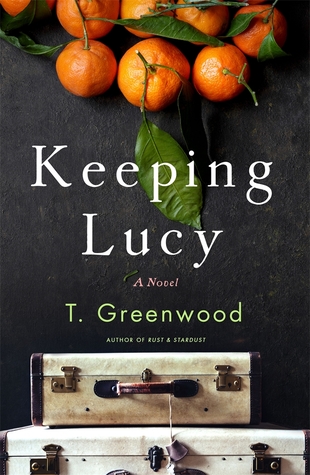
Keeping Lucy – T. Greenwood

Keeping Lucy by T. Greenwood is not the sort of book I would have ever picked on my own to read. Apparently it was inspired by “incredible true events” and while I don’t doubt the novel’s sincerity, there were just too many schmaltzy or wtf moments for me to invest in any of the characters.

Ginny Richardson and her husband Abbott (Ab because he father is Abbott, too) have just welcomed their second child into the world, a daughter they call Lucy. After the delivery, Ginny is told that Lucy has a “condition [that] comes with many, many challenges” including “Heart defects, hearing and vision problems, Thyroid malfunctions.” Ginny is informed that

She’s mongoloid. Which means severe mental retardation. She’ll be feeble-minded, no more intelligent than a dog. The hardship she will bring to your family – women never realize the impact that raising an imbecile has on a marriage. On the other children. You must think of your son.

Okay, sure, it’s 1969, but it’s as if Ginny has no agency of her own. By the time she recovers from giving birth, Lucy has been sent to Willowridge, a “special” school where her particular problems can be looked after. The party line is that Lucy died during delivery and no one but her closest friend, Marsha, her mother and her in-laws know the truth. Ginny returns to her life as mom to her son and wife to her lawyer husband and long days of deciding what to serve for dinner and making sure the house is sparkling when Ab gets home.

Then, two years after Lucy is born, Marsha drops a bombshell. There’s been an exposé about Willowridge. The reporter visited the facility undercover and discovered

the bathrooms without stalls. The sleeping quarters’ walls smeared with human waste. The kitchen with its cockroaches. As she read about the vats of slop meant to pass as sustenance, as food, her stomach turned. […] Broken elevators filled with dirty laundry. Sewage spills. And the children. God, the children huddled into corners. Alone.

Although Ginny has never once visited her daughter, passive enough to believe her husband when he tells her that Lucy is better off where she is, she is mortified by these articles and she insists that Ab do something. Ab can’t though because his father is representing the school in several class action law suits. Ginny decides, with Marsha’s help, to go see for herself. What she discovers is so appalling that she kidnaps Lucy and they, along with her son Peyton, now six, and Marsha head to Florida to try to come up with a plan.

I know that we are supposed to admire Ginny’s maternal instincts and her overwhelming desire to rescue Lucy from what are clearly deplorable conditions, but I just kept shaking my head. You know how sometimes things take you out of a story – there were several instances of that in this book. For example, they stop for food and Ginny buys hamburgers and milkshakes for her children. Her two year daughter who has Down syndrome and has been institutionalized since birth is going to chow down on a McDouble and a shake? Say what? When they stop at Marsha’s aunt’s house for the night, it is described first as “a big farmhouse with plenty of rooms” and when they drive up the driveway suddenly it’s “a small cabin”, which she’d built herself. Stuff like this drives me crazy and I notice it a lot more when I am not invested in the book.

My brothers and I were all born in the 60s. I can’t imagine my mother ever letting any one of us be taken away and placed in an institution. I know things were different, I get it, but Ginny was such a frustrating character to me. When she and Ab meet they have such big plans and suddenly Ab is working for his dad and Ginny is relegated to the role of haus frau. depending on the allowance Ab gives her to run the household. She doesn’t drive; she doesn’t know how to use a credit card; she seems as innocent of the world as Lucy. Except it doesn’t take long for Lucy to be learning words and calling Ginny “momma”.

Keeping Lucy is treacle-y sweet and, while it was easy to read, I just didn’t like it.

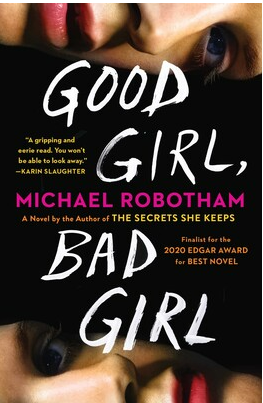
Good Girl, Bad Girl – Michael Robotham

I was expecting great things from Michael Robotham’s novel Good Girl, Bad Girl, which was a 2020 finalist for the Edgar, and named Best Thriller of the Year by both Kirkus and Publishers Weekly.

Cyrus Haven is a psychologist who has been called in to determine whether or not Evie Cormac should be allowed to leave the secure children’s home where she has been living ever since she was discovered hiding in a secret room in a house where a rotting corpse is found six years previous. Very little is known about Evie – not her real name or her exact age or what happened to her because she either can’t remember or she isn’t willing to disclose the information. It’s Haven’s job to figure out whether Evie is a danger to herself or society.

As if that wouldn’t keep Haven busy enough, when the body of a teenage girl is discovered on a footpath by a woman walking her dog, his help is needed to determine who is potentially withholding info. The lead detective on the case, Lenny Parvel, is important to Haven because she was “the first police officer on the scene when [his] parents and sisters were murdered.” So, yeah, Haven has some issues of his own.

So, as he works this case and tries to get to the bottom of Evie’s trauma and shove his own PTSD to the back, you can imagine – it all gets to be a little complicated. Is Haven up to the task? Well, it would appear so. Things get even more convoluted when Evie is released and goes to live with Haven. I can’t imagine that that is a thing that could ever really happen, but it does.

My problem with Good Girl, Bad Girl is that I felt like I never really understood these characters. For example, we never do learn who Evie is or why she was hiding in a secret room, or who the dead guy was beyond his name. That’s apparently going to be revealed in the novel’s sequel When She Was Good, which I won’t be reading. Haven’s own family tragedy is also never really explored. It’s a horrific crime, perpetrated by Haven’s older brother, who is now in a facility for the criminally insane. And although we do discover what happens to Jodie Sheehan, the girl found on the footpath, it’s not that thrilling of a mystery. Evie inserts herself into the investigation in a wholly unrealistic way, too. I kinda got the feeling that Haven was a crap psychologist – which is sort of awkward because I think we’re supposed to be rooting for him. And Evie. And I just didn’t care about either of them. Maybe if the book had focused on just one of these stories and dedicated its energy in making these characters into flesh and blood people things might have turned out differently, but when Evie turns out to be a card shark, wins thousands of pounds at a game she happens to know about, then gets robbed and ends up in the trunk of a car – well, how much are we supposed to believe can happen to one person and not have them be a raving lunatic?

It was a miss for me.

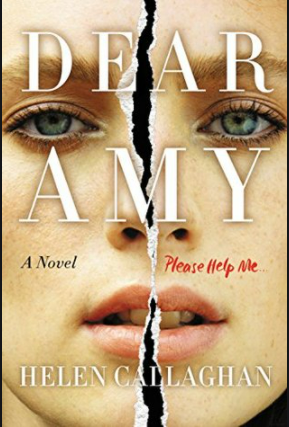
Dear Amy – Helen Callaghan

Helen Callaghan’s debut novel Dear Amy is pretty dang good. It seems like thrillers are a dime a dozen these days, but Callaghan’s story is well-written, and has some twists that readers might not see coming.

Margot Lewis teaches Classics at a prestigious high school in Cambridge, England. She’s a good teacher and she loves her job. In her spare time, she answers letters for The Cambridge Examiner, a sort of agony aunt deal. Her life is falling apart, though – her husband has left her and they are on the precipice of divorce.

One day Margot gets a letter from a girl named Bethan Avery begging for help. The letter claims that the writer is being held prisoner in a basement by a strange man who promises he will never let her go. At first Margot thinks it’s a prank, but the coincidence is too striking. Just a few weeks ago, Katie Browne, a girl who attends Margot’s school, though not one of her students, had gone missing. Margot takes the letter to the police, but they aren’t really interested. Bethan Avery is a real person, but she’d disappeared 20 years ago and the case had gone cold. It isn’t until a second letter turns up that the authorities start to take an interest; well, not the police exactly, but a man named Martin Forrester, a “senior criminologist in the Multi-Disciplinary Historical Analysis Team.” Leave it to the Brits to come up with a complicated way of describing cold cases.

Martin, he of the long hair and dreamy green eyes and bulging muscles, tells Margot that Bethan Avery is not the first girl from the area to have disappeared. Now, despite the twenty years separating Bethan’s disappearance from Katie’s, Martin believes that the two cases are linked, and that there may be others. Martin is suspicious of the letters Margot has received, but Margot is desperate to believe that Bethan is still out there and it may be possible to save her and, if the cases are indeed connected, Katie, too.

Although there were a few instances of “oh, no, you didn’t” in the novel, and although Margot is sometimes shrill and hysterical, I still really enjoyed this novel. Margot’s is not the only voice throughout. At the beginning, we meet Katie, who has just had another dust-up (as sixteen-year-olds are prone to) with her mother and step-father, and she has decided to slip out and head over to her father’s. That decision doesn’t end well. We also meet Chris, the creepy pedophile; the less time spent with him the better. There’s nothing graphic in the book, but let’s face it, our imaginations are more than equal to the task of knowing what Chris is up to.

In any case, if you like thrillers, this one is an enjoyable read.

A Rip in Heaven – Jeanine Cummins

It was only a few months ago that I read Jeanine Cummins’s American Dirt, a novel that, though not without controversy, I could not put down. I had the same experience with her memoir/true crime A Rip in Heaven. I was about 40 pages along when I settled in to read the other night and I finally had to turn off my light at 2 a.m. It was a school night and that’s way past light’s out for me, but I just couldn’t stop reading it.

In 1991, 16-year-old Cummins, her younger sister, Kathy, 14, and older brother, Tom, 18, are vacationing in St. Louis with their parents. Both sides of the family are there, so the siblings have lots of cousins to hang with and it’s a happy time. Tom, in particular, has developed a close bond with his cousins, Julie and Robin, and on his last night in town, he sneaks out to visit the Old Chain of Rocks Bridge, where Julie, an aspiring poet, has left some of her poetry by way of graffiti. Mostly the cousins don’t want their time together to end.

Although it was never officially accredited as a landmark, the Old Chain of Rocks Bridge was widely recognized as one, and the city of Madison was loathe to have it torn down. A couple of decades came and went while the old bridge stood silently straddling the Mississippi and gathering rust. […] Local affection for the bridge, combined with the enormous price tag of demolishing it, kept it standing. By 1991 the bridge, though structurally sound, was in a terrible state of disrepair, and it had become a favorite local hangout for teenagers and graffiti artists from both banks.

It is on this bridge, sometime after midnight, that the trio encounter 23-year-old Marlin Gray, a smooth-talking, good looking, layabout; Daniel Winfrey, “an awkward scrawny kid,”; Reginald Clemons, “a shy, and quiet man of nineteen” and Antonio Richardson, Clemons’s cousin, who was “just plain bad news.” At first these four seem relatively benign to the cousins, but it doesn’t take long for things to take an horrific turn. Tom and his cousins end up in the Mississippi; Tom is the only survivor.

The actual crime is so mindless and so awful, it’s almost hard to believe. It turns out, that’s part of the problem for Tom. When he is finally able to get help, the cops don’t believe his story. The cops employee ever dirty tactic in the book to get him to admit to their version of events and he is finally arrested and charged with two counts of first degree murder.

Cummins writes A Rip in Heaven in the third person, adopting her childhood nickname, Tink, as a way to somewhat distance herself from this story, which is both devastating, and riveting. Like I said, I couldn’t put the book down and had to force myself to turn the light out so I wouldn’t be a hot mess at school the next day. The book follows Tom’s time in police custody and the subsequent trials, which Cummins has pieced together from court documents, police records and interviews. It is also a plea that we not forget the victims in cases such as these. Cummins acknowledges that “As a society, we have a certain fascination with murder and violence. […] We want to know why atrocities happen; we want to understand the causes of wickedness.” But as Cummins points out, “The dead can’t tell their own stories,” so often the perpetrators of the crimes find themselves at the center of attention. This was also the case for the four young men involved in this case.

By all accounts, Julie and Robin were amazing young women, and their deaths left a hole in the lives of all those who loved them: a rip in heaven. Cummins has managed to capture the trauma, the drama, and the way this family banded together to survive it. It makes for compelling reading.

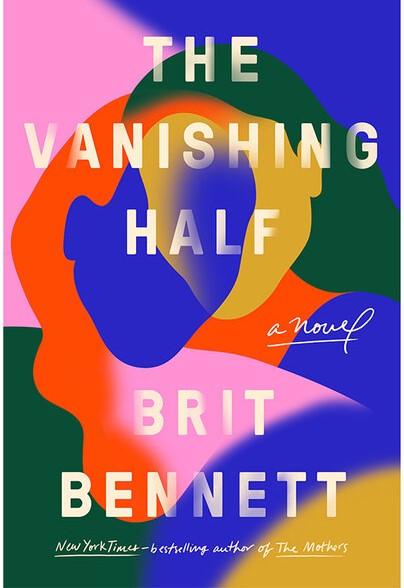
The Vanishing Half – Brit Bennett

Brit Bennett’s novel The Vanishing Half tells the story of twin sisters Desiree and Stella Vignes, who run away from their small-town home at sixteen. Mallard, Louisiana is “more idea than place.” Founded in 1848 by a man “who would never be accepted as white but refused to be treated like Negroes”, Mallard seems to pride itself on breeding generations who are “lighter than the one before.” That’s how one of the twins is able, and makes the decision, to pass as white, and thus enters a world that, in the mid 1950s, she wouldn’t normally be allowed to inhabit.

At first the sisters head to New Orleans, where they hope they will be able to fulfill their dreams which had been “trapped by [Mallard’s] smallness.” Stella, the practical one, is studious and dreams of a bigger life. Desiree “imagined herself escaping into the city and becoming an actress.” But then, one day, Stella disappears. It will be many years before the sisters see each other again.

The Vanishing Half begins when Desiree and her young daughter, Jude, arrive back in Mallard fourteen years after she and Stella first ran away. It’s big news in a small town because nobody left Mallard and “nobody married dark”, but Desiree had done both. From here, the novel reaches back to tell the story of the girls’ initial disappearance, their separation and then what becomes of their lives.

Stella’s story is vastly different than her sister’s. She meets Blake Sanders, and marries him and they move to California, where they have a daughter called Kennedy. It isn’t until a black family moves onto their cul de sac that Stella’s past starts to resurface and we begin to see how much she has buried. Blake doesn’t know she’s black. Kennedy doesn’t know her mother has a sister. She passes as white and she lives as white and it seems to make her life both easier and harder.

It isn’t until Jude decides to attend college in Los Angeles and, by chance, sees Stella at an event where she is working as a catering waitress, that the sisters’ stories merge. Fascinated with her violet-eyed, blonde cousin Kennedy, Jude tries to put her mother’s story back together.

I really enjoyed this book. It was easy to read; the characters were interesting and complicated, and although I guess I didn’t really understand Stella’s motivation for keeping her past a secret, for denying she had a twin, I guess the truth of the matter is that we can never really understand someone until we walk in their shoes. I loved Desiree’s childhood sweetheart, Early Jones, who comes back into her life when he is hired by Desiree’s abusive ex-husband to find her. I loved Jude and her boyfriend, Reese.

Families are complicated and the families in Bennett’s novel are no different. Everyone keeps secrets, some more damaging than others. Stella’s secret, of course, is the biggest of all. Stella’s husband, for example, seems to love her unconditionally, but he doesn’t really know her. Stella’s relationship with Kennedy is, especially as Kennedy gets older, tense, but how could it be anything but? Kennedy has questions; Stella has no answers she’s willing to give.

I didn’t finish Bennett’s novel The Mothers, but I have no qualms about recommending this one to readers.