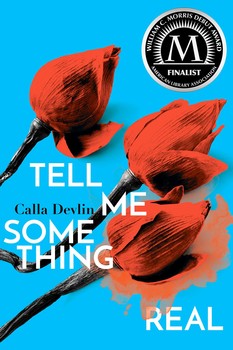
Tell Me Something Real -Calla Devlin

Vanessa Babcock, the protagonist of Calla Devlin’s debut, Tell Me Something Real, is sixteen. She lives with her parents, her older sister, Adrienne, andtell-me-something-real-9781481461160_lg her younger sister, Marie, in San Diego. Their mother, Iris, has leukemia, and Vanessa and her sisters often accompany her to a clinic in Mexico where she is treated with the controversial drug, Laetrile.
…the FDA’s banned Laetrile in the States, [and] a lot of people are coming to Mexico to treat their cancer. Most aren’t as lucky as we are, living in San Diego so close to the border.

Each of the girls have their own quirks. Adrienne is prone to swearing like a sailor. Marie is fascinated with the Catholic saints. Vanessa dreams of attending music school. Their father, an architect, works too much, leaving the care of Iris to his daughters, care that is taking its toll.

On one trip to the clinic Vanessa meets Caleb, a boy just a little older than she is who is also taking Laetrile. When Iris suggests that they open their home to Caleb and his mother, Barb, in an effort to make it easier for Caleb to receive his treatments, it seems like a win-win. Barb cooks real meals, and her sunny disposition improves life for everyone. And then there’s Caleb.

He looks healthy, sunburned, and rosy cheeked like me. It isn’t until he steps through the entryway – away from the protection of the flowers – that I recognize he is one of them.

Caleb becomes Vanessa’s touchstone, until one day he tells Vanessa that he and his mother are going home. Something isn’t right in the Babcock home, but he is reluctant to say just what that something is.

I have mixed feelings about Tell Me Something Real. There’s no arguing that Devlin is a talented writer, even though I didn’t feel like this debut went anyplace particularly special. Vanessa’s first person narrative is compelling enough, but her sisters seem more like a collection of quirky attributes than flesh and blood people. The plot does take an unusual turn, but even that felt somehow contrived.

What I wanted, I guess, was an emotional centre and despite the (melo)drama, Tell Me Something Real just didn’t have a beating heart. I wouldn’t discourage people from reading it, for sure, but it was just only so-so for me.
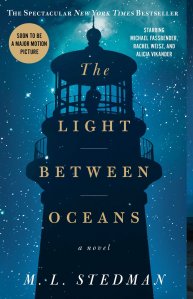
The Light Between Oceans – M.L. Stedman

lightbetweenI feel heartless for saying it – but I didn’t particularly like M.L. Stedman’s first novel The Light Between Oceans. I’ve had the book for a while, but it was last month’s book club pick, so I finally had occasion to read it. [insert long-suffering sigh]
Tom Sherbourne is a quiet man, intent on living a quiet life after having survived WW1. He’s returned to Australia and is about to take up his new post as lighthouse keeper on Janus Rock, an island off the coast of Partaguese on Australia’s western coast.

Teetering on the edge of the continental shelf, Janus was not a popular posting. Though its Grade One hardship rating meant a slightly higher salary, the old hands said it wasn’t worth the money, which was meager all the same.

Tom likes the idea of isolation thinking “If only he can get far enough away – from people, from memory – time will do its job.” It’s the horrors of war, he’s escaping, of course. But also his own childhood: a dead mother, an estranged father, a cold brother.

Just before Tom is about to leave for Janus he meets pretty, young Isabel Graysmark. Eventually the two marry and Isabel moves out to Janus. With a boat coming with supplies only about every six months, the newlyweds are certainly isolated, but they are happy.

Things start to get grim though, as Isabel suffers a series of miscarriages and then, shortly after her third, a small craft drifts into shore and in the boat a dead man and an infant. Isabel takes this as a sign from God, but Tom feels that they need to do the right thing, signal the mainland and report the incident. The decision the couple makes carries them through the rest of the novel.

So what’s not to like, you ask?

Ahhh….the melodrama. There’s boatloads of that. As Tom and Isabel wrestle with the moral, ethical and emotional questions posed by the foundling, their marriage suffers and they suffer personally, too. The constant negotiating got a little on my nerves, I have to say.

But there is another side to the story and that side belongs to the child’s birth parents. The introduction of these new characters is meant to up the emotional ante, and while it did for some of the ladies in my book club, I just felt like we were meant to wallow along with these suffering people and I just couldn’t muster any real feelings. Yes, I felt sympathy. I am a parent and I can only imagine how difficult the whole thing must have been. But to a certain degree I could see the clunky machinations of trying to fit all the pieces together and the swelling, heartfelt conclusion just left me feeling manipulated.

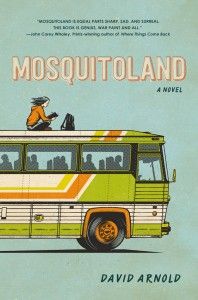
Mosquitoland – David Arnold

Mary Iris Malone, Mim for short, is not okay. Life has thrown her some curve-balls of mosquitolandlate: her parents’ divorce; her father’s quicky marriage to Kathy; their subsequent move from Ashland, Ohio to Jackson, Mississippi. When Mim overhears her father and stepmother talking to the principal, she’s convinced that her biological mother is sick and makes the decision to hop a Greyhound and travel the 947 miles back to Ohio to see her.

This is the premise of David Arnold’s debut novel Mosquitoland , a book which garnered massive praise and stellar reviews when it was published in 2015. I have to say, it’s worthy of all the fuss.

Mim’s journey is both literal, and she meets all-sorts on the bus and beyond, and figurative; this is a journey of self-discovery only a quirky, intelligent and empathetic sixteen-year-old could take.  Mim reveals herself in journal entries addressed to Isabel, and to various passengers, including Arlene, the old lady who sits next to her on the bus. Arlene turns out to be just what Mim needs because “it’s nice to sit that close to someone and not feel the incessant need to talk.”

Then there’s Walt, the boy Mim meets when she ends up getting off the bus. Walt is slightly left of center. He lives in a tent in the woods. “What are you doing?” He asks her  when he finds her asleep under an overpass. “…as a part of big things?”

Walt is a completely endearing character and Mim is “100 percent intrigued” when he says “Do you like shiny things? I have lots of shiny things there. And a pool…You’re a pretty dirty person right now. You could use a pool. Also, there’s ham.”

And then there’s Beck. Mim first notices him on the bus and then in a weird twist of fate, she meets him again at the police station (long story).

He’s older than me, probably early twenties, so it’s not completely out of the question – us getting married and traveling the world over, I mean. Right now, a five-year difference might seem like a lot, but once he’s fifty-four and I’m forty-nine, well shoot, that’s nothing.

There’s a quality about him, something like a movie star but not quite. Like he  could be Hollywood if it weren’t for his humanitarian efforts, or his volunteer work, or his clean conscience, no doubt filled to the brim with truth, integrity, and a heart for the homeless.

There is nothing I didn’t love about Mim or her journey. There is nothing I didn’t love about the other characters she meets – except for Poncho Man. (Obviously.) Mosquitoland has it all: the absurd, the laughs and the feels. It is a beautifully written book about growing up, facing your fears, what family means (both the family you are born with and the family you make) and why it is okay to admit that you are not okay.

Mad love for this book, so of course it is highly recommended.


The Marrow Thieves – Cherie Dimaline

marrowGah! This book, you guys.

Francis, though everyone calls him Frenchie, is on the run from the “recruiters”.  Pretty much every Indigenous person is because their bone marrow holds the key to dreaming, which is something white folks no longer have the ability to do.

“Dreams get caught in the webs woven in your bones. That’s where they live, in that marrow there.”

“You are born with them. Your DNA weaves them into the marrow like spinners….That’s where they pluck them from.”

It’s sometime in the not too distant future and we’ve pretty much wrecked the Earth. Because of course we have. When Cherie Dimaline’s YA novel The Marrow Thieves opens, Frenchie is holed up in a tree house with his older brother, Mitch. But then the recruiters show up, and the boys are separated, and Frenchie finds himself on the run once more.

The characters in The Marrow Thieves are all too aware of their rocky history with the Canadian government, and sharing those stories is part of what keeps them focused on getting to safety, which in this case is north where they hope they will find fresh water and clean air and freedom.  So north is the direction Frenchie heads and it isn’t long before he meets a group of travelers. Frenchie joins this ad hoc family and his adventure begins.

The dystopian nature of this novel is really only the story’s framework. It’s enough to know that these people are considered ‘other’ and useful only for what they can provide to the government. Their current plight mirrors the whole residential school debacle, a part of my country’s history, I am ashamed to admit, I was grossly ignorant of until recently.  Those places were less about assimilation (and even that is abhorrent)  and more about annihilation.

The real story, the heartbeat of Dimaline’s novel, is the characters and their stories – both individually (which they tell in their own ‘Coming-To’ stories) and collectively. Getting to know these people felt like a privilege; I fell in love with them and the way they looked out for each other. I experienced a real fear for their safety and on the few occasions they were rewarded with something good, I felt that, too.

I will not forget these people, their connection to the Earth and each other, for a long time. The Marrow Thieves should be required reading for all Canadians…and, trust me, once you start reading, you won’t want to put it down anyway.

Highly recommended.


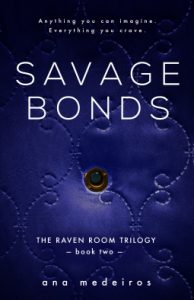
Savage Bonds – Ana Medeiros

Savage-Bonds-cover-194x300Canadian author Ana Medeiros’ The Raven Room Trilogy follows the sexcapades of Dr. Julian Reeve, a child psychologist, and journalism student Meredith Dalton. Sometimes you can jump into a series without having read the first book, but I really felt like I was at a severe disadvantage reading book two in Medeiros’ trilogy. Savage Bonds picks up where The Raven Room leaves off, but for a newbie reader, I literally had no sweet clue what was going on and I never felt as though I was sufficiently caught up.

This is what I do know:

Julian Reeves is addicted to the darker side of sex which, as a card-carrying member of The Raven Club, he has access to. He’s also addicted to drugs. And he has a troubled and complicated past which is somehow connected to Tatiana and Alana. And when Savage Bonds opens he is being questioned by the cops (one of whom just happens to be Meredith’s step-mother, Pam) because Alana is dead and Tatiana is missing.

When another woman with connections to The Raven Room (and Julian) turns up dead, Meredith decides that she needs to investigate. That’s because Julian is Meredith’s lover (or was her lover; they don’t get it on in this book although Meredith gets around and shares Julian’s predilection for rough sex, or at least sex of the non-vanilla variety.)

Many of these relationships seem to have been established in the first book – so it’s really difficult for me to give this book a fair shake considering I spent  lot of time just trying to keep these people straight; I was definitely missing backstory. Although, ultimately, I wonder if backstory would have helped me enjoy this story any more.

I have read a lot of erotica. And a fair amount of BDSM-flavoured erotica…and Savage Bonds didn’t really up the ante. I mean if  The Raven Room is supposed to be this super-sekrit underground club, shouldn’t it be special? A little bloodplay and anonymous blow jobs don’t really scream exclusivity to me. Worse, without the benefit of what came before I just didn’t care about any of these players and all their interactions with each other seemed shrill or forced. Am I supposed to be rooting for Julian because of his troubled past? Am I supposed to be shipping Julian and Meredith?

From what I could tell on the Internet, readers seemed to really enjoy The Raven Room and were quite anxious to read Savage Bonds. A few of them, though, had some of the same issues with this book that I did…and they were invested going in.

So – maybe start with The Raven Room and see how you feel. I won’t be backtracking because, honestly, the whole thing was just meh for me.

Thanks to TLC for the opportunity to review this book.


1,001 Ways to Be Creative – Barbara Ann Kipfer

1001-Ways-to-Be-Creative-cover-300x300Creativity is a funny thing. I look around and see all these people who are tremendously creative. Both of my children are talented artists. My daughter spent many years studying ballet and is a beautiful dancer. Both my children are musical; my son taught himself to play guitar. I have other friends who are artists, painting with words or yarn or fabric or glass or clay. Some put their art on a plate. But I am probably not the only person on the planet who feels like they don’t have a creative bone in their body. I don’t draw or paint. I don’t dance. I can’t sing. The one thing I do like to do is write.  I love to do it and have been doing it for as long as I can remember.
In her book 1,001 Ways to Be Creative,  Barbara Ann Kipfer suggests that creativity “isn’t only about artistic skills; it is a way of seeing the world. It gives you the power to shape your life, unify and balance your interests, and emphasize your uniqueness.”

I love that Kipfer gives readers permission to explore their creativity. Honing it, she suggests, gives you “that inexplicable burst of inspiration that suddenly allows you to see from a new angle or bring something new into existence.” We might call that ‘out-of-the-box’ thinking and its value to every-day problem solving should not be under-estimated.

1,001 Ways to Be Creative offers is a lovely little book that will surely offer inspiration to people like me who probably don’t realize that they are creative (or could be) in a million different ways (or a 1,001) every single day. It’s all in how you look at it.

Kipfer’s suggestions include things like:

356. Ask a stupid question.

429. Look for the unusual in everything you do.

464. Use sealing wax as a dramatic way to end a letter.

494. Change your look for one day.

764. Observe, collect, analyze, and compare patterns.

868. Carve a face in a fruit or vegetable

Kipfer  “speaks to all who seek greater creativity in their lives.”  You can easily start your creative journey with this book.

Thanks to TLC for the opportunity to review this book.

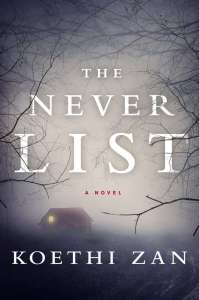
The Never List – Koethi Zan

Never-List-Blog-pictureThe Never List never really got off the ground for me, although the premise had a lot of potential. Koethi Zan’s debut novel is the story of Sarah, a reclusive young woman who is still suffering from the psychological scars of having been held captive by a sadist, Dr. Jack Derber.

There were four of us down there for the first thirty-two months and eleven days of our captivity. And then, very suddenly and without warning, there were three. Even though the fourth person hadn’t made any noise at all in several months, the room got very quiet when she was gone. For a long time after that, we sat in silence, in the dark, wondering which of us would be next in the box.

That was ten years ago. Now Sarah is living a quiet life as Caroline. She’s an actuary in New York City (specifically chosen so that there would always be a lot of people around). Her therapy is at a standstill, she doesn’t have any meaningful relationships (unless you count Jim McCordy, an FBI agent) and she rarely leaves her apartment. Every so often Jack Derber sends Sarah a letter from prison, and it’s the latest letter and the fact that Jack’s parole hearing is coming up that sends Sarah digging into her past.

The novel’s title comes from Sarah and her best friend Jennifer’s ‘never list.’  The two girls, friends since childhood, had compiled a list of all the things they should avoid in order to lead a safe life: “never go to the campus library alone at night, never park more than six spaces from your destination, never trust a stranger with a flat tire. Never, never, never.”

Sarah’s decision to speak at Jack’s parole hearing, even though the thought of facing Jack again fills her with dread, is prompted by her love for Jennifer, who was the girl in the box and whose body was never recovered from Jack’s remote house, where the girls were kept chained in the cellar.

So, the ingredients for a creepy, twisted thriller, are certainly there, but there are lots of things that didn’t work. For one, too many characters and sub plots that just all come together in a rather unsatisfying way in the end. Also, Sarah’s character development was unbelievable. Can the reader really be expected to believe that a woman who is afraid to drive alone in the dark, will actually lead her fellow survivors back to the very place where they’d been held prisoner? Without police? Cue eye roll. And these reserves of strength come out of the blue.

Jack Derber is only seen through the eyes of other characters, so he is never really a threat. Whatever he was doing to those women – none of it is described. I don’t necessarily need to hear all the graphic details – I’ve got a pretty good imagination – but other than ‘the rack’ it’s all pretty vague. Likewise, a trip to a BDSM club is pretty vanilla. And although there is clearly something going on, with Jack Derber still safely behind bars Sarah (and the reader) hardly needs to worry about him.

Some readers will probably be genuinely freaked out by The Never List. For me, it was just okay.

Bear Town – Fredrik Backman

beartownI actually put Fredrik Backman’s novel Beartown in my ‘to donate’ bag before I had reviewed it…and I guess that’s pretty telling. This was a book club selection, and not a book I would have ever chosen to read otherwise, so I guess I was skeptical from the beginning. Beartown made me cranky.
Late one evening toward the end of March, a teenager picked up a double-barreled shotgun, walked into the forest, put the gun to someone else’s forehead, and pulled the trigger.

This is the story of how we got there.

From that relatively interesting beginning, Backman spins a melodramatic tale of a small, isolated town in Sweden. Beartown is a hockey town and I mean a fanatical hockey town. It’s the day before the Beartown Ice Hockey Club plays in the country’s biggest tournament and while that might not seem like a big deal, it’s a huge deal in Beartown.

There’s not much worthy of note around here. But anyone who’s been here knows it’s a hockey town.

Everyone in this novel is connected to hockey.

Amat “sleeps with his skates by his bed every night.”

Maya “hates hockey but understands her father’s love for it.” Her father, Peter, is the hockey club’s general manager. He’s a former NHL hockey player who has returned to his hometown.

Sune is the coach of the A-team. He’s on the verge of being fired by the board even though he’s been with the hockey club forever, even though everyone knows him. He knows that they want to fire him because he tells his players to play from the heart instead of telling them to win.

There’s Kevin, Beartown’s star player. Despite the fact that he’s good enough to play in a bigger town for, perhaps, a better team, he keeps turning down the offers. “He’s a Beartown man, his dad’s a Beartown man, and that may not mean a thing anywhere else, but it means something here.”

Yeah. Okay. We get it. Beartown is a hockey town. And although it’s probably un-Canadian to say – I haven’t cared much about hockey since the days of Wayne Gretzky and Brendan Shanahan. I certainly never cared about it as much as the folks in Beartown do. I certainly have never cared about it enough to read 415 repetitive pages about how characters driven by the desire to win backstab and bully and belittle others. There’s also a crime in the book that divides the town in a way that is wholly unbelievable.

Perhaps something was lost in translation, but for me Beartown was 200 pages too long and peopled with stereotypes. I often felt the novel’s didactic impetus. Pithy nuggets like “We become what we are told we are” and “A long marriage is complicated” are sprinkled throughout and, honestly, made me roll my eyes.

A big no for me.

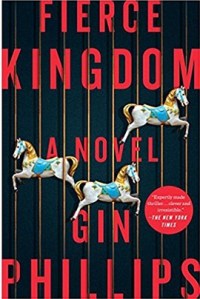
Fierce Kingdom – Gin Phillips

fierceJoan and her four-year-old son Lincoln are enjoying a late afternoon in the zoo when Gin Phillip’s novel Fierce Kingdom begins. It’s almost five o’clock and they are in the Dinosaur Discovery Pit playing with Lincoln’s menagerie of action figure heroes and villains.

She and Lincoln come here sometimes after she picks him up from school – they alternate between the zoo and the library and the parks and the science museum – and she steers him to the woods when she can. Here there are crickets, or something that sounds like crickets, and birds calling and leaves rustling but no human sounds except for Lincoln calling out his dialogue.

With only a few moments left before the zoo closes, Joan and Lincoln make their way to the exit. Joan has a moment of prescience when she imagines “camping in the zoo overnight, maybe even intentionally hiding back there, going to visit the animals in the pitch-black of midnight.” They are almost at the exit when Joan notices the bodies (at first she thinks they are toppled over scarecrows, but no…) and the man in dark clothes, carrying a rifle. Joan grabs Lincoln and they run. For the next three hours the pair are trapped in the zoo with armed men intent on killing them – and anyone else they find.

The scariest thing about Fierce Kingdom is probably that in the current climate it’s not such a far-fetched premise that innocent people are gunned down in what is supposed to be a safe place. I live in Canada and we don’t have the same love affair with our firearms as Americans do, but even so, it’s hard not to be paranoid about being  at the wrong place at the wrong time. Joan might have taken Lincoln to any one of their regular spots – but today they are at the zoo.

Joan’s number one priority is to get them to safety and for a big chunk of the novel they hide out in an old porcupine enclosure “deep in the twists and turns of the primate house. It does not look fit for humans, and that is what strikes her as perfect about it.”  Everything Joan does, every decision she makes, is about protecting Lincoln, and her ingenuity and bravery will likely strike a chord with anyone who has kids. Well, with anyone, really, who has a desire to live.

Phillips keeps the focus  – for the most part – on Joan and Lincoln, but she does introduce a handful of other characters (Kailynne, a teenager who works in a concession stand; Margaret Powell, an older school teacher; Robby Montgomery, a young man with a connection to the shooters), which keeps the narrative from being too insular.

As Joan works to keep Lincoln safe, she ponders the peculiarities of motherhood…the myriad of ways that harm might come to our children. As any parent knows, you can’t think about that stuff or you’ll go crazy; you’d never let your children leave the house.

Fierce Kingdom  is a book about what it means to be a parent wrapped up in a page-turning thriller.

Stronger Than You Know – Jolene Perry

strongerIn  Jolene Perry’s novel Stronger Than You Know, fifteen-year-old Joy Neilsons has come to live with her aunt and uncle after having been removed from the trailer home she was living in with her mother. The Child Services Summary Report  indicates that she wasn’t allowed out of the 750 sq. ft. mobile home, did not attend school and was dehydrated and malnourished when authorities removed her.

Turns out, not having enough to eat or drink was the least of Joy’s problems, and although Perry wisely spares us the graphic details of Joy’s abuse, readers will easily be able to fill in the horrific blanks.

Stronger Than You Know is the story of Joy’s recovery which, as you can imagine, is not without its setbacks. For one thing, Joy hasn’t been properly socialized, so dealing with large groups of people is problematic. Imagine going to school — high school, at that —  for the first time. For another thing, Joy distrusts men, making it difficult for her to be around her uncle, Rob, and her cousin, Trent. Trent’s twin sister, Tara,  is a little easier to cope with, but Joy is still distrustful of this new life she’s been given, a life she knows she doesn’t belong in. Aunt Nicole offers safety and comfort, but the PTSD Joy is experiencing is palpable.

She measures her recovery by listing her accomplishments:

  • Went to school.
  • Ate in the cafeteria.
  • Answered a teacher’s question.
  • Ate a few bites of dinner with the family in the dining room.

All the people in Joy’s new life, even Trent, who initially seems like an asshat (and one could make the argument that he turns the corner with a little too much ease), are warm and loving humans. The boy she meets on the walk to school is patient and understanding when Joy acts peculiarly. Her Uncle Rob is super protective because he’s had some personal experience with trauma. If any characters are under-developed it’s because they are the villains of the piece and it’s easy enough for smart readers to fill in those blanks.

Overall, Stronger Than You Know will speak to any young reader who has had to overcome horrific circumstances in the hopes for a better life. As Joy learns, a better life is waiting.