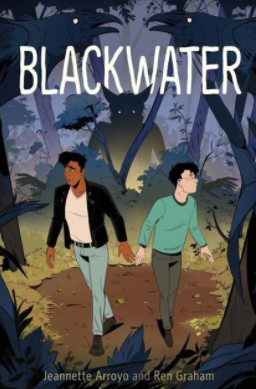
Blackwater, a YA graphic novel, by Jeannette Arroyo and Ren Graham has a lot going for it. First of all, lots of representation including POC, trans, teens with health issues, werewolves, ghosts. Yes, you read that last part right.
Tony is a high school track star with a side of delinquent. Eli is the new kid who misses a lot of time because of an autoimmune disorder. Neither of these boys has the world’s best home life (Tony’s father works a lot and doesn’t seem all that invested in Tony’s life and Eli’s mother just seems completely checked out, perhaps worn down by her son’s health issues.)
A tentative friendship begins to develop between the two boys. Eventually, Tony has to admit that his feelings towards Eli might be something more than “friends.” Then, there’s an incident in the woods and suddenly Tony is dealing with a lot more than just his feelings.
Blackwater is part ghost-story, part high school drama, part m/m romance. I did feel that it was a little top heavy-so the end felt rushed. That said, it’s an hour of your time and it delivers on themes of acceptance, family and friendship.
When Tyler Feder was nineteen, her much-adored mother died of cancer. Feder recounts her relationship with her mother, her mother’s brief illness and death, and the stages of guilt that follow in her beautiful graphic memoir Dancing at the Pity Party.
A mother-daughter relationship is special. I was very close to my mother and felt bereft when she died of lung cancer in 2006. I was 45 and had two young children and a flailing marriage. My mom was always in my corner. I am the oldest of four kids and being the only girl made our relationship extra special. (I know my brothers would all say they had a special relationship with mom — she was that kind of mother.)
Me -in the ugly sweater – with my brothers (L-R) Tom, James and Mark, and my parents Ed and Bobbie circa 1974. My mom did that weird “faux wood” look on the cupboards behind us.
My mom, Bobbie, was a tiny woman – 96 pounds soaking wet – who loved AM radio, instant coffee, really bad white wine, sappy movies, cooking, cheap shoes, and Tai Chi. You only had to meet her once to be considered part of the family. She loved to laugh and didn’t mind being the butt of the joke, and she often was. She made and kept friends easily because she was thoughtful and kind and generous with her time. She was a wonderful grandmother for the short time my children had her in their lives. We lived close enough to each other that my kids could go down to her house on their own from a very young age. She’d drop anything to make cookies or watch a show or go for a walk. Having her so close was handy because I am squeamish and she was a nurse. On more than one occasion she’d come running after I called and said “There’s blood.” She fixed scraped knees, and torn clothes, and broken hearts. She made perfect poached eggs and lasagna and chocolate cake with boiled icing. Following in the tradition of her mother, Sunday dinner was usually at Mom’s. There could be six people or sixteen or twenty-six; it never mattered because she could cook for all of us and never break a sweat. I miss her wise counsel, her steadfastness, and her unwavering support, even when I screwed up.
So, Feder’s memoir about her mother resonated with me. Her mom is carefully rendered, a warm and complete human being with a crazy fixation on eyebrow maintenance, distinctive spiky handwriting and “smiley brown eyes.” Feder herself is the oldest of three girls and, as I well know, being the oldest comes with both perks and hardships. By the time her mom’s health problems announce themselves, her prognosis is dire. Like my mom, Mrs. Feder died very quickly. There is hardly any time to process the illness, let alone the loss.
I found Dancing at the Pity Party to be funny and heart-wrenching in equal measure. Other than the fact that Feder is Jewish and so the customs surrounding grief and mourning are different from my own essentially atheist views, there was little in this memoir that wasn’t familiar to me. Her mother’s physical decline, the spread of the disease, the toll chemo took, the often inappropriate jokes and laughter contrasted with the grief and despair: all of it is part and parcel of what cancer steals from us, and weirdly, gives to us.
I think Feder’s memoir will certainly speak to anyone who has lost someone they’ve loved to cancer. Although it has been many years since my mom died, I found Dancing at the Pity Party cathartic, humourous, and honest. I think anyone who has ever been in Feder’s shoes will find something of themselves in these pages.
It is also a wonderful reminder that our loved ones never really leave us. I send Christmas cards by the dozens because I watched my mother do it year after year, including a little family update with each card she sent to the many people she knew from the many moves we’d made as I was growing up. I now host Sunday dinner – though not nearly as often as my mom did – and I feel her with me every time I pull a turkey from the oven or make Washington Pie. I love the family stories we tell around the dinner table, each of us remembering something different about our mom/sister/grandmother. I love sappy movies, (I can’t watch Dirty Dancing without thinking abut her), and Gordon Lightfoot. I get my work ethic from her. Whenever I say “Age is just a number” I think of her. She used to say that energy couldn’t be created or destroyed. She had the most positive energy of anyone I ever met, even when life was serving her a shit sandwich.
She is with me, I know. I hope Feder feels like her mother is with her, too. In any case, she has written a beautiful tribute to her and I highly recommend others read it.
Heartstopper by British author Alice Oseman began its life as a web series on Tumblr and Tapas. According to Oseman’s website “Heartstopper has amassed an enormous online fanbase with over 52.1 million views to date. [She] crowd-funded a limited print-run edition, meeting her funding goal in less than two hours. Hachette Children’s Group published Heartstopper Volume One more widely in Spring 2019, followed by Volume Two in July of the same year.”
This is the story of Charlie Spring, a fifteen-year-old who becomes friends with Nick Nelson, who is a sixteen-year-old rugby player. Although they attend the same school, their paths have never crossed, probably because Nick is an outgoing, popular athlete and Charlie is shy. Oh, and Charlie is openly gay.
When the novel opens, Charlie is making out with Ben. In secret. That’s because Ben has a girlfriend and Charlie hasn’t quite come to terms with the fact that he is being used. Nick and Charlie end up sitting next to each other in class, and the two become unlikely friends. When Nick notices how fast Charlie is, he invites him to join the rugby team. Despite his friends’ caution that Nick is straight, Charlie starts to develop feelings for Nick.
The relationship that develops between the boys is sheer delight. Nick is good for Charlie, but Charlie helps Nick, too. Watching them navigate their feelings for each other is a joyful experience.
I haven’t seen the Netflix series, but it looks terrific.
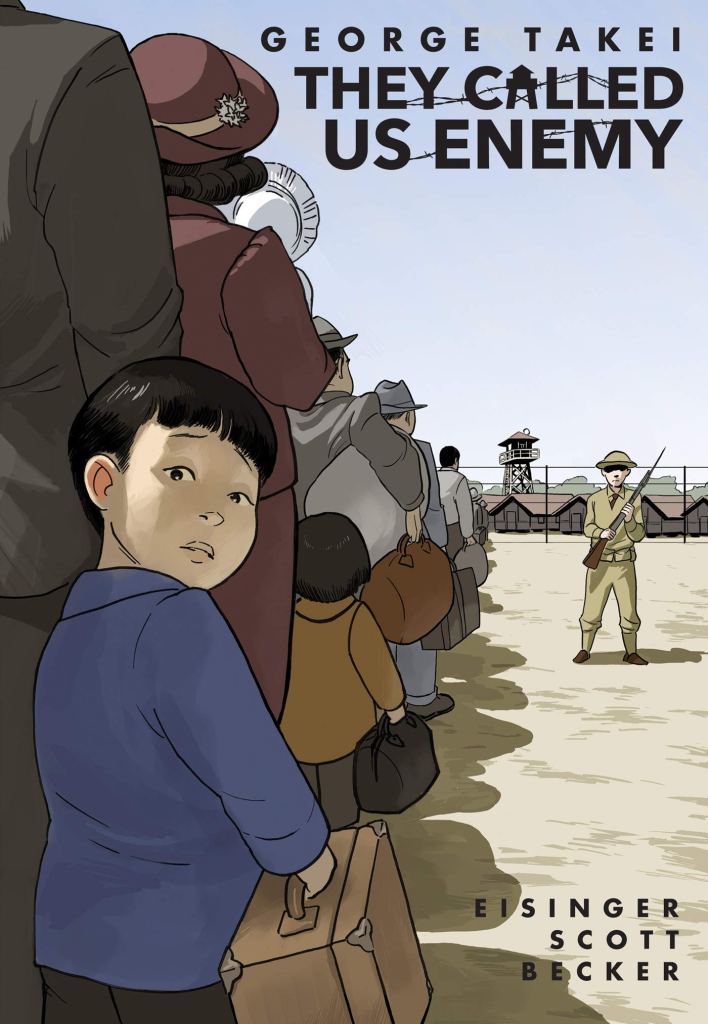
Readers of a certain age will recognize George Takei from his stint on Star Trek (1966-69), where he played Lt. Sulu. He’s had a long show biz career beginning back in 1955. At 83 he’s still working, but is probably best known (currently) for his provocative and political Tweets. I am one of his 3.1 million Twitter followers. He is also an outspoken advocate for gay rights.
Takei, along with Justin Eisinger and Steven Scott, wrote the words and Harmony Becker has illustrated the story of Takei’s young life in graphic form. They Called Us Enemy introduces readers to George, who lives with his brother, Henry, and baby sister, Nancy, with their parents in Los Angeles.
My father, Takekuma Norman Takei, was born in Yamanashi, Japan. He came to America as a teenager and was educated in the Bay area. He later pursued a lucrative dry cleaning business in Los Angeles’ Wilshire corridor.
My mother, Fumiko Emily Nakamura, was born in Florin. California, but was raised traditionally Japanese. Her father had sent her to Japan to avoid school segregation in Sacramento.
Life was pretty awesome until the Japanese bombed Pearl Harbour and the government decided to round up anyone of Japanese descent and place them in camps. These people could take only what they could carry. Their homes and businesses were confiscated; their rights as American citizens null and void.
First stop for George and his family was the Santa Anita Racetrack where they were “assigned to a horse stall still pungent with the stink of manure.” George’s reminiscences are seen through a child’s eyes and all his experiences are tempered by his father, who somehow managed to make the best of the situation in which they found themselves.
Through my child’s eyes, Daddy always seemed in command of any given situation. It was my father who bore the pain, the anguish…and the torturous experiences the most in our family.
Takei’s story is one of resilience and it is no wonder that he is such a force of nature when it comes to activism of all sorts. They Called Us Enemy methodically, and almost without emotion, recounts his story, and the story of thousands of other Japanese who were wrongly imprisoned. I think it’s also a love letter to his father, who Takei claims “taught me the power of American democracy – the people’s democracy.” That’s saying something given the circumstances.
Canada did no better post- Pearl Harbour. Our government rounded up 21,000 Japanese Canadians without charge or due process, exiling them to remote areas of British Columbia and elsewhere. It’s a shameful part of our history and the only way to atone is to make sure it never happens again. Sadly, the world seems to be getting crazier by the moment.
They Called Us Enemy is a chilling and sobering look at what happens when we become afraid of people who don’t look like us. It’s yet another skeleton in our historical closet, and is well worth your reading time.
I probably shouldn’t admit this, being both a Canadian and an English teacher, but I have never read Margaret Atwood’s novel The Handmaid’s Tale. I haven’t watched the series, either. I know, I know. I figured that I could rectify that by reading Renee Nault’s stunning graphic novel of Atwood’s book.
First published in 1985, Atwood’s novel explores a dystopian America. Atwood imagines a totalitarian state where women are commodities without their own names or lives. Some women are sexual servants, that is if they are of the age to bear children. Their names reflect the men they serve, so the book’s narrator is Offred or “of Fred”. In another life, Offred was married, had a daughter, but the family was separated when they tried to escape to Canada. The novel won several awards, including the Governor General’s Award and the Booker.
In many ways, Atwood’s novel was prescient. Flash forward almost 35 years and reflect on what is currently happening in the States (and around the world) and The Handmaid’s Tale should make your skin crawl.
Nault’s beautiful drawings highlight the horrific lives lived by these handmaids.
They dress in red “the colour of blood, which defines us.” Their hats prevent “keep us from seeing, but also from being seen.” Offred reveals her defiance to her situation early on claiming that “I never looked good in red, it’s not my colour.” Friendships are discouraged between the handmaids. Their only job is to be an incubator.
It’s easy to see why Atwood’s novel was ground-breaking when it was first published. It’s difficult to read it even now. Nault’s adaptation should introduce a whole new generation of readers to Atwood’s acclaimed novel. I might just go read the original now.
Although I really don’t know very much about gaming (my gaming experiences consist of playing PacMan and Asteroids at the local pin ball joint, and then a few years later staying up all night to play Scorched Earth), I do understand the appeal of an on-line persona. During my years in fandom, I had a fake name for all the fanfiction I wrote, and I met loads of other people (mostly women) who wrote fic in their spare time: mothers and teachers and lawyers and even a judge. While my persona was very much me, having met some of these ladies in real life, I know that many of them were more daring, outgoing, over-the-top online compared to the way they were in their every day lives. That aspect of Cory Doctorow and Jen Wang’s graphic novel In Real Life was familiar to me.
Anda has recently moved from California to Arizona with her parents. She hasn’t really settled in, except with the boys who play D & D, and so when Liza McCombs shows up in her computer class to invite girls to play Coarsegold, a first person game for girls only, Anda jumps at the chance. (This is the point where I admit that I don’t really know much of anything about this sort of thing.)
Anda creates an avatar, Kalidestroyer, befriends another player, Sarge. Sarge recruits Anda to “kill some guys.” (Virtually, of course.) The guys Sarge wants Kalidestroyer/Anda to kill are gold miners, players who “collect items for gold and sell the gold to other players for cash.” Someone who actually games will probably understand the mechanics of this better than I did, but eventually Anda comes across one of these gold farmers and instead of killing him, she starts to talk to him. Turns out, he’s a boy from China.
Doctorow says in In Real Life ‘s Introduction that he hopes readers will “be inspired to dig deeper into the subject of behavioral economics and to start asking hard questions about how we end up with the stuff we own, what it costs our human brothers and sisters to make those goods, and why we think we need them.” Doctorow believes that while the Internet doesn’t necessarily solve the injustices of the world – which we can all agree are many – it “solves the first hard problem of righting wrongs: getting everyone together and keeping them together.”
As Anda’s gaming life spills over into her real life, it’s easy to see the point Doctorow is making. This is a worthwhile book for gamers and anyone interested in justice.
I am surrounded by teenagers every day and their world seems difficult to me, more difficult than I remember my adolescence. There was no social media back then. We hung out, gathering at someone’s house on Friday night to play Trivial Pursuits and drink Pop Shoppe soda. We had dances where you’d just pray not to be asked to slow dance with some geeky guy, especially for the last dance, which was always “Stairway to Heaven” – longest song on the planet. My locker was covered with pictures of Robby Benson. The drama happened in the girls’ bathroom and the bullying happened in person. We talked for hours on the phone…which was in the kitchen, so your end of the conversation could be heard by pesky brothers and eavesdropping moms.
It’s always interesting to read about young people because even though I feel so far removed from those years (my 40th high school reunion happens this summer!), their lives are fascinating to me. A really good YA novel can capture the essence of what it is to be young and send me spinning back to my own fraught teenage years.
Skim, the award-winning graphic novel by the cousin team of Mariko Tamaki (writer) and Jillian Tamaki (illustrator), unspools the life of sixteen-year-old Kimberly Keiko Cameron aka Skim as she navigates friendships, crushes, school, suicide and depression. Like with their graphic novel This One Summer, the Tamakis zero in on what it is to be young and to cope with all the shit life often throws at you.
Skim’s parents are divorced. She’s interested in wicca and tarot cards and her English and drama teacher, Mrs. Archer, who is “always saying weird stuff like – I’m telling you girls. You might think different, but chocolate is better than sex.” Skim relates to Mrs. Archer because she considers herself a bit of a freak, too.
The simple black and white illustrations capture the essence of high school life; the constant navigating and negotiating that comes with being a young person. Skim is thoughtful and fragile, but there is a toughness to her that allows the reader to believe that she will survive.
You couldn’t pay me money to be a teenager. All those hormones. All that heartache. Still, there is something about this period in your life that is pretty amazing. All that potential. All those feelings so close to the surface. Skim manages to capture that beautifully and Skim’s story will resonate with anyone…well, anyone. Because we were all young once and if you are young now – then at least part of Skim’s story is your story, too.
Pam Smy’s lovely hybrid novel tells the story (in words) of Mary and (in pictures) Ella – two girls separated by twenty-five years. Ella and her father have moved into a house that looks out onto Thornhill Institute which was “established in the 1830s as an orphanage for girls” and sold in 1982 “after the tragic death of one of the last residents, Mary Baines.” For the last twenty-five years, the house has remained vacant, although plans have been made to develop the site.
Through a series of diary entries, we meet Mary. She’s an odd, mostly silent girl who is virtually friendless. As Thornhill prepares to be fully de-commissioned, the few girls who remain are merely passing time, waiting for placement with a family. Mary’s chief tormenter has just returned from a situation which didn’t work out and Mary feels she must “lock myself away. Now that she’s back it is the only way I can keep myself safe.”
Up in her attic bedroom, she spends her time making puppets.
I often wonder what my life would be like without my puppets. …I love that I am surrounded by the things I have made. They sit on shelves above my bed, on my bookcase, suspended from the ceiling, balanced on my windowsill – my puppets are like friends that sit and keep me company..
In the present day, Ella spends much of her time alone, too. Her father, who clearly seems to love her, is away a lot. Her mother is presumably dead. Ella is curious about the house she can see from her bedroom window and the girl she sometimes glimpses in the overgrown garden behind the walls
One day, she manages to creep into Thornhill’s garden and she discovers a puppet head. As the days go on, she continues to see the girl in the garden and to discover more puppet pieces. She becomes more curious about Thornhill’s history and who the girl might be.
Smy makes great use of Mary’s diary entries to round out the story. Her story is particularly sad because there is no one in Mary’s life to take her side against the terrible bullying she endures. The adults in this story are either non-existent or ineffective. Her housemates are cruel and manipulative. Even though it’s obvious that her story isn’t going to end well, you can’t help but root for her.
As for Ella, the monochromatic pictures tell her story as beautifully as Mary’s diary. It will be impossible not to race through the pages to find out what happens.
Ultimately, Thornhill is a story of loneliness and friendship, and although there’s no happy ending, it’s a journey worth taking.
This One Summer by cousins Mariko and Jillian Tamakiis a Governor General’s Literary Award winner in addition to being on several Best Of…lists. I can’t claim any real expertise when it comes to graphic novels, so I don’t really know what the criteria might be for determining what makes a graphic novel superior to others. Like everyone of my generation, I used to be a big fan of Archie and horror comics, but it’s only since I returned to the classroom that I have made it a point to read graphic novels – mostly because I do have students who enjoy them and I want to be sure that I include them in my classroom library.
Rose and her family have been going to Awago Beach every summer since she can remember. Rose says, “My dad says Awago is a place where beer grows on trees and everyone can sleep in until eleven.” It’s magical. It’s also where Windy, Rose’s “summer cottage friend since I was five” lives.
This summer is captured in monochrome as Rose and Windy revisit old haunts and settle back into their summer routine. It’s clear, though, that the one and a half year difference between the girls is impactful this year. Rose, the elder, is contemplative and watchful and often reacts to Windy’s suggestions with a shrug and a “maybe.” At Brewster’s “the only store in all of Awago” the girls buy penny candy, rent horror movies and watch (Windy with girlish disgust and Rose with curious fascination) the overtly sexual relationship between older teens Dunc and Jenny.
This one summer is different in another way. Rose is hyper aware that her parents don’t seem to be getting along all that well and Rose senses the rift is sucking them all in even when her father assures her that “It’s all just adult junk that doesn’t mean anything.” It’s hard to navigate that tricky path from childhood to adulthood without touchstones and Rose is aware, perhaps without quite understanding it, that she is on shaky ground.
This One Summer is a coming of age novel steeped in nostalgia. It will remind adult readers of their “one” summer, that time that now seems captured in a permanently dreamy gauze and it will ring true to young adults for whom that one summer may be this summer.
Sixteen-year-old Glory Fleming is a piano prodigy. When Jessica Anthony and Rodrigo Corral’s hybrid novel – more about that in a moment – opens, Glory is missing. Then the story flashes back eighteen months to help us understand how her life has gone off the rails.
Chopsticks is a quick read, but that’s because much of the story is told through pictures: drawings and photographs.
For example, we learn about Glory’s childhood by flipping the pages of a family photo album. Pictures of her parents Victor and Maria, and baby pictures of Gloria and ‘pasted in’ cards and programs, give us a glimpse into a tight family unit.
Victor is a music teacher and Glory is his star pupil. After the accidental death of her mother, Glory throws herself into her music until she is so accomplished that The New Yorker calls her “The Brecht of the Piano.” Glory is known for her “innovative performances of classical pieces alongside modern scores.” Soon, she is playing sold-out shows at Carnegie Hall.
And it’s all good until Francisco and his family, Argentinian immigrants, move into the house next door. Chopsticks gives us the same insight into Frank’s character by showing us cards from his parents and his diary in which he writes: “She is the most beautiful girl I have ever seen. She invited me over and played Chopin on her piano.”
The pair form a friendship; it seems as though Glory hasn’t actually had too many over the years. Although it’s completely natural, their bond deepens and as she pulls away from her father and her music, Victor tightens his hold on his daughter. Frank isn’t without his own problems. Although he comes from a wonderful family, he has trouble fitting in at school and with the exception of art, and music, isn’t excelling academically.
In an effort to separate the teens, Victor plans a European tour for his daughter. Text messages, post cards and photos mark this period. But, of course, by this time Frank and Glory are in love and the time apart only heightens their feelings for each other.
Chopsticks is a beautiful book to read – each page is visually interesting and the story of Glory and Frank, each of whom want to find their own way out from under parental expectations and to discover their own path, is certainly one most teens will relate to.
I’ve been wanting to read this one for a while and it did not disappoint.




 never read Margaret Atwood’s novel The Handmaid’s Tale. I haven’t watched the series, either. I know, I know. I figured that I could rectify that by reading Renee Nault’s stunning graphic novel of Atwood’s book.
 Although I really don’t know very much about gaming (my gaming experiences consist of playing PacMan and Asteroids at the local pin ball joint, and then a few years later staying up all night to play Scorched Earth), I do understand the appeal of an on-line persona. During my years in fandom, I had a fake name for all the fanfiction I wrote, and I met loads of other people (mostly women) who wrote fic in their spare time: mothers and teachers and lawyers and even a judge. While my persona was very much me, having met some of these ladies in real life, I know that many of them were more daring, outgoing, over-the-top online compared to the way they were in their every day lives. That aspect of Cory Doctorow and Jen Wang’s graphic novel In Real Life was familiar to me.
 difficult than I remember my adolescence. There was no social media back then. We hung out, gathering at someone’s house on Friday night to play Trivial Pursuits and drink Pop Shoppe soda. We had dances where you’d just pray not to be asked to slow dance with some geeky guy, especially for the last dance, which was always “Stairway to Heaven” – longest song on the planet. My locker was covered with pictures of Robby Benson. The drama happened in the girls’ bathroom and the bullying happened in person. We talked for hours on the phone…which was in the kitchen, so your end of the conversation could be heard by pesky brothers and eavesdropping moms.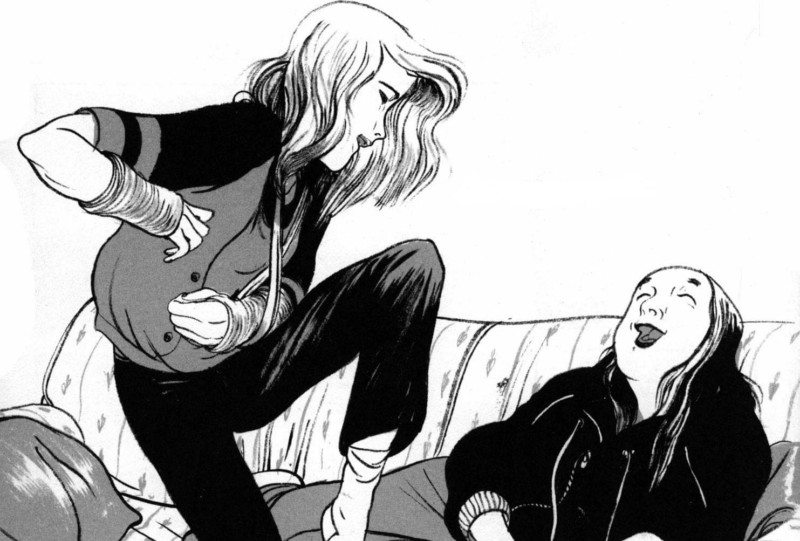
 Pam Smy’s lovely hybrid novel tells the story (in words) of Mary and (in pictures) Ella – two girls separated by twenty-five years. Ella and her father have moved into a house that looks out onto Thornhill Institute which was “established in the 1830s as an
 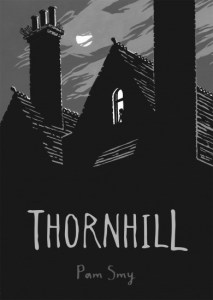 orphanage for girls” and sold in 1982 “after the tragic death of one of the last residents, Mary Baines.” For the last twenty-five years, the house has remained vacant, although plans have been made to develop the site.
 In the present day, Ella spends much of her time alone, too. Her father, who clearly seems to love her, is away a lot. Her mother is presumably dead. Ella is curious about the house she can see from her bedroom window and the girl she sometimes glimpses in the overgrown garden behind the walls
 This One Summer by cousins Mariko and Jillian Tamaki is a Governor General’s Literary Award winner in addition to being on several Best Of…lists. I can’t claim any real expertise when it comes to graphic novels, so I don’t really know what the criteria might be for determining what makes a graphic novel superior to others. Like everyone of my generation, I used to be a big fan of Archie and horror comics, but it’s only since I returned to the classroom that I have made it a point to read graphic novels – mostly because I do have students who enjoy them and I want to be sure that I include them in my classroom library.
 It’s clear, though, that the one and a half year difference between the girls is impactful this year. Rose, the elder, is contemplative and watchful and often reacts to Windy’s suggestions with a shrug and a “maybe.” At Brewster’s “the only store in all of Awago” the girls buy penny candy, rent horror movies and watch (Windy with girlish disgust and Rose with curious fascination) the overtly sexual relationship between older teens Dunc and Jenny.
 Sixteen-year-old Glory Fleming is a piano prodigy. When Jessica Anthony and Rodrigo Corral’s hybrid novel – more about that in a moment – opens, Glory is missing. Then the story flashes back eighteen months to help us understand how her life has gone off the rails.
 The Ludic Reader