 Holy unreliable narrator, Batman! There seems to be a whole slew of books of this type post The Girl on the Train. A.J. Finn (nom de plume of Daniel Mallory, executive editor at Morrow) adds yet another to the cast with Anna Fox, the first person narrator in The Woman in the Window. A student in one of my classes wanted to read this book, so I bought it for my classroom library. He read it lickety-split and then encouraged me to read it, which I did, in two breathless days.
Anna Fox is a watcher. From the windows of her Victorian home in Harlem, she watches the lives of her neighbours. “My Nikon D5500 doesn’t miss much, not with that Opteka lens,” she admits.
From her vantage point, she can observe people living their daily lives: cheating spouses, book club meetings, teenagers playing video games and musical instruments. Slowly it is revealed that Anna is separated from her husband and daughter, and also suffers from agoraphobia. As Anna explains “Agoraphobic fears…include being outside the home alone; being in a crowd, or standing in a line; being on a bridge.” She considers herself to be an extreme case, “the most severely afflicted…grappling with post-traumatic stress disorder.”
She occupies her time on the Internet, learning French and playing chess and overseeing a discussion board called Agora, set up for other sufferers of her condition. (She’s actually qualified because before her life went south, Anna was a psychologist.) She’s a fan of old movies, particularly noir films, and merlot — of which she drinks a lot. The fear of being outside the safety of her mansion/prison is not the only problem in Anna’s life; she is clearly depressed and self-medicating with alcohol and the drugs her own psychiatrist prescribes, a lethal combination that impacts what Anna sees one night.
That would be a murder.
By then, Finn has done such a good job of portraying Anna as such a hot mess that readers won’t know what to believe. Anna doesn’t either. When the police investigate the crime, they discover there’s no body and the person Anna thought she saw doesn’t even exist. Oh, what a tangled web.
Keeping Anna trapped in her house ups the suspense ante, for sure. Her days are often a drunken blur and even when she tries to get it together so that she can figure out what she saw or didn’t see, she just can’t. Despite this, Anna is a sympathetic character, whose well-being you will care about, especially when you discover one of the novel’s central plot points (which I did relatively early on but, trust me, that in no way hindered my enjoyment of this novel).
The Woman in the Window has garnered a lot of buzz and for good reason. It’s well-written, page-turning fun, with a beating heart at its core.
Highly recommended.
 Just when I thought my reading slump was never going to end, I read M.O. Walsh’s compelling debut novel My Sunshine Away. I can’t even begin to tell you how much I loved this book – start to finish.
 is a celebrated graphic novelist, whose series Diana: Queen of Two Worlds, tells the story of “a suburban girl who lives with her “painfully average” family which includes her high-strung easily overwhelmed mother, her ineffectual father, and her dull-witted, staring lump of a sister.”
 Sometimes you happen upon a book with a narrator who just feels 100% authentic. That was the case with Henry Turner’s debut YA mystery Ask the Dark, a finalist for the Edgar Award for Best Young Adult Mystery.
 scoop Starr Carter and her family up and hug them forever. Starr’s the sixteen-year-old narrator of Angie Thomas’s debut novel The Hate U Give, and her story might have been ripped from recent headlines. It feels especially timely now, given what is happening in the U.S.A and around the world. I would like to think Canada is immune to racism, but I know it’s not true.
 deftly that you hardly notice the machinations. Her novel Commonwealth, the story of the intersecting lives of two families, might have crashed and burned in less talented hands, but Patchett moves these people backwards and forwards in time without seeming to break a sweat.
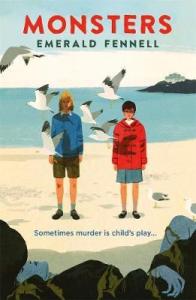 What would you get if you mixed Enid Blyton with Stephen King? I think you’d probably get Monsters by Emerald Fennell.
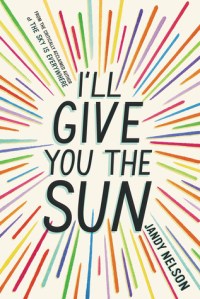 That’s almost-fourteen-year-old Noah, one of the twins who narrates Jandy Nelson’s remarkable YA novel I’ll Give You the Sun. Alternating between Noah and his sister, Jude, who tells her part of the story at age sixteen, the novel traces the siblings’ journey from innocence to experience.
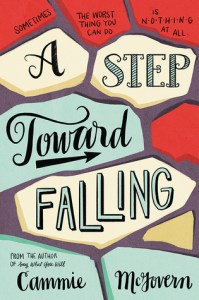 Although Belinda and Emily, the alternating narrators of Cammie McGovern’s excellent YA novel A Step Toward Falling, attend the same high school, the two girls couldn’t be more unalike. Belinda is twenty-one and spends her days in the Life Skills class with other students who have physical or developmental disabilities. Emily is a high school senior who co-chairs her school’s Youth Action Coalition with her gay bff, Richard, but hasn’t ever really taken a stand, preferring to work behind-the-scenes..
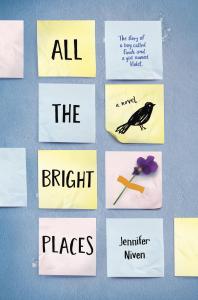 specifically remember reading and falling in love with S.E. Hinton’s That Was Then, This is Now (a book I loved way more than I loved The Outsiders), and Judy Blume’s Forever, but the reading choices certainly weren’t as varied as they are for teens today. I read a lot of YA now because I teach teens. Lots of it is mediocre. Lots of it is good. Then, every so often, you read a book you just want to tell all your students about. You want every single teen you know on the planet to read it. Jennifer Niven’s All the Bright Places is one of those books.
 The Ludic Reader