Help For The Haunted – John Searles

helpforthehauntedIn some ways, John Searles reminds me of Thomas H. Cook, an American mystery writer I greatly admire. Neither of them seem to have any interest in racing through plot points to the story’s denouement. Instead, like Cook, Searles lets us get to know the characters and takes his time layering the narrative. Help For The Haunted  is the story of Sylvie Mason and her unusual family. It is part mystery, part ghost story and part family drama.

“Whenever the phone rang late at night, I lay in my narrow bed and listened,” says 14-year-old Sylvie, the narrator of the story. Late night phone calls are a common occurrence in the Mason household. That’s because Sylvie’s parents, Sylvester and Rose, have a very unusual occupation: they help the haunted. People who feel they may be themselves, or have family members who are, possessed by demons seek them out and the Masons help with prayer. It’s not a lucrative business, people ” only occasionally enclosed a check to cover gas or airline tickets” but it is work that the Masons, particularly the father, feel strongly about.

The phone call that opens the novel is of a more personal nature, though. The Mason’s eldest daughter, also named Rose, has asked her parents to meet her at the church in town.  Rose has always been difficult and on this occasion she has been missing for three days. The Masons don’t want to miss this opportunity to reconcile with their daughter so, despite the blizzard, they head to the church, Sylvie in tow.

When Sylvie’s dad disappears inside the church Sylvie admits to “a prickly feeling of dread” and when her mother ventures inside to see what is taking so long, Sylvie drifts off to sleep only to be awoken by the sound of gun shots.

Searles manages a tricky narrative here. The present blends seamlessly with the past as Sylvie tries to unlock some of her family’s most closely guarded secrets. There is a compelling cast of secondary characters including her father’s estranged older brother, Howie; Sam Heekin, the reporter who wrote a book about her parents; Albert Lynch, the man currently sitting in jail for the murder of her parents.

Sylvie herself, despite her young age, is tenacious and resourceful. A year after the death of her parents, as the police put the finishing touches on their case against Albert Lynch, Sylvie starts to doubt what she saw in the church on that fateful night. New evidence shows that Lynch might, in fact, be innocent and it makes Sylvie question her earlier statement. But if Lynch isn’t the killer, who is?

Help For The Haunted is a literary page-turner. The whodunit isn’t actually as important as Sylvie’s journey from adolescent to adult and the demons, ultimately, are more human than you might think. Great book.
This Is Not A Test – Courtney Summers

testThis is my second book by Canadian YA writer Courtney Summers and, that’s it:  I am a fan. I previously read Some Girls Are and I was totally taken with its unflinching look at what it is to be a teenage girl. It isn’t pretty, people.

This Is Not A Test has won a slew of awards including being named a  2014 OLA White Pine Honour Book, 2013 ALA/YALSA Top Ten Quick Pick for Reluctant Readers, 2013 ALA/YALSA Best Fiction for Young Adults, and  a  Kirkus New & Notable Books for Teens: June 2012. Trust me, the book delivers on every possible level.

Sloane lives in with her father  in Cortege. Her older sister, Lily, has left home and taken a piece of Sloane with her. It won’t take the reader very long to figure out that Sloane’s father is abusive. She tells us he burns the toast because she deserves it and when he reaches out to examine her face, Sloane flinches before she can catch herself. It’s no wonder that Lily has left, but the plan was that they were supposed to go together.

Based on the first couple of pages, it would be reasonable  to think that This Is Not A Test is a story about abuse, but you’d be so wrong. As Sloane is contemplating the burnt toast and the note her father has written to explain her absence from school, their front door starts to “rattle and shake.”  Someone is screaming for help and it is such a creepy event that as Sloane’s father heads to the door to investigate Sloane notes that he hesitates and she has “never seen him hesitate” in her life.

When Sloane’s father returns to the kitchen he’s screaming that they have to leave and he’s covered in blood. And then all hell breaks loose, literally.

Seven days later Sloane finds herself barricaded in Cortege High School with five other students: student body president, Grace, and her twin brother, Trace; Rhys, a senior;  some-time drug dealer and some-time boyfriend to her sister Lily, Cary and Harrison, a freshman who can’t seem to stop crying. The high school offers the six teens sanctuary while they wait for the help the feel sure will come. Unfortunately, the only announcement on the radio proclaims that “This is not a test.”

As the days drone on, Sloane and the rest of the trapped teens struggle to stay calm. They jockey for position, alliances are formed and they wonder what has happened to the rest of the world. It all makes for a riveting psychological drama because Summers has an ear for how teens speak and she doesn’t shy away from the fact that this scenario is relentlessly grim. It’s the end of the world as we know it. Except for the feeling fine part.

Sloane narrates this story and she is a sympathetic character. Even if she could get back home, what does she have to return to? No one knows about the abuse she suffered and without Lily she feels as though she has very little to live for. Thus, she has nothing to lose.

This Is Not A Test is my very first zombie novel. I’ve pretty much avoided them until now because, truthfully, they don’t really interest me all that much. If they were all as good as this one, though, I’d be a fan.

Apparently there is an e-sequel available, but truthfully, I thought the ending to This Is Not A Test was pretty damn perfect.

Highly recommended.

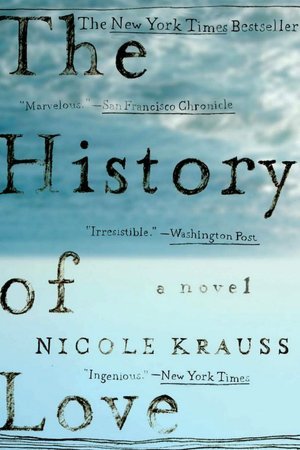
The History of Love – Nicole Krauss

historyWhen Nicole Krauss’s novel The History of Love was published in 2005 it took the literary world by storm (though not like the storm that is raging outside as I write this, cozy in bed with my cat and my tea.) Everyone loved this book: The New York Times, The Guardian, The Globe and Mail. It was also the winner of the Edward Lewis Wallant Award for Jewish fiction and BMOC’s Best Literary Fiction. The book has been on my tbr shelf forever (emphasis on the ‘ever’) and so I chose it as my pick for book club.

The History of Love is the title of the book Leo Gursky wrote for the love of his life, Alma. Alma flees Poland just before the invasion of the Nazis and when Leo finally makes his way to America, he discovers that not only does he have a son, but that Alma has married someone else.

…he stood in her living room listening to all this. He was twenty-five years old. He had changed so much since he last saw her and now part of him wanted to laugh a hard, cold laugh….She said: You stopped writing. I thought you were dead. …At last he managed three words: Come with me….Three times he asked her. She shook her head. I can’t, she said. And so he did the hardest thing he had ever done in his life: he picked up his hat and walked away.

Now Leo is at the end of his life. “When they write my obituary,” he says, “it will say LEO GURSKY IS SURVIVED BY AN APARTMENT FULL OF SHIT.” Leo just wants to be seen. “Sometimes when I’m out, I’ll buy a juice even though I’m not thirsty. If the store is crowded I’ll even go so far as dropping my change all over the floor,” he says. His voice, one part resigned, one part hopeful is one of the novel’s greatest charms.

The other charming voice belongs to fifteen-year-old Alma – not the love of Leo’s life, but that of a teenager who lives in Brooklyn, with her widowed mother (who works as a translator) and younger brother, Bird. Her name is no coincidence: she was actually named after the character in Leo’s book The History of Love. This is where things get a bit complicated and I’m not going to bother drawing the chart required to understand it all – trust me, it’ll all sort itself out.

Alma is on a mission to find her mother a boyfriend. Her father died of pancreatic cancer when Alma was just seven and Alma feels as though her mother has been sad ever since. Alma is trying to navigate adolescence, her mother’s sadness, the fact that her brother thinks he’s the Messiah and her first love, too. Then (and I’m going to say it, girls!) by a weird twist of fate, The History of Love arrives for Alma’s mother to translate and the threads of Alma and Leo’s stories start to reach towards each other.

I really enjoyed The History of Love. There were some moments in the book that literally stopped me in my tracks. For example, Leo says: “All the times I have suddenly realized that my parents are dead, even now, it still surprises me, to exist in the world while that which made me has ceased to exist.” Those of us who have lost our parents will recognize that feeling (although perhaps never articulated) all too well.

This is one of those books, I think, which needs some time to sit in your belly. It is a book about connection – lovers, siblings, friends, parent and child. Leo, at the end of his life (which some might argue he wasted by loving someone he couldn’t have and not pursuing a relationship with his son) has all the insights of a person who has made errors in judgment, but is somehow still open to the world. Ultimately, The History of Love is about the desire we all have to be seen and understood and often the smallest gesture can have the biggest impact.

Highly recommended.

Charm & Strange – Stephanie Kuehn

charmWow. This William C. Morris Debut Award winner has it all. Charm & Strange, the first novel by Stephanie Kuehn, is amazing. I read a lot of YA fiction and this book is just a cut above. Way above.

Win has attended a boarding school in New England since he was twelve. A top-ranked tennis player, Win once hit an opponent across the face with his tennis racket.

He’s a lot of things. He is prone to motion sickness. He’s cold. Dangerous. Broken.

Into his life comes Jordan. She’s the new girl and she doesn’t know anything about Win and that’s pretty much the way he wants to keep it. They meet in the woods. Win has just been attacked by a couple of school bullies and Jordan has witnessed the whole thing. She asks why he didn’t fight back. Win never fights back because “That wouldn’t be fair.”

Their relationship is tentative because Win tends to stay away from people. His only other ‘friend’  is Lex, his former roommate, but even their relationship is strained.

Charm & Strange is a compelling story about dark secrets and how they can twist lives. Kuehn skillfully pulls the reader along a path that is almost too painful to read about, but she does it so well that you just can’t stop turning the pages. The novel is layered: Sixteen-year-old Win at school is told in first person sections called ‘matter’ and ten-year-old  Drew at home with his family (first person narrative in sections called ‘antimatter’). Win and Drew are the same person, and the reason for the name change will be revealed in due course. Win’s family: professor father, depressed shadow of a mother, older brother, Keith, and younger sister, Siobhan, are important characters is Win’s story.

This novel is so cleverly constructed; every page offers just a little more of Win’s story. Win is convinced he is about to change and not in a good way.

Change is imminent.

It has to be.

“Yeah, well, have fun with that,” Lex says. “Moon or no moon, I don’t plan on being anywhere near you.”

“Good,” I snarl, and he laughs even harder than before. My hands curl into fists. I want to shut him up.

Lex notices and skitters toward the door.

“Hey, Win,” he says as he leaves, “maybe it’s your head that’s broken, not your body. Ever think about that?”

Charm & Strange is a terrific book. I am having a hard time articulating how amazing it is. It is almost relentlessly bleak and yet as I closed the final pages I felt confident that despite Win’s dark past, the beast within would be tamed. For mature YA readers, Charm & Strange is one of the best of the bunch.

Highly recommended.

Kept in the Dark – Penny Hancock

keptinthedarkI read Penny Hancock’s debut novel Kept in the Dark in one breathless gulp. I absolutely couldn’t put it down. I love it when that happens.

Sonia lives in a house next to the Thames. Her husband, Greg, is a lecturing neurosurgeon; her daughter, Kit, is a student at university and Sonia herself is a vocal coach. From the outside looking in, it would appear that Sonia has it all. It’s pretty obvious, though, that Sonia isn’t entirely sane. When the nephew of a friend drops by to pick up an album, Sonia plies him with wine, then drugs him and locks him upstairs in the sound proof music studio.

Jez is just fifteen. He’s in London visiting his Aunt Helen and Uncle Mick and applying to colleges. His mother, Maria, lives in Paris. Sonia is taken with Jez immediately.

His dark fringe has fallen across one eye. He flicks I back, and looks at me from under long, perfectly formed black eyebrows. I notice his sinuous neck with its smooth Adam’s apple. There’s a triangular dip where his throat descends towards his sternum. His skin has a sheen on it that I’d like to touch. He’s of adult proportions yet everything about him is glossy and new.

The novel’s first person narrative is so creepy and claustrophobic.  We get to watch as Sonia justifies her behavior and work through the endless complications of keeping a fifteen-year-old boy captive. First of all, what happens when her husband arrives home from his business trip? What will she do when her daughter and her boyfriend come home from university. And then there’s Seb. He’s clearly someone from her past and Jez obviously reminds her of him, but who is he? Sonia says he was “the most beautiful creature that ever walked upon the earth.” Hancock seamlessly weaves Sonia’s present with her past and the mystery of Seb is equally as compelling as Jez’s fate.

There is a second narrator: Helen. Jez’s aunt is a bit of a mess in her own way. Jez’s disappearance while under her care has thrown Helen’s life into turmoil. When her sister arrives from Paris and the police get involved, Helen feels more like a suspect than a relative.

This book was so good. S.J. Watson, author of Before I Go to Sleep, sang its praises and I have to say I agree with Mr. Watson. Sonia’s midlife crisis – a rather strained relationship with her daughter; a sexless marriage; a difficult mother; and the house she grew up in that she vows never to leave despite the fact that her husband wants to sell and move to Geneva all seem to be conspiring against her. But none of it is convoluted or silly. The plot unravels like a dream that is both terrifying and strangely erotic.

Highly recommended.

This is What I Did: by Ann Dee Ellis

whatI didLast week Bruce kicked me in the balls at Scouts and all his buddies were there laughing and I started crying.

That’s Logan, the thirteen-year-old narrator of Ann Dee Ellis’s compelling and unusual YA novel This is What I Did:. Logan is a target for bullies for a variety of reasons: he’s the new kid and he’s mostly silent. There’s a reason, of course. His family has recently moved to the new school because of something horrific that happened concerning Logan and his best friend Zyler. Logan doesn’t want to talk about it, so the details of the event is unspooled in the kind of painful way that makes you read faster.

I also loved the way Logan shared his story.

A year ago I was fine. That’s when there was nothing wrong.

A year ago, in seventh grade, I was fine.

We were living on Mulholand with the hills and the lake and the freeway and the Minute Man Gas Stop and my best friend, Zyler, ate Twinkies and coke and hated girls, except one.

Dialogue looks like this:

Ryan: Why do you sit down here all the time?

Me: Where’s Mack?

Ryan: Helping Dad with something.

Me:

Ryan:

Me:

Ryan: Okay, I think I’m going to go back upstairs.

And then he left.

Logan has parents who desperately want to help him, but aren’t sure how. Given that we see them only through Logan’s eyes, they are believable and sympathetic, but by no means perfect.

It is only when Logan meets Laurel that he starts opening up. One day she hands him a note that says “Nascar=Racecar, Racecar=Palindrome.”  Soon, he and Laurel are sending each other palindromes regularly and before he knows it, Logan has made a friend.

I really liked This is What I Did:. It tackles some weighty issues without shying away from them and allows the reader to share Logan’s journey from broken to healing in  way that was both satisfying and hopeful.

Highly recommended.

Love Remains – Glen Duncan

loveremains Despite the fact that Glen Duncan’s novel Love Remains is only 277 pages long, it took me about a month to finish because I could never read any more than a few pages at a time before my head started to swim. But I mean that as a compliment rather than a criticism.  Duncan is a well-known and much-praised British author who was new to me when I purchased the book. Love Remains, Duncan’s second novel, is almost relentlessly grim. Again – it’s a compliment, honest. There’s no way you could tackle the topic Duncan does in this book without being a skillful craftsman, and Duncan really is an amazing writer.

Nick and Chloe meet in university.

The possibility of love revealed itself to Chloe immediately, in a shock. When they sat opposite each other that first Wednesday, with rain streaking the steamed windows and the delicious reek of frying bacon in the air, she felt (thinking, stunned, of the billions who had felt it, down the long bloodied canvas of history) the first murderous utterance of romance: It’s him.

Nick’s feelings for Chloe are slightly more ambivalent, although he does concede that “he was so curious about what was going on inside her that lust only followed along afterwards, like an obligatory bit of luggage.”

The trajectory of Chloe and Nick’s love story is mostly straightforward. They get married, start jobs,  eventually move into “their first proper home” in Clapham and then, as with many marriages, the romantic impetus drains from their lives as they deal with life’s mundane and often inane decisions: “Do you think we should get a futon, Nick.”  As their marriage closes in around them, “They suffered, periodically, the ache of familiarity.” Chloe feels “suffocated by the sound of his breath escaping through his nostrils” and Nick “hated her for having finished the shape of him.”

Duncan masterfully builds a marriage from the ground up and then, just as masterfully, wrenches it apart in the most violent way possible.  In some ways, it’s almost as though Duncan has written two different, but equally compelling, novels.

When the novel opens, Nick has already left London because that’s what you do “when the future ended.” He is on a journey, it seems, of self-destruction comprised of smoking, drinking and having sadomasochistic sex. None of it makes sense until we learn what has happened to Chloe and, even then, it’d difficult to wrap your head around. Is Nick reprehensible for having abandoned his wife? That’s just one of the moral questions Duncan asks you to consider in this book.

Chloe is on a journey of her own. It is equally compelling, although perhaps more heartbreaking. The random and horrific experience she has endured has sharpened her: “Her face in the mirror, barely recognizable, rewritten.”

What was once a path traveled together, has now been cleaved. I commend Duncan for resisting the urge to offer a tidy ending, but the ending, nonetheless, is remarkable.

Highly recommended.

The Coldest Girl in Coldtown – Holly Black

Thank goodness for Holly Black — she’s put the bite back into vampire fiction.coldest  If you’ve been playing the home game, you’ll know that Stephenie Meyer pretty much took fangs and sex out of the vampire equation with her hugely popular Twilight series.  I didn’t hate the first book, but it went downhill fast afterwards. I loved The Coldest Girl in Coldtown. The prose sparkles, but the vampires don’t, so it’s win-win for lovers of vampire fiction.

Tana woke lying in a bathtub.

It doesn’t take very long for Tana and the reader to realize that something just isn’t right. Tana had been attending a sundown party and had locked herself in the bathroom to avoid her ex boyfriend, Aidan. Exiting the bathroom the morning after, Tana is aware of the quiet.

She’d been to plenty [of sundown parties], and the mornings were always full of shouting and showers, boiling coffee and trying to hack together breakfast from a couple of eggs and scraps of toast.

What Tana finds instead, as she moves through the house which smells of spilled beer and “something metallic and charnel-sweet,” are the bodies of her classmates “their bodies pale and cold, their eyes staring like rows of dolls in a shop window.”  And we’re only on page five, people!

The Coldest Girl in Coldtown takes the best parts of standard vampire mythology and ups the ante. The vampires in this book are rock stars, revered and coveted.  Black builds a mythology that is believable. Patient zero in Black’s world is Caspar Morales, a vampire who decided that he wouldn’t kill his victims, he’d infect them instead. Essentially, you’re bitten by a vampire, you’re infected, or Cold.

If one of the people who’d gone Cold drank human blood, the infection mutated. It killed the host and then raised them back up again, Colder than before. Cold through and through, forever and ever.

Pretty soon, the government has no choice but to barricade the infected people (and the wannabes) in places called Coldtowns. People who suspect that they are infected must,  by law, turn themselves in. And once you’re in a Coldtown, there’s no getting out.

As Tana comes to terms with the fact that her friends are dead, she discovers that Aidan is, in fact, not. He’s been bungee corded to a bed and chained beside him is a vampire boy, a boy who “must have been handsome when he was alive and was handsome still, although made monstrous by his pallor and her awareness of what he was.”

This is Gavriel. He is everything a vampire should be: dangerous, cunning, tortured and impossible to resist. (Okay, maybe I am just a little bit fixated on my personal notion of a vampire here, but Gavriel ticks all the vampire ticky boxes for me. )

The Coldest Girl in Coldtown is so good. Tana is smart and resourceful and brave. The book builds a world that is believable and terrifying. It is a world that just is. The book isn’t scary, but it is definitely a page-turner. The descriptions of vampirism are bloody and sensual (without being over-the-top, so there’s nothing sexually graphic).

I raced to the end, concerned for all the characters and their fates.  Should there be a sequel?  Black had this to say on her website:

Coldest Girl in Coldtown was written as a stand-alone. That said, I know what happens next, and maybe someday you will too. Right now, as with Curse Workers, I’m happy with where I left everyone. I’m sure they’ll be fine. Right?

I’m good with that.

Highly recommended.

Through the Woods – Emily Carroll

throughwoodsJust in time for Hallowe’en comes Canadian author Emily Carroll’s book, Through the Woods, a collection of chilling short stories. The stories would be quite enough on their own, but Carroll ups the ante with amazing art work. As far as graphic literature goes, Through the Woods goes to eleven. (Yes, yes I did just use a Spinal Tap reference.)

There are five stories in Carroll’s collection and each one of the stories feels vaguely old-fashioned. The monsters that live on these pages have been around for a very long time.

In the first story “Our Neighbor’s House,” Mary is left in charge of her two younger sisters, Beth and Hannah, while her father goes off to hunt. Their father tells them “I’ll be gone for three days…but if I’m not back by sunset on the third day, pack some food, dress up warm, and travel to our neighbor’s house.” When their father fails to return, things go from bad to worse in short order.

In the final story, “The Nesting Place, ” Bell, short for Mabel,  spends her school holidays with her older brother, Clarence, and his wife, Rebecca, at their isolated country house. Bell is a solitary child and she takes little interest in socializing with her brother. The only other person at the house is the housekeeper who warns Bell not to venture into the woods because she could easily become lost as Rebecca once had, “found three days later at the bottom of a cave…three days all alone in the dark drinking water out of a fetid pool to stay alive.” Rebecca, as Bell is soon to find out, has been deeply changed by that experience. And not in a good way.

woods

The stories between the first and last are every bit as unsettling. Dreams and teeth and blood and beasts loom large in this collection.Carroll’s illustrations are saturated with primary colours: blood-red moons and sapphire blue rivers. I don’t know much about art, but Through the Woods is a beautiful book to look at – if slightly macabre.

See more of Carroll’s work at her website.


Dare Me – Megan Abbott

daremeWe have cheerleaders at the high school where I teach, but they’re sure as hell not like the cheerleaders in Megan Abbott’s compelling YA novel, Dare Me. These girls are vicious.

Addy Hanlon is the  narrator of this sordid tale.

There I am, Addy Hanlon, sixteen years old, hair like a long taffy pull and skin tight as a rubber band. I am on the gym floor, my girl Beth beside me, our cherried smiles and spray-tanned legs, ponytails bobbing in sync.

Her ‘girl’ is Beth Cassidy, an acerbic teen who spits out insults like bullets. Beth and Addy have been besties since they were young enough to “hang on the monkey bars, hooking [their] legs round each other.” Now they rule their school, part of a cheer squad that makes boys go weak in the knees and girls run for cover when they swagger down the hall, an impenetrable mass of venom.

Ages fourteen to eighteen, a girl needs something to kill all that time, that endless itchy waiting, every hour, every day for something – anything – to happen.

The social order of things is thrown into disarray, though, when the squad gets a new coach.

The New Coach. Did she look at us that first week and see past the glossed hair and shiny legs, our glittered brow bones and girl bravado? See past all the that to everything beneath, all our miseries, the way we all hated ourselves but much more everyone else? Could she see past all that to something else, something quivering and real, something poised to be transformed, turned out, made? See that she could make us, stick her hands in our glitter-gritted insides and build us into magnificent teen gladiators.

Colette French is demanding. On the second day she “takes a piece of Emily’s flab in her fingers” and tells her to “fix it.” The girls discover they can’t fluster her, that she is already bored with their nonsense. Then, Coach dismisses Beth as captain, saying that she doesn’t “see any need for a captain.”

Addy knows Beth’s response, when it comes, will change everything, and it does.

Dare Me is a riveting look at the world of girls on the cusp of adulthood and the woman who allows them a glimpse of what waits for them on the other side. There are no parents here, no sane adults to pull back the reins. Even Coach, who seems dazzling and perfect to the cheerleaders, is soon revealed as damaged and flawed. Addy is particularly taken with Coach and as their relationship morphs into something more intimate, Addy realizes she’s been “waiting forever, my palm raised. Waiting for someone to take my girl body and turn it out.”

I can’t express how  terrific this book is. The writing is dazzling; it was like a mouth full of pop-rocks, you know that candy that fizzes in your mouth? Watching Addy try to navigate her sixteenth year, despite the fact that the world of cheer-leading is totally alien to me, was a thing of horrible beauty.

Highly recommended.