The Lantern – Deborah Lawrenson

lantern If you’ve ever been to Provence, I suspect you’ll recognize the lush and aromatic landscape Deborah Lawrenson describes in her novel The Lantern. I’ve never been, but after reading this gothic romance, I’d love to go.

…the lavender fields, sugar-dusted biscuits, wild-flowers in meadows, the wind’s plainsong in the trees, the cloisters of silver-flicking olives, the garden still warm at midnight

The Lantern is two stories in one, stories that share Les Genevriers, an abandoned house in southern France. In one story we meet Benedicte, the youngest of three children who grows up in the house back when it was a working farm. In the other we meet Dom and an unnamed narrator, who is affectionately called ‘Eve,’ who have recently purchased Les Genevries with a view to restoring it to its former glory.

Eve is a twenty-something translator who meets Dom, a forty-something composer, in Switzerland, in a maze – which is prescient, as her life suddenly becomes a tangle of wrong turns and dead ends. She is instantly smitten with him and he seems to return the affection. When they return to London, Eve says “I tried to play it cool. So did he. But we both knew.” Their whirlwind romance eventually takes them to France and Les Genevries.

That summer, the house and its surroundings became ours. Or, rather, his house; our life there together, a time reduced in my memory to separate images and impressions: mirabelles – the tart ornage plums like incandescent bulbs strung in forest-green leaves; a zinc-topped table under a vine canopy; the budding grapes; the basket on the table, a large bowl; tomatoes ribbed and plump as harem cushions; thick sheets and lace secondhand from the market, and expensive new bed covers that look as old as the rest; lemon sun in the morning pouring through open windows; our scent in the linen sheets. Stars, the great sweep of the Milky Way making a dome overhead. I have never seen such bright stars, before or since.

Sounds romantic, eh? But it’s also isolated and when Dom starts to behave strangely and Eve starts to smell things and see things that aren’t actually there, The Lantern  crosses over into gothic territory. There’s also, as it turns out, an ex-wife whom Dom doesn’t want to talk about and a real estate agent in the local town who does. The plot thickens.

Then there’s Benedicte. She lives her whole life at Les Genevries. Her story, and that of her blind sister Marthe and malevolent brother, Pierre, weave throughout Eve’s narrative and make up some of the “many stories about the place.” As an old woman living in Les Genevries, Benedicte becomes convinced that she is being haunted. She sees her brother, Pierre, “standing, waiting expectantly in front of the hearth, silent, as if his intention was perfectly clear.” And then he is gone. Benedicte has never believed in ghosts, but it is hard to deny that Les Genevries is full of spirits.

Lawrenson does a fabulous job of weaving together the stories of Eve and Benedicte, their connection to Les Genevries and of making Provence jump off the page. The novel is creepy, clever and compelling and a lot of fun to read.

Highly recommended.

Life After Life – Kate Atkinson

life-after-life-“What if we had the chance to do it again and again, until we finally did get it right? Wouldn’t that be wonderful,” says Teddy to his big sister, Ursula, the unusual main character of Kate Atkinson’s even more unusual novel Life After Life.

Ursula is born  in February, 1910. She dies and is born again. And again. Attempting to piece these multiple lives into any sort of coherent order is damn near impossible so I suggest you don’t even try. It’s far easier to just be with Ursula as she is born, grows up and then grows up again, each time encountering different possibilities based on life’s many variables. The reader is dropped into Ursula’s life at different points, just as she seems to be. Ursula hits the ground running, and eventually – with a little bit of attention paid –  so does the reader.

Ursula is a fine character with which to spend your time. She was “born with winter already in her bones” and when winter comes around again she “recognized it from the first time around.” It is through her eyes we see her parents: her perfect and beloved father, Hugh and her slightly snippy mother, Sylvie. When she is born she already has two older siblings, Maurice and Pamela, and then her arrival is followed by Teddy and James. The siblings and their parents live at Fox Corner, an English estate. Her lives and deaths flow almost seamlessly together, darkness falls and she is no more until she is again – still with the same family, still Ursula.

I don’t pretend to understand the novel’s finer points (it would take at least another reading), but I can say this: Life After Life clocks in at almost 500 pages and it was a joy to read. Sometimes Ursula makes choices which are ultimately detrimental to her well-being. One bad decision tips the balance and causes her life to spin out of control.  It’s only human to wonder how things might have been different if only… Other times her life is better, but not perfect. People suffer and die. World War I and then II upset the status quo.

There is a part of Ursula’s conscious that recognizes that her life seems to be on repeat. Her mother tells her it’s déjà vu, “a trick of the mind.” Dr. Kellet introduces her to the word “reincarnation” when she is just ten. But explanations are not necessary for Ursula or the reader. And although not every version of her life is a joy to read about, each one is as compelling as the next. Perhaps Ursula knows instinctively that ” If there’s no great glorious end to all this, if nothing we do matters… , then all that matters is what we do. ‘Cause that’s all there is. What we do. Now. Today. ” (Thanks for that quote, Joss Whedon! From the Angel episode “Epiphany.”)

It might be interesting to consider that Atkinson is also playing with the notion of novelist as God. Of course a novelist really does have the opportunity to make anything they want to happen to their characters happen. They don’t however, under normal circumstances, make every scenario occur in the same novel. If this was an experiment for Atkinson, it paid off in spades. The writing is beautiful. Ursula is everything you’d want in a protagonist; the minor characters are compelling and each and every one of Ursula’s lives offers something of value to careful readers.

Highly recommended.

My Ideal Bookshelf – Thessaly La Force & Jane Mount

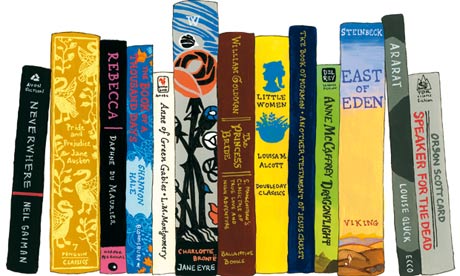
myidealbookshelf1_grande My son gave My Ideal Bookshelf to me for my birthday back in May.  It’s one of those books that is both a pleasure to read and a pleasure to look at. The premise was to ask 100 plus people (writers, designers, chefs, artists, photographers) about their ideal bookshelf.  In other words:

Select a small shelf of books that represent you – the books that have changed your life, that have made you who you are today, your favourite favourites. You begin, perhaps, by walking over to your bookshelf and skimming the spines on the top shelf. You pull down a handful that you remember loving; you grab a couple that you read over and over again. Some you know just by the colour of their dust jackets. One is in tatters – it was passed down by your mother – and it’s dog-eared and carefully held together by tape and tenderness. The closer you look, the trickier the task turns out to be.

You got that right. But before I talk about what I did with My Ideal Bookshelf let me just point out how much fun this book was to read. Although I don’t know everyone whose bookshelves were included, it didn’t matter. If you are a book lover, you are naturally drawn to other people’s bookshelves. You know it’s true. If I am in someone’s house, their bookshelves take precedence over anything else. I must snoop. It’s futile to resist the siren call of the books.

I read My Ideal Bookshelf cover-to-cover. Each person’s shelf is artistically recreated by Jane Mount. For example, this is Stephanie Meyer’s shelf:

meyer

Each shelf is accompanied by a personal reflection. Meyer offers this insight into her choices:

These books contain threads of what I like to write about: the way people interact, how we relate to one another when life is beautiful and horrible. But these books are greater than anything I could ever aspire to create.

None of the commentaries explain the person’s entire collection, but each  offers a glimpse into that person’s reading life.  For example, book designer Coralie Bickford-Smith says “The written word means so much to me. If I design a cover that gets people to pick up a book, then I’ve done my job. I want the younger generation to fall in love with books like Jane Eyre again.”  Interior designer Tom Delavan offers this: “Books are the very best kind of decoration, really. There are two types of books, the ones you read and the ones you have on your coffee table. Both make a space feel like home – you spend time with them, they have meaning for you, and they actually look good, too.” Writer Dave Eggers says “These are the books that crushed me, changed me when I first read them, and to which I have returned many times since, always finding more in them.”

Book lovers always have something to talk about. Always. My Ideal Bookshelf is like a beautiful conversation. With pictures.

I liked the book so much that I thought it would be really cool to ask my students to build their own ideal bookshelves and then write an essay to talk about their reading lives.  There’s a handy template at the back of the book (and it’s also available on their blog). As the school year winds down, this is a great way to have students reflect on the books they’re read – not only during their time with me, but for as long as they’ve been reading. We just got started on Friday, but it was so much fun to walk around and see what had made students’ lists. (When I saw that my Turkish exchange student had Donna Tartt’s The Secret History on her list – we both shared a moment of squealing delight.)

I wanted to take up the challenge, too. I’m going to cheat, though, and do a YA bookshelf and another bookshelf – although there may be some cross-over titles. I am no artist, but here’s what I came up with.

idealbookshelfya

It wasn’t easy to come up with these titles…and I left off a dozen more…so I am looking at this like it’s a snapshot of my YA reading life…including both books that I  read when I was a teenager and younger  (Jane Eyre, A Little Princess, A Tree Grows in Brooklyn, That Was Then, This Is Now and Anne Frank: The Diary of a Young Girl all fall into that category. I read them between 35-40 years ago!) and more recent reads. The thing they all have in common is that I loved them and the characters that inhabit the pages have stuck with me.

My Ideal Bookshelf would make an excellent gift for any book lovers on your list.

I’d love to hear about your ideal bookshelf!

The Raft – S. A. Bodeen

raftRobie, the fifteen-year-old protagonist of S.A. Bodeen’s YA novel The Raft has been back and forth between Hawaii and the island of Midway dozens of times. She lives there with her research scientists parents, but when the novel opens she’s visiting her aunt in Honolulu. When her aunt is unexpectedly called to work on the mainland, Robie isn’t bothered about being alone. She’s used to it and knows how to look after herself.

Looking after yourself on 2.4 square miles of island, as it turns out, is different from looking after yourself in downtown Honolulu. Unfortunately Robie gets accosted on the street one evening — nothing serious — but it spooks her and she decides to take the cargo plane home. Unfortunately, phone and Internet service is spotty on the island and so Robie isn’t able to let her parents know she is coming home. Even more unexpectedly, the plane hits bad weather and goes down. Only Robie and the co-pilot, Max, survive.

This novel is terrific. Like, couldn’t-put-it-down terrific. Robie is resilient and smart and is able to cope with her circumstances better than people twice her age. The raft she floats in leaks, there are sharks in the water — and not much else. It’s impossible to imagine that Robie will make it, but she does.

I don’t want to say too much about the things Robie endures. Once you start reading The Raft you’ll find out pretty quickly because you won’t be able to stop turning the pages. I should also mention that Bodeen slips some compelling stuff about ocean and bird life, conservation and pollution into the mix and it all feels necessary and organic. Robie is at home in this environment and knows “more about ocean fish and seabirds than most post-graduate researchers.” It’s a good thing, too.

Bodeen’s prose is straightforward and Robie’s voice is authentic. In a moment of prescience she remarks: “Lately it seemed there were a lot more days when my life felt less  like luck and way more like suck.”

I’m not one for survival stories, really, but I enjoyed Robie’s tremendously.

Highly recommended.


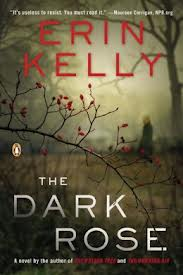
The Dark Rose – Erin Kelly

darkroseSO ANNOYED! I had an awesome review of this book written and when I posted it all that posted was what is below between the **…and I am tired and never going to be able to recreate what I had written and I could SCREAM.

So, briefly:

39-year-old Louisa and 19-year-old Paul are both working on the restoration of a ruined Elizabethan garden in Kelstice, a small town northwest of London. She’s hiding out – as she has done for the past twenty years or so – because she’s still obsessed with the guy she was in love with when she was 18. Paul’s hiding out because his best friend, Daniel, will soon be on trial for murder and he’s the star witness for the prosecution.

Paul’s had a traumatic childhood. He lost his father in a rather traumatic and gory accident which he witnessed. Then he started to get picked on in school and Daniel became his saviour.  He’s really a decent guy who just made some stupid choices because of his loyalty to Daniel.

**It’s also impossible not to relate to Louisa – at least I could relate to her. She falls madly in love with Adam Glasslake, lead singer of the band Glasslake and the more distant and unattainable he is, the more she wants him. What 18-year-old hasn’t been on that roller coaster ride?

After they make love for the first time and after Adam falls asleep, Louisa

…inhaled the thick oily skin between his shoulder blades where he smelled most like himself. If you could distill and bottle the essence of a human being, if you could crush skin like petals , then she would do this with Adam Glasslake. The vetiver scent was faint now, but his neck still bore the visible traces of the oil he had anointed himself with earlier. It was a faint dark green. Below this, on his clavicle, she had marked him for herself, a vivid red circle, half kiss, half bite. She felt intensely female and powerful, like a witch.

Louisa and Adam’s relationship is rocky at best and ends badly and years later she still gives in to a ritual that requires liquor and a few tatty mementos.   The first time she sees Paul she is so overcome that she felt that “the strength of her longing had finally called him [Adam] into being, that she had conjured his spirit.” She is so overcome she “would have smashed through the glass walls of the greenhouse to get away from him.”

When Louisa and Adam’s separate but equally compelling lives intersect, things don’t turn out at all like you might expect. And I mean that in a good way. Kelly does an admirable job making both Louisa and Paul into characters that you actually kind of root for thus elevating The Dark Rose  from run-of-the-mill thriller to literary page-turner.

The Dark Rose is my first encounter with Erin Kelly, but I will certainly be reading more of her work.**

More Than This – Patrick Ness

morethanthis“Here is the boy, drowning” is the opening line of Patrick Ness’s confounding, riveting, philosophical and profoundly moving YA novel More Than This. If you are a regular visitor to The Ludic Reader then you know that I am a Ness fan. I have huge love for his novels A Monster Calls, The Knife of Never Letting Go, The Ask and the Answer and Monsters of Men.

More Than This was my pick for book club and we gathered on Feb 18th to discuss the novel over dinner. The discussion was rich with differing viewpoints; the dinner itself was only moderately successful. My book club – despite the fact that three of its members, myself included, are teachers – doesn’t normally choose YA fiction. The only other book we’ve chosen from the YA canon was Marcus Zusak’s amazing novel, The Book Thief. In any case, as I was reading I had a feeling that my choice might not float everyone’s boat. Even I had trouble wrapping my head around Ness’s ‘big picture.’

More Than This is the story of a boy who, in the novel’s riveting opening, drowns. And then he finds himself, well, not dead.

He seems to be lying on a concrete path that runs through the front yard of a house, stretching from the sidewalk to a front door behind him.

The house is not his own.

And there’s more wrong than that.

For 163 pages, Seth (as the boy eventually remembers) is alone in a post-apocalyptic town in England. This is, as it turns out, the town where he grew up before he moved to America. Bits and pieces of his story come back to him when he dreams. For example, he remembers something horrible happening to his younger brother, Owen, something for which his mother never forgave him. He remembers Gudmund,  a boy for whom he has more than friendly affection. He remembers his other friends, H and Monica. As his previous life filters back to him in dreams, he tries to survive in this new wasteland.

And then he meets Regine and Thomasz. And the Driver, a creepy faceless virtually indestructible being whose sole purpose seems to be to try to catch the three teenagers. And how can there be just them? What has happened to the world?

One member of book club was certain that Seth was suffering from a psychotic break and while her argument is certainly plausible, I am happier taking Seth’s dilemma at face value. I think it’s a more interesting book if we believe in what he sees and experiences. Otherwise, it just feels like Bobby Ewing in the shower.

But believing what Seth does also proves problematic. I’ll admit: I was often confused. But that didn’t negate my love of Seth or his new friends. And, ultimately, I think More Than This has interesting things to say about the myopic lens through which teenagers view their lives. As Seth’s past and present converge, he starts to understand how his story, the story of his life, is unknowable, but that “whatever is forever certain is that there’s always more.”

The last couple of pages of More Than This are outstanding. Some members of my group felt that the novel was 150 pages too long, but I disagree. I think the novel packs a terrific punch and Seth’s journey from self-centered adolescence to manhood is memorable and magnificent.

I continue to be filled with admiration for Ness and look forward to talking about this novel with my students. But make no mistake – this novel has lots to offer thoughtful readers of any age.

Highly recommended.

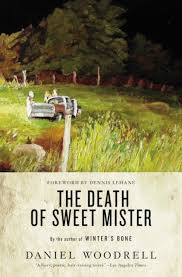
The Death of Sweet Mister – Daniel Woodrell

sweetmisterThe Death of Sweet Mister is grim and virtually unputdownable.

Woodrell’s novel is set in 1960s Ozarks. I don’t know anything about the Ozarks but Wikipedia tells me that “It covers much of the southern half of  Missouri and an extensive portion of northwestern and north central Arkansas. The region also extends westward into northeastern Oklahoma and extreme southeastern  Kansas.”

Morris “Shug” Atkins is thirteen and lives with his mother Glenda and her boyfriend, Red. “The idea that Red was my dad,” says Shug “was the official idea we all lived behind, but I wouldn’t guess that any of us believed it to be an idea you could show proof of or wanted to.”

Red is an ex-con, a mean snake of a man who drinks and does drugs and abuses both Shug and his mother.

…Red was near only the height I was at that age, but a man. He had the muscles of a man and all those prowling hungers and meanesses…

Their lives are just about as miserable as you might imagine them to be.

The three of them live in a house that “looked like it had been painted with jumbo crayons by a kid with wild hands who enjoyed bright colours but lost interest fast”  in the middle of a graveyard. In exchange for their dwelling, Shug maintains the cemetery – mowing and the like.  Red contributes to the family’s meagre existence by sending Shug off to break into houses and steal pharmaceuticals. You know it’s only going to be a matter of time before Shug gets caught.

Shug’s mother, Glenda, is the sort of woman who will never “get too plain or too heavy. Her eyes were of that awful blue blueness that generally attaches to things seen at a distance.” She copes with Red’s nastiness by drinking rum and cola, her special “tea”.

None of the characters in The Death of Sweet Mister seem to hold out much hope for a brighter future, but then into the narrative drives Jimmy Vin Pearce. His shiny green T-Bird and his flashy clothes seem to signal hope, like maybe Glenda and Shug might be able to escape the smallness and meaness of their lives. But one day Shug comes home to find blood had “whirled and whirled in the kitchen.”

I loved the language of Woodrell’s book. I loved Shug’s voice. I felt tremendous sympathy for him. He is a product of his environment and so it’s not particularly surprising how his story concludes. Doesn’t make it any less sad, though.

Highly recommended.


Paper Towns – John Green (with a shout out to John Hughes)

If you are a person of a certain age, you probably have fond memories of John Hughes’ films. Even though I was already in my early 20’s when he started producing arguably the best teen movies ever – I was still young enough to see myself in the characters he committed to celluloid.

Sixteen Candles is my all-time favourite Hughes film, for reasons which will be apparent to anyone who has ever seen the film. I still watch it occasionally and it still makes me laugh and it breaks my heart a little now that Hughes has died.

Yes, you can argue that Jake Ryan isn’t perfect – he did let an underage, unlicensed driver take his very drunk girlfriend home in his father’s Mercedes, but it was the 80’s and, come on,  Jake Ryan is pretty damn dreamy. Also, who didn’t see some part of themselves in the other characters on the screen: Molly Ringwald’s slightly awkward Samantha Baker, Anthony Michael Hall’s loveable dork. Everyone you ever went to high school with is lovingly represented in this flick and in Hughes’ other teen masterpieces, Pretty in Pink, The Breakfast Club,  and Ferris Bueller’s Day Off. 

I would posit that John Green is this generation’s John Hughes and I hope Mr. Green will consider that a compliment because it is certainly meant as one.

Last year because everyone and their dog was reading The Fault in Our Stars I did, too. That was a reading experience I will never forget – curled in the fetal position on my bed at 2 a.m., laughing then crying, then laughing again. That is the experience I want my students to have.

PaperTowns2009_6AThe only other John Green book I have in my classroom library is Paper Towns and I just finished it yesterday. (Trust me, I’ll be rectifying the lack of Green books post-haste.) Paper Towns received rave reviews and the Edgar Award (a prize awarded by the Mystery Writers of America) and it’s totally deserving of both.

Quentin Jacobsen is just weeks away from graduating from high school when his next door neighbour Margo Roth Spiegelman shows up at his window in the middle of the night. Although Quentin and Margo had been childhood friends, they’d drifted apart as they’d gotten older and now, in Quentin’s eyes at least, Margo is this exotic and beautiful creature, but not necessarily his friend.

Margo Roth Spiegelman, whose six-syllable name was often spoken in its entirety with a kind of quiet reverence. Margo Roth Spiegelman, whose stories of epic adventures would blow through school like a summer storm: an old guy living in a broken-down house in Hot Coffee, Mississippi, taught Margo how to play guitar. Margo Roth Spiegelman, who spent three days traveling with the circus – they thought she had potential on the trapeze.

The stories, when they were shared, inevitably ended with, I mean, can you believe it? We often could not, but they always proved true.

Quentin’s best friend, Ben, describes Margo as “the kind of person who either dies tragically at twenty-seven, like Jimi Hendrix and Janis Joplin, or else grows up to win, like, the first-ever Nobel Prize for Awesome.”

Anyway, Margo needs Quentin’s help. She also assures him that this will be the best night of his life. Quentin is a guy who generally plays by the rules, so his decision to help Margo is slightly out of character for him. Nevertheless, he helps Margo carry out a list of tasks, some of them vengeful and some of them contemplative and he is indeed changed by the experience. Which is why when Margo suddenly disappears, he is compelled to follow the breadcrumb trail of clues she’s left behind.

Paper Towns is a clever mystery for sure, but that’s not the only reason to admire the heck out of it. What I love about John Green is the way he writes dialogue. His characters are smart and funny and honest-to-goodness people. In the same way that John Hughes made his characters painfully awkward or awesome or self-deprecating or ironic, Green’s teens are whole and fragile and super smart and laugh-out-loud funny.

And they think thinky-thoughts. The fact that Paper Towns is set in Orlando, Florida (John Green’s hometown) is significant. Margo says “you can see how fake it is…It’s a paper town. I mean, look at it Q: look at all those cul-de-sacs, those streets that turn in on themselves, all the houses that were built to fall apart.”

Quentin’s journey to find Margo makes him question not only everything he thought he knew about her, but also everything he believes about himself and Green does a great service to his characters (and the young adults who will be reading this book) by not giving us pat answers.

So – read John Green. Watch John Hughes. Through their eyes you’ll see teenagers at their worst…and their best. And it’s all beautiful.

Story of a Girl – Sara Zarr

storyofagirlSara Zarr’s debut novel Story of a Girl kept me turning the pages far past my bedtime – a sure indicator of its quality. I read before bed and most nights I’m lucky if I manage a couple dozen pages, but last night I settled in early and once I started, I couldn’t stop.

Story of a Girl begins with sixteen-year-old Deanna Lambert’s admission that she “was thirteen when my dad caught me with Tommy Webber in the back of Tommy’s Buick, parked next to the old Chart House down in Montara at eleven o’clock on a Tuesday night. Tommy was seventeen and the supposed friend of my brother, Darren. I didn’t love him. I’m not even sure I liked him.”

Deanna had been parking with Tommy for a year before she’s finally caught, but her dad’s discovery of her in a compromising position casts the reality of her life in a harsh light. Now her dad can barely look at her. And when the novel opens, at the end of sophomore year (that’s grade ten here in Canada), it’s clear that the story of her tryst with Tommy is still the topic du jour in her small hometown of Pacifica, a sea-side suburb of San Francisco. At least pretty much everyone at Deanna’s high school knows about it – or some version of it. The only people who don’t care are her two best friends: Jason, a boy she’s known forever and Lee, a girl who moved to Pacifica after the incident.

Story of a Girl takes place during the summer between sophomore and junior year. Deanna’s strained relationship with her dad causes her to daydream about leaving home and living with her older brother Darren, his girlfriend, Stacy and their infant daughter, April. Currently they live in the basement. Stacy and Deanna’s dad don’t get along. In fact, Deanna’s household is pretty dysfunctional and so Deanna quickly finds work at a local pizza dive…where, it turns out, Tommy also works.

What I loved about this book was how realistic it seemed. Everyone judges Deanna for a decision she made when she was thirteen, but it isn’t until she comes into contact with Tommy again that she figures out why she always went off with him. And forgiving him – and herself – also allows her to empathize with her father.

…I imagined us through his eyes – his family, sitting in a pink kitchen: his tired wife, who never complained; his son who looked exactly like him; his daughter, who used to be the baby, his baby girl; and now April, his grand-daughter, who had a whole life in front of her, with no real mistakes in it yet. Could he look at us someday, I wondered, maybe today, and not be disappointed? Could he see us, and himself, for who we really were?

Story of a Girl is a beautiful book because, although it is Deanna’s story, no one’s life is lived in isolation. This is a book about family – the family given to us by  biology and the family we choose. The path to adulthood is thorny and it’s good to have some people who are on your side.  There are no villains in this book. Even Tommy, douche that he is, is probably trying to fill in the gaps in his own life. The thing is, we carry our mistakes with us and as Deanna’s boss at the pizza place, Michael, tells her: “…don’t mistake a new place for a new you.”

Big love for this book.

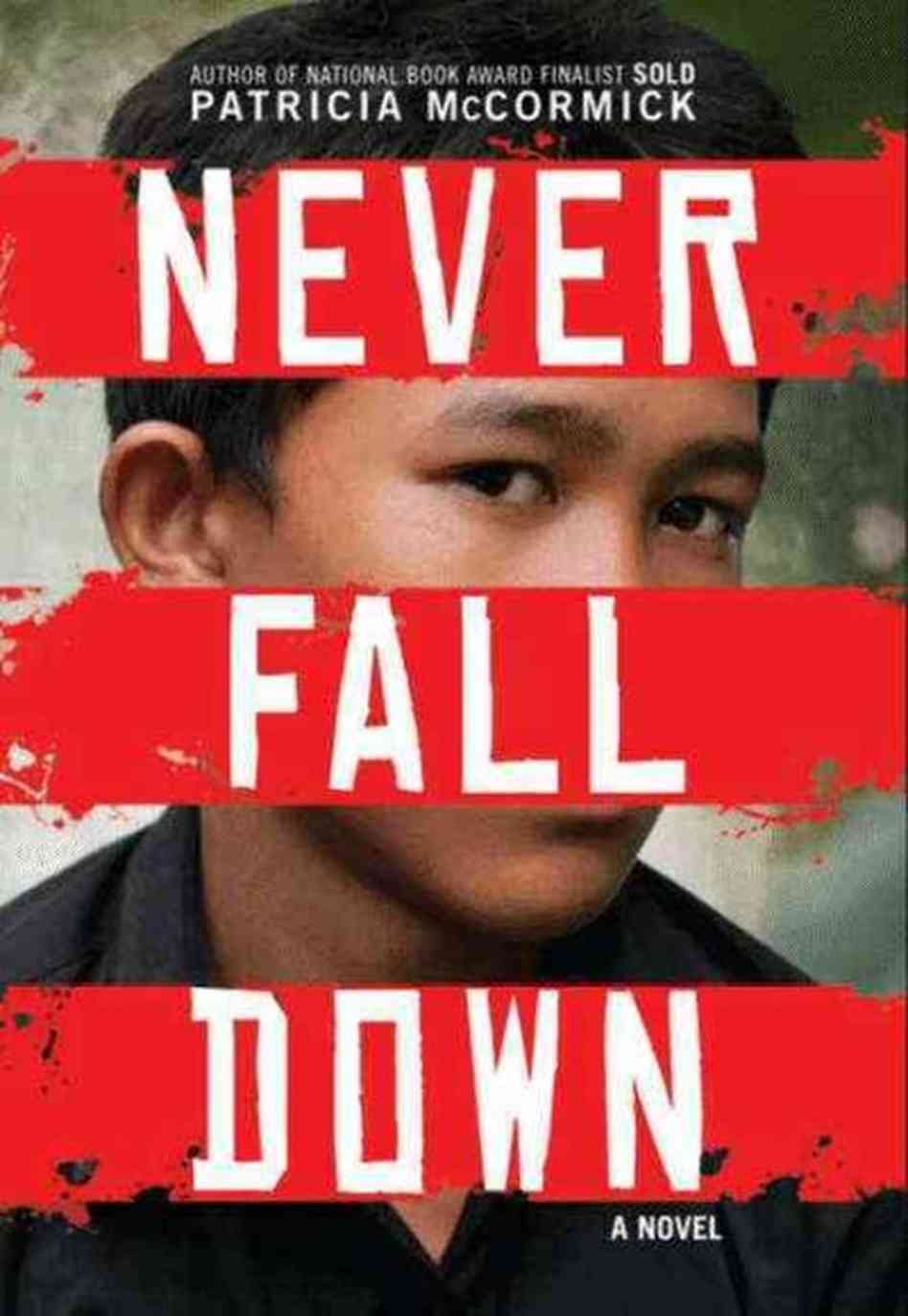
Never Fall Down – Patricia McCormick

neverfalldown Arn Chorn-Pond, the young narrator of Patricia McCormick’s novel Never Fall Down, finally escapes Cambodia and  makes it to the safety of Thailand sometime in the spring of 1979.  At the very same time, I was getting ready to graduate from high school. I knew nothing of the Khmer Rouge and their violence – or if I did, I don’t remember. Reading Arn’s story has reminded me again of the priviledged life I’ve lead and of the absolute power of literature to crack open the insulated world in which we often live.

Arn is just eleven when the Khmer Rouge, a radical Communist regime, and an offshoot of the Vietnam People’s Army, sweeps through Cambodia displacing people and separating families. Arn has lived a relatively happy life up until then. He says, “At night in our town, it’s music everywhere. Rich house. Poor house. Doesn’t matter. Everyone has music.”

When the army blows through town, it’s exciting. Arn says, “…I think this is the most exciting thing to happen here. Real Americans coming. Real airplane.” But that excitement doesn’t last. Soon Arn, his aunt and his siblings (four sisters and one brother) are marching out of town with everyone else. And then the real horror begins.

And this book is horrific.

McCormick spent two years interviewing Arn and then  made the choice to tell his story as a novel because “like all trauma survivors, Arn can recall certain experiences in chilling detail; others he can only tell in vague generalities.”  It’s no wonder his mind has decided to compartmentalize; the atrocities he’s witnessed are almost unbearable.

But Arn does bear them. He survives the separation from his family, the endless work in the rice fields, the starvation, illness, walking miles and miles through the heat. He makes himself indespensible by learning to play an instrument, but even that doesn’t save him from witnessing the Khmer Rouge’s atrocities against men, women and children.

And then, even more horrible, Arn suddenly finds himself with a gun in his hand, fighting with the very people who have held him captive for more than three years. Never Fall Down is a survival story because Arn surely does that.

McCormick makes the decision to tell this story in Arn’s distinctive sing-song voice and it’s a wise choice. We see everything though his eyes and he is a truthful and unflinching narrator.

One night the girl next to me at dinner, she dies. She dies just sitting there. No sound. Just no breathing anymore. All of us, we eat so fast, no one even see this girl. Very quick, I take her bowl of rice and keep eating.

I guess we can never really know what we’re capable of until we are put in the situation where our limits might be tested. Arn was a remarkable boy and he has turned into a remarkable man, a champion for humanitarian causes around the world and the winner of many international prizes. Never Fall Down is a must read book.

This video explains  what happened during that period.

I also highly recommend the movie, The Killing Fields.