The Sense of an Ending – Julian Barnes

I didn’t get a chance to write my thoughts about Julian Barnes’ Booker Prize winning novella, The Sense of an Ending, back when I actually finished it – which was in June.  The book deserves a much more thoughtful review than I am likely to give it here.

Narrated by Tony Webster, a divorced father with a grown daughter, The Sense of an Ending is a meditation on youth and the ways in which our memories are often skewed by our desire to remember ourselves differently from how we actually were.

“We live in time – it holds us and moulds us – but I’ve never felt I understood it very well,” Tony says. He also tells the reader that he is “not very interested in his schooldays, and don’t feel any nostalgia for them. But school is where it all began…”

It is at school that Tony and his friends meet Adrian Finn, “a tall, shy boy who initially kept his eyes down and his mind to himself.” Adrian is bright, clearly smarter than Tony and his friends – or perhaps just more thoughtful, more willing to question the subjects (particularly history) that he is being taught.

History is the certainty produced at the point where the imperfections of memory meet the inadequacies of documentation.

At the end of school, the four boys go their separate ways.  Tony  meets a girl, Veronica Ford, and it is this relationship which sets  the story in motion. Things with Veronica end badly and when she ends up dating Adrian, Tony is hurt and angry.

How this threesome plays out makes up the bulk of the story, but it isn’t a traditional love triangle. This is really a story about who we were, who we become and how we alter our memories to accommodate our own version of ourselves.

The Sense of an Ending is one of those books which would certainly benefit from repeat readings – and trust me, it wouldn’t be a hardship. Barnes’ prose is precise and devastating. The book reads like a mystery and in a way it is – we are often mysteries to ourselves and it is only when our memories are challenged that we see the person we have been.

Monsters of Men – Patrick Ness

My love affair with Patrick Ness’s Chaos Walking trilogy began with The Knife of Never Letting Go. The next book, The Ask and the Answer was also fabulous. Last night I finished the third book, Monsters of Men. I am not ashamed to say that I cried.

Monsters of Men begins on the eve of war. Todd and the Mayor, and  Viola and Mistress Coyle are not only at a stand-off with each other, The Spackle (the indigenous people of New World) have risen up to annihilate them. War proves to be frightening and messy and dangerous.

The flames spill out from the top of the horned creacher and cut thru the middle of soldiers and men are screaming  and burning and screaming and burning and soldiers are turning back and running and the line is breaking and Angharrad is bucking and bleeding and squealing and we’re slammed by a wave of men retreating and she bucks up again and–

The lines between hero and villain, good and evil, are  blurred in Monsters of Men. I found my feelings about the Mayor constantly changing. Is he a decent man caught up in extraordinary times? Is he a master manipulator? Is he a monster? Mistress Coyle didn’t fair much better in my estimation. Viola and Todd ask the same questions about the adults nearest them and as they aren’t physically together for much of this book, they also ask it of each other. How have circumstances changed them?

There’s also a new point of view to consider in Monsters of Men: the Spackle. For the first time we get to hear their noise. Truthfully, I found some of this bothersome because of the names they ascribed to things: the Burden, the Clearing, the Knife, the Sky, the Source. I was caught up in the narrative and it slowed me down trying to figure out who or what  they were talking about. Nevertheless, the Spackle are no longer a faceless enemy — if they ever were the enemy at all.

There are big questions to be considered in this novel, in the series as a whole. Despite the fact that Chaos Walking is marketed as a Young Adult series, Ness doesn’t shy away from asking them. Why do we fight? What does it mean to be human? I even think there is something in the books about this information age — the constant bombardment of data and noise we endure every day. With no quiet space to think, don’t we all have the potential to be driven a little mad? Alternatively, can’t we use this information to better understand and empathize with each other?

As the Mayor says to Todd near the end of the book, “War makes monsters of me, you once reminded me.” It is messy business, to be sure. But there is great humanity in these books. And Todd and Viola, as characters, will be with me for a long, long time.

A Must Read series!

The Slap – Christos Tsiolkas

If you are not easily offended, The Slap is one hell of a book. I just now randomly opened it and counted half a dozen raunchy references to sex and another half dozen expletives. Tsiolkas throws around the ‘c’ word like he’s talking about making a cup of tea. Yet, The Slap is a very human story, albeit one filled with polarizing characters.

At our book club discussion, our moderator (that’s the person who chooses the book) asked us to write the name of the most reprehensible character on a slip of paper. Then she asked us to name the most sympathetic character. She wanted our thoughts on paper before we began talking and were swayed by opposing opinions. Then we began to discuss the book, the premise of which is simple enough. A group of disparate characters gather at the Melbourne home of Hector and Aisha for a barbeque. Hector is a gorgeous Greek man and Aisha is from India and owns her own veterinary clinic. They have a couple young kids. There are cousins and parents and friends and co-workers in attendance. One of the guests slaps the face of four-year-old, Hugo, who was going to — so the slapper thought — bash his son with a cricket bat. Hugo’s parents press charges.

But The Slap isn’t really a book about what becomes of Hugo and his parents or how the trial plays out. Tsiolkas drops in and out of the lives of various characters (one at a time a la Jodi Picoult only WAY more sophisticated and profane), giving us snapshots of their lives and insight into their feelings about the slap. We don’t hear from every character at the bbq and, interestingly enough, some of the characters we do hear from seem like unusual choices. The beauty of the book, though, is that we do get to know the characters well, feeling empathy, admiration and repulsion in equal measure – sometimes all at once for the same character.

The Slap, as another member of our group pointed out, is quite unlike anything else our group has ever read…and that’s saying something considering we’ve been meeting for 13 years. It isn’t just the language — which takes some getting used to even for someone like me who has been known to drop the occasional ‘f-bomb.’ Several of us agreed that we had a visceral reaction to the book and the characters: hard drinking, racist, violent, irreverent and funny drug users – the whole lot.  The Slap is thrumming with energy. It is almost impossible to put down.

Tsiolkas has important things to say about love, though – not just the love between a man and a woman, but the love between friends,  and parents and children.

This, finally, was love. This was its shape and essence, once the lust and ecstasy and danger and adventure had gone. Love, at its core, was negotiation, the surrender of two individuals to the messy, banal, domestic realities of sharing a life together. In this way, in love, she could secure a familiar happiness.

The Slap is an excellent novel.

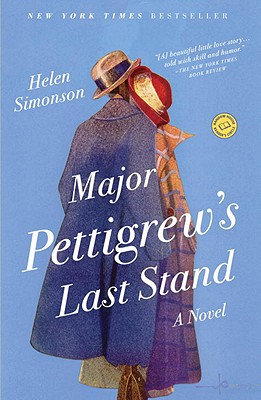
Major Pettigrew’s Last Stand – Helen Simonson

Helen Simonson’s debut novel Major Pettigrew’s Last Stand is the next best thing to spending a holiday in the English countryside. When we meet the title character, Major Ernest Pettigrew (retired), he’s just received the news that his younger brother, Bertie, has died. He’s trying, rather unsuccessfully, to cope with the news when Mrs. Ali, proprietress of the local village shop, appears at his door to collect the paper money. She takes note of his unsteady appearance and  offers to make him a cup of tea. Thus begins their relationship.

Mrs. Ali was, he half suspected, an educated woman, a person of culture. Nancy had been such a rare person, too, fond of her books and of little chamber concerts in village churches. But she had left him alone to endure the blunt tweedy concerns of the other women of their acquaintance. Women who talked horses and raffles at the hunt hall and who delighted in clucking over which unreliable young mother from the council cottages had messed up  arrangements for this week’s play group at the Village Hall. Mrs. Ali was more like Nancy. She was a butterfly to their scuffle of pigeons. He acknowledged a notion that he might wish to see Mrs. Ali again outside of the shop, and wondered whether this might be proof that he was not as ossified as his sixty-eight years, and the limited opportunities of village life, might suggest.

Major Pettigrew’s Last Stand is one of those little gems of a novel – beautifully written, with characters so remarkably authentic they seem to jump off the page. Pettigrew is a widower and Mrs. Ali, too, has lost a spouse. They are drawn together because of a shared love of Kipling, but they live in a small town – everysmalltown, really, where everyone knows your name and your business – and not everyone would have them together. Although Mrs. Ali was born in England, she’s Pakistani and therefore viewed by some as ‘unsuitable.’ I think Pettigrew’s feelings for her take him quite by surprise.  I suspect he thought that at 68, that part of his life was over.

In some ways, Pettigrew is a stuffed shirt. He likes things ‘just so.’ He desires attention and often  believes he’s entitled. The beautiful thing about him, though, is his willingness to change, and he does, too. His relationship with his son, a pompous banker who lives in London, undergoes a transformation. He starts to care less about tangible things, like a pair of shotguns that had once belonged to his father, and more about feelings and people.

To say that nothing much happens in Simonson’s novel is to miss the quiet patina of daily  life – much of which, at least as it’s written here, is laugh out loud funny. As people plan parties that can only go awry, as children squabble over their rightful inheritance, as the battle-lines are drawn between cultures, Major Pettigrew tries to find a way to navigate the messy business of living. He is proof that life does offer second chances, if we are brave enough to open our hearts to receive them.

The Ask and the Answer – Patrick Ness

Oh, Todd. Oh, Viola.  You’re breaking my heart.

Patrick Ness has done it again with the second book in his Chaos Walking trilogy. When we left Todd and Viola in The Knife of Never Letting Go, they were running for their lives into the town of Haven. Well, Todd was running at least; Viola had been shot.

Haven turns out to be exactly the opposite; the pair are captured and separated. When Todd comes to, he is tied to a chair and the Mayor (remember how evil he was in the last book? You ain’t seen nothing yet!) is interrogating him. But all Todd can think about is Viola.

“Where is she?” I spit into the dark, tasting blood, my voice croaking, my Noise rising like a sudden hurricane, high and red and furious. “WHERE IS SHE?”

“I will be the one doing the asking here, Todd.

That voice.

The opening scene in The Ask and the Answer is but a taste of the horrors to come. Ness doesn’t pull any punches: literally.  Haven has been taken by the Mayor and his men and Todd finds himself separated from Viola.  No one is safe and the lines between who is good and who is not are constantly shifting.

The Ask and the Answer is about war. The themes are universal: outsiders rounded up like cattle and branded; a leader crazy for power (or perhaps just plain crazy), and two kids trying desperately to make meaning and find a way to do the least damage.So much comes at them and I often forgot that they were just kids. That was the hardest thing to believe about the whole book: Todd is supposed to have just turned 13 and he seems a lifetime older.  But I am looking at him from my cushy, never-been-in-war, perspective. Who knows what you might be capable of if there was no alternative.

And that question is at the very centre of Ness’ terrific book. If you had no choice – what would you do? If you thought all was lost – what would you do? People constantly surprised me in this book, particularly the Mayor’s son, Davy. It’s a testimony to Ness’ considerable talent that he is able to make Davy sympathetic.

As for Todd and Viola – they continue to be resourceful and bloody amazing and true to each other is ways that are both heart-breaking and inspiring. They’re so brave and so resilient, I hated to leave them again.

Book three, coming up: Monsters of Men

The Knife of Never Letting Go – Patrick Ness

Patrick Ness …I think I may love you just a little bit. Okay, maybe a lot. I can’t remember the last time I read a book where I literally had to force myself to slow down while reading. I’d start a page and I just couldn’t stand it – my eyes would race to the bottom of the page, skip over to the next page…I was so invested in these amazing characters and this  story and look, I’m doing it here.

Context coming right up.

The Knife of Never Letting Go is the first book in the Chaos Walking trilogy (The Ask and the Answer and Monsters of Men are the other two titles in the series.) I purchased it based on someone’s blog review – sorry, don’t remember the blog – and it languished on my tbr pile for several months before I finally picked it up. I read about 10 pages and put it aside. I had the same sort of lukewarm feelings about the book as I did after my first attempt to read The Book Thief. And we all remember how that turned out, right?

The second time I picked up Ness’ book, I fell into the narrative. By page 38 there was NO WAY I was putting the book down; I couldn’t have put it down even if I’d wanted to.

Todd is just days away from becoming a man; that’s what he’ll be on his 13th birthday. He lives in Prentisstown, a place notable for two reasons: there are no women and everyone can hear everyone else’s thoughts. Todd calls it the ‘noise’ and we hear about as he heads off to the swamp to pick apples.

…the swamp is the only place anywhere near Prentisstown where you can have half a break from all the Noise that men spill outta theirselves, all their clamor and clatter that never lets up, even when they sleep. men and the thoughts they don’t know they think even when everyone can hear. Men and their Noise. I don’t know how they do it, how they stand each other.

This visit to the swamp is remarkable though; Todd hears…silence. But that can’t be because “there’s no such thing as silence. Not here, not nowhere. Not when yer asleep, not when yer by yerself, never.” When he returns to the home he shares with Ben and Cillian, he gets an even bigger surprise: Ben tells Todd he has to go. There is no time for discussion or explanation, Todd must run.

The shocks keep coming for young Todd and his faithful dog, Manchee. (And can I just say here that I have never been one to fall for the old ‘boy and his dog’ story until now – I love that dog, whose thoughts Todd can also hear.)

Patrick Ness has created a compelling, suspenseful narrative.  Todd’s life is constantly in danger and  he has to keep adjusting his own story because, clearly, he hasn’t been told the whole truth about the town he comes from or even his own personal history. He leaves Prentisstown with a book he can’t read and a knife and a sense of urgency that propels him forward with barely a chance to catch his breath. I felt like that, too.

I know that dystopian literature is all the rage these days and yes, I am a fan of The Hunger Games, but I think Ness has done something else quite original with The Knife of Never Letting Go. This is a story that grabs you by the throat and shakes the living daylights out of you for 479 pages.  The subject matter is often dark. The character of the preacher, Aaron, is one of the creepiest psychopaths I’ve encountered in literature in a long, long time. And this is a book I want to hand to people and say “read this now!” I love it when that happens.


One Day – David Nicholls

One Day was the first book of our book club’s 2011-12 reading season (and our 12th year together!) After last year’s (mostly) snooze-a-palooza, it was terrific to come back to some current fiction. One Day comes with a little bit of hype, but I think it totally delivers on its promise.

Emma and Dexter  meet on the eve of their graduation from the University of Edinburgh in 1988. Although Emma has admired Dex from afar, this is their first real encounter and she is totally smitten. Although they come from different worlds (Emma is working class and Dexter comes from money) their one (unconsummated) night begins a friendship that we see in snapshots over twenty years. The beauty of Nicholl’s novel is that we revisit Dex and Emma on the same day, July 15th, and sometimes threads of their lives are left dangling.

In the beginning, both Emma and Dexter suffer from post-college malaise. What are we going to do with our lives? Dexter travels and Emma writes him long letters. He falls into a plum job in TV production. Emma works at a crappy tex-mex restaurant, then becomes a teacher. Through it all they prop each other up and tear each other down in the manner of friends who might be more if only they could get their act together.

This is one of the things Nicholls handles so beautifully in this novel. He juggles their lives – their various liaisons and miscommunications- with such finesse. Even when Dexter is acting like a complete prat we see exactly what Emma sees in him. When Emma is perhaps too serious, we just want to shake her. They are beautifully realized characters, flawed and heartbreakingly fragile.

But Nicholls has even more in store for the reader. The book’s denouement adds a layer of richness to the story, bringing us full circle and allowing the reader to consider the infinite possibilities inherent in just one meeting. Oh, the difference a day makes.

I loved this book.

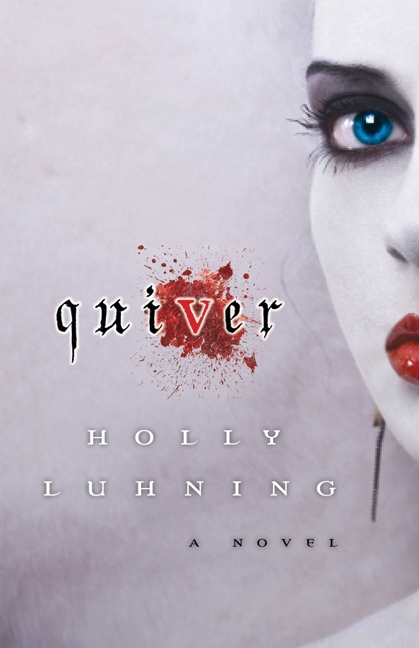
Quiver – Holly Luhning

Saskatchewan native Holly Luhning  has written a compelling novel based on the shocking life of the Hungarian Countess, Elizabeth Bathory.  Bathory, who was born in 1560, earned her shocking reputation for having tortured and killed over 600 young girls so that she might bathe in their blood and thus retain her youthful beauty.

Luhning’s novel, Quiver, is a creepy crawly book that follows Danica, a young foresnic psychologist, who has moved to London with her artist boyfriend, Henry, to work at Stowmoor, a Victorian hospital for the criminally insane. Danica’s patient is Martin Foster, a young man incarcerated for murdering a young girl as a tribute to Bathory.

Danica’s fascination with Bathory grows when a woman from her past, the  beautiful and duplicitous Maria, comes back into her life. Maria, it seems, has discovered Bathory’s private diaries and as she translates them and begins sending the horrific snippets to Danica, Danica’s life starts to shift.

We’re all, to some degree at least, train-wreck fascinated by the heart of darkness.  Danica’s morbid curiousity about Bathory (and the translated diary entries are not for the weak-stomached, believe me!) is complicated by her attraction/repulsion to Maria. Maria is impossibly beautiful and crazy-cool. I didn’t trust her at all, but I could see Danica’s attraction. There was something sinister about her and always an undercurrent of sexual attraction, too.

Quiver races along like the best thrillers, but it also has something compelling to say about art and that 15 minutes of fame so many of us seem to desperately crave.

The Book of Lost Things by John Connolly

Once upon a time – for that is  how all stories should begin – there was a boy who lost his mother.

Thus begins John Connolly’s amazing story The Book of Lost Things. When I finally turned the last page of this book this morning, I felt that keen sense of satisfaction one feels when they have read an amazing book, a book you know you are going to recommend to everyone. I loved every minute of it.

David is just twelve when his mother dies. An only child, David is devoted to his mother and does everything in his power to keep her alive.

He prayed. He tried to be good, so that she would not be punished for his mistakes….He created a routine, and he tried to keep to that routine because he believed in part that his mother’s fate was linked to the actions he performed.

David is not able to save his mother however; she dies. Soon after, his father remarries and he and his new wife, Rose,  have another son, Georgie. David, still heart-broken over the loss of his mother, resents his father’s wife and his new brother.

This family drama plays against the backdrop of WW2. One night, after a fight with Rose, David escapes to the garden. From the sky, a German bomber falls and to escape, David slips into a crack in the swimming pool cum sunken garden. He finds himself, suddenly, in another world — a world of dark and twisted fairy tales.

I am making the book sound much simpler than it actually is. The Book of Lost Things is a coming-of-age-tale and a hero’s journey, a quest for truth and a horror story all rolled into one. Fairy tales, many familiar, are upended, revealing their slimy and rotten underbellies. David’s youth is slowly taken from him as he must fight, both alone and with companions, for his survival.

David begins his journey as a scared and self-involved adolescent, but as he makes his way towards the castle where the old king apparently has a ‘book of lost things’ which may have the answer to how David can get home, he matures and comes to understand certain truths. It’s an exciting  story — funny in places, creepy in others.

And like Dorothy’s journey to Oz, David soon comes to understand the value of what he has left behind. At journey’s end, he is  a changed person. I was profoundly moved by the book’s final pages.

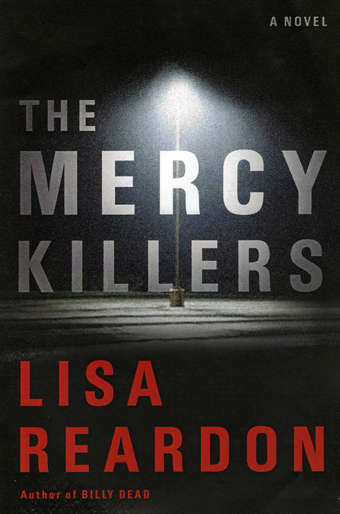
The Mercy Killers – Lisa Reardon

I first discovered Reardon a few years back when I read Billy Dead, a novel that continues to haunt me. The Mercy Killers has been on my tbr shelf for ages but I kept putting off reading it because its subject matter didn’t really appeal to me. Once I started it, though, I couldn’t put it down.

Lisa Reardon writes about characters who live in a world vastly different from my own. They are broken-down people whose lives are messy – filled with violence and alcohol and drugs and hopelessness.

The Mercy Killers concerns the fortunes (and misfortunes) of a group of people who hang out at Gil McGurk’s bar. When the novel opens, one of the regulars, Old Jerry, is complaining about his inability to take a bath. He wants to die.  It’s his birthday.

PT is one of Old Jerry’s grandsons. He’s nineteen and developmentally delayed after suffering one too many beatings at the hands of his father. Charlie, PT’s younger brother, is a petty criminal. He hangs out with Gino whose “bottle blue eyes and falling black hair” make him attractive to Gil’s daughter, Katie. Thing is, Gino’s not interested in women.

When PT decides to grant his grandfather’s wish and smothers him with a pillow, Charlie and Gino decide to cover up the crime. This propels the novel forward; Charlie ends up in Vietnam. Gino, too.

Although these characters weren’t familiar to me – the bonds of family and friendship, the small acts of kindness  in unexpected places certainly were. Charlie is fiercely protective of his older brother, the brother who had put himself in harm’s way to protect him against their violent father as children. Although Charlie is not without his flaws, he has the potential to be decent and it is this inherent goodness on which other characters (Gino in particular) hang their hopes.

Reardon’s writing is propulsive. As with Billy Dead I couldn’t stop turning the pages. I wanted one of these characters to break the cycle of violence and addiction. While there’s no question that Vietnam has a role to play in this book – and that the psychological aftermath of that horrific war adds another layer of despair to the lives of the characters – it is clear that sometimes our own choices cause just as much pain.

As I was surfing around the web looking for a picture of the book, I came across a few stories about Reardon’s personal life. In August 2009, she shot her father. She didn’t kill him, but apparently she meant to. From what I have read, it seems like there was some bad blood between them. When asked whether he knew of any reason Lisa would want to harm him he said “yes,” but wouldn’t elaborate.

Perhaps the marginalized and damaged characters Reardon writes about are cut from personal cloth. I feel badly that she’s had some  trouble. I think she’s an amazing writer.