Bird by Bird by Anne Lamott

I’ve been a writer for as long as I can remember. At first I typed my stories on a little portable Brothers typewriter. I remember that it was blue and that you had to really hit the keys hard. When I graduated from high school, my parents gave me an electric typewriter that weighed at least 50 pounds. At the time it was state-of-the-art, honest.

I have always wanted to be a writer, a published writer and I guess I am. I’ve written and had things published and even been paid for what I’ve written.

Of course the writer’s carrot is the novel and I’ve been slogging away at one – never with the dedication and determination to actually finish it, of course, just enough to say that I’m writing one – for over a decade.

Anne Lamott’s book Bird by Bird speaks to writers who care more about the craft and less about the imagined glory. This is not a how-to book. It’s not a book filled with prompts and practical advice about how to write pithy dialogue or set the scene. Still, it’s a wonderful book.

The very first thing I tell me new students on the first day of a workshop is that good writing is about telling the truth.

Bird by Bird offers  “some instructions on writing and life.” It’s Lamott’s love letter to the written word – and she clearly does love them – the words, I mean.  It  is laugh – out – loud funny and tender, too.  Lamott navigates the writer’s world with a great deal of affection and a healthy dose of tough love. She’s honest about her jealousy when faced with the success of writers she believes to be less talented than she is;  she discusses the pitfalls of the blank page;  she talks about how to negotiate with your characters. But mostly she talks about why we write (and why we read). She says:

Writing and reading decrease our sense of isolation. They deepen and widen and expand our sense of life: they feed the soul.

Writing, says Lamott, is important work. Writers should write, not for the notoriety which they assume comes with publication (and Lamott tells some funny stories about the so-called status of the published author) but because they have to. They want to. They must.

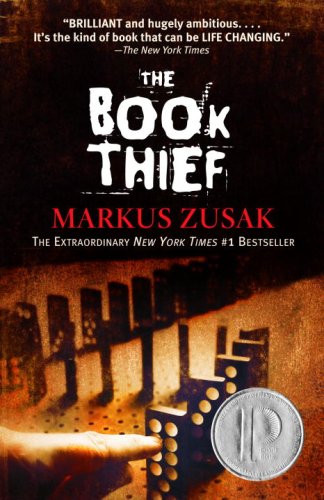
The Book Thief by Markus Zusak

I still remember the feeling I had the first time I read The Diary of Anne Frank. I was probably about 11 or 12. No teacher could have explained the horrors of Nazi Germany to me as well as Anne did. She was speaking to me. Many years later, I visited her attic annex and it was a profound experience.

Reading The Book Thief was also a profound experience for me.

I don’t even know how to begin to talk about The Book Thief. The New York Times said it was “the kind of book that can be life changing.” I mean, you start a book like that with a little trepidation: can it really live up to all the hype? For the first 30 pages or so I thought, “no.” Last night, as I closed the book and wiped the tears away I thought, “every person alive should read this book. I want to teach this book.”

The Book Thief has so many things going for it, I’m not sure where to start singing its praises.

The Book Thief is the story of Liesel Meminger.  Liesel is almost ten when she ends up in Molching with Hans and Rosa Hubermann, her new foster parents. It is 1939. In Nazi Germany.

Readers are either going to be totally enchanted or annoyed by the story’s central conceit: the novel is narrated by Death. “Here is a small fact, ” Death tells us. “You are going to die.” For the next 500-plus pages, Death is our constant companion. Sometimes the action unfolds without commentary, other times he weighs in.  Although I found the first 30 pages or so a bit of a slog, I soon settled into the book’s rhythms.

Then I fell in love with Liesel. And Hans. And Rudy. And Rosa.

Liesel is extraordinary. She and Hans bond late at night, when Liesel’s nightmares wake her, and Hans teaches her to read. Books and words are central to Liesel’s story. So is her friendship with Rudy, the boy next door. Through their eyes we see Hitler and Nazi Germany; we experience the atrocities and the small kindnesses. Zusak’s story is mostly about everyday things: hunger, pettiness, laughter, hope, cruelty and kindness.

Liesel is sustained by the books she steals and anyone who loves words will appreciate and understand their ability to comfort Liesel. But she is also intelligent enough to understand how words can be used to hurt and coerce.

Where is Death in all this? He carts the souls of the dead off and is, in this story at least, a loving and benign figure.

Death gets the last word. He always does.

Instruments of Night by Thomas H. Cook

There’s a really great interview with mystery writer, Thomas H. Cook, in the September ’09 issue of January Magazine. In the article Ali Karim asks the very question that puzzles me every time I finish one of Cook’s novels. Why is this man not enormously famous? I mean, perhaps he is famous in mystery circles – but even if you’re not a fan of the genre, I think you should still give Cook a go.

I picked up Instruments of Night on Friday night and read about 30 pages. It was late when I started and so eventually my eyes gave out. On Saturday I picked it up again and didn’t put it down until I finished – with a gasp, I must add – the book.  I stumbled on Cook totally by accident three or four years back. I picked up, at a second hand bookstore, his novel Breakheart Hill and read these lines: “This is the darkest story I ever heard and all my life I have labored not to tell it.” Hooked. 

Instruments of Night is the fifth novel I’ve read by Cook. It’s the story of writer Paul Graves, a man who has spent his career writing about the horrible dance between serial killer and sadist Kessler (and his accomplice, Sykes) and the man who has spent his career chasing him, Detective Slovak. Instruments of Night operates on more than one level, though. Graves has almost completed the 14th installment of his series when he is invited to upstate New York to meet with Allison Davies, mistress of an estate known as Riverwood. Fifty years ago, Allison’s best friend, Faye, was murdered on the grounds and now Allison wants Paul to “imagine what happened to Faye. And why.”

But that’s not all. Paul Graves is a tortured man. His own past is filled with ghosts, horrible ghosts. He is a beautifully nuanced character and I particularly admired the glimpse we got into his head as a writer. Perhaps Cook was revealing a little bit about himself there, I don’t know, but Paul’s imagination allowed him to write scenes, and adjust them as needed, on the fly. Using this technique, he attempts to solve the question of who killed Faye.

The way Cook juggled the three threads of this story: the mystery of Faye’s death, the stand-off between Kessler and Slovak and the past that is creeping up on Paul is nothing short of amazing. But Cook is an accomplished writer. And this is literature. Truly. Page-turning, white-knuckling, horrifying literature. In every book I’ve read by him, I’ve been amazed at how complex his characters are and Paul is no exception.

If you haven’t read Cook yet, I beg you to give him a go. He’s fabulous!

How I Live Now by Meg Rosoff

How I Live Now by Meg Rosoff  has been on my tbr shelf for a few months. Coincidentally, a friend gave a copy of the book to my 12-year-old daughter, Mallory, for Christmas. We decided it would be cool to read the book at the same time and then share our thoughts about the novel here. This is actually something I’d like to do on a semi-regular basis because there are a lot of YA novels I’d like to read and Mallory is a voracious reader. In any case, we’ll start with this book and see how we make out.

I’ll start by letting Mallory tell you a little bit about herself:

Hi, everyone! I’m a grade seven student in French immersion. Besides reading, I enjoy drawing, dancing, (I study ballet and modern dance ten hours a week), and hanging out with my friends. I do love to read. Some of my favourite books are: Airborn, Skybreaker, A Little Princess, The Twilight Saga, Little Women, and The Little House on the Prairie books.

Christie: Thanks, Mal. So, I’m going to let Mallory tell everyone what How I Live Now is about.

Mallory:  Basically,  How I Live Now is about a teenage girl named Daisy who goes to England to live with her cousins after her father remarries. Once she’s there, two life-changing things happen: she falls in love with her cousin, Edmond, and war breaks out.

Christie: That’s it in a nutshell, Mallory. But this is a pretty remarkable book; it’s certainly not like anything that I’ve ever read before. What did you like about it?

Mallory: You know how when you read you can hear the author’s voice? Well, this book had the strongest voice of any I’ve ever read. Meg Rosoff created an incredible character, and when Daisy spoke she could make you believe anything.

Christie: I think Mal’s touched on the main reason this book is so wonderful. Daisy is a breathless, intelligent, self-deprecating, emotional fifteen-year-old girl whose personal world has been turned upside down….and then she has a catastrophic war to contend with.

When she arrives at the airport and meets her cousin, Edmond, she tells the reader “Now let me tell you what he looks like before I forget because it’s not exactly what you’d expect from your average fourteen-year-old what with the CIGARETTE and hair that looked like he cut it himself with a hatchet in the dead of night, but aside from that he’s exactly like some kind of mutt, you know the ones you see at the dog shelter who are kind of hopeful and sweet and put their nose straight into your hand when they meet you with a certain kind of dignity and you know from that second that you’re going to take him home? Well that’s him.” (3)

The whole story spins out of Daisy’s amazing brain and everything that happens to her is skewed by her needy intelligence.

Mallory: Her relationship with Edmond was really interesting to me. At first, I thought it was sort of freaky because I couldn’t imagine falling in love with my cousin. But after the war starts, and things get more complicated, I began to believe, like Daisy did, that they were meant to be together– related or not.

Christie: The war certainly made the story interesting. What did you think of the way we didn’t really know too much about who was fighting whom?

Mallory: When I was reading any bits where the war is described, my mind was never thinking of who was fighting or what they were fighting for. Mostly the whole time I was on edge with fear for Edmond and Daisy and whether they would make it through.

Christie: I was worried for them too, but I thought it was really interesting to see this war through Daisy’s eyes. Even though she didn’t really understand the hows and whys, she was able to articulate how people were affected by the fighting and the deaths she witnessed were horrific.

Mallory: I agree. Daisy seemed to be in the know and completely out of it at the exact same time — but it didn’t seem to matter. I was just wondering, what were your thoughts on Isaac and Osbert, who didn’t seem to play a big role in this story. And about Piper, who did.

Christie: We should tell people that Isaac is Edmond’s twin, Osbert is his sixteen-year-old brother and Piper, his nine-year-old sister. Their mother, Daisy’s Aunt Penn, goes off to Oslo very early in the book, leaving the children on their own. I think that’s one of the interesting aspects of this book — how these kids have to fend for themselves when the war is relatively distant and how all that changes when it suddenly shows up in their back yard. You’re right, though; Isaac and Osbert don’t really have a large part to play although Isaac does have an impact at the novel’s conclusion. Piper, on the other hand, is extremely important and I think gives Daisy a reason to go on. She’s a great character.

Who should read this book, Mal?

Mallory: Well, this book is suggested for 12 and up- but it’s a pretty intense read. It might not appeal to everybody, but if you’re a strong reader, and aren’t easily upset or offended, I recommend this book. Before I read How I Live Now, The Twilight Saga were my favourite books. I stayed faithful to them for a long time, and was almost positive that I’d never find a book (or series) that was better. How I Live Now was a pleasant surprise. It ended up overtaking Twilight by a longshot– and it’s now the reigning champ.

Christie: That warms my heart Mal because, as you know, not a fan of the sparkly vampires! Now we have to decide what we’re going to read next. Stay tuned!
The Bright Forever by Lee Martin

Lee Martin’s novel The Bright Forever has restored my faith in fiction. After a long drought, The Bright Forever accomplished what all good novels should: it held me spellbound. It is beautifully written, has a cast of damaged and damned characters and is almost impossible to put down.

Nine-year-old Katie Mackey goes missing one hot July night in small-town Indiana. She’s the youngest child of Patsy and Junior Mackey. Junior is a man about town; he owns the glass factory. Katie and her older brother, Gilley, are not spoiled rich kids, though – they are smart and kind.

The Bright Forever is told from the viewpoints of Gilley, Mr. Dees (the bachelor math teacher who is helping Katie improve her math skills that hot summer) and Raymond and Clare, a couple of misfits who live on the other side of town, close to Mr. Dees. Occasionally, the story drops into 3rd person omniscient, allowing us to see how the town is reacting to Katie’s disappearance. These transitions are handled effortlessly and the various voices are distinct and original. Each perspective adds to the story’s central mystery – what happened to Katie – but also allows us to see how fragile and broken these people are.

It’s clearly early on that Mr. Dees and Ray are the prime suspects in this case, but what the reader isn’t suspecting is their complicated complicity and the way their story unfolds. Suffice to say – there is more than one victim in this story.

The Bright Forever is remarkable – it moves at a suspenseful clip and yet, ultimately, it’s a tragedy.  A worthy read, indeed.

Testimony by Anita Shreve

Testimony

Explosive… Shreve flawlessly weaves a tale that is mesmerizing, hypnotic and compulsive. No one walks away unscathed, and that includes the reader. Highly recommended. – Betty-Lee Fox, Library Journal

Pretty much everyone has raved about Shreve’s latest novel, Testimony. I’ve been a Shreve fan since Eden Close, so I was looking forward to reading this book. The novel opens when Mike Bordwin, headmaster of Avery Academy, a private New England boarding school, views a tape depicting three of the school’s top basketball players having sex with  a female student who is clearly underage. While the story opens with Mike’s point of view, the novel flips back and forth allowing us to see how this event and its aftermath affects everyone concerned: the so-called victim, the three boys, their families and even members of the press called upon to report the event once the story is leaked from the school’s hallowed halls.

Shreve is  a talented writer and she manages to make individual characters come alive in this novel by employing third, first and even second person points of view. When the young girl speaks, she seems every bit like a fourteen year old, both naive and culpable. One  boy’s mother speaks in the 2nd person – perhaps to distance herself from the news that her son has done something reprehensible, inexplicable.

It may seem odd that the story’s inciting action is revealed in the novel’s opening pages, but as it turns out, the story unravels to reveal another event which contributes to at least one of the boy’s bad decisions. Silas’s story is heartbreaking and, for me at least, he  carried much of the story’s emotional weight on his shoulders.

We had an excellent discussion about this novel at Indigo’s book club. The ripple effect this event sends through the school and community- upsetting lives and relationships- was immensely powerful. In less confident hands, the novel might have slipped into tabloid sensationalism. Not for Shreve; she’s far too good a writer and Testimony is far too good a book.

The Kindness of Strangers by Katrina Kittle

Man, this was a hard book to read and, strangely enough, a hard book to put down. Katrina Kittle’s novel tells the story of widowed, Sarah, and her two sons, Danny, 10, and Nate, 16. Like many other novels these days, Kittle employs alternating viewpoints, allowing the story to be told (mainly) from Sarah and Nate’s points of view. And Jordan’s.

In fact, this is Jordan’s story. He’s a classmate of Danny’s. One day Sarah sees him walking along the road in the pouring rain and she stops to pick him up. He seems ill, more than ill and when he asks to stop at a service station port-a-potty to be sick, she does. Her mother senses are jangling like crazy and when she goes to check on him, she discovers that he’s collapsed with a hypodermic needle jabbed in his neck.

Jordan’s mother, Courtney, is Sarah’s best friend, but Jordan’s desperate act opens a dark door into his life and this story asks Sarah and the reader to step through it. The Kindness of Strangers is about the worst kind of abuse and it doesn’t shy away from the topic.  Sarah and her sons are barely recovered from the death of their husband and father when they are called upon to help Jordan. In some ways the social network depicted in this novel seems like a best-case scenario; Jordan has some caring adults in his corner, but to live in today’s world is to know that that is often just fiction.

Kittle does a terrific job of getting us into Sarah’s headspace: her horror over what her best friend has been accused of, her horror over what Jordan has suffered, her struggle to balance her own issues with the day to day business of running a house and business and looking after two sons.  She was equally adept at letting us see what motivates Nate, a character who is both flippant and incredibly mature. Finally, Jordan’s voice is heartbreaking; the mother in me nearly wept every time he spoke.

The main story of The Kindness of Strangers is bracketed with chapters from Danny.  I think I understand why his is the first and last voices we hear, but I don’t think losing those two chapters would have harmed the book in anyway.

Not everyone will be able to stomach this novel’s subject matter, but if you think you can, it’s a fantastic book about a very serious topic.

Standing Still by Kelly Simmons

standing

I loved pretty much everything about Kelly Simmons’  novel Standing Still. It’s always a relief to read something you can be excited about after a couple of mediocre books. Standing Still is just a terrific book: part page-turner (there’s an intriguing mystery at this book’s core) and part meditation on marriage and family and the lives women leave behind in order to have those things.

Claire Cooper, mother of three young daughters, spends a lot of time alone because her husband, Sam, travels for business. One night someone breaks into her house and Claire finds him about to make off with one of her daughters. “Take me,” she tells the man. “Take me instead.”

The man does take Claire and over the week of her captivity the reader has access to   Claire’s thoughts about her children and husband, as well as to her growing relationship with her captor, a relationship that proves to be far more profound and moving than you might expect. Their relationship becomes one of intimacy and, dare I say it, friendship and I know there is probably some psychological explanation for what happens between kidnap victims and their abductors, but I don’t think that explanation would actually suffice in this case. Claire is carrying a lot of emotional baggage and for the first time in her life she is forced to confront some of it. It is her time with this unlikely ‘therapist’ that makes healing possible.

On top of all this human drama, Simmons is a beautiful writer. Claire is a fully realized character, fragile and brave. Her unnamed captor is equally interesting –  a scene towards the novel’s conclusion where Claire makes the observation that, sleeping next to him will be the last time she’ll ever feel this safe (232) is both ironic and heartbreaking.

I also really loved that Claire is a woman who is trying to reconcile motherhood and marriage with the fact that she was, once, a very successful career woman. I loved her wild past, her ability to fall in love with a man based on a single characteristic, her yearning for that simple pleasure once again.

This was a book I couldn’t wait to get to at the end of the day…and one I was sorry to finish even as I was racing to the end.

Mister Pip by Lloyd Jones

misterpip

Lloyd Jones’ Mister Pip won the Commonwealth Writers’ Prize for Best Book in 2007. Books with pedigree always make me nervous. What if I don’t like it? What does that say about me as a reader? No chance of not liking Mister Pip, though. This is a terrific book.

Thirteen-year-old Matilda lives on the tropical island of Bougainville in Papua New Guinea. Many of the island’s inhabitants have fled, including Matilda’s father, because of a brutal civil war. Redskins and rambos are fighting, and the island is all but cut off from civilization. The only white inhabitant left in the village is a man called Mr. Watts, also known as Pop Eye. It is decided that he will teach the children, as the school teachers have all fled.

As they clean up the building they will use as a school room, Mr. Watts tells the children “I want this to be a place of light, no matter what happens.”

Mr. Watts begins to read the children Great Expectations which he claims is “the greatest novel by the greatest English writer of the nineteenth century.” And as Pip’s story unfolds, so does Jones’ novel. Not everyone agrees with Mr. Watts’ estimation of Dickens’ worth. Matilda’s mother, Dolores, in particular thinks Mr. Watts should be teaching the children about God and the devil. She and Mr. Watts are adversaries, but there can be no mistaking the impact Watts is having on Matilda.

Mister Pip is a fantastic book about the power of reading and imagination. It is also a powerful and startling novel about bravery and sacrifice, love and forgiveness.

I can not recommend it highly enough.

The Cellist of Sarajevo by Steven Galloway

cellist

Heather Reisman, CEO of Canada’s largest bookstore chain (Chapters/Indigo/Coles) chose The Cellist of Sarajevo as one of her Picks. A Heather’s Pick is a guaranteed read: if you read it and don’t like it, bring it back to the store for a refund. The thing is, though, Heather has pretty good taste. This book, by Canadian author Steven Galloway,  is immensely readable and despite its depiction of the desolation and horrors of war, the book is ultimately hopeful.

Interestingly the premise of the book is simple, so simple in fact that in less skilled hands it might have been a bit of a dog’s breakfast.  The cellist of the title  (as a character) features only nominally in the novel. The book is actually concerned with the fortunes of three people: Arrow, a young female sniper; Kenan, a father who goes out to get water for his wife and children and an elderly neighbour and Dragan, an older man on his way to the bakery where he works. The novel alternates between characters, allowing the reader to spend time with and get to know each of them.

Truthfully, despite the fact that I am certainly old enough, I know very little about the conflict in Sarajevo. I guess I tend to bury my head in the sand when any sort of conflict takes place. I want the world to be a shiny, happy place where people get along.

I guess my desire for a conflict-free world is why I found this book so moving. Spend a few hours with Kenan as he braves the streets, making a treacherous journey to the brewery to collect fresh water for his family. He’s a father who only want to keep his children safe, feed and clothe them. As a mother, I can relate to that. But I live in Canada. When I want water I turn on the tap. I don’t risk death to visit a market where, if I’m lucky, I might score a bag of over-priced rice. I am not elated when the elecrticity comes on, allowing me the ability to charge my radio so that I can listen to the news. Galloway’s book allows us a glimpse into these hardships which happened not fifty years ago…but in the last decade! What kind of world do we live in that we allow this to happen? (That’s a rhetorical question, of course, impossible to answer.)

Each of Galloway’s characters is fully realized- complicated, angry, depressed, determined, and hopeful. Although he plays a minor part in the drama, the cellist of the title is actually the thread that binds these characters who are, otherwise, unknown to each other. The cellist plays Adagio in G Minor every afternoon at 4pm for 22 days to mark the deaths of 22 people who  were killed while waiting in line to buy bread. It is his music that lifts the spirits of the three main characters and the others who come to hear him play.

Perhaps Galloway is saying that our appreciation of  music, art of any sort, is what makes us human. While war certainly brings out the worst in people, it also allows us the opportunity to appreciate what we often take for granted. For 22 days, the cellist was able to remind the people struggling to get by in a city they no longer recognized as their own that they were alive.

It’s a beautiful novel.

Fantastic  photos of Sarajevo during the conflict can be found here. You would almost think Galloway was inspired by some of these photos.