Your Blue-Eyed Boy by Helen Dunmore

Your Blue-Eyed Boy is my second novel by Helen Dunmore. I read her book With Your Crooked Heart a couple years back. Dunmore is a poet and although it’s not always the case, her skill with language translates beautifully to prose. She creates captivating and complicated characters, with interior lives that are filled with wreckage and hope.

Your Blue-Eyed Boy is, I think,  about ghosts. Simone is a District Judge, married to an unemployed architect, mother to two young sons. Her story is told by layering all the bits of her life: her childhood, her young adulthood and her married life. When the story starts, Simone describes herself as being “in that stage of youngishness which seems as if it’ll go on forever”.

And then, out of the blue, Simone receives a letter from someone from her past. If you were to take the novel’s prologue at face value, you would think that this book was about blackmail. “There are things you should know about blackmail…” Simone says.

But Your Blue-Eyed Boy is not as simple as that. This is a novel about reconciling who you are now with who you were when. It’s easy enough to pretend that each section of your life is complete and separate, but this is a novel that asks us to question our past choices, our past loves and our place in the here and now.

It’s a gorgeous book that reads like a thriller.

Fingersmith by Sarah Waters

There are always novels that you envy people for not yet having read, for the pleasure they still have to come. Well, this is one. Long, dark, twisted and satisfying, it’s a fabulous piece of writing…and unforgettable experience.” Julie Myerson, Guardian

Fingersmith
was my choice for book club. As always, I deliberated endlessly over what to choose and wanted to pick something off my ‘to read’ shelf. Despite the book’s length, reviews had promised a page-turner and they were right.

Fingersmith
is a difficult book to talk about without giving anything away – there are more plot twists and deceptions packed into its 500 plus pages than any other book in recent memory.

Set in Victorian England, it concerns the life of Sue Trinder, who was orphaned at birth and  raised by Mrs Sucksby and her ‘family’ of fingersmiths or petty thieves. At 17, Sue is drawn into a plot to bilk Maud Lilly, another orphan who lives in a remote estate with her Uncle, out of her fortune. This plot and the effect it has on Sue’s life (and Maud’s as well) is told first from Sue’s point of view and then from Maud’s and it is intricate and filled with intrigue.

There are some Dickensian elements – Waters makes some social commentary, although not overtly, and there is melodrama galore- but, ultimately, Fingersmith is a highly satisfying read populated with intriguing characters and more chilling dips than a roller coaster.

Highly recommended!

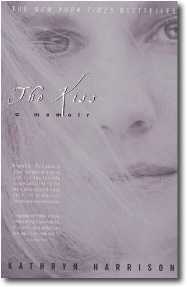
The Kiss by Kathryn Harrison

Appalling but beautifully written…jumping back and forth in time yet drawing you irresistibly toward the heart if a great evil. – Christopher Lehmann Haupt, The New York Times

Memoirs are all the rage these days and I have read a few– but I’ve never read anything like The Kiss by Kathryn Harrison. I’ve read a couple other books by Harrison and I now more fully understand some of the recurring themes in her novels (dysfunctional families, issues of love and the withholding of it, estrangement, emotional blackmail) after finishing The Kiss.

This is a well-known book, I think, despite having been published ten years ago. It received copious praise and, despite its difficult subject matter, I can see why. In fandom, we often write incest fic and consider it to be hot– but Harrison’s story of her affair with her father is never titillating. Instead, it’s a breathtaking and gut-clenching examination of how her seemingly unrequited love for her mother manifested itself into an all consuming and ultimately devastating sexual affair with her estranged father.

Harrison’s father left the family (at his in-law’s request) when the author was six months old. Until she was twenty she only saw him twice. Her father, a well-educated preacher, drew her into an affair with a kiss.

The book is frighteningly honest – Harrison doesn’t spare herself or her part in the relationship. She turns a keen, intelligent (but very emotional) eye on her life, the important relationships she had (or desperately wanted to have) and her father– who is one of the vilest characters I have ever met.

I couldn’t put this book down and when I was done I felt such a great sadness for her.

Sweetness in the Belly by Camilla Gibb

British born, Canadian-raised writer Camilla Gibb’s stunning new novel Sweetness in the Belly divided my book club. I was among those who loved it. The book tells the story of Lilly, born to hippie parents and brought up as a Muslim, after their death, in the city of Harar. Her story is told by layering her young years in a politically charged Ethiopia with her life as a nurse in London. It’s a fascinating picture of a world torn apart by poverty and prejudice and by Lilly’s own beliefs. It is also a love story as we wait with Lilly to learn the fate of her lover, Aziz.

I know nothing of the politics of Ethiopia under Emperor Haile Selassie. I know very little about the Muslim religion, but Gibb’s beautiful prose and attention to detail (she conducted fieldwork in Ethiopia for her PhD in social anthropology) makes this book a page-turner. The characters are complex and interesting and the day-to-day struggles of the women, in particular, are riveting. I was both gutted and elated by book’s end.

The Lake Dreams the Sky by Swain Wolfe

I don’t know how Swain Wolfe’s novel The Lake Dreams the Sky ended up on my bedside table. Somehow I managed to score an advanced reading copy of it and it has been in my ‘to-read’ pile forever. I finally picked it up and couldn’t put it down.

The Lake Dreams the Sky
tells the story of Elizabeth, a high-powered something or other who returns to the lake of the title to visit her elderly grandmother and reacquaint herself with the Montana landscape of her youth. What follows is a beautiful love story prompted by Liz’s discovery of a picture she’d admired as a child.

Liz’s story isn’t anywhere near as interesting as the story the picture has to tell. Ruth, a white woman raised by the Red Crow and Cody, a drifter who arrives in town when his truck breaks down, meet and fall in love. They are both good people who got dealt a shitty hand and their relationship fuels the jealousy of the small-minded people who live in the town. Their only allies are the owner of a local business, who is also an outsider of sorts, and Rose’s Red Crow mother.

Theirs is a story of passion and hope and it is beautifully told. If you aren’t rooting for them to make it by the book’s end, you have a hole where your heart should be.

Breakheart Hill by Thomas H. Cook

“You’ll think you know who (and maybe you do) and you’ll think you know why (and I suppose it’s possible); but trust me, you won’t have guessed everything. “Breakheart Hill” is one of the best written and most marvelously crafted books I’ve read in a long, long time. It’s dark and it’s sad and it’s very, very good. Read it.” – Mystery NewsI picked up Thomas H. Cook’s 1995 novel Breakheart Hill at the second hand store. On the cover was the tagline “a mesmerizing tale of love and betrayal” and I thought, okay, good Sunday afternoon book and bought it. The opening line is one of the most intriguing I’ve read in recent memory: “This is the darkest story that I have ever heard, and all my life I have labored not to tell it.”

The narrator of this dark tale is Ben Wade, a respected doctor in Choctaw, Alabama. As a teenager, Ben grows to love the beautiful Kelli Troy who has moved to Choctaw from the north. It is 1962. The story expertly weaves Ben’s memories of high school with present day, dropping ominous clues about just what happened the afternoon Kelli’s battered body was discovered on Breakheart Hill.

I suppose in some ways, I’ve been spoiled by mystery/thriller/suspense novels which unfold at breakneck speed; I was often impatient reading this book. Sometimes it seemed to take forever to get anywhere, but ultimately that’s one of the book’s many charms.

Breakheart Hill is a leisurely southern gothic novel, filled with a real sense of place and time. The characters are interesting and flawed and I was 100% surprised by the ending, which wasn’t a cheat even though it felt like it should have been.

If you like an intelligent mystery that will break your heart, this is the book for you.

The Truth About Celia by Kevin Brockmeier

Devastating and dazzling; in its painful fusion of pathos, fantasy – ultimately- realism, Brockmeier’s heartbreaking book is reminiscent on The Lovely Bones.” Time Out

I’d agree with the first bit of this assessment of Kevin Brockmeier’s book,  but not with the second: this book is nothing like The Lovely Bones, a book which I admired the heck out of for the first 100 pages and was then incredibly disappointed with.

Other than a few rave reviews, I knew nothing about this book or its author. The book’s cover is disconcertingly like The Time Traveler’s Wife (a book I love to bits), but there are no other similarities. Brockmeier’s book is an incredible journey into the devastating grief that grips fantasy writer, Christopher Brooks, and his wife Janet, after their seven year old daughter, Celia, goes missing from their back yard.

The book consists of several short stories, all written by Christopher as he attempts to come to terms with Celia’s disappearance; he imagines (and writes about) her living in different worlds and he also addresses his own grief– and the grief of his wife– in these stories.

There is nothing linear about this book and there is no resolution, and the mystery of Celia’s disappearance is never solved and none of that matters one bit. The Truth About Celia is luminous, heartbreaking, and utterly beautiful.

highly recommend it.

Swimming Sweet Arrow by Maureen Gibbon

Maureen Gibbon’s novel, Swimming Sweet Arrow, is something of a surprise. The first surprise might be the very graphic sex. But the second surprise will most definitely be how affecting the novel’s narrator, 18 year old Vangie is.

“When I was eighteen, I went parking with  my boyfriend Del, my best friend June, and her boyfriend Ray. What I  mean is that June fucked Ray and I fucked Del in the  same car, at the same time.”

Gibbon establishes Vangie’s voice– at once innocent and experienced– from the novel’s opening lines and from that moment on it’s hard to stop turning the pages as a year in Vangie’s life unfolds.

Vangie graduates from high school, moves in with Del, parties incessantly and slowly begins climbing out of her youth and into her adulthood. The success of the book is the way in which Gibbon writes Vangie, a character who never shies away from who she is or what she wants. And even when she makes horrible mistakes in judgment, Vangie never passes the buck.

Despite the subject matter, which might be potentially too-graphic for some, Vangie’s search for meaning, for love, and for a place to belong is a thing of beauty.

End of Story by Peter Abrahams

I cut my teeth on mystery novels when I was about eight. Every gift-giving occasion, my uncle would give me two brand new Bobbsey Twins books– hard covers. I loved following Bert and Nan, Flossie and Freddie as they solved mysteries in and around their home town, Lakeport. My daughter has those books I managed to save through numerous moves.

Anyway, I still love a good mystery and I finished a new one this morning. Peter Abraham’s new book End of Story. I added this book to my ‘must read’ list when it appeared on Entertainment Weekly’s list of Best Books for 2006. End of Story is a great book, but not just because EW said so. (Or any of the other media outlets which have called it everything from “cunning…suspenseful…very scary” (New York Times Book Review) to “almost physically impossible to put down.” (Booklist) I’d have to agree with that last one; I read last night until my eyes were burning. This is a great book because it pays attention to details, transcends crime-story cliches and delivers characters that are cunning, charismatic, naive.

End of Story tells the compelling tale of Ivy Siedel, an aspiring writer, who takes a job teaching writing to a small group of inmates at Dannemora Prison, in Upstate New York. When one of her students, Vance Harrow, turns out to be a talented writer, Ivy decides to take a closer look at his history and discovers something about him that both shocks and excites her…and changes her life forever.

Abrahams doesn’t waste any time –  dumping the reader right into the middle of Ivy’s story- which barrels along as fast as you can turn the pages (and I was turning pretty fast. I read the book over the course of two days.) Obviously, since this is a mystery novel, I can’t give you too much info. But I can say that the novel’s natural climax offers a surprising twist as Ivy works and reworks the details of Vance’s story. Along the way Abrahams makes some interesting observations about writing and the process of doing it.

Billy Dead by Lisa Reardon

Lisa Reardon’s book, Billy Dead, earned copious praise when it was published in 1998 and it deserves the honors. Years after I first read it, I keep thinking about the story’s flawed and difficult characters, siblings Billy, Ray and Jean. The story is narrated by Ray and it’s a story of poverty, abuse, and redemption. It’s unflinching, too; Reardon doesn’t gloss over any of the details and it is for perhaps this reason that the book was highly regarded by critics. Alice Munro (perhaps the greatest writer of short stories ever) said: “Billy Dead is a brave, heart-wrenching debut. I couldn’t look away.”

I chose it for my book club several years ago… and no one liked it. Truthfully, the book probably isn’t for everyone: it’s graphic and violent. But the characters are so compellingly real and their journey is so honest, they’ll make an indelible impression on you. Really.

To save you from signing up, here’s a review from the NY Times

Lisa Reardon’s first novel, Billy Dead, instantly brings to mind Dorothy Allison’s Bastard Out of Carolina. Both depict poor, rural white families in which innocent lives are ravaged by brutality and incest. But Billy Dead, if you can believe it, is even more harrowing, and while Reardon possesses enough skill to render any awful act believable, she does so at the expense of the book’s frail beauty. When you finish reading it, you’re left with a crowd of horrific images that overwhelm what the story is finally about: the redemptive power of love, no matter how unconventional.

Unlike Allison’s child narrator, the speaker in Billy Dead, Ray, is an adult who has the language and sexual knowledge to describe the family’s heinous history in graphic detail. Of the three Johnson children, who grew up in Michigan, Ray was clearly the least equipped to shoulder abuse; as a man, he is helpless and dazed, given to hallucinations and physical self-torture. He lives in a perpetual cringe, shrinking from memories that constantly threaten to unravel him. But when he learns that his beastly older brother, Billy, has been sadistically murdered, Ray can’t help flashing back to his freakish family life, a three-ring circus of savagery in which the siblings all take turns in the spotlight.

Ray and Billy have a little sister, Jean, who not only suffers her father’s beatings as they do but also endures sexual abuse at the hands of all her menfolk. But she is a mean, tough kid — qualities that meek, sensitive Ray admires. When Jean is only 7, Billy and Ray force her to perform fellatio on them, an act that belies Ray’s affection for Jean and underscores his fear of Billy. A few years later, she pounces on her opportunity for revenge: as Ray, now 14, lies weak in bed with chickenpox, she burns his sores with a cigarette while bringing him to orgasm with her other hand. ”Do you love me?” she asks, grinding the hot cigarette into his wounds. ”Are you sorry?” He appears relieved to submit to Jean’s punishment; he is also in awe of her spitefulness.

Ray and Jean remain allies in their house of horrors. After his senior year, Ray spends the summer working in another town; Jean, now 16, joins him. Away from their tormentors, they become lovers, and, impossibly, you find yourself actually rooting for them. It’s a credit to Reardon’s writing that their romance seems right and tender. But everything goes wrong when they return home to find that the whole town knows about them. In a flash of possessiveness, Ray turns on Jean, and the two remain estranged until Billy’s death years later — an event that prompts Ray to seek her out again. Whoever got Billy ”must have been even meaner than him. Only one person I know like that,” Ray says as he begins a delirious search for the love of his life, his baby sister.

Billy Dead is quite well written, but its literary merits are diminished by the relentlessness and intensity of its atrocities. Billy throws a cat against a wall for fun, breaking its neck, and his father then chops the dying pet’s head off with a shovel; after Billy molests her, Jean hangs his dog from a tree and beats it to death with a baseball bat; during one particularly violent episode of rape, Jean nearly bites her father’s penis off. Still, all this excess isn’t just sensationalism, and most of these scenes seem warranted by the larger story. Indeed, this is an extremely powerful novel, but whether you want to read it depends on your stomach for human — or, better said, subhuman — ugliness.
-By LAURA JAMISON