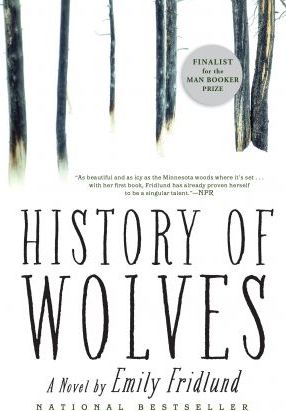
History of Wolves – Emily Fridlund

Emily Fridlund’s debut, History of Wolves, was shortlisted for the Man Booker Prize in 2017 and was the winner of the McGinnis-Ritchie Award for its first chapter. Awards generally mean very little to me because an award is no guarantee of my enjoyment. Just because someone is a NY Times best selling author doesn’t mean they can actually write. cough::Colleen Hoover::/cough

Linda lives with her parents on a lake in northern Minnesota. Once a part of a commune, Linda and her parents are all that remain.

I knew from stories how my parents had ridden in a stolen van to Loose River in the early eighties, how my father had stockpiled rifles and pot, and how, when the commune fell apart, my mother traded whatever hippie fanaticism she had left for Christianity.

The first thing to upend Linda’s life is a new teacher, Mr. Grierson, who “arrived a month before Christmas with a deep, otherworldly tan [and] wore one gold hoop earring and a brilliant white shirt with pearly buttons.”

Friendless and an outsider, Linda watches and “I wanted him to know that I saw how he looked at Lily Holburn.” The scandal about Mr. Grierson breaks in the fall of Linda’s grade nine year when he is accused of “pedophilia and sex crimes at his previous school and was promptly fired at ours.”

Then she meets four-year-old Paul and his mother, Patra, who have moved in across the lake. Thus begins a long, strange relationship which Linda recounts both as she lives it, but also from an adult perspective several years after the events take place.

At the trial they kept asking, when did you know for sure there was something wrong? And the answer was probably: right away.

History of Wolves is beautifully written, slow-moving novel about family, memory, faith and what it is to leave your childhood behind. Highly recommended.

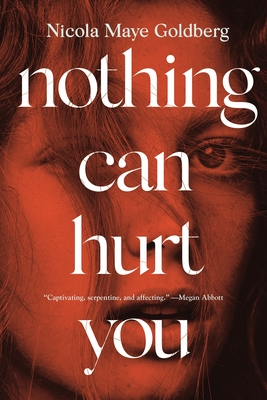
Nothing Can Hurt You – Nicola Maye Goldberg

Sara Morgan, a student at a liberal arts college in upstate New York is violently killed by her boyfriend Blake Campbell. He admits to the crime straight away and pleads temporary insanity. Nicola Maye Goldberg’s beautifully written novel, Nothing Can Hurt You, follows how this violent crime affects the people in the community where Sara lived, as well as her family and friends.

Goldberg’s novel is not linear; instead, it reads like a series of short stories that don’t even necessarily connect to each other other than the fact that the character in each one is somehow connected to Sara.

Marianne, for example, has recently moved to Rhinebeck with her husband. Marianne is fragile. She suffers from episodes.

At first it was just nausea. Then came images, as clear as if I were watching them on television. They were so violent. I saw myself stretched out on a piece of wood. Then the wood snapped in half, and so did I.

It is these episodes that have driven Marianne and her husband out of NYC, where they both hope that the fresh air and slower pace of life will help Marianne heal from her trauma. It is Marianne who discovers Sara Morgan’s body.

Katherine meets Blake Campbell at Paradise Lake, a tranquil Recovery Centre.

If she’d met Blake at a party, or a bar, Katherine would have liked him a lot. It helped that he was movie-star handsome, the kind of handsome that shifted the air in the room when he walked in.

Then there’s Luna, Sara’s half sister. Luna was just two when Sara was killed so she has no real memories of her. Twenty years later she takes a job as a nanny to Blake’s daughter, Ruby.

Nothing Can Hurt You asks you to consider our fascination with violent crime, with the perpetrators and the victims. It is not a thriller per se, but it is a thrilling read. And while you don’t come to know any of the characters very well, especially not the victim, and although there isn’t a traditional resolution or structure, this is a book that is thoughtful, intelligent and well-written.

Sorrow and Bliss – Meg Mason

Martha Friel, the protagonist of Meg Mason’s widely praised novel Sorrow and Bliss, is in the middle of a crisis: her marriage is imploding. Things have gotten so bad that, on their way home from the last party they attend as husband and wife, she says to him “When you do that pointing thing it makes me want to shoot you with an actual gun.” Patrick’s response? “How about we don’t talk until we get home.”

Things weren’t always so vitriolic between the pair. Once upon a time, they were each other’s most favourite person and Martha felt as though “we had been melted down and made into another thing. […] It was the happiest I have ever felt.”

Happiness, as it turns out, is a rare commodity for Martha. She and her younger sister, Ingrid, comes from a relatively dysfunctional family. Her father, Fergus Russell, is a failed poet; her mother, Celia Barry, a sculptor. Fergus and Celia still live in the family home in Shepherd’s Bush (a district in West London), but they can only afford their lives because of Celia’s sister, Winsome, who at first seems like a rich snob, but in the end turns out to be the rock in the lives of these fragile, broken people. Patrick was childhood friends with Winsome’s son, Oliver, and Martha has known him since she was sixteen.

It is around the same time that Martha meets Patrick that she wakes up with “no feeling in [her] hands and arms.” It is the beginning of a long period of ill (mental) health for Martha. No one seems able to diagnose the problem, and her family reacts with varying degrees of sympathy. Her mother “no longer came into [her] room, except once with the vacuum cleaner. She pretended not to notice [her], but made a point of vacuuming around [her] feet.” Her father “stayed up with [her] in the night, sitting on the floor, leaning against [her] bed.” Ingrid tells her “You’ve basically turned into Mum.”

Sorrow and Bliss traces Martha’s journey through this unnamed mental illness (Mason uses dashes — instead of naming it, and a nurse in my book club said it sounded like schizophrenia), but Mason herself says that the book is not really about mental illness. In an article in The Guardian, Mason said “It’s not the schizophrenia book, the bipolar book, the borderline personality book, it’s a book about what it feels like to have X or to look after someone with X and what it does to the extended family and the marriage.”

By the time the book begins, Martha has been — with varying degrees of success –managing her mental health issues, the myriad dysfunctions of her family, her own stalled career aspirations and for the last eight years, her marriage to Patrick; one woman tells her that she should feel so lucky to be “married to a man like that.” The truth of the matter is that life and relationships are complicated and Martha’s life sometimes spins itself into a deep, dark hole from which there is often no escape. Strangely, it is a tattoo artist who puts things into perspective for Martha

Everything is broken and messed up and completely fine. That is what life is. It’s only the ratios that change. Usually on their own. As soon as you think that’s it, it’s going to be like this forever, they change again.

I loved this book. I loved Martha’s family, particularly Winsome. I loved Martha’s relationship with Ingrid – which was often laugh-out-loud funny. I loved Patrick, who somehow didn’t come across as a martyr even though he was self-sacrificing. And I loved Martha, in all her messy glory.

This book is a winner and I highly recommend it.

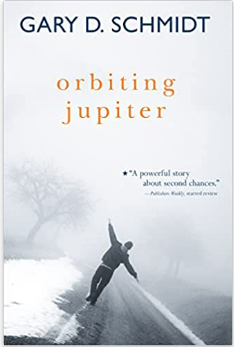
Orbiting Jupiter – Gary D. Schmidt

I’m not sure if award-winning author Gary D. Schmidt’s 2015 novel Orbiting Jupiter is supposed to be Young Adult or Middle Grade, but either way it’s a terrific albeit heart-wrenching tale which I read in one sitting.

Jack is just 12 when Joseph, 14, comes to live on his family’s organic farm in Maine because his parents have a reputation for successfully fostering difficult kids.

…he won’t wear anything orange. He won’t let anyone stand behind him. He won’t let anyone touch him. He won’t go into rooms that are too small. And he won’t eat canned peaches.

[…]

“He has a daughter.”

Despite his troubled past, Joseph is not a delinquent. It is clear he’s been dealt a shitty hand, but his quiet determination soon wins over his foster family as well as a couple teachers at his school. Honestly, it was impossible not to like Joseph, which is what makes the story so tragic.

Another reason to like this novel is Jack. Although he is younger than Joseph and certainly far less experienced, his hopefulness and loyalty to his new ‘brother’ grounds the novel. He catalogues the times Joseph smiles (or almost smiles) and is constantly reminding Joseph that his name is Jack not Jackie, but their banter and their silences is certainly indicative of two boys who care for each other.

Orbiting Jupiter is a thoughtful, quiet and heart-breaking book and I highly recommend it.

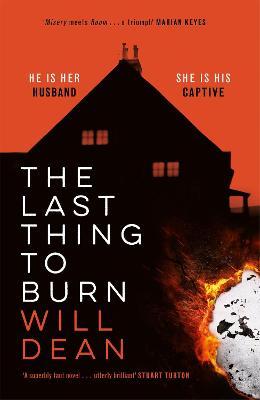
The Last Thing to Burn – Will Dean

Coming on the heels of a really disappointing read, made Will Dean’s novel The Last Thing to Burn extra terrific. I probably would have felt that way about it no matter when I read it though. I discovered this book via Twitter, which is the same way I came across Chris Whitaker’s amazing novel We Begin at the End. Twitter, keep up the good work.

The Last Thing to Burn opens with our first-person narrator hobbling across a field, her “right ankle the size of a fist.” Her voice is so distinct and her anxiety so palpable that I was immediately sucked into the story. It is only when a Land Rover appears on the track and the man driving comes for her, that we realize this person is a captive.

He holds me with no force. His power is absolute. He needs no violence at this moment because he controls everything the eye can see. I can feel his forearm at the back of my knees and he’s holding it there as gently as a concert violinist might hold a bow.

His name is Lenn. Her name is Jane. Except that’s not her name. She’d come to England from Vietnam with her younger sister, Kim-Ly. They’d been told there would be jobs waiting for them and that they’d be earning enough money to send home. First, though, they would have to pay back the people who’d arranged for their travel. This debt is endless. At first, Jane and Kim-Ly work on a farm where they are fed and have one day off. Then, Jane is sold to Lenn and Kim-Ly is sent off. That was seven years ago.

Jane’s life is one of captivity. There are cameras everywhere in the little farmhouse she shares with Lenn. Every day when Lenn comes back from tending to the fields, he watches the tapes. Her responsibilities are to keep the house just as his mother, also called Jane, did and to cook his meals, the same rotation every week, exactly as his mother did. She wears his mother’s old clothes, uses her cloth sanitary napkins. One week a month, Jane is allowed to sleep in the back bedroom. Three weeks a month,

I lie on the bed and pull the thin cotton sheet over myself. I adjust it so the sheet’s covering me from the navel and higher. This is, in some ways, the worst of it. The waiting. because it drives the truth home like a hammer would drive a nail through a plank of rotten wood.

When Jane misbehaves, Lenn throws one of her precious belongings into the fire. All these years later, all that remains are her ID with her true name on it, letters from her sister (who is working in a Manchester), a picture of her parents and a copy of Of Mice and Men.

The Last Thing to Burn is really one of those books that you read with your heart in your throat. I flew through it in two sittings because I had to know what was going to happen. Jane is an unforgettable character, but so is Lenn. He’s clearly a monster, a psychopath, and “even though he’s not a violent man, not usually, […] he’ll take what he wants in his own horrifically gentle way.” Dean wisely avoids being too graphic, but it won’t matter, the implied is enough.

Although the ending was a teensy bit abrupt, The Last Thing to Burn is a solid, well-written, propulsive page turner, and I doubt you’ll soon forget Jane.

Highly recommended.

Our Chemical Hearts – Krystal Sutherland

“I always thought the moment you met the great love of your life would be more like the movies,” Henry Page, the protagonist of Krystal Sutherland’s YA novel Our Chemical Hearts announces. Henry, a high school senior, is a romantic at heart and when he imagines falling in love, it’s not with someone like Grace Town, the new girl at school. Grace wears boy’s clothes, walks with a cane and seems neither clean nor healthy.

When Henry and Grace are picked to co-edit the school’s newspaper and are forced to spend time together, Henry finds himself drawn to Grace’s quirks because he has some of his own. Then he discovers that before moving to Henry’s town and school, Grace was “a girl in a red dress with red lipstick and loose curls in her honey-blond hair. She was smiling brilliantly…” Henry wants to know more and the more he knows the more he falls, until Grace’s secret is revealed and his life implodes.

Our Chemical Hearts is not a fluffy YA romance. It deals with some serious real-life issues and treats its characters like the almost-adults that they are. Henry, for example, has long admired the “perfect” relationship his parents have and yearns for the same sort of fairy-tale love. It’s not until his much older sister, Sadie, shares some things about his family that he may not know that he starts to understand that relationships, and the people who inhabit them, are complicated.

Grace is truly messed up. She starts to reveal herself, bit by bit, to Henry and his optimism is the seemingly perfect antidote to her pessimism – the ying to his yang.

…tell me you believe that our lives are anything more than a ridiculous cascade of random chances. A cloud of dust and gas forms our planet, a chemical reaction creates life, and then all of our cavemen ancestors live long enough to bone each other before they die awful deaths. The universe is not the magical place people like to paint it as. It’s excruciatingly beautiful, but there’s no magic there, just science.

Ouch.

Henry and Grace bond over music, literature, even their co-editing gig provides them with common ground, and their story is as true a depiction of a high school romance as you’re likely to find.

Highly recommended.

Saint X – Alexis Schaitkin

When the Thomas family, eighteen-year-old Alison and her seven-year-old sister, Claire, visit Saint X with their parents, they have no idea how this Caribbean holiday will irrevocably alter their lives. On the last night of their vacation, Alison disappears, and then turns up dead on a nearby cay.

This event sets Alexis Schaitkin’s debut novel Saint X in motion.

Looking back, the things I remember most clearly from the days after Alison went missing and before she was found are strangely inconsequential. For example, I remember the hunger I experienced on that first day when my parents forgot about breakfast and lunch, and how I felt sorry for myself in that banal way any child feels sorry for herself when she finds herself overlooked in a flurry of attention devoted to her older sibling.

Although Clive and Edwin, two men who work on the resort, are questioned about Alison’s disappearance, they are never charged and the circumstances of Alison’s death remain a mystery. Many years later, Alison is working at a publishing house in NYC when she gets into a cab driven by Clive and that chance encounter sends her spiraling into the past, desperate to connect to the sister she didn’t really know.

While not a thriller, Saint X does read like one in many ways. Alison contrives a way to meet up with Clive again and then essentially starts stalking him until she orchestrates yet another chance encounter. She is convinced Clive can answer all her questions about Alison. Her obsession with her sister’s death and with Clive himself takes over her life. She cuts herself off from her friends, loses focus at work and spends her time listening to the audio diaries her sister kept as a teenager.

Schaitkin layers Claire’s journey with Clive’s story – one of abandonment and longing. We learn of his early life on Saint X, and his childhood friendship with Edwin, who grows into a gregarious man who knows how to flatter the tourists at the resort and make double the amount in tips. We see Alison through Clive’s eyes, a skewed portrait of a teenager on the cusp of understanding her tremendous power.

While the novel is certainly about Claire’s quest for understanding, this is also a book about privilege, fate, grief and family. When Clive finally reveals what he knows (or doesn’t know) about Alison, Claire realizes that the details “had very little to do with me.” That’s one of the brilliant observations in Schaitkin’s novel. You can’t possibly know everyone’s story – not even the people closest to you.

This is a beautifully written book, one to savor, and I highly recommend it.

Fire Keeper’s Daughter – Angeline Boulley

Angeline Boulley’s debut Fire Keeper’s Daughter was my first read in 2022 and it’s a cracker. It’s almost 500 pages long, but it was so good I had a hard time putting it down. It’s nice to start a new reading year with a great book!

Eighteen-year-old Daunis Fontaine lives in Sault Ste. Marie, Michigan. Her white mother comes from a wealthy, important family – a building at the local college is named after her grandfather. Her Ojibwe father, who died when she was seven, lived on the Sugar Island reservation, the place Daunis calls her “favorite place in the universe.” Daunis has a brother, Levi, who is just three months younger than her. There’s complicated family history, but Levi and Daunis are close; they are both talented hockey players, and they both idolized their father, who himself was a superstar on the ice, destined for great things until he was injured in a car accident. Daunis is meant to be headed to the University of Michigan for pre-med, but when her uncle David dies and her maternal grandmother ends up in a nursing home, Daunis makes the decision to start her post-secondary education closer to home.

Then she meets Jamie. He’s a new recruit to the Supes, the local elite junior A team her brother captains. There’s an immediate spark between the two. Soon they are running together in the morning and Daunis finds herself sharing things with him that she’s never shared before.

There is so much to love about this book I don’t even know where to start. First of all, Daunis is a fabulous character: smart, resilient, capable, loyal. She aligns herself with her Ojibwe heritage even though she is an unenrolled member because her father isn’t listed on her birth certificate. Her best friend Lily is in the same boat and “We still regard the tribe as ours, even though our faces are pressed against the glass, looking in from outside.”

Boulley captures all the hardships of being a biracial teen, the casual racism Daunis experiences, the sexism; it’s all here, but none of it is didactic. The novel also weaves traditional beliefs as well as stories and language throughout the narrative, which as a white person with very little knowledge of these things, I found fascinating.

Something else that is encroaching on her life is the proliferation of meth, which seems to be coming from Sugar Island and which is starting to impact people she cares about. Her childhood friend, Travis, who has become a shadow of his previously charming, handsome and goofy self now has ” hollows under his cheekbones [that] are concave to the point of sickly. Any softness is gone.” Travis’s addiction is just the tip of the iceberg, though and when Daunis witnesses a murder and discovers that Jamie is not quite who he seems, she finds herself helping the FBI investigate the meth and the novel kicks into high gear.

It would be one thing if Fire Keeper’s Daughter was just a story about a girl trying to figure out how she fits into two very different worlds, but this ambitious novel is so much more than that. It’s a mystery, it’s a coming-of-age story; it’s a story about culture and family. It’s so good.

Highly recommended.

The Black Flamingo – Dean Atta

Although I do not know this for sure, Dean Atta’s novel-in-verse The Black Flamingo feels like a very personal story. Atta tells the story of Michael, born in London to a Greek Cypriot mom and a Jamaican dad who exits the family shortly after Michael is born.

“…six days before the millennium,/ she burned their Christmas dinner/ and he shouted, “You’re useless!”/ before throwing his plate down, turkey/ stuck to the kitchen floor. and I cried,/ startled by early indoor fireworks./ That was the end for them. The beginning/ for Mummy and me.”

Atta unspools Michael’s story, which is the story of someone who isn’t quite Greek enough or Jamaican enough, and definitely not straight enough, a fact he seems to realize relatively early on. When he is just six he tells his mother “If you only get me one present/ this year, please can it be/ a Barbie?”

I can relate to that. My son was totally enamoured with Bratz dolls when he was a kid. And long hair; he desperately wanted long hair, so eventually we got him a hat with all these long braids sewn along the edges. He wore that thing constantly.

The next year Michael tells his mother he wants to change his last name to hers, a request that earns him “the longest hug I’ve ever had.” (Nineteen seconds!)

The novel traces Michael’s adolescence, his friendship with Daisy, and finally his journey to attend university in Brighton. It is here that he finds his people at Drag Society, and ultimately himself.

“I’m just a man and I want/ to wear a dress and makeup on stage./ I want to know how it feels to publicly/ express a side of me I’ve only felt privately/ when playing with my Barbie as a boy.”

The Black Flamingo is a coming-of-age story, a story about identity and family, and it is lovely and lyrical and hopeful, too.

Odd One Out – Nic Stone

One of the topics the students in my Young Adult Literature class discussed this semester was the importance of diversity in fiction. Nic Stone wrote a wonderful opinion piece called “Don’t Just Read About Racism—Read Stories About Black People Living” where she expressed her own experiences with books featuring Black characters and the problem of having every single ‘diverse’ text tackle issues of police brutality and racism or simply featuring characters she didn’t recognize. Tokens or sidekicks.

“I met three African-American characters in books between 8th and 12th grade,” she writes. “The first was a Black man falsely accused of a horrific crime—literally because of #WhiteWomanTears—who despite his innocence suffers a horrific fate (Tom Robinson in To Kill a Mockingbird). The second was a Black man with a role so minor, most people don’t remember he was Black or don’t remember him at all (Crooks from Of Mice and Men). And the third was an escaped Black slave written (by a white man) in vernacular so dense that half the time, I had zero idea what homie was trying to tell me (Jim from The Adventures of Huckleberry Finn).

I hated all of it.”

Why was it, Stone wonders, that growing up she never read about Black kids going on adventures, solving mysteries, falling in love? “What if we’d seen Black people in books just being human?” she writes.

Cue her 2018 YA novel Odd One Out, the story of seventeen-year-old besties Courtney “Coop” Cooper and Jupiter “Jupe” Charity-Sanchez. Coop has been in love with Jupe for as long as he can remember, but Jupe likes girls. At least she’s pretty sure she likes girls. She hasn’t really had any experience with them. Then Rae Chin moves to town. Suddenly Jupe and Coop find themselves part of a very complicated triangle.

This is exactly the sort of book Stone was talking about when she described the sort of stories that were unavailable to her when she was growing up. The characters in Odd One Out are just trying to navigate family stuff (Jupe has two dads; Coop’s father was killed in a car accident; Rae’s mom took off, but all the parents in this book are professional, loving, sane parents — not a gang banger among them), school and what turns out to be very complicated feelings for each other.

All three main characters get a turn to tell their story (Coop was my favourite; I found him funny, loyal, and charming) and I loved every second I spent with them. The drama is all self-made, but these smart and sensitive teens are trying to figure it out and that sometimes makes for hurt feelings, which Stone doesn’t shy away from. Odd One Out is a coming-of-age story which will appeal to any teen who has ever been in love or questioned their sexuality. The fact that I adored this book proves Stone’s point that “the more we see Black people living—loving and doing and being and feeling and going on adventures and solving mysteries and being the heroes—the more we come to recognize our shared humanity.”

Amen.

Highly recommended.