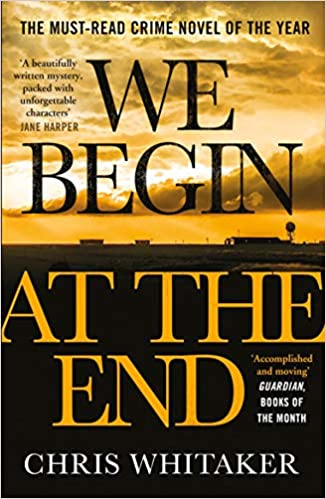
We Begin at the End – Chris Whitaker

Chris Whitaker’s novel We Begin at the End was all over my Twitter feed and the praise was copious, so I did what any booklover does, I ordered the book. Regular readers will know that having possession of a book doesn’t necessarily mean it’s going to land on my bedside table (which is where my currently-reading books live), but this one called to me. I needed to know what all the fuss was about. I needed to know if it was deserving of the fuss.

Hell, yeah.

Whitaker’s mystery/coming-of-age/noir novel concerns the fates of a whole cast of characters. It starts in the past as the town of Cape Haven, California, including Walk and his best friend Vincent King, are out looking for the body of Sissy Radley, younger sister of Vincent’s girlfriend, Star. Flash forward thirty years: Vincent’s been languishing in prison, Walk is now the town sheriff, and Star’s the messed-up mom of 13-year-old Duchess and 5-year-old, Robin.

Walk has made it his mission to look out for Star and her kids. Star’s a bit of a hot mess. She and her kids live in poverty, and Star spends a lot of time self-medicating with booze and pills. Duchess thinks part of her mom’s difficulty stems from what happened to Sissy all those years ago. “Duchess had got the bones of the story over the years, from Star when she slurred it, from the archive at the library in Salinas.”

When Vincent is released from jail he returns to Cape Haven and sets about restoring his family home, which just happens to be on a prime piece of waterfront. Dickie Darke, the local badass and sometime consort of Star, wants Vincent’s land badly, but Vincent isn’t interested in selling. He mostly just wants to be left alone. Vincent’s freedom is short lived though, and he’s soon back in jail for another crime, and this crime is the mystery which threads itself through the novel. Vincent insists on Martha May, another childhood friend and Walk’s old girlfriend, to represent him even though she’s not a criminal lawyer. That brings Martha back into Walk’s orbit after a long absence.

There are lots of surprises in Whitaker’s novel and some of the best ones are saved for the end, but it isn’t really the mystery that kept me turning the pages, it’s the characters.

Walk is loyal and dogged, and he’s spent his whole life in Cape Haven, where he knows everyone, Cape Haven is a quiet coastal town and he’s never even really had occasion to draw his gun. Vincent is taciturn and patient. Star is a hot mess. Even Dickie Dark is complicated. Minor characters, Milton, the town butcher and head of the local neighbourhood watch, Cuddy, the guard at the prison where Vincent has spent the last thirty years of his life, and Hal, the children’s grandfather, are compelling. But it’s Duchess who draws you in

If Duchess is perhaps a tad too precocious, she’s to be forgiven. She’s been dealt a rotten hand. And when circumstances land her and Robin in Montana with the grandfather they don’t know, her life is upended again. It takes every ounce of energy she has to rein herself in, and she’s really only willing to do that for her little brother. She doesn’t let people get close; it takes patience and perseverance to get past her defenses. Luckily, there are people in her life willing to keep trying. I loved her. She reminded me of Turtle, the protagonist of Gabriel Tallent’s stellar debut My Absolute Darling. This is a compliment, trust me.

There are a lot of moving pieces in Whitaker’s novel, and a lot of characters, too. There has been some criticism of his prose and the short hand he uses. I don’t read westerns and while much of this novel feels like a western, I chalked Duchess’s odd vernacular up to bravado: “I am the outlaw Duchess Day Radley” she tells more than one adversary. Perhaps odd coming from a kid from California, but not necessarily from a smart kid looking to build a protective shield around herself and those she loves. As for the novel’s prose, once I settled into Whitaker’s world, the writing just seemed spare. I think it suited the story, laid it bare.

This is a great book on so many levels. Read it for the mystery. Read it for the characters. Read it for the gut punch at the end. But read it!

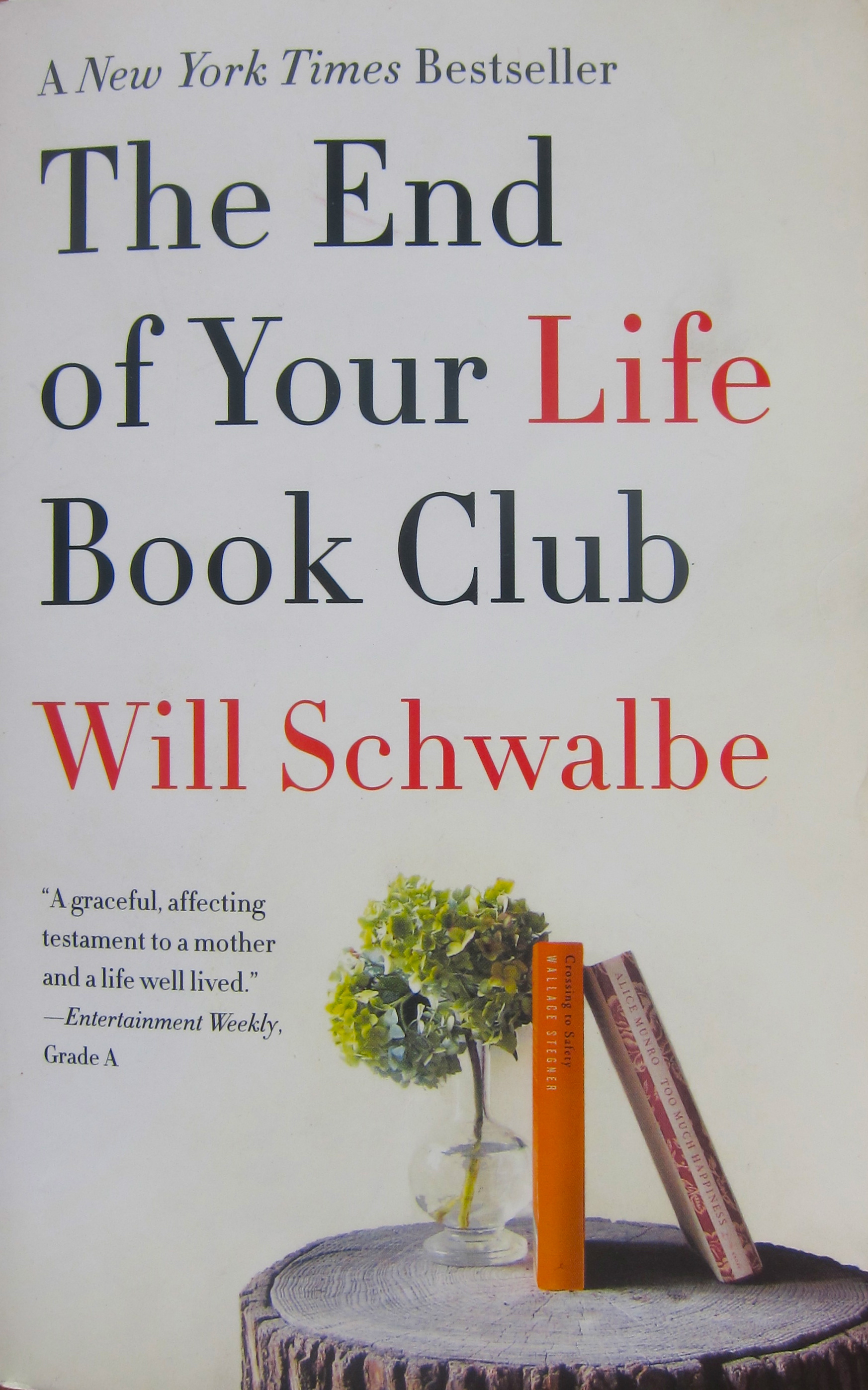
The End of Your Life Book Club – Will Schwalbe

Will Schwalbe’s memoir, The End of Your Life Book Club, is about the last couple of years before his mother’s death from pancreatic cancer and it is a beautiful tribute to family, faith, hope, and books. Always books. This book has been languishing on my tbr shelf for ages and it’s one of those books that when I finished, with a satisfied sigh and perhaps a tear or two, I thought I wish I’d picked you up sooner. I guess Schwalbe and his mom, Mary Anne, might say that the book found me at the right time.

I imagine Schwalbe’s family as sort of East Coast aristocracy, without the snobbish bits. His parents both worked in academia, and then his father got into concert management. Schwalbe describes his mother as “the hub” of the family.

Mom didn’t confine herself to coordinating our lives. She was also helping to coordinate, almost always at their request, the lives of hundreds of others: at her church at The Woman’s Commission for Refugee Women and Children (she’d been the founding director), at the International Rescue Committee (she’d been board staff liaison and founded the IRC’s UK branch), and at all the other myriad organizations where she’d worked or served on boards.

Mary Anne is clearly a force to be reckoned with and her cancer diagnosis is a setback not a death sentence. She’s diagnosed in 2007, first with hepatitis, and then eventually with pancreatic cancer. Mary Anne’s oncologist calls her cancer “treatable but not curable”, and these words offer Mary Anne and her family (her husband, and Schwalbe’s brother and sister) hope.

The Schwalbe family have always been readers and soon Will and his mother have formed a book club of two, reading and discussing a variety of books over the long hours at Memorial Sloan-Kettering in NYC, where Mary Anne gets her hope by way of chemotherapy.

Our book club got its formal start with the mocha and one of the most casual questions two people can ask each other: What are you reading?

Beginning with Wallace Stegner’s 1987 novel Crossing to Safety, a book which I read many years ago, the mother and son read their way through classics, non-fiction, popular fiction and do what any book lovers do — debate, deconstruct and discuss. They don’t always agree, but they appreciate each other’s choices, and as any reader knows many a great discussion can be had even if you didn’t necessarily love the book. These discussions also allow them to share their lives with each other in a meaningful way. Schwalbe is hyper aware that he knows his mother as ‘mom’, the person who kept his world on its axis, but perhaps he doesn’t know her quite so well as Mary Anne, the woman. This is his opportunity.

Mary Anne’s faith is the constant in her journey, and although Schwalbe doesn’t share her certainty about God and the afterlife, he is buoyed by hers. Mary Anne constantly sees the upside. When hearing of a friend’s Alzheimer’s diagnosis she says “I feel so lucky […] I can’t imagine what it would be like not to be able to know the people I love, or to read, or to remember books I’ve read or to visit my favorite places and remember everything that happened there, all the wonderful times. “

The End of Your Life Book Club is not as maudlin as it might sound. It’s a beautiful book that reminds us of the value and irreplaceable nature of family, and reminds us how important it is to cultivate relations with the people in our lives. Mary Anne struck me as the kind of woman who looked you in the eye when she talked to you. As Schwalbe reminds us “we’re all in the end-of-our-life book club, whether we acknowledge it or not; each book we read may well be our last, each conversation the final one.”

Highly recommended.

Hamnet & Judith – Maggie O’Farrell

Very little is actually known about William Shakespeare, the man (I believe is) responsible for writing some of the most beautiful poetry ever committed to paper. His plays are still produced some 400 years after his death. He is a mainstay of English Language Arts curriculums the world over. In fact, I am just beginning to look at Romeo and Juliet with my Grade 10 classes. It is a play I love to talk about and I can totally trace my love of angst back to my first exposure to it in 1977.

Maggie O’Farrell’s novel Hamnet & Judith tells the story of an unnamed man (clearly Shakespeare) and his wife, Agnes (more commonly known to us as Anne) from their first meeting, through the birth of their first daughter, Susanna, followed by the arrival of their twins, Hamnet and Judith. The novel bounces forwards and backwards in time, but somehow still manages to move forward to its perfect (yet heartbreaking) conclusion.

Agnes is really the central character in O’Farrell’s novel. She and her brother Bartholomew (loved him!), have been orphaned by the death of first their mother, and then years later their father. Now they live with their unkind stepmother, Joan, and a gaggle of step siblings. The tutor who is teaching Agnes’s younger brothers, becomes enamoured with Agnes when he sees a figure out walking in the fields with a hawk on her arm.

She has a certain notoriety in these parts. It is said that she is strange, touched, peculiar, perhaps mad. He has heard that she wanders the back roads and forests at will, unaccompanied, collecting plants to make dubious potions.

It is said that the stepmother lives in terror of the girl putting hexes on her, especially now the yeoman is dead. Her father must have loved her, though, because he left her a sizable dowry in his will. Not that anyone, of course, would want to wed her. She is said to be too wild for any man.

Hamnet & Judith concerns the relationship between Agnes and the tutor, a relationship that seems quite modern, actually. Agnes soon learns that the tutor needs out from under his father’s controlling hand and she finds a way to give him his freedom, although I think it does come at great personal cost to her. The way they are portrayed in this novel, one could never doubt their love for one another.

It also concerns the relationship between Judith and Hamnet. The novel actually begins when Hamnet, 11, discovers his sister very ill. It is plague times, of course, and O’Farrell even includes a chapter in the book that explains how Judith came to be ill – from a flea that traveled in a container of glass beads all the way from Murano, Italy. Of course, it is not Judith who dies – I hope that’s not a spoiler – and four years after Hamnet’s death, his father writes, perhaps, his most famous play, Hamlet.

Ultimately, this is a novel about family. It’s about grief, and watching Agnes mourn the loss of her son is absolutely heart-wrenching. It is about the minutiae of daily life. Given that we are experiencing a global pandemic, it’s difficult not to see the parallels despite the 400 years that separate our story from this one. Let’s not forget, although O’Farrell’s story is fiction, Shakespeare and his family were very real.

I loved this book. It’s more than worthy of the praise.

The Lesser Dead – Christopher Buehlman

I think vampire stories are difficult to do well. Do you mess with the tropes? Do you make them evil or angsty? Should they sparkle? Have a conscience? Be sexy? Ruthless killers? Earlier this year I re-read Nancy Baker’s The Night Inside and it didn’t quite hold up to my memories of it. Christopher Buehlman’s 2014 book The Lesser Dead is, on the other hand, a fabulous book about vampires, if bloodsuckers are a thing you enjoy.

Joey Peacock was just fourteen when he was turned in 1933. Now it’s 1978 and Joey lives with an ad hoc family of vamps in the unused subway tunnels of New York City. His first person narrative is both funny and kind of heartbreaking.

If you’re looking for a story about nice people doing nice things, this isn’t for you. You will be burdened with an unreliable narrator who will disappoint and repel you at every turn.

Still with me?

Too bad for you.

I can’t wait to break your heart

Joey tells us a tale of monsters and warns readers that “if you like those stories, it means you’re bad.” He spends the early part of his story explaining how he and the others live, their hierarchy and how they hunt. He tells us the story of how he came to be a vampire and it’s a life he likes just fine. Then, one night, he sees something peculiar on the subway.

It was a kid. A little girl. Long black hair like an Oriental, but she was Anglo. Pale skin. Pretty but haunted. She was sitting two seats closer than she had been, though I never saw her move, holding a Raggedy Ann doll she didn’t seem interested in. She was looking at briefcase-hooker-notepad guy.

He looked back at her. And stared. It was all wrong.

This won’t be the only time Joey encounters this little girl, and the other children she hangs with. Their arrival in NYC starts a chain of events that is gory, horrifying and a lot of fun to read.

It’s interesting to read a vampire story that respects the lore, but isn’t afraid to tweak it a little. These vampires can eat and drink, but it’s only for show; food of the non-blood variety upsets their tummies. Sunlight. Not good. Thrall – totally a thing. Decapitation – end of the road for a vampire in this world. I loved all these little details.

I also loved the other vampires who shared Joey’s life: Margaret, their leader; Cvetko, Old Boy, Ruth, Billy and Luna are among the fourteen vampires in Joey’s immediate circle. Of them, he’s closest to Cvetko, who was turned around 1890. He’s the scholar in the group and acts, in some ways, as Joey’s mentor. Television, he tells Joey, will rot his brain. Joey describes Cvetko as a “charming but endearing calamity.”

The Lesser Dead is a great book and Joey is a fantastic narrator. I loved the time I spent with him trolling the tunnels of NYC and trying to do the right thing. Turns out, some vampires do care a great deal for humanity, even if their reasons are somewhat selfish.

Highly recommended.

Concrete Rose – Angie Thomas

I fall in love with fictional characters all the time, and I fell hard for Maverick Carter, Starr’s father in Angie Thomas’s outstanding debut The Hate U Give. In Concrete Rose, Thomas has turned her gaze to Maverick’s teenage story and it’s a doozy. Could I love Mr. Carter any more than I already did? Um, hell yeah.

The setting is familiar, the Garden Heights neigbourhood where The Hate U Give takes place. Seventeen-year-old Maverick lives with his mother who works two jobs to try to fill in the financial gaps left by Mav’s father’s incarceration. Mav has a legacy on the streets of Garden Heights because of who his father is, former crown of King Lords, (I guess that means top dog.) There’s a gang hierarchy

You got youngins, badass middle schoolers who swear they got next. They do whatever the rest of us tell them to do. Then you got li’l homies like me, King, and our boys Rico and Junie. We handle initiations, recruitment, and sell weed. Next is the big homies, like Dre and Shawn. They sell the harder stuff, make sure the rest of us have what we need, make alliances, and discipline anybody who step outta line. When we have beef with the Garden Disciples, the gang from the east side, they usually take care of it. Then there’s the OGs, original gangstas. Grown dudes who been in this a long time. They advise Shawn. Problem is, there ain’t a lot of OGs left in the streets. Most of them locked up like my pops, or dead.

Despite his gang affiliations, Mav is not a punk. His girlfriend, Lisa, is college-bound. His mother is supportive and no-nonsense. Mav’s older cousin, Dre, is one of the big homies, and always has his back. When Mav gets the news that he’s a father, his world is rocked back on its heels, and the book shifts into high gear. When the baby’s mother essentially abandons him, Mav has to start making some tough decisions. If you’ve already read The Hate U Give you know how that turns out because Maverick as a father: chef’s kiss.

I loved this book. First of all, I loved how immediate and compelling Mav’s voice is. I live in small-town Atlantic Canada. I don’t know anyone who speaks this way.

When it comes to the streets, there’s rules.

They ain’t written down, and you won’t find them in a book. It’s natural stuff you know the moment your momma let you out the house. Kinda like you know how to breathe without somebody telling you.

For me, the way this book is written is absolutely one of the best things about it. Mav’s voice is so compelling and original.

I also loved how many people were in Mav’s corner, pushing him to make better choices. I mean, he’s a seventeen-year-old father who still has to go to school and work part time at a job he hates for way less money than he’d make selling dope on the street. His boss, Mr. Wyatt, tells it like it is and doesn’t cut Mav any slack. Three strikes, he’s out. His baby cries all night, Mav still has to go to school. But these people are still in his corner, and watching him try to live up to his responsibilities is truly a thing of beauty.

Although Maverick’s story obviously takes place seventeen years before the events in The Hate U Give, and so is perhaps technically a prequel, I still suggest you read The Hate U Give first. You will fall in love with him as an adult. Going back and learning how he got there will only make you love him more.

Highly recommended.

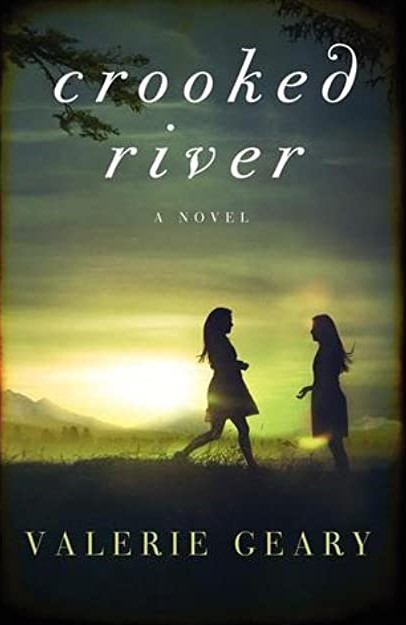
Crooked River – Valerie Geary

Fifteen-year-old Sam and her younger sister, Ollie, 10, have come to live with their father, Bear, in a teepee in a meadow in Oregon. Bear’s eccentric, sure, but he’s not crazy. One day he left his home, his wife and kids, in Eugene, and just didn’t come back. Sam’s been spending summers with her father since she was seven and she’s come to appreciate the quiet of both the place and her father.

…there was no electricity, only the sun. No plumbing, only the river and a barrel to catch the rain. No roof over our heads to blot out the stars, no television to drown out the bird and cricket songs, so asphalt to burn the soles of our feet. Most kids would probably hate a place like this, but to me it was home.

This is Ollie’s first summer; she’d previously gone to summer camp instead of going to Bear’s, but now there is no choice: the sisters’ mother has died suddenly.

When Valerie Geary’s beautiful novel Crooked River begins, the girls are down by the river and they find a “woman floating facedown in an eddy where Crooked River made a slow bend north.” They try to pull her to shore, but the current takes her. Sam is certain Bear will know what to do, but when they get back to the tent they find something that starts a chain reaction of discoveries, coincidences, and bad decisions. Before the girls can even make sense of what’s happening, their father is arrested for murder.

It is mostly down to Sam to tell this story because Ollie has elected to stop talking. “I was trying to be patient” Sam says, “but her silence was finally starting to wear me thin.” Ollie may not talk to anyone else, but she does commune with ghosts. The night is made of them, she says. “I see. I see things no one else does. I see them there and wish I didn’t. I want to tell and can’t.”

The sisters know their father is innocent, and Sam is desperate to prove it. Part of what makes Crooked River so great is the mystery, but what I really loved about the book is its sense of place. From the meadow’s hidden delights, to the beehives Bear tends, everything in Geary’s novel is written with a true appreciation for their inherent beauty. The mystery part, though, kicks into high gear in the novel’s last third and it’s a thrill ride.

This is also a book about family, grief and growing up. And if you think that’s all too much to cram into one book, then you don’t know Geary’s prodigious gifts as a novelist. There’s a beating heart at the center of this book and a crooked river runs through it.

Highly recommended.

The Tragic Age – Stephen Metcalfe

Billy Kinsey is an outsider. It’s not just the port-wine hemangioma on the right side of his face. It’s not just the fact that he’s moved to L.A. suburb from the San Joaquin Valley, where he lived a slightly more normal life. It’s not just that he’s an insomniac. It’s not just that his father won 37 million dollars in the lottery and now his mother lunches and plays tennis and his father drinks. It’s not even just that when he was 11, his twin sister Dorrie died of cancer. Well, actually, it’s all of these things.

Stephen Metcalfe’s debut novel, The Tragic Age, is laugh-out-loud funny, tender and wry. Billy, 17, is adrift. He wants to do the right thing, but he’s not exactly sure what the right thing is. It isn’t until Willard “Twom” Twomey comes into his life, followed by the re-entrance of his sister’s childhood bestie, Gretchen, that the fog starts to lift for Billy.

Twom is a larger-than-life character. He doesn’t back down from anyone. When the school’s meathead starts teasing Twom about his name, Twom lets him have it with the back of his dinner tray.

I also soon discover that despite his revolutionary’s attitude towards rules and authority, Twom has his own highly evolved sense of right or wrong. He dislikes what he calls the “dickhead club” and he has complete empathy for the underdog.

Although I wouldn’t necessarily say that Billy’s an underdog, he sure could use a friend or two and Twom comes along at the right time.

So does Gretchen. Although Billy of course knows her, she and her family have been, until recently, living in Africa, where Gretchen’s father “was a hotshot doctor of infectious diseases.” Her arrival back in Billy’s orbit is problematic.

It goes without saying that girls can make you do insane things. One minute a guy can be, if there is such a thing, normal, the next, he’s cracking stupid jokes and running and dancing in place like a babbling, mindless idiot. Another word for this is “dating.”

The Tragic Age follows Billy as he navigates his final year of high school, falls in love and tries to figure out what anything means…and whether anything is worth it, after all. The grief he feels over Dorrie’s death is clearly unresolved; in fact, he and his parents never even talk about Dorrie. They don’t really talk about much of anything, and that’s part of Billy’s problem.

Billy is on a slippery slope and the novel’s final pages are made for the big screen. That makes sense, since Metcalfe has worked in the film biz. I’m not sure the frenetic pace suits the rest of the book, but I still really enjoyed it. Billy is a memorable character and his experience of disillusioned, navel-gazing, teenagedom will be recognizable to anyone who has ever struggled to fit in or figure out how to simply survive.

Unspeakable Things – Jess Lourey

Cassie McDowell, the narrator of Jess Lourey’s riveting novel Unspeakable Things, confronts her memories of her thirteenth summer when she returns to her small Minnesota hometown for a funeral. She alludes to writing a novel about a “gravedirt basement”, but now “that cellar stink doubled back with a vengeance.”

It’s the 1980s and Cassie lives with her older sister, Sephie, and her parents on a thirteen acre hobby farm. Her father, Donny, is an artist and her mother, Peg, a teacher. It doesn’t take very long to feel the sense of dread that permeates Cassie’s home life. She “felt a quease leaving [Sephie] up with [her parents] when they’d been drinking” and she sleeps either under her bed, or squirreled away in her bedroom closet. The basement of their farmhouse is off limits. The tension is almost unbearable.

Their town, Lilydale, is full of strange characters, like Sergeant Bauer, the local cop, and Goblin, the creepy guy who lives down the road from the McDowells. And then, boys start disappearing. This causes the town to invoke a 9 p.m. curfew, which does little to alleviate fear.

That sent a shiver up my spine. First, what Betty had said this morning about the boy being raped, and now this. Mom’d told us on the drive over that we didn’t need to worry about anything, but Betty had most definitely seemed concerned. Bauer did, too. He suddenly had our complete attention.

“Always travel in pairs. I don’t want to see ay of you kids out alone this summer.”

That shushed us all up, every last one of us.

This time it wasn’t the words, or even his tone.

I think it was the first moment we caught a whiff of what was coming for us.

Something is coming for the boys of Lilydale, and when it comes for Gabriel, the cute boy Cassie has a crush on, she decides to do some investigating of her own. But, make no mistake, this isn’t a light-hearted Nancy Drew-esque detective story. There are creepy-crawly things in Lilydale’s underbelly and in Cassie’s own home. In fact, there is so much to be worried about the dread quotient is off-the-charts.

Yes, someone is scooping boys off the streets and when they come back they are changed in ways they seem unable to articulate. But Cassie has to deal with what is going on in her own backyard: her father’s mercurial moods, her parents’ ‘parties’ and the implied sexual abuse going on her home. When her father’s footsteps start up the stairs, the terror Cassie – and surely the reader – feels is palpable.

Unspeakable Things is a mystery and a coming-of-age story, and all of it (and Cassie’s voice) will twine around your heart and squeeze hard. Some might find the end of this novel less-than-satisfactory. Lourey wrote an epilogue, but then left it out of the final version. You can read that here. I liked both versions.

I loved this book. Highly recommended, but potentially triggering.

Looking For Alaska – John Green

Miles Halter, the protagonist of John Green’s debut novel Looking for Alaska, is a loner who is about to leave Florida to attend a boarding school in Alabama. Just how much of a loner is Miles? His mother insists on throwing him a going away party and Miles is “forced to invite all [his] “school friends,” i.e., the ragtag bunch of drama people and English geeks [he] sat with by social necessity” even though he knew they “wouldn’t come.”

Miles loves famous last words. That’s one of the reasons he’s anxious to head off to Culver Creek, the same school his father and all his uncles attended, a school where they had “raised hell”, which sounds like a much better life than the one Miles currently has. In the words of Francois Rabelais, Miles wants to “go to seek a Great Perhaps.” That’s the reason, Miles tells his father, that he wants to leave Florida, “So I don’t have to wait until I die to start seeking a Great Perhaps.”

Miles’s roomate at Culver Creek is Chip Martin aka “Colonel”. He immediately renames Miles “Pudge” and then introduces him to Alaska Young, the force-of-nature, girl who lives five doors down. The novel follows this trio’s adventures and misadventures and their tragic consequences.

I have long been a fan of Green’s ability to write smart, believable and heartbreaking YA characters. The juggernaut The Fault in Our Stars was my first book by him, and I totally got the fuss. (I have also read Turtles All the Way Down and Paper Towns). If I didn’t already know how good Green was, I would have been amazed by Looking for Alaska. As a debut it’s funny, irreverent, and thoughtful. And so, so smart.

My grade 10 students are currently examining what it means to come of age. Two of them are reading this book and as I was reading it, I kept thinking that it was such a perfect book to help them think about this topic. I know the book has been challenged on many occasions for language and sexual content, but, really, who are we kidding? Shouldn’t we want our kids to read books that ask (and tries to answer) big and complicated questions? Shouldn’t we rejoice when we find an author that doesn’t talk down to kids, or pretend that they are one-dimensional?

Pudge and his friends, after a tragedy which occurs about half way through the book, seek to find answers to their questions. Pudge notes

There comes a time when we realize that our parents can not save themselves or save us, that everyone who wades through time eventually gets dragged out to sea by the undertow – that, in short, we are all going.

Looking for Alaska is terrific.

You Were Never Here – Kathleen Peacock

There are so many things to admire about Kathleen Peacock’s YA novel You Were Never Here, but let’s just start with the fact that it’s set in New Brunswick. I can’t tell you how much fun it was to read a book that takes place in my home province. Okay – now that that minor squee is out of the way, let’s talk about Mary Catherine Montgomery aka Cat.

Cat has been exiled from New York City, where she lives with her screenplay-writing father, to her Aunt Jet’s in small-town New Brunswick. (The town is called Montgomery Falls, but I pictured Fredericton, for those of you to whom that means something.) Aunt Jet is the caretaker of the family’s now crumbling ancestral home, which she operates – out of necessity – as a boarding house. The reason for Cat’s exile and her subsequent banishment creates just one of You Were Never Here‘s mysteries. Another is the disappearance of Cat’s childhood friend Riley Fraser.

The boy in the picture is handsome. Chiseled jaw and wavy hair kind of handsome. The kind of handsome that gets crowned prom king or maybe class president. Even though the smile on the boy’s face looks forced around the edges, it’s wide enough to bring out the dimple in his left cheek.

There are a thousand Riley Frasers in the world, and the boy in the poster is mine.

Riley Fraser has been missing for months. The two had been friends the summer they were twelve (five years ago, and the last time Cat had been to Montgomery Falls), but something happened between them (another mystery) and even though Cat knows “I don’t owe Riley Fraser anything – not after the last thing he said to me”, knowing that he has disappeared is deeply unsettling.

Cat has no intention of doing anything other keeping to herself while she’s in Montgomery Falls, but then she meets gorgeous Aidan Porter, one of Montgomery House’s boarders. He proves to be a welcome distraction as Cat tries to process not only what happened back home, but also her complicated feelings about Riley, their truncated friendship, and his disappearance.

Those feelings become even more complicated when she bumps into Riley’s older brother, Noah. At first, Noah seems disinterested in his brother’s whereabouts, but soon he and Cat team up to try to solve the mystery of what happened to Riley.

And there’s yet another mystery in You Were Never Here which has to do with Cat herself. She seems very reluctant to touch people. There’s an incident on the bus from NYC to New Brunswick, when Cat hesitates before letting a woman sit beside her.

…there’s only so much you can do when you’re big. You can twist and contort all you want, but volume is volume, and with both of us “fat” – “overweight,” my dad always corrects, as if that somehow sounds better – a trickle of sweat forms where our hips press against each other.

Cat’s size is only part of the issue, though. (And how awesome to encounter a protagonist who is not a ‘perfect’ size zero; neither is her weight a punchline or flaw.) The other reason for Cat’s reluctance to touch people is germane to who Cat is, but I’ll let you discover that secret on your own.

I flew through You Were Never Here because it was all the things I love in YA: well-written, suspenseful, peopled with realistic characters, and loads of fun. The last third of the book was so tense, I couldn’t turn the pages fast enough. The fact that I was in a somewhat familiar setting was just the icing on the cake.

Highly recommended.