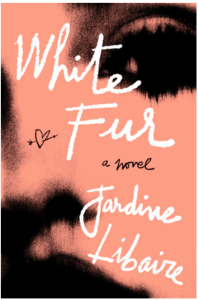
White Fur – Jardine Libaire

2A9B3047-F747-494D-9D63-8CA23DE73869Funny, or maybe not, that the book I read right after Normal People was also about a love affair between two young people. Jardine Libaire’s novel White Fur shares a couple similarities with Sally Rooney’s novel; both books concern couples who are from very different social classes and both pairs of lovers have fraught relationships.

Jamey Hyde is a student at Yale when he meets Elise Perez. She lives next door to Jamey with Robbie, the guy who rescued her from sleeping in a parked car. Jamey and Elise couldn’t be more different, and you know what they say about opposites attracting.

“Is she frightening? Is she pretty?”

That’s what Jamey and his roommate, Matt, think when they first meet Elise and the truth is she is both. She’s run away from a messy home life, and she doesn’t suffer fools lightly.

She didn’t leave home last summer with a plan. Twenty years old, she never finished high school, she was half-white and half-Puerto Rican, childless, employed at the time, not lost and not found, not incarcerated, not beautiful and not ugly and not ordinary. She doesn’t check any box…

In some ways she is almost too tough, but something about her exerts a magnetic pull for Jamey. He’s heir to a vast family fortune and has never really had to work for anything in his life. Instead of making him a spoiled brat, though, he’s actually a decent guy. Before he even meets Elise, his life is sliding sideways. He and Elise shouldn’t work, but they actually make a strange kind of sense.

When the novel opens, Elise is holding a shotgun to Jamey’s chest and from there the novel flashes back to unravel the tale of their meeting, their tremendous sexual attraction, and their crazy summer in New York City.  Because you want to know how they ended up in a motel in Wyoming with a gun, it’s easy to turn the pages and Kirkus called this book one of “11 Thrillers for Summer.” But this isn’t really a thriller.

This is a book about love, about making your own way in the world in spite of the odds against you and in spite  of the privileges you’ve been given. The writing is beautiful and these are characters you won’t soon forget.

White Fur probably would have meant something different to me if I had read it 40 years ago, back when all my relationships felt a little bit like this one. I could relate, on many levels, to the crazy intensity these two felt for each other. But that’s not to say that I didn’t enjoy this book as a woman of a certain age because I enjoyed it a great deal.
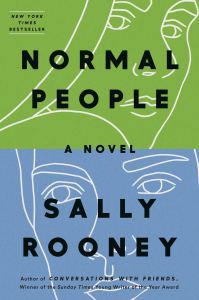


Normal People – Sally Rooney

normalpeopleYou know you’re getting old when…

That’s my main take away from Irish writer Sally Rooney’s second novel Normal People. The story follows the on again – off again – on again relationship between Marianne and Connell, a couple 18-year-olds (when the novel begins) who strike up a friendship of sorts when Connell arrives at Marianne’s house to pick up his mother, who is the housekeeper there.

The two would never have said a word to each other at school where Connell is “so beautiful” that Marianne liked to imagine “him  having sex with someone; it didn’t have to be her, it could be anyone. It would be beautiful just to watch him.”  Marianne herself is awkward and “has no friends and spends her lunchtimes alone reading novels.” The two of them just happen to be the smartest kids at school and so somehow, despite their awkwardness,  (because Connell,  despite his beauty, is awkward), the two form a relationship that shapes the next few years of their lives.

The thing with these two, though, is that they never seem to be playing the same game at the same time. Their attraction turns out to be mutual, but Connell suggests they keep their relationship a secret and when he finally betrays her, the two go their separate ways. It doesn’t matter, though, they are drawn to each other – moths to flame – and in that respect, I could so relate to their story. The two meet up again at Trinity College in Dublin, where suddenly Connell is the fish out of water and Marianne seems to have found her people. Rooney deftly handles the strange dance that happens when two young people desperately want to be together, but keep fucking it up.

So, is Normal People a book for an old doll like me? Am I the novel’s intended reader? Probably not, and I have a feeling that the ladies in my book club (for which this was our January 2020 pick) are likely going to pan the book. They’ll take exception to the lack of quotation marks for dialogue (and I knew that was going to bug me  – but ended up not being as annoying as I thought it might be) and they’ll probably dislike the melodrama inherent in a story about young love,  but I liked this book.

I was always falling in love at that age and I could see myself in both of these characters. Their need for connection, their disillusionment, their constant search for themselves was reminiscent of my own journey, and will likely ring true to anyone who has ever felt like an outsider. I found the book eminently readable, elliptical and troubling. When I finished the book – and I whipped through it in just a couple sittings – I found myself really trying to wrap my head around what I’d just read, and I think that’s the sign of something special.


The Dutch House – Ann Patchett

dutchI think some authors could write about paint drying and it would be worth reading. Ann Patchett is one of those authors. The Dutch House  is the third book I’ve read by Patchett (Bel Canto, Commonwealth),  and it did not disappoint.

Danny and Maeve grow up in the Dutch House, a gorgeous jewel-box of a house in Elkins Park, a suburb of Philadelphia. The house seems to “float several inches above the hill it sat on.”  Danny and Maeve’s father, Cyril,  had bought the house as a surprise for their mother, Elna, but she didn’t like the house – or so the story goes – and left the family for parts unknown. When the novel opens, Danny and Maeve are 8 and 15 respectively, and being introduced to their father’s ‘friend’, Andrea and her two young daughters Norma and Bright. The arrival of Andrea into their lives changes everything for the siblings.

The Dutch House is not a linear story. It bounces back and forth through time, covering roughly fifty years. Not every writer could manage this sort of narrative as easily as Patchett does. Although the perspective is Danny’s, readers will come to know and love (or hate) many other characters, most notably Maeve, who is the centre of Danny’s world.

She taught me the proper way to hold a fork. She attended my basketball games and knew all my friends and oversaw my homework  and kissed me every morning before we went our separate  ways to school and again at night  before I went to bed regardless of whether or not I wanted to be kissed. She told me repeatedly, relentlessly, that I was kind and smart and fast, that I could be as great a man as I made up my mind to be. She was so good at all that, despite the fact that no one had done it for her.

When Andrea turfs them from their house, their lives are thrown into chaos. They find themselves parking in front of the Dutch House over the years, reminiscing about and redacting their past, never quite able to let go. In some ways, their lives are halted by this connection to a place.

Not much happens in the novel, but at the same time everything happens. Danny and Maeve’s  lives and relationship are the story,  which makes sense, really. As we’re waiting for our own plots to unfold, life is actually happening all around us. The bitter feelings Maeve clings to derail her life, but we don’t really understand that until her mother turns up out of the blue. Or we see what ends up happening to Andrea.

Patchett has written characters you will absolutely come to care about and given them lives which should remind us to care more deeply about our own, and the people we share them with.

Highly recommended.

The Current – Tim Johnston

the currentI was so excited to get my hands on Tim Johnston’s novel The Current. I gazed longingly at the hardcover every time I went to the book store, but I rarely spring for a hardcover unless they’re on sale. Then one day: paperback. I dropped everything that I was reading to deep dive into it.

I read Johnston’s novel Descent three years ago and I loved it. I often recommend it to others because it is the perfect combination of page-turning-thriller and thoughtful family drama. The Current examines some of the same themes but is, in some ways, even more ambitious.

College students Caroline and Audrey are on their way to Audrey’s hometown in Minnesota. Audrey’s father, former sheriff,  is dying of cancer and Audrey wants to spend some time with him. They are almost there when they have an ‘accident’ and their vehicle is plunged into the icy river. Only Audrey survives. That seems spoiler-y. I know, but that much information is provided for the reader on the back of the book.

As Audrey recovers, her father, Tom,  sets out to discover just what happened to the girls because, well, this wasn’t quite an accident. And this wasn’t the only time the river had claimed a life. Ten years ago, Holly Burke, 19, had turned up dead in the river. Her father, Gordon, shows up at the hospital to remind Audrey’s father about the fact that his daughter’s murder was never solved.

…I just kept asking myself: What would Sheriff Sutter do differently now, if it was his girl instead of that other one who didn’t make it? What would he do for himself that he didn’t do for me?

Holly’s murder has haunted Tom Sutter and as Audrey recovers, it begins to haunt her as well, although she was only a child when Holly was killed. Their stories, though, begin to twine around each other, and many other people are swept along in that current.

Unlike Descent, which is very tightly focused on the Courtland family, The Current, drifts in and out of the lives of other characters, specifically Rachel Young and her sons Mark and Danny. Danny was a prime suspect in Holly’s murder, but there’d never been enough evidence to convict him. Gordon and Rachel had been close, but of course that friendship had ended.

Danny and Mark are characters that will really stay with me. Danny’s whole life is changed by the accusations made against him and even when he returns to visit his mother, the past is always nipping at his heels. Mark is somewhere on the spectrum and is tasked with filling in for his brother when he leaves. I worried about these guys. A lot. That’s saying something since in some ways they are peripheral to Audrey’s story. Still, I loved them.

Johnston is gifted when it comes to characterization. These people seem wholly human: frail and foolish, damaged and determined. The whole town seems stuck, somehow; no one has recovered from Holly’s murder. The novel is filled with moments of heartbreaking kindness, bravery and selflessness. And the town they live in: secrets galore.

And yes, you’ll want to know whodunit, but that’s actually the least interesting part of this masterful book.

If Tim Johnston is not yet on your reading radar, he should be. Highly recommended.

Out of Sight – Isabelle Grey

Out of Sight, by British writer Isabelle Grey, is the story of  Patrickoutofsight Hinde, a homeopath who, when the novel opens, lives with his wife, Belinda, and young son, Daniel, in Brighton. He has a happy life, for the most part, except for the stress brought on when his parents visit. He seems to be a bottled up sort of fellow and although he is capable of offering impartial advice to his patients, I wonder if he wouldn’t benefit from his own advice. As the novel goes on, readers will become aware of Patrick’s own emotional trauma, a condition he describes as “An inherited predisposition…something that leaves a residue which has a negative impact on the vital force.”
Flash forward five years and meet Patrice (aka Patrick) who is now living in the house his grandmother Josette left him in France. Leonie, another Brit who is working in the same small town as a letting agent for holiday properties, meets Patrice and is immediately smitten. Patrice proves to be a bit cagey, but despite his reticence to share feelings or disclose too much about his life, Leonie sets her romantic sights on him.

Leonie, for her part, is still recovering from a recent break-up. You’d think she’d know better than to put all her romantic eggs into Patrice’s clearly flawed basket, but she’s keen on him. The heart wants what it wants, that sort of thing, even though Patrice tells her he doesn’t “want [her] thinking he’s a good bet when [he’s] not.”

Patrice’s reluctance to get too involved with Leonie is legitimate. There’s nothing sinister about it, though, although you might be mislead by the novel’s tagline “A moment of madness. A family changed forever.” For some reason I was under the impression that Out of Sight  was going to be sort of a thriller and it’s really not.

I didn’t dislike Out of Sight, but I didn’t love it either. I found Leonie tiresome and although I don’t dispute the fact that Patrick’s trauma is worthy of sympathy, at the end of the day the book lacked any real emotional heft for me.

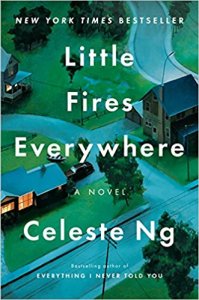
Little Fires Everywhere – Celeste Ng

littlefires“Sometimes you need to scorch everything to the ground and start over,” Mia tells Izzy in Celeste Ng’s second novel Little Fires EverywhereI read Ng’s first novel Everything I Never Told You a couple years ago and I love that book. So much. Little Fires Everywhere is also excellent. There is no doubt that I will buy and read whatever Ng writes going forward.

Shaker Heights, Ohio is America’s first planned community with rules determining what colour your house can be painted and where schools are placed so that children don’t have to cross any major streets.

The underlying philosophy being that everything could – and should – be planned out, and that by doing so you could avoid the unseemly, the unpleasant, and the disastrous.

Elena Richardson believes in the defining principles of Shaker Heights and, in fact, that’s the way she runs her household and her life. Her three oldest children Lexie, Trip, Moody seem to tow the family line. Her youngest, Izzy, is more of a problem child and when the novel opens “Everyone was talking about […] how Isabelle, the last of the Richardson children, had finally gone around the bend and burned the house down.”

What would compel Izzy to commit such an act?  Meet Mia and Pearl. They’ve just moved into the Richardson’s rental property. Mia is an artist and Pearl her intelligent fifteen-year-old-daughter. When Pearl and Moody become friends, the two families’ lives intersect. In the Richardsons, Pearl sees “a state of domestic perfection” and in Mia Izzy has someone who understands her and listens to her.

Little Fires Everywhere is a book about motherhood and it asks important questions about what it means to be a mother. Are you a mother because you’ve given birth? Is it a choice? Is a relationship between a mother and their child automatic or is it something that must be cultivated beyond mere biology? What happens if you give up a child? Do you have the right to change your mind?

Free-spirited Mia worries that her daughter is perhaps being unduly influenced by the Richardsons and wonders “if it was right for her daughter to fall under the spell of a family so entirely.” She and Pearl have always been vagabonds, moving from place to place in search of inspiration for Mia’s photography. Now she has promised Pearl that they will stay put.

In Mia, Izzy finds a sort of surrogate mother, someone who listens to her complaints about the state of her world and asks her what she intends to do about it. “Until now her life had been one of mute, futile fury” but Mia encourages her to consider her options.

This is a book that is very female-centric. We don’t spend a lot of time with the men, but that’s okay, the women are fascinating. Their hopes and dreams, some derailed by circumstance, others by choice, are worthy of close inspection. I loved my time in Shaker Heights. Little Fires Everywhere is filled with stymied, passionate, damaged, beautiful and complicated characters, and like Everything I Never Told You there is something about the way Ng tells a story that just keeps you turning the pages to get to the end. Then, you want to start all over to spend more time with her magnificent characters.

Highly recommended (and not just by me. The accolades are endless.)

You – Joanna Briscoe

youjoannabriscoeYou, by new-to-me author Joanna Briscoe, is the elliptical story of two families, the Bannans and the Dahls, whose lives first intersect in Dartmoor, England in the 1970s.

Dora and Patrick Bannan have moved into a dilapidated longhouse, Wind Tor House, with their children. The house is in rough shape and soon there are various “men with foxy beards and fluty women in dresses resembling aprons” living in various outbuildings on the property, ostensibly to help with the mortgage or help fix up the property with their labour.

Cecilia, the middle child, is an adult returning to Wind Tor when the novel opens. She and her partner, Ari, and their three daughters have moved back to her childhood home to help Cecilia’s mother recover from breast cancer and to hopefully patch up a rocky relationship. But the move sends her spinning back to when she was seventeen and “slender and omnipotent and powerless.”

That’s when Cecilia first meets James Dahl, an English teacher at the local school, a bohemian place called Haye House. Cecilia feels like a misfit there; she’s a bookish, dreamy girl and “she couldn’t even pretend to relax in a school where class attendance was voluntary and children swarmed naked across the lawns.” Mr. Dahl and his wife Elizabeth have come to teach at Haye House and their arrival changes everything.

At fifteen, Cecilia is almost immediately smitten with Mr. Dahl. He’s beautiful and the two bond over a shared love of literature. Briscoe does a beautiful job of capturing  those impossible feelings of longing  as Mr. Dahl opens first Cecelia’s mind and then her heart.

But James is not the only Dahl making an impression. Dora is also teaching at Haye House (Wind Tor is proving impossible to maintain and she has the marketable skills) and she is as drawn to Elizabeth Dahl as her daughter is to James.

Dora couldn’t tell anyone. It was imperative. Distraction had come upon her and yet she had barely noticed its arrival, its source was so outlandish. Elizabeth Dahl, that wife, mother, new housemistress at the school – above all, that woman – was nagging at her thoughts, staining them, unsettling her.

You hops back and forth in time as the Bannan women navigate their untenable circumstances. Dora is married and her attraction to another woman is, even in the bohemian 70s, unthinkable. James is more than 20 years older than Cecilia and their relationship is fraught. Both mother and daughter keep secrets from each other, but as we all know the truth will out. Cecilia’s return to Wind Tor reveals the fault lines and complicates her already complicated life in unexpected ways.

I loved this book. The poetic writing reminded me of one of my favourite British authors, Helen Dunmore.  It’s a book to savour, even though you desperately want to know how this riveting family drama is going to play out. And the ending….perfection, although it is perhaps slightly too loose-endy for some readers.

Highly recommended.


The Saturday Night Ghost Club – Craig Davidson

The ghosts in Craig Davidson’s novel The Saturday Night Ghost Club are not literal saturdaynightghosts. The ghosts haunting 1980s Niagara Falls (and man, did I love this novel’s setting – from the actual seedy city itself to the allusions to super specific Canadian touchstones like The Beachcombers) are personal.

Davidson is probably best known for his 2013 Giller Prize nominated novel Cataract City, but I have never read that book. I have read Davidson’s horror novel The Troop, though, which he wrote using the pseudonym Nick Cutter. That book was super icky, but also really good. This book, The Saturday Night Ghost Club, is not icky at all. It’s a coming-of-age tale reminiscent of Stephen King – which is a compliment.

Jake Baker is a loner. He lives with his parents, spends a lot of time with his mother’s brother, Uncle Calvin, and  tries to stay out of the way of the town bully, Percy Elkins. Percy isn’t Jake’s only tormentor, but he is the kid who is, perhaps because they were once friends, relentlessly cruel.

The novel takes place the summer Jake turns 12. That’s when he meets Dove and Billy Yellowbird. When Billy shows up at Uncle Calvin’s occult shop looking for a way to contact his dead grandmother, the boys form a fast friendship.

Jake recounts this summer from the vantage point of adulthood.  Now a successful brain surgeon, Jake is fully aware that “memory is a tricky thing….memories are stories – and sometimes these stories we tell allow us to carry on. Sometimes stories are the best we can hope for. They help us to get by, while deeper levels of our consciousness slap bandages on wounds that hold the power to wreck us.” Memories are, in fact, ghosts.

Uncle Calvin suggests that the he and the boys, and Lex, Calvin’s best friend who owns the video store next door, form a sort of ghost hunting club. Calvin knows all the haunted spots in town and on Saturday nights they meet at graveyards and lakes and burned out buildings, where Calvin tells the story of whatever might have happened there. Although there are certainly some creepy moments, that’s not really what The Saturday Night Ghost Ghost Club is all about.

I loved this book. I loved the characters. I loved how Canadian it was. (I know, that’s probably a weird thing.) I loved that this is a story about growing up, which is exactly what Jake does that eventful summer. He goes from being a friendless kid afraid of the monsters in his closet to being someone who is deeply empathetic. It’s a journey well worth taking.

Highly recommended.


The Female Persuasion – Meg Wolitzer

What does it mean to be a feminist? At its core, feminism is about equality, right, femalemeaning that women are afforded the same privileges as men: personal, economic, social, and political equality. It’s hard to look at the state of the world and think that we’re actually there, though.
Meg Wolitzer’s novel The Female Persuasion is the story of Greer  Kadetsky. When we meet Greer, she’s a freshman at Ryland College. She’s like many other naive college students – well, okay, she’s not naive exactly, but she hasn’t found her voice. At a college party, she’s inappropriately groped by the loathsome Darren Tinzler. She doesn’t know exactly how to cope with this until she meets super-famous feminist Faith Frank in the woman’s washroom after a lecture. Faith gives Greer permission to use her outside voice, but also warns her to “forget him” because “There’s plenty more for you to do.”

This impromptu meeting fuels Greer because Faith is an icon, someone Greer looks up to and wants to emulate. After she graduates from college, she finds her way to NYC and a job with Greer at a foundation meant to lift women up by way of symposiums and workshops. Or something. None of it was particularly interesting to me.

Strangely enough, the most interesting character in the novel is Cory Pinto, son of Portuguese immigrants and Greer’s boyfriend.  Cory doesn’t attend Ryland; he got into an Ivy League school. He is faithful (mostly) and kind and smart and way more interesting than Greer, who spends most of her time slavishly devoted to her own journey. When personal tragedy strikes close to home, it ultimately causes a rift between Cory and Greer. Any time spent with Cory, however, is time well spent.

Faith is, to me, a caricature. She’s meant to be all about the gals, but not every decision she makes would demonstrate care and concern for the sisters. I’m not saying that perfection is realistic, but when Faith and Greer finally part company, the way it happens is so  – well – ridiculous really. So much for having each other’s back.

The Female Persuasion  was easy to read. I didn’t dread my time with these characters, but the irony wasn’t lost on me that the most feminist character in the novel was a guy.

The Perfect Nanny – Leila Slimani

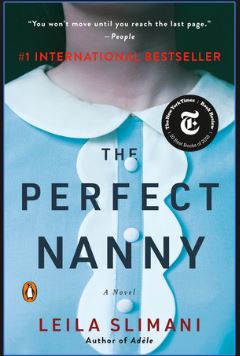
nannyLeila Slimani’s novel The Perfect Nanny was one of The New York Times  Top 10 books of 2018. Hmmm. It was also the winner of the Goncourt Prize. (Yeah, I’d never heard of that one, either, but apparently it’s “a prize in French literature, given by the académie Goncourt to the author of “the best and most imaginative prose work of the year”. Wikipedia) To me, I thought it was going to be a quick little thriller with a pedigree that was perhaps a cut above. Because go into any bookstore these days and there are about a zillion thrillers out there. How are you supposed to know what’s good?

I’ll save you the trouble: not The Perfect Nanny.

Myriam, a French-Moroccan lawyer, and Paul, her husband who is a music producer,  need someone to look after their two small children, Mila and Adam. They live in a small apartment in Paris and Myriam has recently decided to go back to work. They interview a few potential nannies, and then they meet Louise.

She must have magical powers to have transformed this stifling, cramped apartment into a calm, light-filled place. Louise has pushed back the walls. She has made the cupboards deeper, the drawers wider. She has let the sun in.

To Myriam, Louise is “a miracle worker.” Not only does she transform their living space, she “sews buttons back on to jackets…hems skirts…washes curtains…changes sheets…she is like Mary Poppins.”

She works her magic with the children, too and “When Myriam gets back from work in the evenings, she finds dinner ready. The children are calm and clean, not a hair out of place.”

But of course, not all is as perfect as it seems and we know that from The Perfect Nanny‘s opening line “The baby is dead.”

Slimani weaves Louise’s backstory throughout the novel, snippets of information about her dead husband, the horrible Jacques, her MIA daughter, Stephanie, other homes and families she has worked with. Simmering just below the surface, Louise is fragile. It seems she has buried all her own needs in service to others. She lives in a shithole; she has no friends; she has no money. Without someone else to look over, Louise is a non-person.

The Perfect Nanny has been compared to  Gone Girl  but I don’t think it’s an apt comparison. This book is a slow-moving, naval-gazing look at motherhood and surrogacy. It’s about how we treat people in subservient positions, about privilege. Yes, that opening line might make you think you’re about to read a thriller, but there’s never any question of whodunit and so all that remains is the why. At the end of the day, I didn’t care about any of these characters, so the why hardly mattered.