The Last September – Nina de Gramont

Brett loves Charlie. He’s the older brother of lastsepther best friend, Eli. She and Eli are students in Colorado and one stormy night they attend a party and Charlie is there, too, his flight delayed because of the storm.

That day, the first day I ever saw him, he had three days’ worth of stubble. He wore a thin black thread around his neck, beaded with a smooth lapis stone that matched the color of his eyes.  When I looked at him, his lips slid up at the corners. My heart lurched. I don’t know why. It lurched toward him and refused – stubbornly – to ever lurch away.

Nina De Gramont’s book The Last September takes zero time to hook you by the throat and it doesn’t let you go until the very end. I really couldn’t put this book down. On the surface it’s a love story. But it’s a love story that goes horribly wrong because by the end of the first sentence we learn that Charlie is dead. Brett tells us “Because I am a student of literature, I will start my story on the day Charlie died. In other words, I’m beginning in the middle.” By the end of the first page we’ll know that Charlie has been murdered.

Their love story unfolds in flashback. When the novel opens, Charlie, Brett and their toddler daughter, Sarah, are living in Charlie’s family cottage at Cape Cod Bay. Brett is finishing her PhD dissertation; Charlie is doing odd jobs.  On this particular day, Brett is frustrated with Charlie, a feeling not at all out of place in most marriages. When Charlie mentions that Eli had called and that he wanted to come for a visit, Brett is reluctant to see her old friend because “the last time we saw Charlie’s brother he’d dropped an enormous amount of weight and begun scribbling notes on his jeans and forearms.”

I have guilty reading pleasure buttons and, I have to say, The Last September hit every single one of them. Angsty love affair. Check. Unbearable suspense. Check. Heartbreak. Check. Check.

What happened to Eli? What happened to Charlie? What happens when Ladd, Brett’s former fiancé arrives back in town? If this sounds suspiciously like Peyton Place, you’re not wrong. But, omg, The Last September is so much fun to read. The writing is luminous and so even when I didn’t 100% buy the plot twists, it didn’t matter because I just wanted to find out what had happened to Charlie and I wanted to know that Brett was going to survive the grief.

Highly recommended.


The Great Gatsby – F. Scott Fitzgerald

gatsbymal.png

It took me four reads before I finally fell in love with F. Scott Fitzgerald’s Great American novel, The Great Gatsby. I might not have ever read it again after the last time (a couple years ago my book club had a ‘year of classics’) had it not been for the fact that I am teaching grade twelve this year. Often referred to as the quintessential American novel, its place in literary canon is certainly undeniable, but I just never bought in. The Great Gatsby  is my daughter Mallory’s favourite novel and she was understandably flummoxed as to why her English teacher geek of a mother never really liked the book. Now we’re on the same page. If you believe that a classic is a book that never runs out of things to say, this book certainly qualifies. I guess I’m just late to the party.

how-whimsical-2006-great-gatsby-book-coverNick Carraway, the novel’s narrator, moves from the mid-west to Long Island’s West Egg to take a job on Wall Street. Across the bay in East Egg lives his cousin, Daisy Buchanan, and her husband, Tom, an old Yale classmate of Nick’s, a man so “enormously wealthy” he’d brought  “down a string of polo ponies from Lake Forest.”  Nick comments “It was hard to imagine that a man in my own generation was wealthy enough to do that.”

Despite their wealth, Daisy and Tom don’t seem particularly happy and on his first visit with them Nick discovers that Tom is having an affair.  When it comes to the Buchanans, all that glitters is not gold.

Next door to Nick’s little house, and directly across the bay from the Buchanans,  lives Gatsby. His mansion is “a colossal affair by any standard.” Gatsby throws lavish parties every weekend  – huge glittering affairs attended by the who’s who of New York and “In his blue gardens men and girls came and went like moths among the whisperings and the champagne and the stars.”  On the first night Nick attends a party at Gatsby’s he is “one of the few guests who had actually been invited.” Soon after meeting his charming and enigmatic host, Nick finds himself drawn into a compelling love affair between Daisy and Gatsby, a love affair that had actually begun five years earlier.

The Great Gatsby operates on two very distinct levels: as a love story and a social commentary on the decadence and decay at the heart of the American Dream.

Gatsby’s single-minded devotion to Daisy, his desire to wipe out the present and reclaim their shared past drives him to create a sort of fantasy life. Everything Gatsby does is for Daisy and Nick remarks on his “extraordinary gift for hope,” his “romantic readiness such as I have never found in another person and which it is not likely I shall ever find again.” But Nick also acknowledges that perhaps Gatsby wants “too much” of Daisy and cautions him  that “You can’t repeat the past.”

On another level, Fitzgerald’s novel captures the glittery, frenetic 20s. A generation of young men had returned from the Great War, Wall Street was booming and in Fitzgerald’s version, anyway, people cared about little else except having fun.   Underneath the façade, though, there is rot and corruption. No one works except for Nick. They just drink and laze about. Nick sees it and when the veil is pulled back he tells Gatsby, “They’re a rotten crowd….You’re worth the whole damn bunch put together.”

The Great Gatsby is a beautiful novel, I see that now. I am sorry it took so long to believe in the dream.


Coventry – Helen Humphreys

On November 14, 1940, Coventry, a city in England’s West Midlands, was devastated by a German bombing raid that  leveled two thirds of the city, including the city’s cathedral, which was built in the 14th century.

coventry-cathedral-is-extensively-damaged-in-german-bombing-raids-136394373067803901-151113164642.jpg

This event is the backdrop of Helen Humphrey’s 2008 novel, Coventry. The novel captures the horror and chaos of that night as seen through the eyes of Harriet Marsh, a 44-year-old woman who is acting as a fire-watcher on the cathedral rooftop and Maeve, an artist whose 22-year-old son, Jeremy,  is also acting as a fire-watcher the evening the Germans dropped 500 tonnes of explosives on the city.

coventryWith the exception of a flashback to introduce us to Harriet’s husband, Owen, and to allow Harriet and Maeve to briefly meet, the novel spends its time during the ten-hour raid. Although it might be hard to imagine the scene, Humphreys does capture the horrible chaos of that night in simple, unembellished prose.
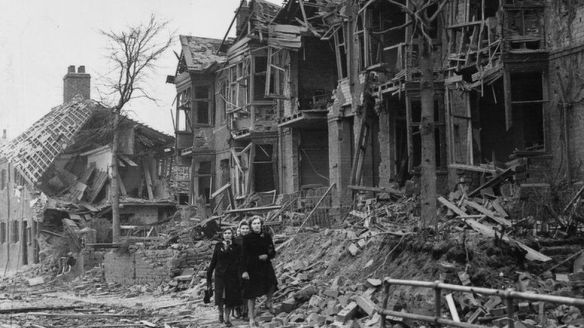
The bombing shakes the ground so that people fleeing through the streets stumble as though drunk. The trembling earth shifts them one way, and then the other, and Harriet finds herself reaching out to steady herself on walls that are no longer standing. She falls in the street, picks herself up from the shaking ground, and falls again.

Nearly 600 people were killed on that night; over 1000 more were injured. It’s perhaps not easy to imagine the chaos, but Humphreys does manage to capture it as Harriet and Jeremy make their way through the city to their respective homes. The horrors of war are all around them: people who have been fatally wounded, people buried under rubble, animals wandering aimlessly. Maeve leaves the shelter of the pub and heads home, but she and Jeremy miss each other.

_86655454_gettyimages-3356152

The British were known for their stoic resilience during the Second World War. Some of that resilience is seen on display in Coventry. In one particular scene, Harriet and Jeremy happen upon a makeshift first aid station and while Jeremy jumps in to help, Harriet wanders off to see if she can’t rustle up some tea. C’mon! It doesn’t get any more British than that.

How did these people cope? They just did what they had to do and when it seemed like they couldn’t go on, they did that, too.

I am a fan of Helen Humphreys. I loved her novel The Lost Garden  which I talked about here.  I also really enjoyed Afterimage, which I read before I started this blog. What I admire about her writing is her ability to capture moments so perfectly. Perhaps that ability comes from having started her writing career as a poet.  I just know that she is one of those rare writers who make you pause and nod your head in agreement.

Coventry is a short novel that, nevertheless, captures the horror and the unexpected beauty to be found amidst  chaos.

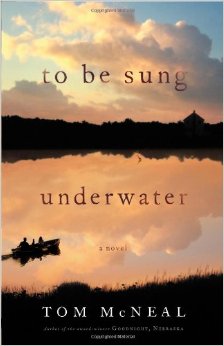
To Be Sung Underwater – Tom McNeal

Judith Toomey’s life “swerved” (her word) when she was forty-four. At the time she is a  Los Angeles film editor, married to a successful banker, Malcolm, and mother to a teenage daughter, Camille. Life is okay. Sometimes better than okay.underwater

…there were  whole hours and even days when Judith was visited by a dull ace that in spite of its unspecific origin seemed symptomatic of yearning, but there were also whole hours and days of productivity, good cheer, and reasonable warm fellow-feeling that she presumed she should, to be fair about it, call happiness, or something within inches of it.

But then one day, the “bird’s-eye maple bedroom set, handed down to Judith’s father by his grandparents, and by Judith’s father to Judith, and by Judith to Camille” ends up in a heap by the pool, ready to be collected and disposed of, and something in Judith unfolds, “a slow blossoming of resentment.”

To Be Sung Underwater is the story of a woman who suddenly finds herself in a life she doesn’t understand anymore. It’s not that she doesn’t love Malcolm or Camille, it’s just that a choice she’d made twenty-seven years earlier is something she can no longer ignore. Instead of allowing the furniture to be taken to the dump, Judith rents a storage facility and recreates her teenage bedroom. The space becomes an oasis for Judith –  a place where she can dream and sleep and remember.

And what Judith remembers is her time living with her father in Nebraska. Judith’s parents are separated because, as her father says “Our marriage, like all marriages, was happy until it wasn’t.” Judith’s mother is a free-spirited woman and her lifestyle irks Judith, so she eventually joins her father, an English professor at a small college. They live a quiet existence, sharing music and literature and stories from her father’s past.

Then, when Judith is sixteen, she meets Willy Blunt. He calls her “dangerous” and “his eyes, reaching in, exerted on Judith what felt like a subtle but actual pull, which alarmed her.” A year later, when they meet again, there is no denying their connection.

To Be Sung Underwater resonated with me in ways I am not sure I will be able to articulate. Judith makes her living piecing frames of film together to make a coherent whole, but the pieces of her own life no longer make sense to her. She wants to go back, but as Thomas Wolfe famously said, “You can’t go home again.” She wants to see Willy, and we know from the prologue that she does.

It has been a long time since he has seen her, a very long time, but he would have known her in a second. A fraction of a second. For a moment he feels he might soon waken from a dream, but for once, at last and after all, it is not a dream.

Reading that again, after having spent a few hours with Judith and Willy, is deeply moving. I loved everything about Willy. I loved his wry sense of humour and his deep and abiding love for Judith. I loved Judith, too. She’s smart and thoughtful; she cares about the past. I loved how McNeal’s book  tapped into the everyday moments that make up a life: eating and reading and sleeping and falling in love.

To Be Sung Underwater magnificently captures that very human impulse to revisit what we have lost and to try, where possible, to make ourselves whole again. This is a beautiful novel and I highly recommend it.

Mercury- Margot Livesey

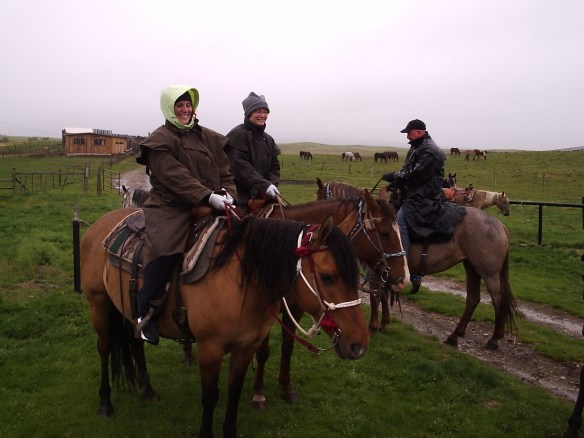
When I was about twelve,  I wanted a horse. Don’t ask me why; I certainly couldn’t tell you now. I’ve had three horseback riding experiences in my life – none of them involved me racing along a forest path or a stretch of beach, one with the horse. The one common theme of those riding experiences is me being terrified. In two instances, the horse decided to run (trot? gallop?) and I was unable to stop the bloody beast. In my 40s, while working for The Canadian Antiques Roadshow, I spent a freezing May afternoon  with some of my colleagues at a ranch outside of Lethbridge. A two-hour trail ride left me with bruises on the inside of my legs. I couldn’t sit comfortably for a week. So horses, after all, not my thing.

OLYMPUS DIGITAL CAMERA

That’s me in the middle. I am only smiling because we haven’t started our journey.

I tell you these stories so you’ll understand why I didn’t relate at all to Viv, one of the two narrators in Margot Livesey’s novel Mercury. Viv and her husband, Donald (the second, and predominate, narrator) live in a rural community outside Boston. Don is an optometrist; Viv runs a stable with her best friend, Claudia. They have two children.

28446368The first section of the novel is narrated by Don, a somewhat stoic Scotsman, who is still grieving over the loss of his father whom he admits he missed “in every way imaginable.” Perhaps this is meant to explain how things at home start to shift without him noticing: finances, his son’s trouble at school, his wife’s growing obsession with Mercury, a new horse being boarded at the stable.
Mercury, true to his name, was unmistakably hot-blooded. The lines of his body, the arch of his neck, the rise and fall of his stride, were, I agreed with Viv reluctantly, beautiful.

And obsession just about sums it up, too, as Viv tries to jumpstart her dream of competing with Mercury. Even though the horse doesn’t belong to her, Viv feels a kinship with him.

At the gate Mercury fixed his large dark eyes on me a nickered softly.  Then he scraped the ground, twice, with his right front hoof, choosing me.

Sadly, for me, I didn’t feel this kinship. Mercury is a novel with a billion things going on and a cast that, even though I read the book over the course of a handful of days, had me flipping back to figure out who they were. And all these characters have stories, too. There’s Don’s mom, feisty widow ready to love again; Jack, a blind (literally) professor who takes up with Hilary, owner of Mercury;  there’s Charlie, stable-girl who also covets the horse; Bonnie, a blip on Don’s devoted husband radar. The only thing keeping all these threads pulled together is Livesey’s prose. I’ve been a fan since Eva Moves the Furniture.

And, yeah, I get the whole Don’s an optometrist (irony!) but doesn’t actually see his wife. And I get that Viv’s devotion to Mercury blinkers her to everything else. And I also understand that Viv feels that Don’s grief over his father is isolating. But for me, there  wasn’t any emotional center in Mercury. I just didn’t buy that a horse could cause such a fuss.

I thank HarperCollins for providing me with my review copy and TLC Book Tours for inviting me to participate in this book tour.


The House at the Edge of the World – Julia Rochester

Twins Morwenna and Corwin have grown up on the Devon coast with their unhappy parents, John and Valerie, and their paternal grandfather, Matthew. They are eighteen when the novel begins and their father has just fallen off a cliff to his death. Morwenna, the narrator of Julia Rochester’s compelling novel The House at the Edge of the World says “He was pissing into the brine at Brock Tor on his way home from the pub and fell headlong drunk into the spring tide with his flies open.”

house-edge-worldMorwenna draws us into a gothic landscape where people use language with scalpel-like precision and the characters are not particularly sympathetic.

Take Morwenna herself. I can’t remember the last time I read a book with a first-person narrator that I didn’t really like. Morwenna is prickly and often cruel. Her employer that eighteenth summer tells her she is “a bad-tempered, foul-mouthed little smartarse.” He’s not wrong. The only person she seems to even remotely care about is Corwin, her beautiful and enigmatic twin.

After the death of their father, Corwin leaves Thornton and heads to India where he says he is going to “move water.” Morwenna goes to London, first to school and then to a job as a book-binder. It’s incongruous to her personality – the care she takes to make these beautiful hand-crafted books with their embossed leather covers and beautiful end-papers.

Then Morwenna tells us “For seventeen years after my father’s death nothing much happened and then a pigeon flew through my window.” It’s a sign, surely. Corwin comes home and the siblings, again in each other’s orbit, start to pull at the thread of their family history.

Much of this history is captured in the map their grandfather, Matthew, has been painting for as long as they can remember. The map captures both the landscape and the history of their ancestral home and soon becomes an important clue in the mystery of Morwenna’s father’s life and death.

Even more intriguing to me is the relationship between Morwenna and her brother. To say it’s complicated would be the understatement of the year. His arrival back in England after a long absence offers Morwenna only “one last  lazy unspoiled afternoon” before Matthew’s map and their childhood home spills its secrets.

I really liked The House at the Edge of the World. The language is beautiful. There is an element of idioglossia between Morwenna and Corwin.  They are endlessly compelling even if you don’t particularly like them. The same is true for the rest of the characters. Only Valerie, when she finally moves away from Thornton, seems to manage a modicum of happiness.

I am not satisfied with the way I am talking about this novel. Gah! It’s probably because I don’t want to give anything away and I also have all these conflicting emotions about it. So let me just say this:

Highly recommended.


The Wicked Girls – Alex Marwood

wicked.jpgIt’s 1986 when eleven-year-olds Jade and Bel meet in the village store. Their paths weren’t likely to have crossed before because Jade is one of the notorious Walkers – a family from the far side of the tracks – and Bel lives in a fancy house with servants. This fateful meeting is to change the course of the girls’ lives forever because by the end of it another little girl will be dead and Jade and Bel will be arrested for the murder.

This isn’t the only thing happening in Alex Marwood’s novel The Wicked Girls, though.

There’s Amber, head cleaner of Funnland, a boardwalk amusement park in the seaside town of Whitmouth (I imagined Blackpool only smaller and seedier). She lives with Vic, a handsome but slightly passive-aggressive carny. Amber lives a quiet, tidy life. She takes pleasure in overseeing her crew of cleaners and helping them when she can. When Amber discovers a dead girl in the park’s  hall of mirrors, her life becomes significantly more complicated.

Then there’s Kirsty , a freelance journalist married to Jim, an out of work  IT guy, and mother to a couple children. When the body is found at Funnland, Kirsty finds herself on assignment and inevitably comes face-to-face with Amber, the last person she’d ever expected to see again.

The reason: after their release from prison,  Jade and Bel were given new identities and cautioned about ever making contact with each other again. Not that the girls were likely to meet; they barely knew each other to begin with.

Marwood balances the story of Jade and Bel, unspooling the narrative of what happened that long ago day with the present day  Amber and Kirsty, two women who have made a desperate attempt to reinvent their lives.

As if that weren’t enough, let’s not forget Martin, creepy Whitmouth resident. He’s been rebuffed by Jackie, one of the Funnland cleaners. He’s clearly deranged and

the rage of rejection crawls beneath his skin; invisible, unscratchable. All she needs to do is text him back. He doesn’t want to go out, but if she refuses to respond he’s going to have to. As his mother was always assuring him, persistence is the most important quality in life. And he knows he is the most persistent of all.

The seemingly disparate threads of Marwood’s novel do come together, but whether you find the ending satisfying or not will depend on how you like your mysteries. There were a few super tense moments in The Wicked Girls, but there were also moments I found really slow going – not superfluous exactly. I guess I just like a little more ass-kicking and a little less naval-gazing in my thrillers. That said, the characters were definitely nuanced and sympathetic and the writing was good, but over-all I would have to say  The Wicked Girls is more slow burn than page-turner. That’s not necessarily a bad thing, though.

Bittersweet – Miranda Beverly-Whittemore

18339743Mabel Dagmar, the seventeen-year-old narrator of Miranda Beverly-Whittemore’s stunning novel Bittersweet is attending an upper-crust East Coast college on a scholarship. Her roommate, Genevra “Ev” Winslow is from an  influential blue blood family. The two girls couldn’t be any more different and yet somehow Mabel finds herself invited to spend the summer at Winloch, the Winslow family compound in Vermont. Mabel has no interest in returning home to Oregon for the summer, so she gratefully agrees even though she has to help Ev prepare Bittersweet, Ev’s personal cottage, for her father’s “inspection”.

“…if we don’t get that little hovel in shipshape in less than a week, I won’t inherit it,” Ev tells Mabel on the train to Vermont.

Winloch is a strange out-of-time place comprised of an assortment of cottages and a communal Dining Hall set around a beautiful lake,  inhabited by Ev’s immediate family including her parents, Birch and Tilde. It’s isolated and idyllic and Mabel is enchanted. This, she decides, is the life she wants.

Her visit to Birch and Tilde’s cottage only reaffirms her admiration:

Upon the honey-colored floor stood antique wood sideboards and a large mahogany table. An exquisite burgundy Oriental rug tied the furniture together, ending before a large fireplace sporting a brass fender and matching andirons. Canapes were arranged in colorful formations upon hand-painted porcelain platters: crab cakes and mini-lobster rolls and demitasses of chilled pea soup.

Even more impressive, the Winslow’s cottage boasts an impressive Van Gogh, “the most beautiful painting I’d ever seen.”

But there is also something slightly sinister about Winloch. For one thing, Ev installs bolts on the bathroom and bedroom door at Bittersweet. Then Mabel meets Indo, Birch’s sister, who enlists Mabel’s help in locating some important documents lost somewhere in the attic of the Dining Hall, claiming she’d been “looking for a friend like [Mabel] for a while.”

Mabel soon finds herself negotiating a landscape of shifting loyalties and strange tensions. It makes for compelling reading, that’s for sure; I couldn’t turn the pages quickly enough.

Although the bulk of Bittersweet takes place during that one summer, Mabel is actually remembering the events from a vantage point many years later. This will, in part,  help explain why Mabel seems older than seventeen. Her own personal history, revealed in tantalizing snippets, will also help the reader understand her motivations. Bittersweet is Shakespearean in its scope.

Highly recommended.

Lilac Girls – Martha Hall Kelly

Lilac Girls, the debut novel by Martha Hall Kelly,  is the first novel for my book club’s 2016-17 reading year. When it was chosen I can’t say that I was all that interested in reading it. We have all summer to read the book chosen for our first meeting of the new reading year, but I tend to like to read fast, snappy thrillers/mysteries in the summer – with the occasional YA or lit fic thrown into the mix. Also – not a tremendous fan of historical fiction. But I always read the book club selection because our get-togethers are a lot more fun when I’ve read the book. All this to say that I started this novel with a relatively negative attitude.

Lilac book jacketKelly’s novel tells the story of three very different women: New York socialite Caroline Ferriday, Polish teenager, Kasia Kuzmerick and German doctor Herta Oberheuser. It is 1939 and the one thing these women have in common is Adolf Hitler.

Caroline is 37 when the story opens. She’s a retired actress who volunteers at the French consulate. Kasia is just 16 when Germany invades Poland and changes her life forever. She is working as a courier for the underground resistance movement when she and her older sister, Zuzanna, and their mother are arrested and shipped off to Ravensbruck, a Nazi concentration camp for women. It is there that she encounters Herta, a young doctor who has taken a post at the camp because it is difficult for women in the medical field to find work.

The novel is told in three separate first person narratives and once the book gets going it’s almost impossible not to be carried along by the horrors of Ravensbruck and Kasia’s desperate attempts to survive. There’s also a little angsty love story between Caroline and famous French actor Paul Rodierre.  I read the first 200 pages in one sitting.

Caroline and Herta are real people, as Kelly explains in her notes. Kazia and her sister are

22907ea70de32fa19f35246c55131f05

Caroline Ferriday

“loosely based on Nina Iwanska and her physician sister, Krystyna, both operated on in the camps.”

It is almost impossible not to invest in these characters, and the sections concerning Kasia in Ravensbruck are particularly harrowing. There, she and her sister are among hundreds of women used as real-life guinea pigs (or “rabbits” as they are called) for the Ravensbruck doctors to experiment on. Herta’s participation in these horrific experiments,  crimes that are against every aspect of the Hippocratic oath, seal her fate as a villain.

The book is long and the ending seemed a little rushed to me and I could never figure out the title or the dumb book cover- which makes it seem like three girls are the best of friends. I also wasn’t fussy about Kasia and Herta’s showdown, but ultimately Lilac Girls was a good read.

The Girls in the Garden – Lisa Jewell

Although I have hundreds of books waiting for me on my tbr shelf, I can’t seem to stop buying new books whenever I am at the bookstore, which is – let’s face it – often. There’s been all these suspense thrillers out there like I’m Thinking of Ending Things and The Widow and Twisted River  and The Crooked House which I seem to be drawn to like the proverbial moth to the flame. Maybe it’s because it’s summer and I just like to read something that’s fun, I dunno. But I have no trouble ignoring the huge catalogue of back-listed books I have waiting to be read and, instead, buy the shiny new books.

the-girls-in-the-garden-9781476792217_hrThe Girls in the Garden is one of those books. Although it turned out to be not the book I thought it would be, it was a great read nonetheless.

Clare has moved to a small enclave somewhere in urban London. Virginia Park is “formed in the space between a long row of small, flat-fronted Georgian cottages on Virginia Terrace and a majestic half-moon of  stucco-fronted mansions on Virginia Crescent, with a large Victorian apartment block at either end.” She and her children, eleven-year-old Pip and twelve-year-old Grace are recovering from a horrible incident involving Clare’s husband, Chris. (And again, what is it with book blurbs getting it wrong? The back cover says Pip is older, but she’s not.)

From the outside, Virginia Park seems like a miracle of a place. In the boundary formed by the buildings is a beautiful park which Pip describes in a letter to her father as being “like Narnia.”

…there are all these pathways and little tucked-away places. A secret garden which is hidden inside an old wall covered with ivy, like the one in the book. A rose garden which has bowers all the way around and benches in the middle. And then there’s a playground, too.

It’s a place of magic for the girls and a place for Clare to catch her breath. Except, of course, the magic is short-lived.

Adele also lives in Virginia Park with her husband, the handsome and slightly oily Leo, and their daughters Catkin, Fern, and Willow. The girls are home-schooled and the family leads a slightly bohemian life. Soon, Clare and her girls are brought into the welcoming embrace of Adele’s family. (Okay, maybe the girls aren’t 100% welcoming; you know how kids are.)

Tyler, another pre-teen who lives in one of the flats and her best friend, Dylan, the beautiful thirteen-year-old boy who also lives at the park, round out the gang that Grace and Pip find themselves hanging around with.

The Girls in the Garden reads like a thriller. The novel begins with the discovery of Grace’s unconscious and bloody body being discovered by her sister in the rose garden and then backtracks to unspool the story, mainly from the point of view of Clare, Adele, and Pip.

Jewell cleverly manipulates the reader into imagining a variety of very plausible scenarios before the story takes an unexpected (but not unbelievable) turn, ultimately making The Girls in the Garden less of a thriller and more of a domestic drama. But really, is there anything more thrilling than that? Isn’t it absolutely true that we never really know people, even those closest to us?

I thoroughly enjoyed this book.