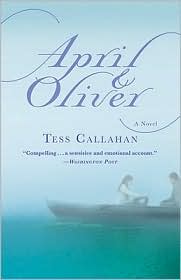
April & Oliver – Tess Callahan

april and oliverApril Simone is the damaged character at the centre of Tess Callahan’s first novel, April & Oliver. She’s the sort of twenty-something girl you want to shake and hug because her decision-making skills have been compromised. (I was going to say  somewhere along the road to adulthood, but once you know her story – you know exactly where it happened). We meet her younger, much adored, brother Buddy, first. But we don’t get to spend much time with him because he’s killed in a car accident:

He wishes he could let her know that what’s happening now doesn’t hurt at all. He’s fine. A veil of snow shrouds the windshield. Buddy feels a growing pause between each breath, like a stride lengthening, an aperture opening by increments, until at last he slips through.

And then we meet Oliver, her cousin – although they are not linked by blood. (They sort of share a grandmother because their fathers had been step-brothers through Nana’s second marriage. I think.) April and Oliver had been best friends as children and teenagers, but they have been estranged for the last several years. Oliver moved away and they just lost touch. Buddy’s funeral brings them back together – but their reunion is anything but happy.

Every conversation between April and Oliver is barbed and sexually charged. While Oliver  certainly seems like the one who has it all together (he’s a law student, engaged to the beautiful and selfless, Bernadette), the longer he spends with April the more his carefully constructed life seems to unravel.

April tells him: “I know your problem, Oliver. In your head is a girl who doesn’t exist.”

Bernadette is all too aware of April’s magnetic pull. “Is there anything else I should know about?” she queries. “It was never like that,” Oliver answers. But it’s a lie because between April and Oliver it’s always been like that and denying it is perhaps part of the problem.

But April is a mess. She’s recently invoked a no contact order against her boyfriend, TJ – a man with a horrific past who is both scary and somehow sympathetic. She lives in a dump of an apartment, has a crap job and has so many skeletons in her closet, it’s no wonder she pushes Oliver away. He knows her too well.

They know each other too well, and their ability to peer into each other’s dark corners both antagonizes and comforts them.

April & Oliver is beautifully written; I’ll give it that. And when I finished the book I did feel satisfied  despite its ambiguous ending.  Sometimes, I admit, I did find the book frustrating – but perhaps I was meant to. I am a sucker for angst, though,  and April & Oliver has that in spades.

The World More Full of Weeping – Robert J. Wiersema

worldCanadian writer Robert J. Wiersema packs a punch with his novella, The World More Full of Weeping. On the day before going to spend a week with his mother in the city, eleven-year-old Brian disappears in the woods behind his father’s house. Wiersema manages to capture both the frantic search, and Brian’s journey in the forest in 77 short pages.

Part of the novella’s success can be attributed to Wiersema’s split narrative. Beginning in present day, Brian shares breakfast with his father who explains to him that his mother will be picking him up at four. Brian clearly doesn’t want to go, but lacks the ability, it seems, to articulate his feelings. Instead, he tells his father, Jeff, that “Carly said you wouldn’t understand.”

Carly’s true identity is just one of the mysteries of The World More Full of Weeping. Who is  Carly? At first she just seems like a girl Brian meets in the woods. But after Brian goes missing  and Jeff calls over to his neighbour John’s to see if he’s seen him, the mention of her name causes John to encourage Jeff to call “Chuck Minette at the Search and Recuse…call him right now.”

Many years ago, Jeff also went missing in the woods only to turn up the next day. When men from the community come to help look for Brian, it’s clear everyone thinks his disappearance might be a case of “like father, like son,” with the same happy outcome.

While the search for Brian continues, we see him in the woods with Carly, who is always in the same thin dress despite the uncertain March weather, her cheeks “pink and rosy.” Carly knows secret places in the woods, places Brian has not ever seen.  She asks him if he wants to “see more hidden things” and promises she can show him “a whole hidden world in the forest.”

There are no concrete answers in The World More Full of Weeping. The only certainty is that when given the opportunity Jeff and Brian made different choices. Perhaps some readers will take comfort in Brian’s decision, but for me I can’t quite get the picture of Jeff on his knees, crying for what is lost,  out of my head.

A magical and profoundly moving story.

The White Devil – Justin Evans

whitedevil

SHE WALKS IN BEAUTY

SHE walks in beauty, like the night

Of cloudless climes and starry skies;

And all that’s best of dark and bright

Meet in her aspect and her eyes:

Thus mellow’d to that tender light

Which heaven to gaudy day denies.

One shade the more, one ray the less,

Had half impair’d the nameless grace

Which waves in every raven tress,

Or softly lightens o’er her face;

Where thoughts serenely sweet express

How pure, how dear their dwelling-place.

And on that cheek, and o’er that brow,

So soft, so calm, yet eloquent,

The smiles that win, the tints that glow,

But tell of days in goodness spent,

A mind at peace with all below,

A heart whose love is innocent!

Justin Evans has written an intriguing and creepy novel inspired partly, I’m sure, by the year he spent at Harrow School. That’s right, the Harrow school in The White Devil  is a real place situated about 40  minutes from London’s West End. From the look of its website, it’s  prestigious and slightly stuffy.

The White Devil cashes in on verisimilitude of another sort: Lord Byron was once a pupil at Harrow. Byron (George Gordon Byron 1788-1824) was quite notorious, even in his own life time and not just for his Romantic poetry. He was sexually voracious and had several lovers including his half-sister. It has long been speculated, although likely not by Byron’s peers, that he was bisexual.

header-overview-11

Andrew Taylor, the novel’s 17-year-old protagonist, has been sent to Harrow in a last ditch effort to make him agreeable to American universities. He’s been turfed from his own school back home for drug-related crimes and this is his last chance to get his shit together – so to speak. From the moment he arrives at Harrow, though, Andrew feels out of place. He doesn’t understand the humour or the customs or how he’s going to survive a year in this place that is “dank, cramped and old.”

header-overview-03

When Andrew’s first friend at Harrow is found dead under somewhat suspicious circumstances, things start to go a little hairy at Harrow.  For one thing, Andrew is the person who found the dead boy. For another, he thinks he saw the person who did it. And he’s been having these dreams. Because there’s apparently a ghost at Harrow. And for some reason the ghost seems focused on Andrew. By lucky or rather unlucky (as it turns out) coincidence, Andrew is a dead ringer for the dead poet.

As the ghost at Harrow becomes more menacing, Andrew tries to figure out who it is and what it wants. He’s not alone. Helping him are Piers Fawkes, the school’s tortured poet-in-residence; Judith Kahn, a crisp librarian and Persephone, the headmaster’s daughter and the only female student at Harrow.

The White Devil is delightfully twisty and I’ll tell you one thing, it made me very curious about Byron’s life. I have read other novels featuring Byron: the YA novel  AngelMonster by Veronica Bennett and Tom Holland’s excellent Lord of the Dead, but The White Devil really brought its A game: it’s well-written, smart and a lot of gothic fun.

Evans talks about the book here.

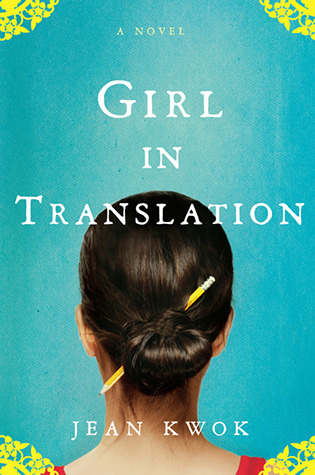
Girl in Translation – Jean Kwok

girlintranslation“I was born with a talent. Not for dance, or comedy, or anything so delightful. I’ve always had a knack for school.”

Kimberly is just eleven when she and her ‘Ma’ emigrate to the States from Hong Kong. It has long been a dream of theirs to live in America and chase that American dream. They arrive in New York with little more than the clothes on their backs and the promise of a new life.

Ma’s older sister, Paula, has been living in New York with Uncle Bob for several years and it is because of her sponsorship that Kimberly and Ma are able to come. But don’t get the idea that Paula is a benevolent soul; she’s not. She puts Ma to work in the clothing factory Bob manages – a sweat shop – and sets her sister and niece up in an apartment so filthy, cold,  and vermin infested that the building has all but been condemned. In fact, every other tenant has moved out in anticipation of the building’s eventual demolition.

Girl in Translation is the story of Kimberly’s adolescence. It’s about her tenacity. If she weren’t so intelligent, her story might have had a different conclusion, but she’s really smart and it’s those smarts that propel her past many of the obstacles poverty throws in her way.

Those of us who live a comfortable existence likely have very little notion of how incredibly difficult it must be for people who come to, let’s say, North America and try to start a new life. Immigrants often don’t speak the language. They don’t understand how anything works. They have no way of advocating for themselves. Kimberly and her mother also have to contend with Aunt Paula who is petty and stingy and jealous of Kimberly’s smarts.

There are moments of kindness in Kimberly’s story. She makes a true friend early on. She finds success academically. She makes her way. But there are significant sacrifices, too.

Like Kimberly, Kwok was born in Hong Kong and immigrated to New York City. She, too, worked at a sweat shop. She, too, was smart. At about the two third mark in the novel I started to feel a bit…I don’t know…disappointed. Kimberly’s story remained interesting, but I really felt as though this was a memoir dressed in a novel’s cloak. I can’t quite explain why, but I didn’t feel like I was living the story anymore, I felt like I was being told the story. And then…that thing I HATE. Flash forward twelve years and let’s see where all the characters are. Nothing about that epilogue – over-wrought and schmaltzy as it was – seemed to fit the rest of the novel.

That’s my own personal niggle, though. The novel has been praised all over the place and I suspect the vast majority of readers will really enjoy it.

A Spell of Winter – Helen Dunmore

I read Helen Dunmore’s novel With Your Crooked Heart many years ago and I’ve been a fan ever since. Dunmore’s prose is like poetry, every sentence a perfect balance between beauty and truth. Winner of the 1996 Orange Prize, A Spell of Winter is the fourth novel I’ve read by her, and I have also read her collection of short stories, Ice Cream.

A Spell of Winter concerns the lives of Cathy and Rob, siblings who live in a crumbling manor house in England.  Their guardian is their maternal grandfather, “the man from nowhere”, and through Cathy’s eyes he is seen as stern and unsympathetic.

When A Spell of Winter begins Rob is nine and Cathy, our narrator, is seven. They are on their way, with Miss Gallagher, to visit their father in the sanatorium. It’s a traumatic visit –and also marks the last time the children will see their father alive.

The children’s lives are isolated and insular. Cathy remarks:

I look at the house, still and breathless in the frost. I have got what I wanted. A spell of winter hangs over it, and everyone has gone.

Perhaps it is isolation, perhaps it is abandonment, but eventually Cathy and Rob cross the line. Their story reminds me of another pair of British siblings who become lovers: Cathy and Christopher, protagonists of Carolyn Slaughter’s magnificent novel Relations (also published as The Story of the Weasel.) With a huge house to creep around in and no one to pay attention to them except Kate, their trusted servant, Cathy and Rob fall into a strange spell of their own.

A Spell of Winter has many of the gothic hallmarks: the gloomy dwelling, a sense of mystery, a distressed heroine. As long as Cathy and Rob are isolated, they manage to sustain their relationship. But like winter, it can’t last. Eventually, the real world seeps in in ways both expected and unexpected.

I loved A Spell of Winter. It’s not a ‘love’ story in the way Relations is. I wasn’t rooting for Cathy and Rob. I was rooting for Cathy. She is abandoned many times during her life, but her resilient nature, whether through necessity or tenacity, keeps her going.  The language is beautiful. And the story despite its dark subject matter, is brimming with the promise of spring.


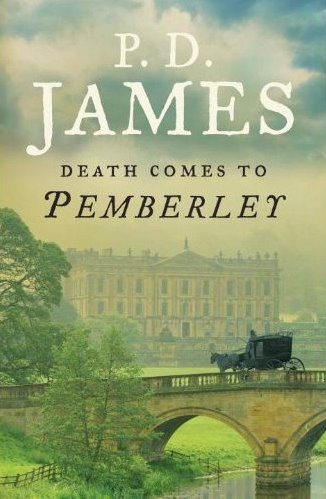
Death Comes to Pemberley – P.D. James

Death Comes to Pemberley by famous British crime novelist P.D. James is fan fiction. That’s right: P.D. James borrowed characters and settings made famous by Jane Austen and wrote them into a new story which takes place six years after Elizabeth and Darcy marry. That’s essentially what fan fiction is; writers (albeit, generally amateur writers) find new ways to breathe life into familiar characters. Because James is a crime writer, she wrote a mystery (although a relatively tame one, even by my standards.)

Fan fiction is (according to Wikipedia) “a broadly-defined term for fan labor  regarding stories about characters or settings written by fans of the original work, rather than by the original creator. Works of fan fiction are rarely commissioned or authorized by the original work’s owner, creator, or publisher; also, they are almost never professionally published.”  I would have agreed with that definition except for all the fan fiction that has found its way into bookstores recently (Fifty Shades of Grey, for example, literally started its life as Twilight fanfiction; Pride and Prejudice and Zombies and Android Kareninaare two examples from Quirk Classics). Perhaps I am misinterpreting the definition of fan fiction, but to me when you borrow another writer’s characters and just give them a new plot — that’s fan fiction. Yes, even if it’s a parody. (Fan fiction writers write parodies all the time.)

But, hey, I’m a huge fan of fan fiction and so pointing it out isn’t meant as a criticism. Even Pulitzer Prize winning author, Michael Chabon understands the merits of derivative fiction. In his book of essays Maps and Legends: Reading and Writing Along the Borderlands he says:

 …all literature, highbrow or low, from the Aeineid onward, is fan fiction. That is why Harold Bloom’s  notion of the anxiety of influence has always rung so hollow to me. Through parody and pastiche, allusion and homage, retelling and reimagining the stories that were told before us and that we have come of age loving – amateurs – we proceed, seeking out the blank places in the map that our favorite writers, in their greatness and negligence, have left for us, hoping to pass on to our own readers – should we be lucky enough to find any – some of the pleasure that we ourselves have taken  in the stuff we love to get in on the game. All novels are sequels; influence is bliss.

No matter the source material, all literature, ultimately, has to stand on its own two feet. Readers needn’t be a fan of Austen — or even know who she is — to read Death Comes to Pemberley because in the opening chapter James fills us in on the backstory. Once readers have the lay of the land, they can jump into the mystery which for me was only so-so. I like Austen fine, although I wouldn’t say I am a huge fan. I love a good mystery. I don’t have any problem with dense, old-fashioned prose (really good fan fiction mimics the original author’s style and recreates characters that are recognizable to readers of the original work). But Death Comes to Pemberley was a big YAWN. Seriously: nothing happens.

Elizabeth and Darcy are madly in love — although they spend virtually no time together. Elizabeth is preparing for Pemberley’s yearly Lady Anne’s ball when her younger sister, Lydia, arrives screaming that her husband George Wickham has been murdered in Pemberley Wood. Wickham is a bad apple and has been a constant source of embarrassment for Darcy. When it turns out it’s not Wickham who is dead but another male who was traveling with him, Darcy isn’t sure Wickham actually committed the crime.

It’s not much to make a mystery meal out of, but James fills page after page with lengthy descriptions of relationships and manners and protocol and the moon on the woods and it was so S-L-O-W. If it hadn’t been our first book club pick (and by a new member, no less) I would have abandoned it, for sure. I kept plodding along, but for me, the original charm of the Elizabeth/Darcy relationship was absent and the rest of the book just wasn’t my cup of tea.

Room – Emma Donoghue

Today I am five. I was four last night going to sleep in Wardrobe, but when I woke up in Bed in the dark I am changed to five abracadabra. Before that I was three, then two, then one, then zero. “Was I minus numbers?”

Jack is the narrator of Emma Donoghue’s stunning novel, Room. (Yes, I am late to the bandwagon; everyone and their dog was talking about this book when it first came out. But you all know I buy more books than it will ever be possible for me to read, right?)

From the book’s opening scene until I closed the novel a few hours later I was totally mesmerized by Jack and his Ma and the eleven by eleven world they lived in, their ‘Room.’  Jack and Ma live in this Room because of Old Nick, a predator who kidnapped Ma when she was 19 and has held her captive for seven years. Room is a prison, but it’s also the only home Jack has ever known. He doesn’t understand Outside, but he’s curious and  Ma knows that time is running out. They must find a way to escape.

Jack is a mesmerizing character and although it was risky to allow the story be told entirely through him, it’s a risk that pays off.  His worldview is so naive. He has no real concept of time (his sixth birthday will happen next week, his birthday cake takes hours and hours to make) and he believes that the people in TV “are made just of colors.”  His world is structured: sleep, eat, exercise, watch TV, read. His only playmate is his mother, but even through his innocent eyes he can see that Ma is struggling. Sometimes she spends entire days “Gone.” Sometimes she displays emotions Jack is unable to understand.

What wakes me up is a noise over and over. Ma’s not in bed. There’s a bit of light, the air’s still icy. I look over the edge, she’s in the middle of Floor going thump thump thump with her hand. “What did Floor do?”

Ma stops, she puffs out a long breath. “I need to hit something,” she says, but I don’t want to break anything.”

“Why not?”

“Actually, I’d love to break something. I’d love to break everything.”

“I don’t like her like this. “What’s for breakfast?”

Room is a remarkable achievement. It reads like a thriller; I couldn’t turn the pages fast enough. But it is also a beautiful testament to the power of love. What wouldn’t Ma do for Jack? Even more amazing, is what Jack is willing and able to do for Ma. I’ll be thinking about this book for a long time.

Highly recommended.

Rape: A Love Story – Joyce Carol Oates

Joyce Carol Oates wastes no time cutting to the chase in her novella, Rape: A Love Story.

After she was gang – raped, kicked and beaten and left to die on the floor of the filthy boathouse at Rocky Point Park. After she was dragged into the boathouse by the five drunken guys – unless there were six, or seven – and her twelve-year-old daughter with her screaming Let us go! Don’t hurt us! Please don’t hurt us!

Teena  Maguire and her 12-year-old daughter, Bethie, leave a July 4th party after midnight and cut through Rocky Point Park.  They take a short-cut through the woods and encounter the group of drunken men, many of whom are known to Teena from around her Niagara Falls neighbourhood.

Although Bethie is beaten, she manages to escape and hide under a boat. She listens as her mother is raped and savagely beaten and left for dead. The reader is not spared from the horror of this crime, but Oates — skillful writer that she is — never crosses the line into gratuitous.

Bethie manages to attract the attention of a police officer and it happens to be Officer Dromoor, a man who knows Teena because of an encounter they’d had one night at a local bar. Dromoor is a good man– a married father-to-be with a finely attuned sense of justice.

Teena survives the attack, but her life is forever altered. Rape: A Love Story sets about examining the ways in which this horrific incident changes her and Bethie and Dromoor and even three of the perpetrators and their families. It asks questions like was Teena dressed inappropriately and thus ‘asking for it’? Oates doesn’t offer any answers, though.

I have a love/hate relationship with Oates. There’s no denying her considerable talent, but sometimes I find her hard work. It’s not style over substance — although, no question she has some stylistic tics which take some getting used to. In Rape, she employs second person narrative (always a risky choice, imho, although clearly well-handled here), choppy sentences, and a narrative that jumps around. But, let’s face it, she’s Joyce Carol Oates.

I always want to like her more than I actually do.

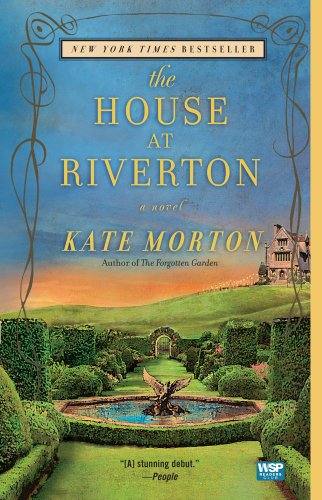
The House at Riverton – Kate Morton

I’m sure many of you have already read Kate Morton’s debut novel, The House at Riverton, but I only just finished it yesterday afternoon. If you haven’t already found a book to while away the dog day’s of summer, might I suggest you run to your bookstore immediately and purchase this one. Whew. What a read!

Grace Bradley is fourteen years old when she comes to Riverton House to work. Her mother had also worked at the sprawling Essex manor house, but had to leave under mysterious circumstances.  It is through Grace that we learn of Riverton and its inhabitants.

I have been thinking about the day I started at Riverton. I can see it clearly. The intervening years concertina and it is June 1914. I am fourteen again: naive, gauche. terrified, following Nancy up flight after flight of scrubbed elm stairs. Her skirt swishes efficiently with every step, each swish an indictment of my own inexperience.

The story, though, starts in the present. Grace is an old woman now. Her husband is dead; her daughter is in her sixties and her beloved grandson, Marcus, has been missing for several weeks. When a filmmaker from America writes to ask if Grace would consult on a film she’s making about a tragedy at Riverton, Grace is pulled back into her memories.

Fans of Downton Abbey will be able to picture Grace’s life perfectly: the servants downstairs, their dedication to service, their hierarchy. But Grace is more concerned with the Hartford siblings: David, Hannah and Emmeline. Over the years she becomes particularly close to Hannah and  when Hannah marries, she is whisked off to London to live.

The House at Riverton is about an aristocratic family in decline. Set between the two great wars, characters go off to their deaths, or come home damaged. The Roaring Twenties usher in an era of shifting sensibilities. Morton does a spectacular job of evoking a time and place. It’s easy to sympathize with the female characters who yearn for  a different life and although criticism has been leveled at Grace for choosing service over personal happiness, I believe I understand her choice.

Because Grace is looking back, the reader knows early on that some tragedy has befallen the Hartford family. That alone would be enough to turn the pages. But the novel takes its time arriving at its conclusion. Perhaps some readers found the novel slow and the prose over-written; I know it took me a while to settle into the story.

However, when I left Grace, 468 pages later, it was with great sadness because even though this is the story of Riverton, Grace’s own story is inextricably linked.

So Much Pretty – Cara Hoffman

I rarely pick up a book randomly anymore, but So Much Pretty was calling my name. Not only was it calling my name, it actually jumped the pile instead of languishing on my bookshelf for months and months. Still, despite the endless glowing praise I had a hard time settling into the book. Perhaps it was the time of year I started to read it — late June, when school is busy. I took the book with me on a family holiday and while the kids were swimming, I sat on a beautiful screened porch and lost myself in Cara Hoffman’s small-town drama.

Told from multiple perspectives, So Much Pretty flips over the small town of Haeden, NY and exposes its creepy underbelly. When the body of a missing teenager, Wendy White, is discovered in Tern Woods, it kick starts an examination of several lives particularly Flynn, the brittle newspaper reporter and  Claire and Gene and their daughter, Alice, transplants from NYC. The book also includes police reports and interviews. In this way, the book is difficult to navigate at first. It really deserves to be read in one sitting because once I made time for it, it really wouldn’t let me go.

Although there is a horrific crime at the center of this book, the real crime has more to do with the ways in which people are often complicit.  Parents misreading their children; neighbours turning away from each other; individuals looking for the spotlight. The story unfolds at a leisurely pace, making sure the reader understands all the players and their connections, but I feel like I missed a lot of clues — no, not even clues — signs that things were not quite right in Haeden because my mind was occupied trying to figure out how Alice was connected to Wendy. I got it horribly wrong, btw.

There are questions to be answered here, but Hoffman’s  feelings are opaque. She masterfully navigates all the pieces, but I never got the preachy feeling I often get with, say, a Jodi Picoult novel. The bulk of what happens to Wendy is left to the reader’s imagination, and her fate is far worse because of it. This would be a fantastic book club pick because of the inherent opportunities  for discussion. So, while it took me a bit to get into, I ended up loving So Much Pretty. Its copious praise is well-deserved.