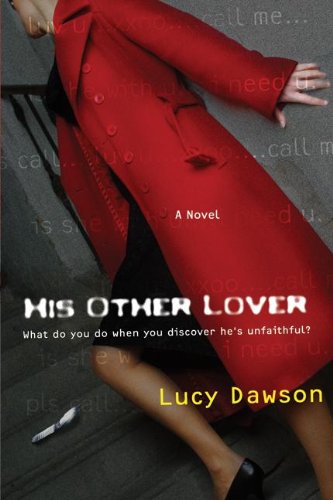
His Other Lover by Lucy Dawson

I seem to be on an infidelity kick lately. I read Lucy Dawson’s debut novel, His Other Lover, over two nights, reading until my eyes burned. In all the ways Love and Other Natural Disasters failed, His Other Lover succeeded.

One night, Mia, a 20-something woman who works for a small advertising firm somewhere near London, discovers a text message on her live-in boyfriend’s phone. Mia thought Pete was the one. Turns out he’s someone else’s one, too. That someone else is an actress named Liz.

The discovery of the text message begins a downward spiral of destructive behviour which upends Mia’s life. But hers is not the only life shattered by the discovery.

It’s interesting, but true, I think: women who are cheated on often blame the other woman. Mia pours all her anger and hatred on top of Liz. She almost makes Pete seem like another victim, someone who fell into Liz’s Black Widow trap and was helpless against her sticky charms.

Of course it’s all much more complicated that that. Mia goes completely off the rails, calling in sick for days on end while she tries to track down Liz. She wants her boyfriend back and the only way to do that is annihilate the enemy.

Dawson does a terrific job of getting inside of Mia’s head. The whole range of emotions are there: grief, anger, the hot desire for revenge. Mia is single-minded in her thirst for getting back her man. The thing is: he’s not worth it.

But the book is.

Love and Other Natural Disasters by Holly Shumas

When Eve, a young mother pregnant with her second child, overhears her husband having what sounds like a very intimate conversation on the phone in the middle of Thanksgiving dinner, her whole neatly ordered world is turned upside down. She overhears her husband say: “Shh, you’re going to be okay” and that’s all it takes to know that something is going on.

Holly Shumas’ novel Love and Other Natural Disasters explores the effects of an affair – not a physical affair, but an  emotional one – on a marriage. I suspect that there are probably some people who would say that if there isn’t any sex, it’s a “no harm, no foul” situation. Shumas does a pretty good job, though, of illustrating that looking outside of your marriage for any sort of fulfillment can have devastating consequences.

Love and Other Natural Disasters traces Eve and Jonathan as they try to put their marriage back together. It’s a push/pull affair as they both try to cope with their own issues and the unresolved issues in their marriage.

Shumas herself is a licensed marriage and family therapist and if I have any niggles with the book it’s that sometimes it seems instructional. The characters each have a part to play to demonstrate the various stages of grief: the disbelief and anger, forgiveness and acceptance. Sometimes their reactions seemed over-the-top or not quite harsh enough. For example, after she discoveres her husband’s relationship, she reads his emails looking to understand what’s gone wrong. Later, in therapy, Jon blows up about her invasion of his privacy. Um, hello, there wouldn’t have been any need for her to go snooping if you hadn’t done something inappropriate. But I know the therapist’s point of view might be to suggest that Jonathan has a right to his anger.

Some of Love and other Natural Disasters resonated with me, but not because the book was beautifully written or original. And even though I sometimes felt as though it was too instructional, and that the characters weren’t particularly nuanced – Love and Other Natural Disasters is topical.

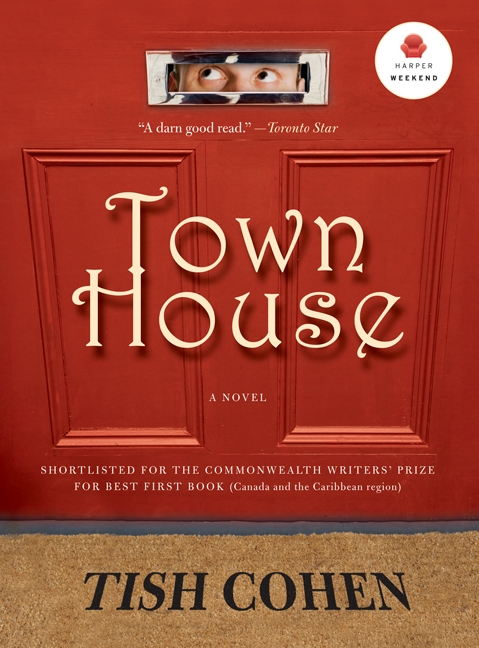
Town House by Tish Cohen

You can’t help but think that Tish Cohen is going for Hollywood with her novel Town House. There’s the wacky ensemble cast: Jack Madigan, son of deceased rock legend Baz Madigan; Jack’s son, the eccentric stuck-in-the-70’s teen, Harlan;  Jack’s ex-wife, Penelope, and her soon- to- be new husband, Yale; the strangely mature girl-next-door, Lucinda and Dorrie, the real estate agent so inept and adorable you just know she and Jack will end up together. (It will come as no surprise that Town House is, in fact, destined for the big screen.

As for the plot, well, Jack’s agoraphobic; he can’t leave the house without having a meltdown – so he doesn’t leave.  He rigs up a ‘groper’ to retrieve the paper and the mail; Harlan looks after the groceries and Jack lives quite happily in the huge (albeit, slightly decrepit) Boston town house his father left for him. The hilarity starts when the money stops and the bank decides that the house must be sold.

Town House isn’t all that funny, though. Sure, it ticks along, but the characters didn’t really interest me. And some of the plot twists just seemed contrived and unrealistic. I absolutely hated the ending. Cue music, already.

Sometimes the plot seems to be pointing in one direction – for example Jack is apparently a master paint mixer. He has discovered (and understands) the perfect white. A subplot involving that goes nowhere.  Also, I thought his love-interest was spineless. And, despite his illness, of which, I admit, I know nothing, Jack isn’t all that likable. How is he, after all, able to bust free of his illness when Lucinda needs him, but can’t do the same for his own son?

So – I didn’t love this book. It was moderately entertaining, and might make an amusing film, but it wasn’t my cup of tea.

To the Power of Three by Laura Lippman

To the Power of Three was my first novel by Laura Lippman. It’s hard to know what to say about it because while I didn’t love it, I certainly appreciated its merits.

To the Power of Three tells the story of Kat, Perri and Josie, childhood best friends. One June morning, one of the three  brings a gun to school, shoots two of the girls (one fatally) and then herself. The novel then begins to unravel the story of what would have caused this horrible act of violence.

Lippman is an accomplished writer. In some ways, her work reminds me of Carol Goodman. Lippman’s characters were complicated and well drawn – even minor characters have interior lives, hopes and fears. We come to understand these three girls and share their bond through the years of their friendship, but we only come to understand what caused one of the girls to take such drastic measures at the novel’s conclusion.

For me, that was the novel’s weakness. The book’s over 400 pages long – too long, perhaps, for such a mediocre resolution. As a reader, we’ve invested a great deal in these characters (and their parents and peripheral friends) that it’s a let down to discover what actually happened on that fateful day – and why it happened. (After giving this more thought, I think the reason why the ending didn’t work for me is because it gives one of the characters a moral compass that – while not exactly coming out of nowhere – doesn’t seem earned either.)

To the Power of Three wasn’t a page-turner in the way that some mysteries are. Perhaps that balancing act is hard to achieve: literature and suspense; a well-written story that you speed through because you can’t bear not to know whodunit. For my money, no one manages that sort of book better than Thomas H. Cook. Still, Lippman’s skills are apparent and I’d certainly read her again. In fact, I have What the Dead Know waiting on my tbr shelf.

Where the River Runs by Patti Callahan Henry

A while back I read Henry’s novel Losing the Moon and although I had misgivings when I started the novel, it won me over in the end. Sadly, I can’t say the same about Where the River Runs. I wanted to like it, I really did…but I just had so many problems with it.

Where the River Runs is the story of Meridy Dresden, lawyer’s wife and mother to a teenage son, BJ. She has a strained relationship with her mother and sister and a big secret that she’s kept since the summer she graduated from high school and her boyfriend, Danny, was killed in a fire. When she’s asked to write a curriculum based on Gulluh (descendants of African slaves) culture, she goes back to her childhood home to interview Tulu, her childhood housekeeper.

What this novel expects us to believe is that 20 years after the tragic fire that killed Danny,  Meridy’s best childhood friend, Tim, is being asked to pay for the damage to an old historically significant cottage that burned down. The novel also asks us to believe that people’s strained family relations can be miraculously resolved over iced tea on the porch. Meridy’s struggle to reconcile her past was real enough except that the secret she built her life around was ridiculously inconsequential.  I just didn’t buy into her angst. It all seemed contrived and convenient and forced.

For me, the best parts of Where the River Runs were the Gulluh sayings at the start of every chapter. Things like Death is one ditch you cannot jump and the heart doesn’t mean everything the mouth says.

Where the River Runs is part of the New American Library Accent series, novels which are meant to touch on subjects close to a woman’s heart, or as the tag line says: “Fiction for the way we live.” I don’t know anyone who lives this way.

Didn’t like this one at all…read Losing the Moon instead.

Still Alice by Lisa Genova

stillalice

My mother was a geriatric nurse for most of her career. When I was in my late teens I had a summer job working at the nursing home where she was head nurse. Many of the patients had dementia and I remember one lady in particular, Annie. She was sweet and over the summer we became friends…except she never remembered who I was from one day to the next.

Lisa Genova’s novel Still Alice is the story of Alice Howland, renowned Harvard professor, mother of three, happily married to John, also a Harvard prof. After seeing her doctor because she’s suffering from strange lapses in her memory, Alice is diagnosed with early onset Alzheimer’s. She is 50.

The novel traces Alice’s diagnosis and subsequent decline. At first she merely struggles to find words (and I don’t do this, but sometimes I start a story and totally forget what I was going to say!) but then her lapses in memory become more pronounced: she gets lost walking a familiar route, she forgets people who were introduced to her only moments before, she mistakes a mat on the floor for a black hole.

Still Alice isn’t literature. Okay, yes, it tells a story, but often times I felt like the author was trying to convey information. Alice says to her neurologist:

“You should also tell them about DASNI. It’s the Dementia Advocacy and Support Network International.”

There are several other instances of this sort of writing, places where I felt Genova had an agenda and she was writing to fulfill it. Somehow it lessens the emotional impact of the story because as a reader I was more interested in Alice and her life than I was in hearing about clinical trials.

I can only imagine that being diagnosed with Alzheimer’s is the worst torture imaginable. The disconnect between your life and the lives of the people you love would be beyond horrific. The thought of losing the ability to read (I can’t even imagine my life without books!), to watch a movie, to do simple tasks, or to recognize the faces of my children fills me with dread. Yet near the end of the novel, Alice still has the wherewithal to stand up in front of the delegates of a Dementia Care Conference and give an impassioned lecture about how, despite her symptoms, she is still a person worthy of note.

“Please don’t look at our scarlet A’s and write us off. Look us in the eye, talk directly to us. Don’t panic or take it personally if we make mistakes, because we will.”

The whole lecture seemed like  authorial commentary…and it didn’t work for me. Strangely, the part that I found most moving in the novel was when Alice attends the graduation of her last grad student, Dan. Even though we’ve seen very little of their relationship and hardly anything of Dan in the novel, his post-graduation moment with Alice is very touching.

People will love Still Alice. My feeling about it is that it’s a timely topic written without artifice.

The Woods by Harlan Coben

Woods

So, I know there are loads of Harlan Coben fans out there. I get why people like him. He’s a straight-up writer, lots of dialogue and characters and plot threads to keep you busy. Coben’s the sort of writer you read when you’re looking for something fast-paced and, dare I say it, fluffy.

The Woods has a convoluted plot that concerns Paul Copeland, County Prosecutor. Twenty years ago his sister, Camille, went missing (presumed dead) along with three of her friends while they were all at a camp for teens. When one of the presumed dead turns up dead (again) twenty years later, it cracks open a door to a past that Paul knows nothing about.

I liked Paul’s character. He’s a smart-mouthed lawyer who isn’t afraid to look the bad guy in the eye. His chief investigator, Muse, is the female equivalent of Paul and they make a fine team.

For me, though, The Woods was just too busy and, at the end of the day, the secrets buried in the woods just weren’t enough to hang 400 pages on.

Dark Debts by Karen Hall

debtsKaren Hall’s novel Dark Debts is a lot of things, but the most ‘terrifying horror thriller of the last decade’ is not one of them. That’s not to say that I didn’t enjoy this book – I did. But it didn’t scare me.

Dark Debts tells the story of Randa, a newspaper writer; Jack, eldest son of a cursed family (all of whom have either committed suicide or been executed); and Michael, a Jesuit priest who’s in love with Tess, a book editor. Their connection isn’t immediately apparent, but as it turns out they have more in common than you’d think. Don’t worry, all is revealed by the book’s rather neat-bow ending.

What I liked about Dark Debts had less to do with its, at times, heavy-handed musing on the nature of faith and more to do with Hall’s ability to write dialogue that is often very funny.It’s the dialogue that propels the novel along, and so it shouldn’t come as any surprise that Hall’s other career is as a successful television writer. (The fact that Dark Debts is destined for the big screen should therefore be no surprise either. )

Her characters are all likable, too, even when they do unrealistic things.

There’s a lot going on in Dark Debts – murders and devils and exorcisms, but none of it’s scary –  or maybe I’ve just been forever spoiled by the demon who possessed Regan in The Exorcist.

Body of a Girl by Leah Stewart

bodyofgirl

I read Leah Stewart’s novel The Myth of You and Me a couple years back and I had a lot of problems with it. I had a lot of problems with Body of a Girl, too.

Olivia Dale is a crime reporter for a Memphis newspaper. She’s not a rookie, but she’s young and it shows despite her best attempts to hide her reactions to the horrible things she’s called upon to write about. When the novel opens, she’s at a crime scene. Timing allows her to be closer to the body of a girl than she would normally be allowed.

“I’ve learned to stomach the photographs they show me,” Dale says, “but now I know it’s nothing like being so close you could lean down and touch that dead, dead skin” (2).

Perhaps because the dead girl is similar in age and appearance or perhaps she’s just the final straw in Dale’s precariously constructed life-  either way,  she  becomes obsessed with finding out everything there is to know about the dead girl. Not only does she throw  her personal safety out the window, she chucks out her common sense as well. As the book chugs along I felt less and less sympathetic and more and more annoyed with her.

I think Body of a Girl attempts to answer some of the questions we all ask: what makes us the same, what makes us different? How close to the edge can we walk without toppling over? Can we ever really know someone? The problem with Dale is that, despite her profession, she’s a piss-poor judge of character and doesn’t seem to have a compass of any sort. Her journey, ultimately, seems self-destructive, rather than a real attempt to understand the human condition. Dale just seems reckless and stupid by the novel’s rather sappy ending.

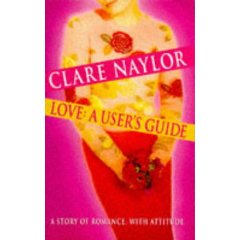
Love: A User’s Guide by Clare Naylor

usersguide1

It’s been a long time since I’ve read a book this bad. And when I say bad I mean stinky bad- filled with clunky writing, unrealistic characters, stupid plot. So I’m lying a bit when I count it as a book I’ve actually read- mostly I skimmed.

Amy works for Vogue in London. She’s beautiful and smart and funny and quirky and perfect and fashionable and and and. Orlando Rock is a movie star. He’s gorgeous and perfect and kind and hot and not even remotely stuck on himself.

Amy and Orlando meet on a beach (shortly after Amy has her first sexual encounter of the lesbian kind with someone who happens to be a dear friend of Orlando’s). He’s smitten. So is she.

What followes is a completely ridiculous courtship followed by even more ridiculous plot machinations aka tabloids which drive a temporary wedge between our lovers. Every once and a while the author speaks  about the characters as if she’s some sort of benevolent angel watching over their love affair.

“…we have to make allowances for love and hope that the lesson they learn won’t be too painful.” (170)

Yeah okay- what about the pain you’re causing your readers, Ms. Naylor?

This book was so bad, I had to make a new tag category: really bad books.