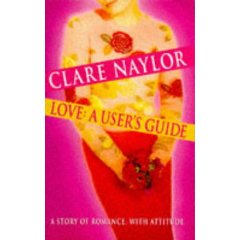
Love: A User’s Guide by Clare Naylor

usersguide1

It’s been a long time since I’ve read a book this bad. And when I say bad I mean stinky bad- filled with clunky writing, unrealistic characters, stupid plot. So I’m lying a bit when I count it as a book I’ve actually read- mostly I skimmed.

Amy works for Vogue in London. She’s beautiful and smart and funny and quirky and perfect and fashionable and and and. Orlando Rock is a movie star. He’s gorgeous and perfect and kind and hot and not even remotely stuck on himself.

Amy and Orlando meet on a beach (shortly after Amy has her first sexual encounter of the lesbian kind with someone who happens to be a dear friend of Orlando’s). He’s smitten. So is she.

What followes is a completely ridiculous courtship followed by even more ridiculous plot machinations aka tabloids which drive a temporary wedge between our lovers. Every once and a while the author speaks  about the characters as if she’s some sort of benevolent angel watching over their love affair.

“…we have to make allowances for love and hope that the lesson they learn won’t be too painful.” (170)

Yeah okay- what about the pain you’re causing your readers, Ms. Naylor?

This book was so bad, I had to make a new tag category: really bad books.

Red Leaves by Thomas H. Cook

redleavesI’ve gotta say- Thomas Cook hasn’t disappointed me yet. Red Leaves is the fourth novel I’ve read by this terrific mystery writer and it was excellent. Not my favourite so far, but still a great read. Let’s face it, there are only so many mystery stories to tell: murders committed by psychopaths, depraved sex crimes, crimes of passion, greed or power run amok. Cook is the cream of the crop of writers in this genre for a couple of reasons. First of all, the man can turn a phrase. Secondly, his characters are complicated people with messy human lives. Cook does a terrific job, in every book I’ve read, of turning them inside out and exposing their frailties, fears and darkness.

Red Leaves tells the story of the Moore family: Eric (owner of a camera shop), Meredith (teacher at a small community college) and Keith (their teenage son). They live in a small New England town and live, what Eric believes, is a perfect life. That is until eight-year-old Amy Giordano goes missing and the last person to have seen her is Keith, who’d been babysitting her that evening.

As Eric struggles to come to terms with his failed relationship with his son and his growing suspicions that Keith might actually have had something to do with Amy’s disappearance, other cracks in his life start to appear. What follows is a terrific page turner as Eric races to protect Keith and shore up his own life against the damage secrets and lies cause.

I’ve said it before about Cook, he is a wonderful observer of human nature and he writes about the things that we love and fear as well as any other popular writer I’ve ever read. If you haven’t given him a try, I’d encourage you to check him out.

The Slow Moon by Elizabeth Cox

slowmoon

Elizabeth Cox’s novel The Slow Moon was a huge disappointment to me. I was really looking forward to reading it but it turned out to be really, really mediocre.

Central to the story is the relationship between Crow, 16,  (the son of wealthy, well-respected parents) and Sophie, 14, (daughter of a widow). The story opens as they sneak off from a high school party to have some alone-time in the woods. Crow and Sophie really like each other and they have decided that they want to take their relationship to the next level. The next level requires condoms though, and Crow has forgotten those in his truck. He leaves Sophie alone to retrieve them and she is brutally attacked.

This rape isn’t enough for Cox to make a meal on, however. So instead of giving us any real insight into how Sophie feels and how Crow, wrongfully accused, feels, she fills the novel with a bunch of stupid subplots: Crow’s parent’s cracked marriage, his father’s infidelity, his mother’s pre-marriage pregnancy (so the man who Crow thinks is his Dad, isn’t his Dad.) Crow’s best friends all have their own problems – one is trying to come to terms with the fact that he may be gay, another finds out the father he thought was dead is actually in prison.

And can I just say a word about the writing.  What 14 and 16 year olds (loss of innocence not withstanding) actually “like[d] examining the frailty of others.” (294)  The novel is filled with passages like this: “Another car went by, throwing light onto the walls and ceiling, and the light felt heavy, like a horse running fast into his room; the threat of being crushed came to his mind.” (247) Um, what?

Jodi Picoult’s endorsement on the front of the book says “I found myself pausing over the beauty of this book, and wishing I’d been the one to think of it.” Jodi, honey, you did think of it and you wrote it and called it The Tenth Circle. That book is infinitely better.

Beautiful Lies by Lisa Unger

beautifullies

Beautiful Lies is a silly book. Silly in the sense that the plot is mostly ridiculously contrived and way more convoluted than it needed to be. But who cares? When you read suspense thrillers only a couple things really matter. First of all- can we get behind the main character? Do we like her/him? Do we care what happens to them? Secondly,  is there enough  mystery/action/suspense/sex to keep the pages turning?

Beautiful Lies concerns the life of Ridley Jones, a successful, single freelance writer living in New York City. One day, on her way to meet her ex-boyfriend for breakfast, she saves a life and is thrust into the spotlight.  Soon after,  she gets a letter in the mail and everything she ever thought she knew about herself and her life is suddenly suspect.

There’s a lot of stuff going on in Unger’s book: doting parents who have pat answers for all Ridley’s questions, a junkie brother, a cloying ex-boyfriend, and a new love interest cut from romance 101 fabric.

Yet even as I questioned some of Ridley’s choices, even as I tried to piece together things that didn’t make a lick of sense, I kept turning those pages.

Perhaps it was Unger’s conversational style. Ridley tells the story herself and in some ways as a reader I felt as though she was telling me her story over a pot of tea on a  long afternoon. That intense focus, though, also means as a reader you get to be more critical of the character and I have to admit that sometimes I did want to shake her.

Ultimately, though, you don’t read a book like Beautiful Lies for insight into the human condition. You read it for sheer fun and I had a lot of that.

Places in the Dark by Thomas H. Cook

placesinthedark

This is third book I’ve read by mystery writer Thomas H. Cook and I have to say that I continue to be impressed. The critics seem to adore Cook and have described Places in the Dark as “a serpentine tale of long-buried secrets leading to murder and betrayal” (The Orlando Sentinel) and “complex, multi-layered and haunting” (Romantic Times).

The story concerns brothers William and Cal who grow up in an idyllic seaside town in Maine in the 1930s. They are as different as night and day: William an energetic dreamer who rushes through life filled with hope and enthusiasm and Cal, the older more pragmatic brother. Still, despite their differences, they are close. Then Dora March comes to town.

It gives nothing away to say one brother ends up dead, but the book’s mystery isn’t so much a whodunit as a what are the circumstances surrounding the death.

Cook’s skill comes from his ability to create character. His mysteries unfold slowly, but I don’t mean to say that his books aren’t page turners. You’ll turn the pages, but I think you’ll also linger over Cook’s beautiful writing. Cook is a master of layering his character’s motives, of giving them real interior lives. He’s also pretty good at leading us on and this is particularly true in Places in the Dark where things are not always what they seem.

If you like a well-written mystery, I highly recommend Thomas H. Cook. I haven’t been disappointed yet.

The Awakening by Donna Boyd

awakening1

Donna Boyd’s novel The Awakening starts off promisingly enough. A woman wakes up, confused and disoriented. It’s clear that something  traumatic has happened to her, but she has no recollection of what it is. Then we meet Paul Mason, his wife Penny and their daughter, Elsie. Paul’s a famous writer who hasn’t published anything new in over six years; Penny is a busy surgeon; Elsie is their troubled thirteen-year-old daughter. Paul and Penny’s marriage is hobbling along after Paul’s infidelity; Elsie is apparently in therapy to recover from some traumatic event.

The Awakening is a ghost story. Apparently, though, writing a ghost story wasn’t sufficient for Boyd, so she’s thrown in teen angst, suicide pacts, buried family secrets, cancer, and the whole notion of life after death. All the bits and pieces are meant to add up and when the ghost finally comes to terms with her death (and is ultimately reuinited with her true family, although we don’t actually see this happen ), the miracle of her existence propels the Masons down a road towards reconciliation and emotional healing.

Should you expect more than entertainment when you read a book like this? Not necessarily, I guess. There was something that just didn’t add up though…or maybe it’s that things did add up, just the teensiest bit too easily. So many big topics, Paul’s infidelity, for example or the ways that he and Penny had drifted apart or what happened to Elsie which had caused so much stress in the family, all of it is explained or resolved in the book’s final pages.

The Awakening turned out to be one of the tamest ghost stories I’ve ever read and an even less compelling family drama.

The Innocent by Harlan Coben

Those who like Harlan Coben, seem to like him a lot. The Innocent was my first Coben book and while I didn’t love it, it did deliver enough curious twists and sympathetic characters to keep my interest.

The difficulty in writing about a suspense thriller is trying to avoid giving away too many important plot points. Briefly, The Innocent concerns Matt Hunter an ex-con (but only marginally because his crime was more accident than premeditated) who has returned to his home town after serving his sentence with his wife, Olivia. Olivia goes away on a business trip and Matt receives a cell phone picture of her in a hotel room with another man. The story unravels from there.

In some ways The Innocent’s convoluted plot doesn’t really work.Too many people have too small a part to play in the book’s nasty business…and some of the pieces seem gratuitous rather than helpful. Still, like a good book in this genre should, the book clicks along at a healthy pace and the lead character, Matt, is smart and likable.

Catch Me When I Fall by Nicci French

I’m a big fan of Nicci French. (For those of you who don’t know- Nicci French is actually the married couple Nicci Gerrard and Sean French.)

I first discovered them with the book Killing Me Softly, which I absolutely loved. Since then I have read several more of their books, plus two others written by Nicci Gerrard on her own. So- I am a fan. Together as Nicci French, they write a really great sort of psychological fiction- filled with menace and surprises and shadowy figures. Page-turners.

Catch Me When I Fall
was unlike any French book I’d read before. It tells the story of Holly Krauss, this wildly confident career woman who lives in London with her husband, Charlie, a graphic artist. When we first meet Holly we think she might be merely reckless, but it turns out her behaviour is more complicated than that. Her husband and her best friend and business partner, Meg, watch helplessly as Holly’s behaviour becomes more and more bizarre and self-destructive.

As an examination of mental illness, this is a compelling read. But that’s not the only thing French has up for grabs in this book. It isn’t my favourite French book- but I enjoyed it just the same.

The Falls by Karen Harper

You know you’re in trouble when you come across a line like this in a book: “I have a feeling my survival training from years ago and my duty during Operation Desert Storm is going to come in real handy.’

Of course the joke’s on me. The revelation- spoken by hard-as-nails Sheriff Nick Braden doesn’t come until page 285- but I knew the book was gonna be a stinker by page 10…yet I still kept reading.

Publishers Weekly loved The Falls and said Harper has a fantastic flair for creating and sustaining suspense… Um- okay.

Claire Malvern wakes up in the middle of the night and discovers that her husband, Keith, is missing. They live in Washington State, where they are renovating an old fishing lodge they intend to open as a B and B. When Keith’s body turns up in the river, presumably after having jumped off the bridge at Bloodroot Falls, the Sheriff calls it suicide, but Claire just knows Keith would never kill himself.

Sadly, though, Claire knows less about her husband than she thinks she does. And it turns out that most of the small cast of characters in Harper’s cliched novel have something to hide. Sadly, none of it is very interesting.

Look- there are all sorts of this kind of book out there and I’ve read lots of them. What’s the most important ingredient to make them work? You have to care about the characters. They have to be believable.

Nothing to look at here, folks. Move along and save your money.

King of Lies by John Hart

John Hart’s debut in the world of fiction is that most engrossing of rarities, a well-plotted mystery novel that is written in a beautifully poetic style…The King of Lies will mark the beginning of a long and stellar career. – Mark Childress, author of Crazy in Alabama

People apparently loved this book. There are three pages of positive reviews excerpted in the front of the book. That’s surely a good sign, right?

Personally, I feel sorta ho-hum about this book.

Jackson Workman Pickens, or ‘Work’ is a relatively successful lawyer in a Southern town. He’s unhappily married to Barbara.  He has a mentally ill sister, Jean. He’s generally well-liked. Then, one day, his famously successful lawyer father, Ezra, (who has been missing for eighteen months) turns up in the closet of a dilapidated mall- two bullet holes in his head. Naturally, Work is a suspect, but because he knows the system he is able to stay (mostly) one step ahead of the detective who is, convinced he is the murderer, hot on his trail.

In all fairness to Hart, I do think he is trying to do more with The King of Lies than unravel a mystery. Work is a complex guy: he’s genuinely decent and tries to do the right thing, even though he’s emotionally reticent. He’s been in love with another woman since he was 12, but he’s never been able to say the words to her…and he married someone else. He is estranged from his sister, but he’s fiercely protective of her. His relationship with his father was acrimonious and the whole Pickens family is plagued by secrets.

But for me- the book moved too slowly. I mean, it wasn’t a page turner in the sense that I couldn’t wait to know what was going to happen next. It was well-written (although he did use some of the same figurative language more than once…and that always bugs me) and Work was a good guy, but certain things niggled. Jean: barely coherent in one section, full of self-knowledge and insight by book’s end.

If you’re a fast and true mystery fan, you could certainly do worse than The King of Lies.