The Little Paris Bookshop – Nina George

F96E7CCB-2F2E-4033-A1CA-9F4483B1F637A friend once told me that I was the most romantic person they’d ever met. I don’t actually think that’s true. Or, if it used to be true, it’s not true anymore. I think I am cynical about romance now and it’s through that cynical lens I read Nina George’s much lauded novel The Little Paris Bookshop which made me cringe on so, so many levels.

Jean Perdu (and as I was pointing out some of the novel’s cringe-ier moments, my son said “Perdu means lost, mom”) is a “literary apothecary”. Basically, he can find the right book for what ails you. Geesh, I can do that out of my classroom library, but whatever. He lives in Paris and sells books out of a barge docked on the Seine.

One day, a new woman moves into his apartment building. She’s left her husband and has nothing, so the concierge of his building asks if he might have a table to loan her. He does; the problem is that this table is in a room that he blocked off with a wall of books twenty years ago. For reasons.

The delivery of the table sets off a whole chain of events. The woman, Catherine, finds a letter in the table and it is this letter (and Perdu’s sudden and unexpected feelings for Catherine) which set the novel’s main narrative in motion. Because suddenly Perdu knows what happened to Manon (simply called ———-, for the first part of the story because, clearly, it’s too painful for Perdu to even say her name), the LOVE of his life. She disappeared twenty years ago and for twenty years Perdu has been healing others with his books, but not healing himself. (INSERT EYEROLL)

When he gets his first erection of the last twenty years, Perdu has no choice but to RUN AWAY. He hops onto his barge, about to make a clean getaway when suddenly he is joined by Max Jordan, a wunderkind writer who is now suffering from crippling writer’s block. So, the two of them float down the Seine – Perdu in an effort to bury the past and Max just because.  Along the way, they pick up one more guy, Cuneo.

The Little Paris Bookshop is a road trip bromance sort of novel filled with pithy observations about the world and set-pieces designed to show these dudes as enlightened beings. The women in the novel are props. Everyone is thoughtful and forgiving and treacly.

I had high hopes for this book. Paris (which I visited for the first time in July 2018), books: what’s not to love? I thought.

Le sigh.
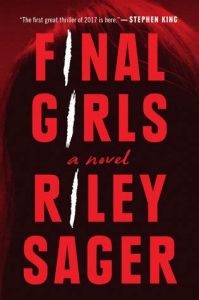
Final Girls – Riley Sager

finalI didn’t realize that the term “final girls” actually referred to the last girl standing in a horror film. I chalk it up to not being a fan of stalker-type films; I can’t deal with the violence.  According to Vox “Final Girls are tough enough and strong enough to make it to end — the only people still standing when the last trickle of blood has hit the floor.” (It’s worth reading the whole article, actually, as it’s a really interesting look at Final Girls.)

Riley Sager (a  pseudonym for author Todd Ritter – and what is it about all these pseudonyms lately?) has taken this horror movie trope and spun it into his best seller Final Girls…although I would disagree with the ‘best’ part of it.

Ten years after her best friends were massacred in a remote cabin, Quincy Carpenter, the only survivor,  is still trying to recover. Now she’s a NYC baking blogger living with her lawyer boyfriend in NYC. She smooths out the rough edges of her life with Xanax, a little kleptomania, and sporadic visits with Coop, the cop who saved her life that night in the woods. He’s her touchstone, the one person who understands what she endured and ultimately survived that night when she escaped from Him. (That’s what Quincy calls the killer – a moniker that never stopped reminding me of  a BDSM master/slave.)

She’s not the only Final Girl, though. There’s Lisa, who survived a sorority house massacre at the hands of a crazed psycho and Sam, who lived through the Sack Man’s rampage at the Nightlight Inn. Lisa reaches out to Quincy with an offer to teach her how to be a Final Girl.  Sam is MIA until she unexpectedly shows up on Quincy’s door and Quincy’s life begins to unravel.

It’s Lisa’s death – an apparent suicide –  which is the catalyst for Sam’s arrival in New York and Quincy’s sudden departure from her quiet life. Sam is a bit of a wild child and suddenly Quinn’s drinking too much Wild Turkey and walking through Central Park after midnight – just looking for trouble. Sam provokes Quinn.

I want to see you get angry. You’ve earned that rage. Don’t try to hide it behind your website with your cakes and muffins and breads. You’re messed up. So am I. It’s okay to admit it. We’re damaged goods, babe.

The past starts closing in on Quincy and the book definitely does pick up some momentum even if I didn’t believe the ending one bit.

Final Girls suffers in comparison to  The Woman in the Window even though the books aren’t strictly in the same genre. I started Final Girls and read probably 100 pages and then started The Woman in the Window, which I absolutely couldn’t put down, even though I did figure out some of the twists in advance. Final Girls just felt clunky to me by comparison. Quincy is shrill and not particularly sympathetic and yes, of course, she survived a horrific event and I should cut her some slack, except that I just didn’t  care about her.

I am a big fan of psychological thrillers and I am definitely in the minority here. Even Stephen King called this book “the first great thriller of 2017.” For me, Final Girls just didn’t fulfill its blood-spattered promise.


The Husband’s Secret – Liane Moriarty

It’s no secret to the ladies in my book club: I didn’t like Liane Moriarty’s novel The Husband’s Secret. At all. But here’s the thing, the critics loved it. Geesh, even Anne Lamott called it “smart, wise, funny.” husband

The husband in question in The Husband’s Secret is Cecilia’s husband,  John-Paul Fitzpatrick, he of the “deep, warm and comforting” voice; hopeless at the minutiae of daily life, but “he took care of his wife and daughters, in that old-fashioned, responsible I-am-the-man-and-this-is-my-job way.”  One day, while searching in the attic for a little piece of the Berlin Wall (cue metaphor alert) to give to her  daughter, Esther, who has recently shown an interest, Cecilia discovers  (by accident…or is it fate?)  an envelope upon which is written: For my wife Cecilia Fitzpatrick,  To be opened only in the event of my death.

In another part of town is Rachel, a woman whose life has been forever coloured by the death of her teenage daughter, Janie, some twenty-eight years ago. She has a son, Rob, and daughter-in-law, Lauren and a two-year-old grandson, Jacob. Rob and Lauren have just told Rachel that they are moving to New York to take advantage of a terrific job opportunity for Lauren. Jacob is the light of Rachel’s life and the news is devastating to her – never mind that she has discounted Rob and Lauren forever, because – you know – she’s grieving. Still. Always.

The third woman to figure in Moriarty’s over-stuffed plot is Tess, who has recently come home with her young son, Liam,  because her husband, Will, and cousin, Felicity, (who are also her business partners) have just revealed that they have fallen in love. Ouch.

Really, there’s enough going on in The Husband’s Secret to fuel three novels, but Moriarty chooses, instead, to tangle the fates of all these three women together and also try to comment on infidelity, love, marriage, family, parenting, friendship, and how to make a million bucks selling Tupperware.

A novel like this, let’s call it domestic drama, depends on one thing and one thing alone and that’s believability. I didn’t believe any of these characters, nor care about them one iota. The book seemed interminable to me, over 400 pages bookended with a prologue and epilogue that asks you to consider the myriad of ways your life might have gone had you only chosen a different path. But as Robert Frost’s misunderstood poem “The Road Not Taken” warns us “the passing there/ Had worn them really about the same.” No matter which path you choose in life,  a belief in fate is also a belief that everything turns out as it should.

The Husband’s Secret is an “everything but the kitchen sink” novel that tries hard to be all things to all readers: mystery (though not so much for careful readers), and family drama, with a little bit of sex thrown in for good measure. When one of my friends joked “just wait until you get to the aliens,” I actually considered she might be telling the truth.

A world of no.


The Winter People – Jennifer McMahon

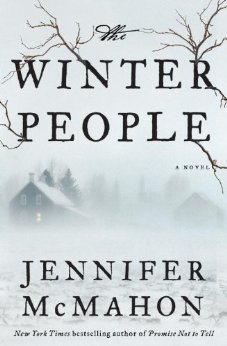
A few years back I read Jennifer McMahon’s debut novel Promise Not To Tell, and I enjoyed it a great deal. A couple years after that I read McMahon’s novel Dismantled, a book I did not like one bit. Now I’ve just finished reading The Winter People, and I have to say it falls sort of in between.winterThe Winter People is a story which bounces between present day and 1908. In the past, Sara Harrison Shea lives on the farm where she grew up with her husband, Martin, and her little girl, Gertie. West Hall, Vermont is well-known for its mysteries and ghost stories, many of which center around Sara and her family farm, a house filled with secret places and, well, secrets.

In her diary, Sara writes “The first time I saw a sleeper, I was nine years old.”

I had heard about sleepers; there was even a game we played in the schoolyard in which one child  would be laid out dead in a circle of violets and forget-me-nots. Then someone would lean down and whisper magic words in the dead girl’s ear, and she would rise and chase all the other children. The first one she caught would be the next to die.

Turns out, though, there is dark magic and Sara’s Auntie, an Indian woman who cared for Sara’s dying mother before she started sleeping with Sara’s widowed father promises to “write it all down, everything I know about sleepers.” In case it’s not obvious, sleepers are people brought back from the dead, but they only exist for seven days, you, know, unless they shed blood during that time – then they live forever.

In the present, nineteen-year-old Ruthie lives in Sara’s farmhouse with her mother, Alice, and her little sister, Fawn. One morning Ruthie gets up to discover her mother is missing. Cold tea on the table, truck in the barn – vanished into thin air.

Then there’s Katherine. She’s still grieving the loss of her son, Austin, when her husband, Gary, is killed in a car accident. Thing is, he told her he was going to be one place and he was actually in West Hall. Last seen: Lou Lou’s Cafe with Alice.

These disparate threads do come together by novel’s end, but I lost interest about half-way through. The Winter People is clearly meant to be a ghost story, but once crazy Candace shows up, intent on getting the missing pages of Sara’s diary so she can sell the secret of raising the dead so she can fight for custody of her son -yeah, right about then I was…c’mon. Oh, plus there’s a gun. Two guns actually. And other crazy shenanigans. And then, a lot of exposition to tie up those pesky loose ends.

When McMahon stuck to the ghost stuff…there were some creepy moments, but The Winter People is nowhere near as good as Promise Not To Tell.

Hausfrau – Jill Alexander Essbaum

hausfrauPoor Anna. Her life sucks. She’s the protagonist in Jill Alexander Essbaum’s novel Hausfrau,  an American living in Dietlikon, a suburb of Zurich, with Bruno, her Swiss banker husband and her children: Victor, 8, Charles, 6, and baby Polly. She doesn’t work. She’s barely even learned to speak the language despite having lived in Switzerland for almost a decade. Her mother-in-law seems wholly unimpressed with her– and no wonder: Anna disappears for hours, taking language classes and having sex with random men.

It’s hard to really like Anna very much. She’s not the effusive American one might expect. Instead of joining the other mothers when she meets her sons at school she “scuffed the  sole of a brown clog  against the sidewalk’s curb…fiddled with her hair and pretended to watch an invisible bird flying overheard.”  She claims she is “shy and cannot talk to strangers.”  That may be true, but she speaks the universal language just fine.

Yep – Anna is a serial cheater. The reader meets Archie Sutherland first, an expat Scotsman.

Archie and Anna shared a plate of cheese, some greengage plums, a bottle of mineral water. Then they set everything aside and fucked again. Archie came in her mouth. It tasted like school paste, starchy and thick. This is a good thing I am doing, Anna said inside of herself, though “good” was hardly the right word. Anna knew this. What she meant was expedient. What she meant was convenient. What she meant was wrong in nearly every way but justifiable as it makes me feel better, and for so very long I have felt so very, very bad.

Oh, well, that’s all right then. You just go ahead and fuck whomever you please without any regard for anyone else but yourself because, clearly, life is rough for you. Oh please.

I am not a prude. I think everyone deserves a chance to be happy. The problem with Hausfrau is that I didn’t care one bit about Anna and by the time Essbaum actually gave me a reason to care about her it was too late. Anna is a hot mess and for no good reason that I can see.  She’s whiney and self-centered and in one instance, treats her adored younger son, Charles, so deplorably that there was just no way for me to like her after that.

Okay — maybe I am being too harsh. I mean, it’s tough to be a modern woman. Like, she’s got three kids and she lives in a foreign country and her husband is a stoic workaholic. Oh, wait, she comes and goes as she pleases. She doesn’t have to worry about money. She recognizes that her affairs are a product of her “longing for diversion…and from boredom particular habits were born.” No Netflix in Switzerland, eh? How about knitting or a good book, Anna?

Not even her psychoanalyst, Doktor Messerli, is able to offer any real useful advice. Instead, she imparts pithy gems like “Shame lies. Shame a woman and she will believe she is fundamentally wrong, organically delinquent.” And when it is clear Anna is desperate, the good doctor tells her to stop ringing her bell and leave immediately. Okay, then.

Critics loved this book. I did not.

The Birthing House – Christopher Ransom

Birthing_HouseConrad Harrison takes a wrong turn after leaving his father’s funeral and ends up in Black Earth, Wisconsin. He stops for food, glances at the paper someone left behind, and sees a listing for a house he decides to check out. When he goes to meet the real estate agent, Conrad had to admit that the house “made his heart beat faster.”

Faster than you can say “sold,” Conrad has bought the house. Then he returns home to Los Angeles to tell his wife Joanna. Except that when he gets home he discovers that Jo is not alone.

Christopher Ransom’s debut novel The Birth House is a lot of things, but sensical ain’t one of them. Okay, yes, I get it that Conrad was itching for change and that catching his wife with another guy (although not really) could certainly be impetus for said change, but he bought a house in a hick town without consulting his wife. Was it grief over the death of his father and the fact that he had a huge insurance cheque burning a hole in his pocket? The reader will never know because we never learn very much about his relationship with his dad other than he wasn’t around much. Clearly his relationship with Jo is at a crossroads because almost as soon as they move to Black Earth, Jo is head-hunted and takes a new job which requires her to leave for eight weeks of training.

That means Conrad is all alone in the house.  (Well, not completely alone; he has his dogs.)

Cue creepiness.

First there’s the guy who used to live in the house with his wife and kids, all of whom have birth defects.

Then there’s the book of the house’s history, delivered by its former owner. The book explains that the house used to be a birthing house, a place women went to have their babies, but it freaks Conrad out so much that he burns the book in the fireplace.

Then there’s the woman who appears at night.

And something weird is happening with Conrad’s snakes. (Yes, he keeps snakes except that they seem more like a convenient plot point than an actual thing that could potentially escape and wreak havoc.)

And let’s not forget about the mind-blowing orgasms Conrad has in his…sleeps? dreams?

As if that’s not enough, Conrad has a back story involving a girl called Holly and while his wife is away he befriends the nineteen-year-old daughter of his next door neighbours who just happens to be pregnant.

Conrad just keeps getting dumber and dumber. And so does the book.

Blech.


Firefly Rain – Richard Dansky

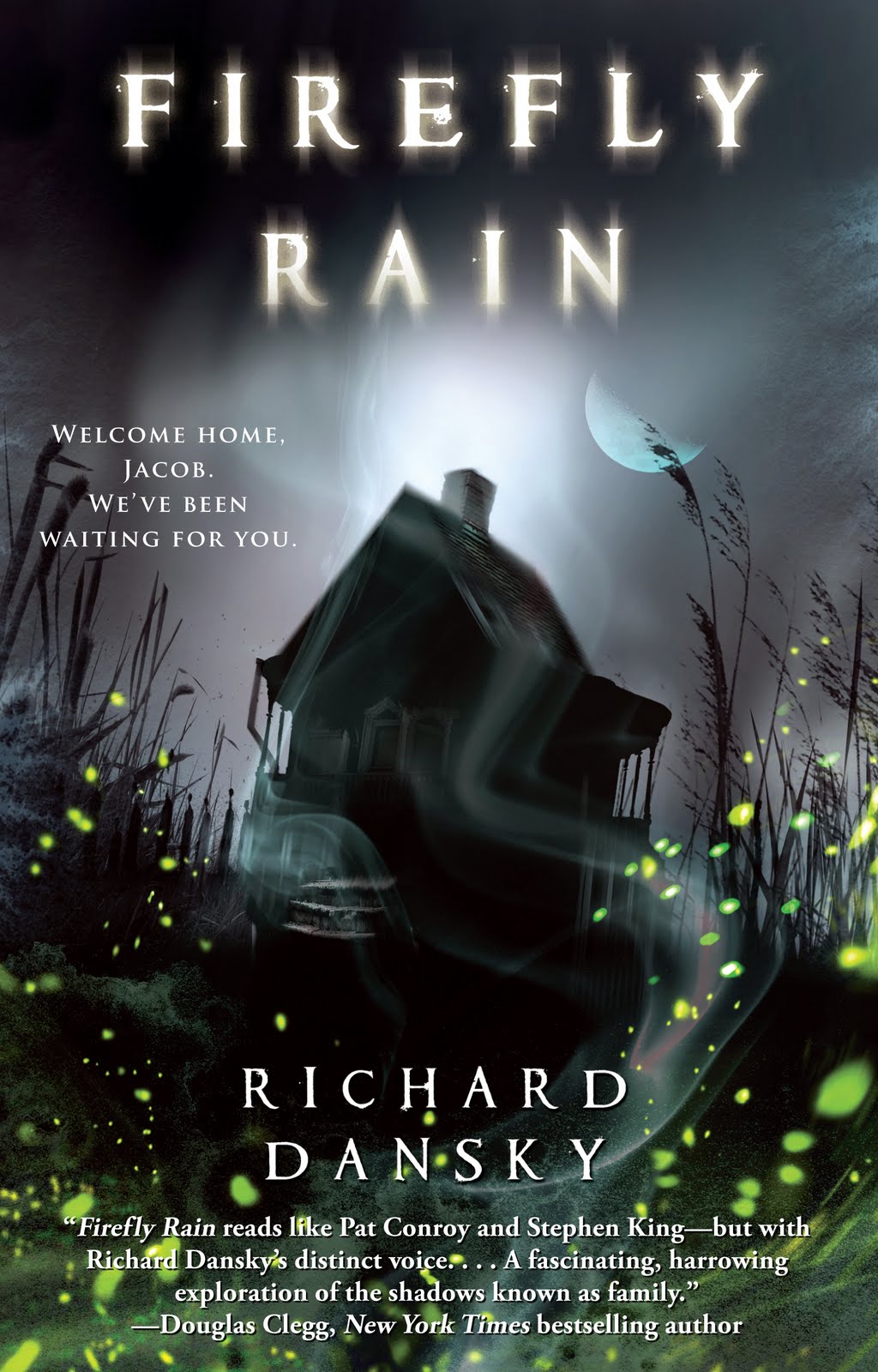
firefly rain Not to be confused with Firefly Lane, Richard Dansky’s debut novel Firefly Rain is about the prodigal son coming back to his childhood home in some back woods town in North Carolina – although he just calls it ‘Carolina.’ His business in Boston has failed, his parents are dead, but the old homestead is just waiting for him.

So, yeah, Jacob Logan goes home to Maryfield. His childhood isn’t quite as he remembered it. For one thing, the fireflies he used to catch on his property now don’t seem to want to come onto Logan land – they stop just at the border of his property and if they cross onto it, they die. For another, his house is creepy – doors open and bang shut; toy soldiers turn up where they shouldn’t be. Carl, the old guy who Jacob has been paying to look after the property after his parents died, is weirdly antagonistic. Then someone steals his car.

Firefly Rain is supposed to be scary. In fact, Publishers Weekly called it “Disturbing…remarkable” and Library Journal called it “Classic horror…a tightly paced tale of mystery and terror.”

I call it hokum.

Nothing was scary about this book. At all. Except perhaps the way the characters spoke.

“I need someone down here whom I can trust,” Jacob says to his friend Jenna. “I’m spooked Jenna, spooked bad, and I need someone who can watch my back until I can get my head screwed on straight.”

Then there’s the scene where Jacob chases his stolen car up and down a dirt road until he finally collapses in the ditch. In his slippers. In the rain.

And then there’s the convoluted denouement – where all the men of Maryfield show up on the property because of some wacky promise they made to Jacob’s mother.  I didn’t really get it…but by then, I didn’t really care.

Creep – Jennifer Hillier

creepDumbest. Book. Ever.

Seriously…I can’t even believe I read it.

So, Dr. Sheila Tao, she of the velvet lips, is a psychology professor at Puget Sound State University. Apparently she’s an expert in human behaviour – except not so much because she doesn’t realize that Ethan Wolfe, the 23-year-old teaching assistant she’s been sleeping with for the past three months, is actually bat-shit crazy. That’s probably because she’d been blinded by lust. He’s HAWT. Oh, also, she’s a sex addict but until her father died (trigger) and she took up with Ethan (couldn’t resist the hawtness), she’d been living sex-free.

Anyway, she’s fallen in love – for realsies.  His name is Morris and he’s an ex NFL player and an ex-alcoholic and just an all-round great guy. He doesn’t know about Ethan, or Sheila’s addiction to sex. He’s also apparently never questioned why his 39-year-old, once-married girlfriend won’t have sex with him. He kinda likes that about her.

Okay, so Sheila’s got a problem. She’s now engaged to Morris so clearly she has to dump Ethan. Which she does…on page five. Understandably, Ethan doesn’t take it too well. Obviously: he’s a psychopath. Nevertheless, I knew I was dealing with crazy people pretty early on – like when Sheila becomes infuriated when Ethan turns the tables on her and announces that he’d “never wanted this to be a long-term thing. But you were so goddamned needy. You kept telling me not to go.” Really? Who cares who breaks up with whom? Move on, Sheila.

Anyway, Ethan threatens to expose their affair with some video he’d apparently taken of them doing the deed and so Sheila has no choice but to let him remain her T.A. But then that’s not enough for Ethan, he’s got to kidnap her and hold her hostage in the retro-fitted basement of the mansion he paid for with cash and you see where all this is going, right? Oh…and he’s a master of disguise, people. A master – with like amazing custom-made silicone masks and make-up skills etc.

It’s just all ridiculous. All of it. What does Ethan do with Sheila once he has her all chained up in his basement. Um. Nothing. He keeps her drugged and makes her wear adult Depends. That is until he finally lets her go to the bathroom and that, my friends, is one reason to steer clear of this book. It’s meant to be scary. A thriller. No, no. This is what we get:

It was ridiculous to be embarrassed about a fart – after all, she was being kept here against her will, and what could be worse than having to urinate in adult diapers – but she was ashamed nonetheless.

We get to hear about her cramps and the stench and how grossed out Ethan is.

He was looking at her with such shock and disgust that, despite her abdominal pain, she couldn’t resist a chuckle.

“Well, what did you expect? I’ve been here for days, you cocksucker.” Sheila grunted again. “I’m not done. I suggest you get the fuck out.”

Even Sheila has to admit that it was “quite possibly the world’s stupidest conversation.” One of many, Ms. Hillier.

Critics loved this book. Loved it. There was nothing frightening, suspenseful, or creep-y about it. Stock characters, a deux ex machina visit from Morris’s estranged son, Randall…I’m just…gah. Hillier is compared to Chelsea Cain. Please read Heartsick instead.

Always Something There to Remind Me – Beth Harbison

alwaysI’m not a book snob. I like a good ‘chick lit’ book as well as the next gal. I know Beth Harbison is a much-loved, best-selling author of women’s fiction…but Always Something There to Remind Me will have the distinction of being both my first and last book by Ms. Harbison. Blech.

Erin Edwards is a beautiful, successful party planner in Washington D.C., where she lives with her precocious sixteen-year-old daughter, Camilla. She and Camilla’s father are no longer together…not that we know much about their relationship (and not that it matters anyway). Always Something There to Remind Me is Erin’s story to tell and we get the then (in third person) and now (in first person).

Then happened twenty years ago. Sixteen-year-old Erin has her heart set on eighteen-year-old Nate Lawson.

From the first time she’d seen him, his image had been emblazoned on her mind, and when he stepped into view it was as if her mind closed over it like a trap. She didn’t want to think about him, but she couldn’t stop.

His eyes met hers and something clicked.

Ahh. Young love.

Erin and Nate’s teenage romance has all the requisite twists and turns: silly fights, jealousy, sneaking around in the dead of night to have sex on basement floors. But even though Erin really, really, really loves Nate, she still can’t help doing childish things and eventually he dumps her, breaking her heart and leaving her to wallow (however secretly) for the next twenty years.

Fast forward twenty-odd years and she is in a relationship with smart and perfect and handsome Rick who has just asked her to marry him. Erin’s hesitating though because she can’t stop thinking about Nate…even though she hasn’t seen him in forever.

Until the day she’s visiting her mother in the old neighbourhood and she decides to take a walk which invariably leads her past Nate’s parents’ house and – as luck (or fate) would have it – there’s Nate.

I just watched the shock in his eyes as he took me in, and knew mine probably looked the same. Shocked, glad, scared…it was hard to read both what I saw and what I felt.

But I couldn’t look away. And when I saw him try, I realized he couldn’t either. He glanced down, a muscle in his jaw tensed, but then he looked back at me, still unspeaking.

People – you can see where this story is going from like a mile away and that would all be fine except that WHO CARES? Seriously. Erin is annoying as a teen and not even remotely self-aware as an adult. Her daughter, Cam, sounds like a therapist and the treacley ending made my teeth ache.

I bought this book because it sounded like it might have something significant to say about regret and love, but if you want a book that looks backwards at what you’ve left behind, read Losing the Moon instead.


Cemetery Girl – David Bell

cemeteryI read the first 192 pages of David Bell’s novel Cemetery Girl lickety split. I couldn’t put the book down. I wondered – how come I’ve never heard of this book or this author? How come the only positive promotion is from other authors? Where has this author been all my life?

And then it all went to hell in a hand basket.

Cemetery Girl is the story of college professor Tom Stuart and his wife, Abby, and their daughter, Caitlin, who disappeared four years ago when she was twelve.  Now, Abby has decided it’s time to say goodbye to Caitlin and has organized a memorial service for her daughter. It’s caused something of a rift between Tom and Abby because Tom hasn’t given up hope that his daughter will come home to them because her body has never been found.  But Tom and Abby’s marriage is on the slippery slope anyway. Abby has found religion and is spending more and more time with Pastor Chris her new ‘best friend.’ Yeah, right.

For the first half of the book I was totally invested in Tom’s story and the novel’s attempt to make him a somewhat unreliable narrator. For example, he and his half-brother, Buster, have different takes on their childhood. Tom remembers his step-father, Paul, as a mean and abusive drunk; Buster claims it wasn’t like that at all.

There are a bunch of minor characters in the novel – Detective Ryan, the one and only cop still assigned to Caitlin’s case; Susan Goff, a volunteer with the police department (who is not a therapist or professional counsellor, just someone to talk to); Liann Stipes, a lawyer whose own daughter had been murdered and who has acted as an advisor to Tom; Tracy Fairlawn, a stripper who claims she saw Caitlin. Then there’s this mysterious blonde girl who keeps appearing near Caitlin’s tombstone or outside the Stuart house in the middle of the night.

Like I said, Bell kept me turning those pages for quite a long time. Then I just didn’t believe it anymore. I didn’t believe the way characters started to speak to each other. I didn’t believe the resolution of the book’s central mystery. I didn’t believe any of Tom’s interactions with anyone – they just all felt artificial. I’m a parent; I wouldn’t behave this way.

Cemetery Girl had a lot of potential, but a book like this depends on credibility and at the end of the day – it just didn’t have any.