Along Comes A Stranger by Dorie McCullough Lawson

Okay – so another book that sounded so promising and ended up being mediocre. What’s up!?

Kate Colter has lived in small-town Wyoming for 15 years. Her husband, George, is a paleontologist; her daughter, Clara, is just seven and suffers from MCADD, a disease that requires her to eat regularly or else her body runs out of glucose and starts to shut down.

What we’re expected to believe – because the author tells us , is that Kate is somehow dissatisfied with her beautiful family and lovely life, that she’s  an East Coast girl at heart and has never really settled into life in the West. That’s why when she meets her mother-in-law’s new boyfriend, Tom Baxter, she’s immediately smitten. He’s from away and as far as Kate’s concerned, he’s exciting and intelligent and they have things to talk about.

About 50 pages in, Kate mentions her aunt Joanie. She’s clearly a plot device, so the author can tell us about Kate’s fascination with criminals.

I can’t say Joanie’s and my interest in the underworld arises from a concern for something greater, like justice, nor does it come from something emotional or psychological within either one of us, like a deep-seated fear of evil, for instance. No, Joanie and I just like to talk about all these crimes and criminals because they make for good, fast-moving stories.

So, life ticks on. George goes off on a dig and Kate is required to fill her days – which she does. Maybe this is the reason why she doesn’t notice, at first, the huge red flags that something is not 100% square with Mr. Baxter. Oh no! Then, even the tiniest things start alarm bells ringing until the novel’s wholly ridiculous conclusion.

Look, I’ve read dozens of these stories – you have, too – lots of them are terrific. This one is not. The characters, every last one of them, are one-dimensional and the  whole thing is contrived and lacks any sort of suspenseful momentum.
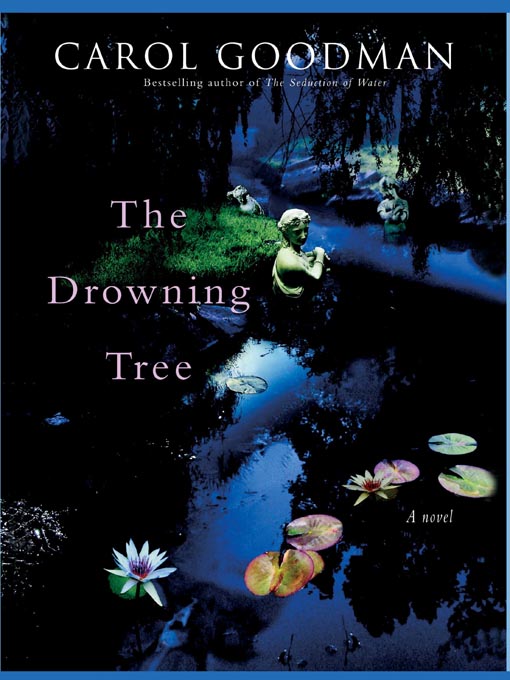
The Drowning Tree by Carol Goodman

It’s been thirteen years since I last saw Neil – and fourteen years since we both nearly drowned in the river – and I still dream about him every night, and because he told me once that he believed that we could visit each other in our dreams, I always have the feeling that that is what he’s doing – coming to me in my dreams each night. – The Drowning Tree

Carol Goodman’s interest in Latin and Art and Literature is obvious. The first novel I read by her, The Lake of Dead Languages concerned a Latin teacher at a private girls’ school. The Drowning Tree tells the story of Juno  McKay, a woman who runs a glass business (she’s in the business of building and restoring stained glass windows and is currently working on the reconstruction of a beautiful window from her old  school, Penrose College.) The novel is steeped in Greek and Roman mythology.

Juno’s best friend from college is the beautiful and wildly smart, Christine. She blows into town to deliver a lecture about Augustus Penrose and his wife Eugenie and her sister, Clare and the very window Juno is currently restoring. After the lecture, Christine disappears. Juno spends the next 300 pages trying to figure out what happened to Christine and why.

My feelings about The Drowning Tree are lukewarm, I’m sad to say. Goodman is a fine writer. She clearly cares about the craft and her work has depth…but she’s supposed to be a writer of literary thrillers and her books (at least the two I’ve read) move slower than cold molasses. Nothing. Happens.

In fact, in The Drowning Tree, it isn’t until Juno’s long- institutionalized husband, Neil, makes a reappearance some 200 pages into the book that things start to perk up a little. I guess Juno herself just isn’t engaging enough to carry the novel all on her own. And the book’s central mysteries –  what happened to Christine and what was the deal with Eugenie and her sister –  aren’t compelling enough to hold 338 pages aloft.

Perhaps it’s the publisher that does Goodman a disservice by calling the book a “literary thriller”. Literary for sure; thrilling, no way.

Traveling with Pomegranates by Sue Monk Kidd and Ann Kidd Taylor

Having read The Mermaid Chair and  The Secret Life of Bees, both by Sue Monk Kidd,  I was excited when this was chosen as one of our book club selections. That was in November. I just finished reading the book now. What does that tell you?

Traveling with Pomegranates should have been a better book than it actually is. This is a mother(Sue)/daughter(Ann) memoir about travel, faith, love, creativity and writing. At the beginning, as I settled in, I thought that it was going to be quite compelling. I felt a kinship with Sue:

“I didn’t understand why I was responding to the prospect of aging with such shallowness and dread, only that there had to be more to it than the etchings on my skin” (4).

In Sue’s capable hands, this journey is – if not always engaging – at least well written and thoughtful. Sadly, I can’t say the same for Ann’s part. I found her whiny and entitled. I never warmed up to her.

Mother and daughter visit Greece together in 1998. Ann is 22 and Sue mourns the loss of the little girl she was. She is also acutely aware that something troubling is going on with her daughter. At first glance it might seem that Ann’s disappointment has to do with the fact that she didn’t get into graduate school, but as the mother/daughter writers unspool the story it turns out that they are both looking for something more complicated. And they spend the rest of the book kneeling at the feet of Madonnas (and other powerful female icons) in Greece and Crete and France…trying to find it.

Ultimately, it turns out that graduate school was never what Ann truly wanted; she wants to be a writer. And how wonderful for her that her mother is and that they could do this book together.

Where the River Runs by Patti Callahan Henry

A while back I read Henry’s novel Losing the Moon and although I had misgivings when I started the novel, it won me over in the end. Sadly, I can’t say the same about Where the River Runs. I wanted to like it, I really did…but I just had so many problems with it.

Where the River Runs is the story of Meridy Dresden, lawyer’s wife and mother to a teenage son, BJ. She has a strained relationship with her mother and sister and a big secret that she’s kept since the summer she graduated from high school and her boyfriend, Danny, was killed in a fire. When she’s asked to write a curriculum based on Gulluh (descendants of African slaves) culture, she goes back to her childhood home to interview Tulu, her childhood housekeeper.

What this novel expects us to believe is that 20 years after the tragic fire that killed Danny,  Meridy’s best childhood friend, Tim, is being asked to pay for the damage to an old historically significant cottage that burned down. The novel also asks us to believe that people’s strained family relations can be miraculously resolved over iced tea on the porch. Meridy’s struggle to reconcile her past was real enough except that the secret she built her life around was ridiculously inconsequential.  I just didn’t buy into her angst. It all seemed contrived and convenient and forced.

For me, the best parts of Where the River Runs were the Gulluh sayings at the start of every chapter. Things like Death is one ditch you cannot jump and the heart doesn’t mean everything the mouth says.

Where the River Runs is part of the New American Library Accent series, novels which are meant to touch on subjects close to a woman’s heart, or as the tag line says: “Fiction for the way we live.” I don’t know anyone who lives this way.

Didn’t like this one at all…read Losing the Moon instead.

Dismantled by Jennifer McMahon

I was so excited to be given this book which had arrived at the bookstore where I used to work. The manager there knew I was a huge fan of McMahon’s novel Promise Not to Tell, and so she passed this along. Dismantled is the story of the Compassionate Dismantlers, four art students: Tess, Henry, Winnie and the charismatic Suz. The Compassionate Dismantlers believe that “to understand the nature of a thing you have to take it apart.” What they really believe, it seems, is that you can ruin someone’s career and set fires and manipulate lives for your own personal gain. At the end of their post-graduation summer in a cabin by the lake, Suz is dead and the remaining Dismantlers go their separate ways. Flash forward ten years. Henry and Tess are unhappily married and have a 10 year old daughter, Emma. Winnie has had her own struggles with mental illness. A simple act by Emma sets off a chain of events with far reaching consequences.

Dismantled was a big disappointment for me and it truly pains me to say that because I loved Promise Not To Tell and encouraged everyone I know to read it. For me, there was just too much going on. Was Dismantled a novel about a failing marriage, infidelity, the nature of art, childhood fears, imaginary friends, ghosts – real and imagined? Was it a mystery? Was it a ghost story? Was it a novel about revenge?

Honestly, I really struggled to finish Dismantled and only kept going because I thought maybe the end would justify the rest.  I didn’t like any of the characters and worse, I didn’t care about any of them.

Read Promise Not to Tell instead.

At A Loss For Words by Diane Schoemperlen

lossforwords

It sometimes happens that a book that no one particularly likes generates an excellent discussion. This was the case with Canadian writer Diane Schoemperlen’s book At A Loss For Words.  One woman in my book club actually said: “I knew you wouldn’t want me to finish it.”

I didn’t actually have any trouble finishing the book, but not because it was the most original or beautiful or innovative book I’ve ever read about the nature of love. The story is rife with cliches and prose so purple you might think you’re scarfing grape jelly by the jar.

An unnamed woman rekindles a relationship with an old boyfriend. She and this guy (also unnamed) had a  fairly serious thing which, one gathers, ended rather badly 30 years ago. She’s a writer, but since renewing her relationship with this guy, she’s unable to write. The story (such as it is) consists mostly of her lists of writing prompts and her e-mail correspondence with the man a sort of he said, she said only in this case it’s I said, you said.

To say that I didn’t believe a word of what they said to each other would be harsh, but really who talks like this?

“I do appreciate these thoughts. I want to say how much I welcome and treasure everything you say. Your letters are too wonderful! You life my spirits immeasurably with all that you write. You warm me up on this gray damp day”  (59).

As soon as this relationship is consummated, it begins to unravel. The woman starts clinging and the man starts pulling away and the denouement is neither original or shocking. In addition, you sort of wanted to shake her a little; I mean, she’s a successful writer and she’s not 20- couldn’t she sort of see this coming?

Still, who hasn’t been in love with the wrong guy…maybe even the wrong guy on more than one occasion. Hands up! So, while none of us were enamoured with Schoemperlen’s rather writerly tale, we had lots and lots of fun talking about rekindled passion, first love and our very first (after 10 years in book club) discussion of orgasms.

The Slow Moon by Elizabeth Cox

slowmoon

Elizabeth Cox’s novel The Slow Moon was a huge disappointment to me. I was really looking forward to reading it but it turned out to be really, really mediocre.

Central to the story is the relationship between Crow, 16,  (the son of wealthy, well-respected parents) and Sophie, 14, (daughter of a widow). The story opens as they sneak off from a high school party to have some alone-time in the woods. Crow and Sophie really like each other and they have decided that they want to take their relationship to the next level. The next level requires condoms though, and Crow has forgotten those in his truck. He leaves Sophie alone to retrieve them and she is brutally attacked.

This rape isn’t enough for Cox to make a meal on, however. So instead of giving us any real insight into how Sophie feels and how Crow, wrongfully accused, feels, she fills the novel with a bunch of stupid subplots: Crow’s parent’s cracked marriage, his father’s infidelity, his mother’s pre-marriage pregnancy (so the man who Crow thinks is his Dad, isn’t his Dad.) Crow’s best friends all have their own problems – one is trying to come to terms with the fact that he may be gay, another finds out the father he thought was dead is actually in prison.

And can I just say a word about the writing.  What 14 and 16 year olds (loss of innocence not withstanding) actually “like[d] examining the frailty of others.” (294)  The novel is filled with passages like this: “Another car went by, throwing light onto the walls and ceiling, and the light felt heavy, like a horse running fast into his room; the threat of being crushed came to his mind.” (247) Um, what?

Jodi Picoult’s endorsement on the front of the book says “I found myself pausing over the beauty of this book, and wishing I’d been the one to think of it.” Jodi, honey, you did think of it and you wrote it and called it The Tenth Circle. That book is infinitely better.

The Awakening by Donna Boyd

awakening1

Donna Boyd’s novel The Awakening starts off promisingly enough. A woman wakes up, confused and disoriented. It’s clear that something  traumatic has happened to her, but she has no recollection of what it is. Then we meet Paul Mason, his wife Penny and their daughter, Elsie. Paul’s a famous writer who hasn’t published anything new in over six years; Penny is a busy surgeon; Elsie is their troubled thirteen-year-old daughter. Paul and Penny’s marriage is hobbling along after Paul’s infidelity; Elsie is apparently in therapy to recover from some traumatic event.

The Awakening is a ghost story. Apparently, though, writing a ghost story wasn’t sufficient for Boyd, so she’s thrown in teen angst, suicide pacts, buried family secrets, cancer, and the whole notion of life after death. All the bits and pieces are meant to add up and when the ghost finally comes to terms with her death (and is ultimately reuinited with her true family, although we don’t actually see this happen ), the miracle of her existence propels the Masons down a road towards reconciliation and emotional healing.

Should you expect more than entertainment when you read a book like this? Not necessarily, I guess. There was something that just didn’t add up though…or maybe it’s that things did add up, just the teensiest bit too easily. So many big topics, Paul’s infidelity, for example or the ways that he and Penny had drifted apart or what happened to Elsie which had caused so much stress in the family, all of it is explained or resolved in the book’s final pages.

The Awakening turned out to be one of the tamest ghost stories I’ve ever read and an even less compelling family drama.

New Moon by Stephenie Meyer

Oh, Stephenie.

You know, I really did like Twilight. At the very least I was willing to overlook the artistic license the author took with vampire conventions. And I was willing to forfeit my belief that the vampire myth is intrinsically connected to sexuality because there’s no sex in Meyer’s books. Given all that, Twilight at least moved along at a reasonable clip. The same can not be said about New Moon.

The central character of these books is Bella, a high school student living with her Police Chief father, Charlie. She turns 18 as the book begins and soon after her vampire boyfriend, he of the exquisite face, Edward, announces that he is leaving her. For her own good. Of course. Problem is, his reason for leaving is explained in a line which is lost in pages of pedestrian prose which I had to re-read several times to actually figure out why he decided he must depart.

They aren’t reunited until 500+ excruciating pages later…pages filled with, um, filler. Bella restarts her friendship with Jacob, a boy with a secret of his own. Her relationship with her father stretches and strains and Bella rebels by…learning to ride a motorcycle.

I wish I could say that the book (and the characters) redeems itself by the end, but it doesn’t. New Moon felt like a rushed (bloated) sequel to a popular book. It could have used a really good editor. And a story.

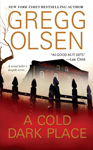
A Cold Dark Place by Gregg Olsen

Oh dear.

I picked up Gregg Olsen’s book A Cold Dark Place on a whim. It wasn’t on my to-read list; I hadn’t heard anything about it. I’ve been on a bit of a mystery-suspense thriller kick and this one sounded good.

When you’re talking about this kind of book, you don’t want to give too much away. I mean, generally speaking, suspense thrillers aren’t literary gems. I read them because they’re fun. Page turners filled with menace and heart-racing thrills.

A Cold Dark Place tells the story of Detective Emily Kenyon who is hot on the trail of a killer. A tornado has just swept through the town of Cherrystone, Washington. Kenyon has gone out to the home of a family no one has heard from since the storm. Their house is leveled, but a closer inspection of the premises turns up three dead bodies: dad, mom and a young boy. They’d all been murdered. The older son, Nick, is missing. Soon after Kenyon begins her investigation, her teenage daughter, Jenna, disappears. Jenna and Nick were friends, but Kenyon can only believe the worst.

This is only the beginning of a convoluted plot that involves convicted serial killer Dylan Walker, old cases that Kenyon was involved in, an adoption agency, a hateful relationship with her ex-husband, a creepy lawyer and an ex-partner who turns up at the end to help Kenyon.

The ending is wholly unbelievable (and, okay, sometimes that’s the case in this sort of book), but worse- the characters are shrill and annoying. Olsen was a true crime writer before he turned to fiction and maybe that’s why none of the book’s details seemed authentic. (I know, it seems ridiculous- but a true crime writer doesn’t have to fabricate anything.) In A Cold Dark Place what characters had for dinner seems like a tacked on detail rather than an investment in their character- and let’s face it, if you’re not rooting for someone in this kind of book, the denouement hardly matters.