Played – Dana Davidson

I am slowly working my way through all the books I bought for my classroom library. I want to be able to put books into the hands of my students and to be able to say something meaningful about them. Although I am way past my teen years, I have to say that I am pleasantly surprised by the calibre of the teen fiction out there today. I’m not talking about the mega hits like Stephanie Meyer’s Twilight series which, sure, teens read en masse but which I can’t say is quality literature by any stretch.  I’m not talking about better-written fare like The Hunger Games. I’m talking about those quiet, often over-looked, books that speak directly to young adults about things they care about and things they worry about: divorce, illness, love, sex,  abuse, drugs and alcohol. Those sorts of books were few and far between when I was growing up – which is why everyone and their dog read Judy Blume’s novel, Forever or Go Ask Alice by Anonymous.

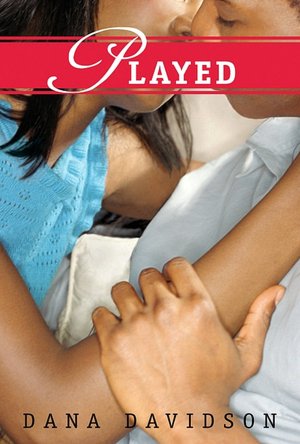
Dana Davidson’s novel Played tells the story of handsome and talented Ian Striver, a boy who does know the difference between right and wrong, but who also wants – more than anything – to be accepted into an elite group at his school. Ian has made it past the induction phase of FBI (Freaky Boys Incorporated) but now he must pass one final test: he has to bed someone chosen for him by members of the FBI.

Kylie is the girl and it is impossible not to fall in love with her. She’s smart, she’s kind, she values the right things (her family: single mom and her younger brother and sister) and even when a little voice tells her that it can’t be possible that a boy like Ian could fall for a plain girl like her, she allows herself to fall in love with him.

Ian, on the other hand, was so fine and so popular that he could have any girl he wanted. Kylie wasn’t sure what, but she felt that something wasn’t quite right.

But the truth was that she wanted something more to happen to her. She went to school, took care of her siblings, kept their house clean, did her homework and saw her girlfriends from time to time. But that wasn’t enough. It seemed to Kylie that a perfectly healthy, reasonably intelligent teenage girl ought to be able to get into more than that. Kylie felt as if her life was more like that of a thirty-five-year-old than that of a sixteen-year-old. So while she had her suspicions about why Ian was taking time with her, she was going to let it ride and see where it took her.

While Ian does set out to play Kylie for his own gain, Davidson does a terrific job of making him likeable and complicated. Played does not play out exactly as the reader might anticipate and I enjoyed it a great deal.

34/365

Love You Hate You Miss You – Elizabeth Scott

Back in the mid 7os, when made for TV movies were the rage, Linda Blair starred in one called Sara T: Portrait of a Teenage Alcoholic.  I’m sure it’s incredibly cheesy now, but I remember thinking that it was shocking and heart-breaking back then (and, yes, I realize I’m dating myself!) See for yourself.

I love the fact that all this stuff turns up on YouTube!

Love You Hate You Miss You by Elizabeth Scott is an updated take on teenage drinking. It tells the story of Amy whose best friend, Julia, has been killed in a car accident that Amy feels wholly responsible for. At the start of the book, Amy is just being released from Pinewood, a teen treatment center. She’s back home with her parents, high powered people from whom Amy has always felt distant. She has to return to school and continue to see her therapist, who insists she ask and answer some hard questions about her relationship with Julia.

Some of Love You Hate You Miss You is written in the form of letters to Julia. Amy’s therapist thinks it would be a good idea to journal her way to recovery, but Amy decides that she’ll write to Julia instead. The rest of the novel is a first person account of Amy’s attempts to fit back into a life she never really fit in to before.

Instead of a ‘movie of the week” feel, though, Love You Hate You Miss You seems authentic. Amy is 16 and she sounds it. She is trying to make sense of her life, but now she has to do it without her best friend. She drank because it made her feel less awkward, more confident.  Of course, the truth is alcohol just masks things temporarily – when the high wears off, you are who you are.

Amy has no choice but to come to terms with her parents, her life and herself and Love You Hate You Miss You allows that to happen without talking down to its intended audience.

Now, I think I’ll re-watch Sara T!

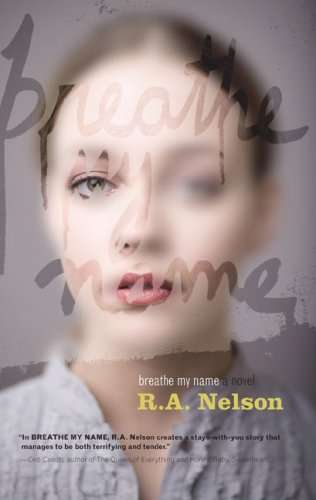
Breathe My Name – R.A. Nelson

Fireless is the country where we live. Every day Momma teaches us something new about it.

Frances is 18 and something of a loner. She lives with her parents and two younger brothers in small-town Alabama.  It isn’t until the new boy, John Mullinix  or Nix, arrives at her school that Frances’ life cracks open.  Frances has been living in the shadow of a traumatic event – an event so horrible that she never talks about it and has, in many ways, surpressed its horror.

Frances’ best friend Ann Mirette insists that Frances tell Nix about her “first family,” but Frances is understandably reluctant. She really likes Nix and one senses that Frances doesn’t form attachments easily. She’s afraid that if she tells Nix what happened in Fireless, he’ll bolt.

Breathe My Name is a beautifully written book about facing your past and freeing yourself from its terrible hold. I don’t want to spoil the novel by spilling Frances’ closely guarded secrets. She’s been protected by her parents for eleven years, but the past has a way of finding you even when you’re trying desperately to hide from it.

I gladly went along with Frances on her journey to adulthood but I do have one niggle with the book. I just didn’t buy what happened in Charleston. The book had this beautiful rhythm going and Nelson deftly handled the past and the present, but the climax of the novel just felt out of place and Carruther’s motivation seemed like an afterthought. One of those: okay now why would this guy behave in this manner, wait, let’s make him an obsessed psychopath sort of solutions. I would have been just as happy if after he set Frances on her journey he was never heard from again.

Still, in the great scheme of things it hardly matters. Breathe My Name had lovely things to say about family and the courage it takes to confront your past and, more importantly, forgive yourself for surviving it.

The Knife of Never Letting Go – Patrick Ness

Patrick Ness …I think I may love you just a little bit. Okay, maybe a lot. I can’t remember the last time I read a book where I literally had to force myself to slow down while reading. I’d start a page and I just couldn’t stand it – my eyes would race to the bottom of the page, skip over to the next page…I was so invested in these amazing characters and this  story and look, I’m doing it here.

Context coming right up.

The Knife of Never Letting Go is the first book in the Chaos Walking trilogy (The Ask and the Answer and Monsters of Men are the other two titles in the series.) I purchased it based on someone’s blog review – sorry, don’t remember the blog – and it languished on my tbr pile for several months before I finally picked it up. I read about 10 pages and put it aside. I had the same sort of lukewarm feelings about the book as I did after my first attempt to read The Book Thief. And we all remember how that turned out, right?

The second time I picked up Ness’ book, I fell into the narrative. By page 38 there was NO WAY I was putting the book down; I couldn’t have put it down even if I’d wanted to.

Todd is just days away from becoming a man; that’s what he’ll be on his 13th birthday. He lives in Prentisstown, a place notable for two reasons: there are no women and everyone can hear everyone else’s thoughts. Todd calls it the ‘noise’ and we hear about as he heads off to the swamp to pick apples.

…the swamp is the only place anywhere near Prentisstown where you can have half a break from all the Noise that men spill outta theirselves, all their clamor and clatter that never lets up, even when they sleep. men and the thoughts they don’t know they think even when everyone can hear. Men and their Noise. I don’t know how they do it, how they stand each other.

This visit to the swamp is remarkable though; Todd hears…silence. But that can’t be because “there’s no such thing as silence. Not here, not nowhere. Not when yer asleep, not when yer by yerself, never.” When he returns to the home he shares with Ben and Cillian, he gets an even bigger surprise: Ben tells Todd he has to go. There is no time for discussion or explanation, Todd must run.

The shocks keep coming for young Todd and his faithful dog, Manchee. (And can I just say here that I have never been one to fall for the old ‘boy and his dog’ story until now – I love that dog, whose thoughts Todd can also hear.)

Patrick Ness has created a compelling, suspenseful narrative.  Todd’s life is constantly in danger and  he has to keep adjusting his own story because, clearly, he hasn’t been told the whole truth about the town he comes from or even his own personal history. He leaves Prentisstown with a book he can’t read and a knife and a sense of urgency that propels him forward with barely a chance to catch his breath. I felt like that, too.

I know that dystopian literature is all the rage these days and yes, I am a fan of The Hunger Games, but I think Ness has done something else quite original with The Knife of Never Letting Go. This is a story that grabs you by the throat and shakes the living daylights out of you for 479 pages.  The subject matter is often dark. The character of the preacher, Aaron, is one of the creepiest psychopaths I’ve encountered in literature in a long, long time. And this is a book I want to hand to people and say “read this now!” I love it when that happens.


After – Francine Prose

Minutes after the shootings, everbody’s cell phone rang.

So begins Francine Prose’s topical  YA novel, After.  The novel’s narrator, 16-year-old, Tom, is in Math class when his father calls to let him know about a school shooting at Pleasant Valley, a school about 50 miles away. The killing spree at the neighbouring high school was perpetrated by three students, two boys and a girl, students who “never even registered as blips on the other kids’ radar.”

It’s almost impossible not to immediately think about Columbine. I remember exactly where I was when the entire continent was riveted to the tv screen watching the events in Littleton, Colorado unfold.  Dylan Klebold and Eric Harris had  planned to kill hundreds of their classmates and teachers that day, April 20, 1999. They’d been planning the massacre for months. In the end,  12 students and one teacher were dead and so were Klebold and Harris.

The fictional killing spree at Pleasant Valley costs five students, and  three teachers their lives. Fourteen more students are critically injured. All the shooters killed themselves. It’s a pretty dramatic opening.

But it isn’t actually what After is about.  At first, Prose’s novel seems to be about how Tom’s school reacts to the events at Pleasant Valley.  First of all, the school board hires a grief and crisis counselor, Dr. Willner. “We can no longer pretend to ourselves that it can’t happen here,” Dr. Willner says to the student body at an assembly. “And so we must change our lifestyle to keep our community safe and make sure that it won’t happen.”

Things start to go south for Tom and his friends after that. The school installs a metal detector, students aren’t allowed to wear the colour red or have cell phones. Certain books are banned for being subversive. All of these things make excellent talking points, actually. How much freedom should students have? Where is the line in the sand between safety and a police state? Then, there seems to be something even more sinister happening and for me the book veered off into territory which was less interesting to me.

Still, I liked After. It asks some compelling questions and Tom is a likeable and sympathetic hero.

One Night – Margaret Wild

The parties were Bram’s idea-

calculated,

sophisticated,

daring.

For a long time

they were the best-kept secret

in the city.

They ended one night

when Al nearly killed Raphael.


Margaret Wild isn’t the first writer to pen a novel written in poems, but One Night is the first poetic novel  ever read. One Night tells the story of three friends, Gabe (the beautiful one), Al (the wild partier) and Bram (the planner).  They’re in their last year of high school somewhere in Australia. Their personalities are revealed slowly, little snapshots that illuminate them, make them more than what they seem on the surface. Bram, for example “catches two buses to school,/ and never brings friends home.”  Al wears a coat summer and winter because “without it he would be/ a snail without it’s shell-/soft/exposed/defenseless.”

Into the boys’ world comes Helen. She has a damaged face and a dazzling smile. Just one night and one of the boy’s lives is forever changed.

One Night only took a couple hours to read, but that doesn’t mean that Wild’s novel is lightweight.  These characters are fully realized. In just a few short lines, Wild had me feeling tremendous sympathy for Bram, a character who appears to be – on the surface at least – all hard edges. One Night captures the daring sense of ‘anything goes’ shared by many young people; the notion that actions have no real consequences. In Helen, we have a character willing to make sacrifices and decisions far beyond her years.

One Night is also about family. It isn’t only biology that binds us; sometimes we choose our families out of need and circumstances and sometimes these families serve us better than those we came by naturally.

One Night is a terrific novel – timely and beautifully witten.

AngelMonster – Veronica Bennett

Veronica Bennett reimagines the life of Mary Shelley, author of the novel Frankenstein, in her novel AngelMonster. It is 1814 and Mary is a smart but dreamy 16 year old. She and her sister, Jane, often imagine finding true love with a poet because  as Mary remarks, “a poet is the only acceptable sort of lover these days.”

Jane and I had often discussed the possibility of falling in love with a poet. If poetry was any measure of a man, we had observed, everything we longed for in a lover – romance, desire, spirit, soul – was clearly contained in it.

Into Mary’s life (well, her father’s bookshop) walks Percy Shelley. Not yet the super-star poet he was to become he is nevertheless known as someone to watch and certainly meets Mary’s criteria for a lover. And lovers they become, even though Shelley is already (at the tender age of 20) married with children.

AngelMonster is a thoroughly modern tale. It’s kind of like reading a memoir from a current celebrity. It drops names ( Lord Byron and Polidori are companions of Shelley’s) and is full of dalliances and intrigues and twisted love triangles. Young readers, especially those who dismiss poetry and classic fiction as boring, might be intrigued by the flesh and blood people who actually lived and wrote these works that have endured.

Mary herself is an interesting character.  Her mother, Mary Wollstonecraft, was one of the first feminists and author of A Vindication of the Rights of Women. (Wollstonecraft died a few days after Mary was born.)  Her father  was the writer and political journalist,  William Godwin. Mary herself is clearly intelligent, but youth makes her romantic and dreamy. Still, she wrote Frankenstein when she was just 21. As Bennett writes her, she is young but determined. Her affair with Percy is ill-advised, but she loves him and sticks with him even when he doesn’t deserve it. She is a thoroughly modern creation.

I think AngelMonster would be a great companion to a  young adult’s study  of the works of Byron,  and both Percy and Mary Shelley.

Bad Girls Don’t Die – Katie Alender

So, there’s nothing wrong with Katie Alender’s novel Bad Girls Don’t Die. It’s the story of Alexis, a high school student who takes photos, thinks her doll-loving twelve year old sister, Kasey, is kind of annoying and goes out of her way to distance herself from just about everyone at her school. Alexis is smart and Alender does a terrific job of capturing her voice from the very beginning of the novel. Although like many teens, Alexis takes herself a tad too seriously sometimes, she’s also self-deprecating and intelligent.

Alexis has a lot on her plate. Her parents are generally absent from her life and she is often left in charge of the household and her sister, who starts acting weirder and weirder. Added to all this, Alexis finds herself drawn to a new student at her school.

Bad Girls Don’t Die is a ghost story (think Jane-Emily rather than Stephen King).  It’s not particularly scary, although there’s enough of a  creep-factor to get younger teens huddling together with the lights on. 

I think my reading of it suffered from having recently finished The Hunger Games – which is a kick-ass book. Bad Girls Don’t Die pales by comparison.

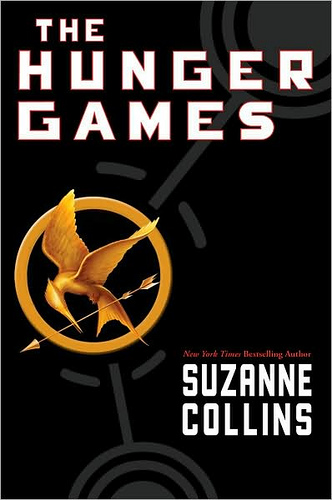
The Hunger Games by Suzanne Collins

There’s been a lot of excitement in the house over Suzanne Collins’ book, The Hunger Games.  Both of my kids have read it and have been harassing me to read it, which I finally did. I have to say – I loved it as much as they did. So we thought we’d talk about the book a little.

Mallory: This book takes place in post-apocalyptic North America. The people of North America had attempted a rebellion against the government, but weren’t successful. So, the government split them into 13 Districts, and each year as a punishment,  every child ages 12-18 in every District has their name put into the Hunger Games. They draw two names from each District and those people must compete against kids from other Districts in an arena. It’s a fight to the death; last one standing wins. Basically, the main character, Katniss Everdeen from poor District 12 takes her sister’s place to go into the Games.

Christie: That’s a great summary, Mallory. It’s a terrific premise for a book, not altogether dissimilar from the 1987 film The Running Man.  Of course the stakes are a little higher in the book especially since the players are just kids.

Mallory: Katniss is 16 when she went to into the Hunger Games, so she was one of the older kids competing. Imagine how hard it would be if you were just 12, trying to kill 17 and 18 year olds. Katniss is such a great character, and Collins did an incredible job building her up. Every moment of the book I was so scared because I loved Katniss and didn’t want her to get hurt.

Christie: I agree, Mallory. I loved Katniss from the very start of the novel. She’s resourceful, mature, and brave. When we first meet her, she demonstrates her willingness to break the rules to provide for her family. She’s a good hunter, she wastes nothing, and you get the sense that she could handle herself in just about any situation. But she’s not the only admirable character in the novel. Who else did you like, Mallory?

Mallory: Well, I must say that I love Gale, Katniss’ best friend, and Prim, her sister (who were introduced at the very beginning of the novel). But as the novel progresses, we meet many more amazing characters, some that we love, and others that we hate. Like, Rue, a contestant in the Games who I adored. What about you?

Christie: I’m with you, Mal. All the characters were really well drawn – even characters you don’t get to know very much about, like Cinna and Thresh. As you get to know some of the other Tributes (contestants), it’s impossible not to get attached and what’s remarkable is that Katniss feels admiration for some of these people too, even though she knows she might have to kill them to stay alive. The Games themselves were very exciting, didn’t you think?

Mallory: Well yeah! They were amazing! What an incredible concept for a book. I wish I had thought of it first, because it’s just so clever. Everything about the Games seems so real, so legitimate. She doesn’t make them seem like a board game, or something you play. Collins really gets it across to you that the Hunger Games are about fear, and death, and despair. The Games are so scary, that you just feel really sad for the Tributes, even if they are merely characters that came out of Collins’ mind.

Christie: Beyond the suspenseful plot and characters, Collins has created an interesting and scary future-world and, for me, the writing was crisp and readable – a nice change from a lot of the Young Adult fiction out there. How does this book compare to other books you’re reading, Mallory?

Mallory: Honestly, The Hunger Games isn’t really comparable to the books I’ve been reading because it’s just so different, and that’s what I love about it. Most YA Fiction out there at the moment is either about vampires or rich girls with dirty secrets. Sure, I like Twilight, and books like Pretty Little Liars, but The Hunger Games sets itself apart from all the generic and boring books.

Christie: A lot of kids I teach are reading it (or have read it) and I’d say 99% of them have loved it. And for my money – this book is heads and tails better than the Twilight series.

Mallory: My school is having the same Hunger Games craze too! Most of my friends (I’d say 85%) hate to read, and will only force themselves to open a book if it’s absolutely necessary. But surprisingly, a ton of them have read The Hunger Games (girls and boys) and they loved it! The book has been passed around the entire grade 8 French immersion population, and instead of gossiping at lunch time, we all discuss our favourite parts. It’s a nice change.

Christie: Well, I guess that makes it unanimous, then. The Hunger Games: loved by boys, girls and moms!

A Gathering Light by Jennifer Donnelly

So, while my copy of Donnelly’s novel is called A Gathering Light, apparently the novel is called A Northern Light in the USA. I don’t understand why they have to change book titles. Does anyone know the rationale?

Whatever the book is called – I loved it. I didn’t even realize it fell into the category of teen fiction until I finished it and started reading about Donnelly.

A Gathering Light is the story of 16 year old Mattie who lives with her widowed father and three younger sisters on a farm in Adirondacks in 1906. Her older brother, Lawton, has left home after a fight with their father and the family doesn’t even know where he is. Life on the farm isn’t easy. Mattie’s family doesn’t have much money and Mattie isn’t the homemaker her mother was. Her father – since the loss of his wife – is stern and angry. Mattie has to juggle her responsibilities at home with her secret desire to go off to college and study to be a writer.

Donnelly’s novel does a number of things remarkably well. First of all, it captures a time and place beautifully. After a particularly disastrous start to her day Mattie recalls that her mother could “make breakfast for seven people, hear our lessons, patch Pa’s trousers, pack our dinner pails, start the milk to clabbering and roll out a piecrust. All at the same time and without ever raising her voice.”

Mattie is a wonderful character. I fell in love with her from the start – her kindness (when she feeds a couple kids from down the road, even though there’s barely enough food for her own siblings and father)  and her determination and even her dreams – to leave her home and go off to New York City.

During the summer, Mattie goes off to work at the Glenmore, the finest hotel on Big Moose Lake.  While there she meets a guest, a young woman, who hands her a bundle of letters and tells Mattie to burn them. Later that day, the woman is found drowned; her companion, a young man, is missing. It is these letters and the fact of the woman’s death that propel Mattie on her journey towards freedom and adulthood. Of course, it’s all much more complicated than that. The most handsome boy around, Royal, has his eye on Mattie. She can’t forget the promise she made to her dying mother that she’d look after her sisters and father and her teacher, the outrageously independent Miss Wilcox, is hell-bent on getting Mattie off the farm.

A Gathering Light draws some of its inspiration from a real life murder, but ultimately this is Mattie’s story. It’s impossible not to root for her.