The Adoration of Jenna Fox by Mary E. Pearson

Well, we’re back with another mother/daughter review.  This time we’re going to talk about The Adoration of Jenna Fox. It tells the story of a young girl, Jenna, who wakes up after having been in a coma for a year. Her parents tell her she’s been in a terrible car accident and it’s taken this long to recover.  The thing is, Jenna doesn’t remember very much about her life before the accident.

There were all sorts of clues  about what this book was going to be about. I had it figured out pretty early on, but that doesn’t mean I didn’t enjoy the book. How quickly did you figure out Jenna’s story, Mallory?

Mallory: Well, I was pretty clueless at the start. I thought she was just a girl who’d woken up from a coma — and everything was normal. But near the middle of the story, I started to put things together and by the end, I’d already figured it out.

Christie: Pearson does an excellent job, though, of stringing the reader along. Under normal circumstances, waking up from a long coma would be disorienting. Jenna doesn’t even live in the same state as she had before the accident. Her friends aren’t there. Nothing is familiar. Strangely, her grandmother (who is living with them) is almost hostile. Plus, Jenna is also trying to cope with being a teenager and that’s all complicated by this 12 month hiatus from her own body.

Pearson does something else in this novel which seems to be popping up more regularly in fiction – she’s included some poetry which has been written by Jenna. What did you think of that, Mal?

Mallory: To be honest, I didn’t like the poetry. I’ve never been a massive fan of poetry and I didn’t really look forward to the regular poetry pieces that were scattered throughout the whole book. They were interesting, but I think the book could have done without it. All the pieces in the book were more or less the same. They were either about Jenna not remembering words or her being confused. It bored me; I’m sorry.

Christie: No need to be sorry. LOL

The Adoration of Jenna Fox reads like a mystery/thriller. You really race along trying to get at the novel’s center because even if you think you’ve figured Jenna’s story out, there are all sorts of little pieces that have to be fit together.

Mallory: Yeah, I agree. The whole book (like the cover art) is like a puzzle. You need to take all the little events and clues and piece them together. Some pieces may not fit, and then you have to start over. Because I have no patience at all for puzzles, I didn’t try to figure out the book at the start because I just ended up angry and frustrated. But everything makes perfect sense in the end.

Christie: I’m not sure how Mallory feels about this, but I liked how this book made me think about what makes us human. I liked the way it echoed  Kazuo Ishiguro’s Never Let Me Go, which is obviously a much more sophisticated novel, but Pearson’s book is a terrific book for its intended audience. I think it would be a great novel to teach. What was your overall feeling about it, Mal? Would you recommend it to your friends?

Mallory: Unfortunately, barely any of my friends care about reading, and they absolutely hate reading in class. But, if more of my friends read, I’d recommend this. I don’t know if this matters to you, Mom, but a huge part of a book– to me at least– is the characters. I need to fall completely in love with the characters and that makes the whole reading experience so much better. An example would be Meg Rosoff’s How I Live Now. I probably mention this book wayyy too much,  but I’m obsessed. The first time I read this book I felt like I was a sister to all the characters. I loved them all, and my heart was bursting out of me whenever they were in danger. This is how I want to feel about a book, and I honestly didn’t feel that for Jenna Fox. If I had, I would’ve liked the book a lot more, but during the read I didn’t really care what happened to her. This disappointed me because it wasn’t me who was making the decision to not care for Jenna; it was just the way Pearson developed her main character.  Rosoff took nearly half the book to develop all of her characters, and it took me three words to become attached to Daisy. I wish every book could be like How I Live Now, but overall this book was good. Not amazing. But good.

Christie: Wordy much? That’s my kid- talking about character. It makes the book nerd (and English teacher) in me  swoon with delight.

I guess I liked this book a little more than you because I could see it from a couple different points of view. I understood Jenna’s mom, for example, and her motivations. I understood the grandmother…and as I have a daughter who is minutes away from being a teenager, I sort of got that perspective, too. It’s a great book for discussion…but it’s hard to discuss without giving stuff away…and we don’t want to do that.

Just Listen by Sarah Dessen

Just Listen is my first Young Adult novel by Sarah Dessen, although I was certainly aware of her name. She’s always on Best Books for Young Adults lists and so I figured that, as a teacher of young adults, I should at least see what all the fuss was about.

It also gave Mallory and I another opportunity to share a book. She read this one a couple weeks ago, but I was in the middle of something else which I had to finish first.

I’ll let Mallory start by telling you a little bit about the novel.

Mallory: This book is about a model named Annabel Greene.  She’s the youngest of three girls and both of her older sisters are models, too. Even though on the outside it would seem as though Annabel’s got it all (the looks, the best friend, the beautiful house, basically a charmed life) she’s actually going through some pretty serious things. For one thing, her middle sister, Whitney, has an eating disorder that weighs down the whole family. Secondly, Annabel’s best friend is no longer speaking to her. In fact, no one is speaking to her. This is a book about how Annabel learns how to express her true feelings about things.

Christie: That’s a good summary of what the book’s about.  One of the book’s main points is about how appearances can be deceiving. Annabel often comments about the glass house her architect father has built and how people slow down when they drive by. What they might see is a family sitting down together to dinner, but Annabel knows that it’s much more complicated than that.

Did you like the book?

Mallory: Yes, I liked the book. I’ve read a couple of books before this one about eating disorders. They’re pretty scary, but this one seemed easier to read. Instead of describing everything Whitney does to deprive herself of food, it explains how even though she’s beautiful, she’s still struggling with her appearance. I really liked that part of the book. What about you?

Christie: Well, what I liked was that Whitney’s struggles were only one part of the book. What I liked was how Annabel struggled to make her own voice heard. Something horrible has happened to her (something I found sort of easy to guess at), but she isn’t able to say anything. Instead, she lets her former best friend, Sophie, treat her badly.  It isn’t until Owen, the school’s misunderstood ‘thug’ (by reputation only) befriends her, that she allows herself to be more assertive.

Mallory: I agree. Owen seemed to open up something that Annabel didn’t even know was inside of her. Even though she and Owen only talked about music, she was allowed to express her opinion (mostly about her hate of techno) without any repercussions. And I also predicted the reason for the fallout  between Annabel and Sophie, but I knew all along that Annabel was the real victim, not Sophie. She just didn’t know how to explain the truth.

Christie: There are lots of novels out there that deal with these subjects: eating disorders, failed friendship, parents who don’t understand their kids (although I have to say that the adults in this novel were decent)…what do you think Dessen did well in Just Listen?

Mallory: The main thing that I loved about Just Listen is the way Dessen built up her characters’ personalities. By the end of the book I knew that Annabel was a complicated person on the inside, Owen was extremely misunderstood, and Sophie was crazy — basically a wildchid. She made it so clear who each one of these people were. It makes a book so much more enjoyable when you feel like you know the characters. Like they’re your friends.

Christie: I agree. I think Annabel’s voice was well done here. And I have to admit that I fell in love with Owen from the very beginning. I guess I have a soft spot for big, hulking, slightly off-center guys.

Mallory:  I must say that I also knew that Owen wasn’t a ‘thug’ or anything that people had said at the start. I always try to see the character in a couple different ways before really deciding if they’re the good guy or the bad guy in a book. I didn’t really have to do this with Owen. He was the quiet, music-lover that was stereotyped for his height and tough persona. Just by Dessen’s description I could tell that Owen was protective, but gentle. And I loved his little sister from the very moment her name was mentioned. Mallory. That says it all.

Christie: So – overall…would you recommend this book?

 Mallory: One of my friends is a Sarah Dessen fan and she raved about this book when she saw me reading it at school. She pulled out Dessen’s novel Someone Like You and said “You must read this when you’re done.” I think she basically recommended it for me. But I would like to add that if you can sympathize with the characters in this book, and the situations that they’re in, you’ll love it. It has a moral, it teaches a lesson, and it’s a great read for young adults. I’d definitely say that if you’ve never heard of Sarah Dessen you need to read this book– and check out her other books as well. They look very promising. 

Christie: I don’t disagree. I think she’s topical. The writing is generally crisp. The characters are well drawn. Young adults could do far worse. 

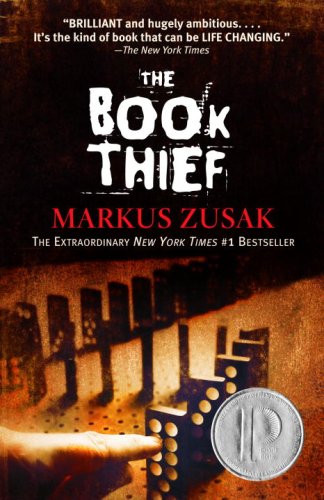
The Book Thief by Markus Zusak

I still remember the feeling I had the first time I read The Diary of Anne Frank. I was probably about 11 or 12. No teacher could have explained the horrors of Nazi Germany to me as well as Anne did. She was speaking to me. Many years later, I visited her attic annex and it was a profound experience.

Reading The Book Thief was also a profound experience for me.

I don’t even know how to begin to talk about The Book Thief. The New York Times said it was “the kind of book that can be life changing.” I mean, you start a book like that with a little trepidation: can it really live up to all the hype? For the first 30 pages or so I thought, “no.” Last night, as I closed the book and wiped the tears away I thought, “every person alive should read this book. I want to teach this book.”

The Book Thief has so many things going for it, I’m not sure where to start singing its praises.

The Book Thief is the story of Liesel Meminger.  Liesel is almost ten when she ends up in Molching with Hans and Rosa Hubermann, her new foster parents. It is 1939. In Nazi Germany.

Readers are either going to be totally enchanted or annoyed by the story’s central conceit: the novel is narrated by Death. “Here is a small fact, ” Death tells us. “You are going to die.” For the next 500-plus pages, Death is our constant companion. Sometimes the action unfolds without commentary, other times he weighs in.  Although I found the first 30 pages or so a bit of a slog, I soon settled into the book’s rhythms.

Then I fell in love with Liesel. And Hans. And Rudy. And Rosa.

Liesel is extraordinary. She and Hans bond late at night, when Liesel’s nightmares wake her, and Hans teaches her to read. Books and words are central to Liesel’s story. So is her friendship with Rudy, the boy next door. Through their eyes we see Hitler and Nazi Germany; we experience the atrocities and the small kindnesses. Zusak’s story is mostly about everyday things: hunger, pettiness, laughter, hope, cruelty and kindness.

Liesel is sustained by the books she steals and anyone who loves words will appreciate and understand their ability to comfort Liesel. But she is also intelligent enough to understand how words can be used to hurt and coerce.

Where is Death in all this? He carts the souls of the dead off and is, in this story at least, a loving and benign figure.

Death gets the last word. He always does.

Over to you…great books for teens

When I only begin to read, I forget I’m on this world. It lifts me on wings with high thoughts.” – Anzia Yezierska

So, we’re in a deep freeze here in Eastern Canada. That’s what happens when you get complacent about winter, I guess. Until the last few days we’ve had a perfectly respectable winter…but minus 30 with the wind chill, come on!

In the real world I teach high school. I don’t have a long career behind me because I started teaching, got frustrated, abandoned it and did other stuff and have only recently returned. It’s shocking how many kids today don’t read. Shocking. What I would like to do is compile a list of great books for teens and I am looking for suggestions. I would also like to make a list of books/poems/plays that every teen should read before they leave high school. Yes, we have a curriculum, but I am shocked at the gaps in their reading.

Great books for teens.

A comprehensive reading list for teens.

Any thoughts?

Jane-Emily by Patricia Clapp

Well, Mallory and I have read another book – this time a story I remember reading (and loving) when I was about Mal’s age. I stumbled across Jane-Emily when I was ‘shopping’ at Book Closeouts and couldn’t resist. It’s a story about a little girl, Jane, who goes to visit her paternal grandmother after her parents are killed in a buggy accident. She’s accompanied by her 18 year old aunt, Louisa. Her grandmother is kind but stern. She’s had some tragedies in her life — the recent loss of Jane’s father, of course, but also the death of her beloved husband and young daughter, Emily. Emily appears to have some unfinished business at the house.

I remember this book as being really creepy, but let’s face it, that was 35 years ago. I wonder how it compares to some of the books Mal’s read. What did you think, Mallory, did you find Jane-Emily scary?

Mallory: No. Not at all. It wasn’t scary, but I loved the way the story took place in 1912. I love books that take place in the past. What about you?

Christie: Well, I have to agree with you, Mal. Not scary at all. In fact, I have to admit to finding the book a little slow-moving. It’s just a novella, only 140 pages, but it moved fairly slowly. I think I remember it as being slightly more action-packed. I did like how atmospheric it was, though. Do you know what I mean by that?

Mallory: Umm… I think you might be talking about the feeling each day brought as it passed in the book. If I’m right, then yes, I did. I liked the way each moment seemed a little care-free or relaxed. It is summer vacation, remember.

Christie: You’re close. Atmosphere is the way the story makes you feel…so, for example, Clapp took her time making you feel the heat of each summer day – when it was hot, you knew it was. Remember how they were always going to sit in the shade of the tulip tree? And when they went up into the attic, there was this sense of foreboding, like they might discover something awful and they did – remember?

Mallory: Yeah, I do remember what poor little Jane found. That wax doll with the melted face. Emily sure seemed like a nice little girl, right?

Christie: Well, I guess that’s the difference of 35 years. This isn’t a splashy book. There wasn’t any violence or anything graphic, but as  a ghost story I think it was okay. How does it compare with other creepy stories you’ve read?

Mallory: I think the romance in this book overshadowed any ‘creepy’ parts. As for a comparison- the book The Enchanted Attic by M.D Spenser forced me to read it only in daylight. Literally. And truthfully, (and I’ll only admit to doing this once) I read nearly all of Jane-Emily at night with a little reading light. I didn’t even shiver.

Christie: Busted.

Mallory: I’m going to deny anything you accuse me of. ;). I recommend Jane-Emily to  readers who can’t handle a huge scare,  and who prefer more ‘mild’ creepy books. But I must say, this novella paints a gorgeous picture of summertime in your head. And I think every ludic reader loves a book that does that!

How I Live Now by Meg Rosoff

How I Live Now by Meg Rosoff  has been on my tbr shelf for a few months. Coincidentally, a friend gave a copy of the book to my 12-year-old daughter, Mallory, for Christmas. We decided it would be cool to read the book at the same time and then share our thoughts about the novel here. This is actually something I’d like to do on a semi-regular basis because there are a lot of YA novels I’d like to read and Mallory is a voracious reader. In any case, we’ll start with this book and see how we make out.

I’ll start by letting Mallory tell you a little bit about herself:

Hi, everyone! I’m a grade seven student in French immersion. Besides reading, I enjoy drawing, dancing, (I study ballet and modern dance ten hours a week), and hanging out with my friends. I do love to read. Some of my favourite books are: Airborn, Skybreaker, A Little Princess, The Twilight Saga, Little Women, and The Little House on the Prairie books.

Christie: Thanks, Mal. So, I’m going to let Mallory tell everyone what How I Live Now is about.

Mallory:  Basically,  How I Live Now is about a teenage girl named Daisy who goes to England to live with her cousins after her father remarries. Once she’s there, two life-changing things happen: she falls in love with her cousin, Edmond, and war breaks out.

Christie: That’s it in a nutshell, Mallory. But this is a pretty remarkable book; it’s certainly not like anything that I’ve ever read before. What did you like about it?

Mallory: You know how when you read you can hear the author’s voice? Well, this book had the strongest voice of any I’ve ever read. Meg Rosoff created an incredible character, and when Daisy spoke she could make you believe anything.

Christie: I think Mal’s touched on the main reason this book is so wonderful. Daisy is a breathless, intelligent, self-deprecating, emotional fifteen-year-old girl whose personal world has been turned upside down….and then she has a catastrophic war to contend with.

When she arrives at the airport and meets her cousin, Edmond, she tells the reader “Now let me tell you what he looks like before I forget because it’s not exactly what you’d expect from your average fourteen-year-old what with the CIGARETTE and hair that looked like he cut it himself with a hatchet in the dead of night, but aside from that he’s exactly like some kind of mutt, you know the ones you see at the dog shelter who are kind of hopeful and sweet and put their nose straight into your hand when they meet you with a certain kind of dignity and you know from that second that you’re going to take him home? Well that’s him.” (3)

The whole story spins out of Daisy’s amazing brain and everything that happens to her is skewed by her needy intelligence.

Mallory: Her relationship with Edmond was really interesting to me. At first, I thought it was sort of freaky because I couldn’t imagine falling in love with my cousin. But after the war starts, and things get more complicated, I began to believe, like Daisy did, that they were meant to be together– related or not.

Christie: The war certainly made the story interesting. What did you think of the way we didn’t really know too much about who was fighting whom?

Mallory: When I was reading any bits where the war is described, my mind was never thinking of who was fighting or what they were fighting for. Mostly the whole time I was on edge with fear for Edmond and Daisy and whether they would make it through.

Christie: I was worried for them too, but I thought it was really interesting to see this war through Daisy’s eyes. Even though she didn’t really understand the hows and whys, she was able to articulate how people were affected by the fighting and the deaths she witnessed were horrific.

Mallory: I agree. Daisy seemed to be in the know and completely out of it at the exact same time — but it didn’t seem to matter. I was just wondering, what were your thoughts on Isaac and Osbert, who didn’t seem to play a big role in this story. And about Piper, who did.

Christie: We should tell people that Isaac is Edmond’s twin, Osbert is his sixteen-year-old brother and Piper, his nine-year-old sister. Their mother, Daisy’s Aunt Penn, goes off to Oslo very early in the book, leaving the children on their own. I think that’s one of the interesting aspects of this book — how these kids have to fend for themselves when the war is relatively distant and how all that changes when it suddenly shows up in their back yard. You’re right, though; Isaac and Osbert don’t really have a large part to play although Isaac does have an impact at the novel’s conclusion. Piper, on the other hand, is extremely important and I think gives Daisy a reason to go on. She’s a great character.

Who should read this book, Mal?

Mallory: Well, this book is suggested for 12 and up- but it’s a pretty intense read. It might not appeal to everybody, but if you’re a strong reader, and aren’t easily upset or offended, I recommend this book. Before I read How I Live Now, The Twilight Saga were my favourite books. I stayed faithful to them for a long time, and was almost positive that I’d never find a book (or series) that was better. How I Live Now was a pleasant surprise. It ended up overtaking Twilight by a longshot– and it’s now the reigning champ.

Christie: That warms my heart Mal because, as you know, not a fan of the sparkly vampires! Now we have to decide what we’re going to read next. Stay tuned!

The Silver Sword by Ian Serraillier

I first read Ian Serraillier’s novel The Silver Sword when I was 12. All these years later I had vague memories of what the story was about, but  very vivid memories of having loved it. We read it in school and so it wasn’t a book that I’d actually come across elsewhere. One day, while perusing the selection at Book Closeouts I came across the book and decided to order it. I wondered, after all these years, if it would stand up. Some childhood books do and some don’t.

The Silver Sword is the story of Polish siblings Ruth, Edek and Bronia. When the Nazis invade Warsaw in 1940 their father, Joseph, and mother, Margrit, are taken away leaving the children, then aged 13, 11 and 3, to fend for themselves. We hear a little bit about the father who manages to escape a couple years later and make his way back to Warsaw. There he encounters a young ruffian named Jan. It’s part luck and part contrivance that the children should meet up with Jan and together they set off for Switzerland in search of their parents.

I am sad to say that The Silver Sword wasn’t a magical experience the second time around. The story is simplistic, the characters are one-dimensional and the happy-ending is unrealistic. That said, it in no way diminishes my memories of what I loved about the book 30-odd years ago. Then the trials of these children: their hunt for safe places to sleep, finding food, trying to stay out of the way of the Nazis, searching for their parents, was both thrilling and heart-wrenching. I can only attribute my disappointment to the fact that I am older and jaded.

I think my children will love it as much as I did then.

New Moon by Stephenie Meyer

Oh, Stephenie.

You know, I really did like Twilight. At the very least I was willing to overlook the artistic license the author took with vampire conventions. And I was willing to forfeit my belief that the vampire myth is intrinsically connected to sexuality because there’s no sex in Meyer’s books. Given all that, Twilight at least moved along at a reasonable clip. The same can not be said about New Moon.

The central character of these books is Bella, a high school student living with her Police Chief father, Charlie. She turns 18 as the book begins and soon after her vampire boyfriend, he of the exquisite face, Edward, announces that he is leaving her. For her own good. Of course. Problem is, his reason for leaving is explained in a line which is lost in pages of pedestrian prose which I had to re-read several times to actually figure out why he decided he must depart.

They aren’t reunited until 500+ excruciating pages later…pages filled with, um, filler. Bella restarts her friendship with Jacob, a boy with a secret of his own. Her relationship with her father stretches and strains and Bella rebels by…learning to ride a motorcycle.

I wish I could say that the book (and the characters) redeems itself by the end, but it doesn’t. New Moon felt like a rushed (bloated) sequel to a popular book. It could have used a really good editor. And a story.

Seven Crows by John Vornholt

I picked it up at the little second-hand shop we visit almost every Saturday with the kids. I discovered fandom late and so I haven’t read more than a handful of these novelizations, probably because I discovered fanfiction first. Later, when I did try a couple of these sorts of books I found them to be lacking- fic was always better (and pornier!)

Seven Crows was okay, though. Vornholt’s plot about vampire smugglers on the US/Mexico border (set in an alternative season 7) was interesting. The writing was so much better than the Nancy Holder books I tried years ago. And best of all- the story features Riley and Sam Finn in need of some help and who better to call than Buffy and Angel, who haven’t seen each other in months and still have all these complicated and very real feelings for each other. For the B/A shipper- it was a great little book to kill a couple hours.

Twilight by Stephanie Meyer

“Propelled by suspense and romance in equal parts, this story will keep readers madly flipping the pages of Meyer’s tantalizing debut.” – Publishers Weekly

I picked up Twilight by Stephenie Meyer despite the fact that it is geared for a teenage reader. How could I resist this?

About three things I was absolutely positive. First, Edward was a vampire. Second, there was a part of him- and I didn’t know how dominant that part might be- that thirsted for my blood. And third, I was unconditionally and irrevocably in love with him.

This is the story of 17 year old Isabella (Bella) who moves to Forks, Washington to temporarily live with her father, Charlie, the local Chief of Police, while her mother goes off to Florida with her new husband. Bella hates Forks; her childhood memories of the place include the devastating end of her parents’ marriage.

At her new school she gets her first glimpse of the Cullens, their faces “so different, so similar… all devastatingly, inhumanly beautiful.” She is particularly taken by Edward Cullen, who turns up in her Biology class and also turns out to have taken an immediate and hostile dislike to her.

But Edward is hiding a dark secret. And, of course, Bella is drawn to him– moth to flame.

There are, of course, lots of vampire stories out there. But I have to say that I liked this one quite a lot, even though it was rather tame. (As it would be given that it was written for teens.)

Bella is a smart, likeable character and Edward is haunted and beautiful– perhaps too perfect. The prose is clear and straightforward and the story (all 498 pages of it) moves along at a good clip.

You begin these sorts of stories with a willingness to suspend disbelief anyway. And my view of vampires is coloured by my love of those in the Jossverse. Although Edward (and the vampire mythology employed here) is quite unlike any I’ve ever read about– he was a seductive character.

And apparently the book has legions of fans…there are lots of sites dedicated to Edward and Bella.