Orchestra in My Garden – Linda Brooks

It probably would have made more sense to talk about Linda Brooks’ beautiful 953A7BC0-3D92-49DF-B19E-85D966DCF6A4coffee table book Orchestra in My Garden back in the spring, which is when I purchased my copy.  But spring is always a busy time at school, and then I went away, and then school  started again…you know how it goes. Now that the days are getting darker and colder, I feel like Linda’s book is the perfect antidote.  Plus,  Orchestra in My Garden would make a fabulous gift for the gardeners, wannabe gardeners and musicians on your list this holiday season.

Linda and I are cousins, although I wouldn’t say that we know each other particularly well. She is the second youngest of five and I am the oldest of four, so on the few occasions when our families would get together,  we would have been of little interest to each other. My dad and Linda’s dad are first cousins. I do have childhood memories of going to the farm where Linda grew up. It was always a lot of fun. My parents loved her parents, Jack and Margie, and I remember loving them, too.  It was probably a lot of fun for the adults to get together and let the nine of us run wild.

Orchestra in My Garden is a love song, and not just to gardening, although Linda is clearly a talented gardener. (She would say “enthusiast” not “expert”.) Her beautiful Nova Scotia garden, nurtured for over a decade, is simply the backdrop, though, for Linda’s blossoming awareness of a new season in her life. (And look at me, with all these corny gardening metaphors. They just write themselves, people!)

I was between albums with  no immediate pressure to produce more content and no outside expectations. Life was throwing some milestones my way. The approach of a 50th birthday coinciding with a first child heading off to university may have encouraged a greater awareness that my life was taking a new turn.

Linda has lead a creative life. Although she has a BA from Mt. Allison and a Bachelor of Law degree from Dalhousie, I always think of her as a musician. She has recorded several albums, two of them in Nashville, and been nominated for ECMAs.  The essays included in her book are her way of expressing herself “beyond the lyrics of a song.”

The essays in this book tackle a wide range of topics: the joys of digging deep (literally and metaphorically, I think), marriage and motherhood, family, inspiration. There really is something for everyone in Linda’s essays. The nice thing about them is that they really feel like personal reflections, rather than didactic lessons.

Supporting and nurturing and, perhaps especially, challenging each other to bloom means understanding that no one of us has all the answers and there is not only one perspective. When we learn to respect another’s growth, we accelerate our own. That’s what family, friendships, and my garden keep teaching me.

And what would a book about gardens be without pictures. First time garden photographer Mark Maryanovich has taken some truly beautiful photos for this book. This might be his first time snapping pics of flowers, but he comes with an impressive resume and it shows.

If all this weren’t enough, Linda has included a code which allows you to download 22 original songs inspired by four seasons in her garden.

Orchestra in My Garden would be a lovely book for anyone who loves nature, sure, but also for anyone who might appreciate what it means to come to a crossroad in life and consider the paths that lay ahead. Download Linda’s songs, make a cup of tea and enjoy.


We All Love the Beautiful Girls – Joanne Proulx

E1A054FB-47D3-4BF8-93BC-7A8F56A62626The characters in Joanne Proulx’s second novel We All Love the Beautiful Girls are so perfectly imperfect that you can’t help but fall in love with them.

At the centre of this finely crafted family drama is the Slate family, Mia and Michael, and their seventeen-year-old son, Finn. Then there’s Jess, Finn’s former babysitter who now sneaks into his bedroom at night to…you know. Frankie is the daughter of Michael’s business partner, Peter. Peter’s wife, Helen, is Mia’s best friend. Frankie and Finn have grown up together.

Mia and Michael’s perfect life starts to unravel when they get a visit from Stanley, the company accountant (I’m not sure that’s his actual his title, but it doesn’t really matter; he’s only the messenger). He’s discovered that Peter has restructured the company and written Michael out. Michael has, it turns out, been pretty lax about the financials of the company because he and Peter have “known each other since high school.”

On the same night that Michael finds himself screwed out of his own company, Finn finds out that Jess won’t be leaving her boyfriend, Eric, for him. She can’t even though Finn is “So gorgeous and so nice.”  Finn is just a kid. (She’s 23.) Eric’s a total douche and happens to be the older brother of Finn’s best friend, Eli. Finn’s at a party at their house, drunk, and after an encounter with Jess he makes a couple of bad choices. First, he hooks up with Frankie. Second, he passes out in the backyard. It’s  January. In Canada.

These two incidents are game-changers for the Slate family and their repercussions propel Proulx’s story along like a thriller. I literally could not put this book down. I finished it well past my bed-time. On a school night.

The novel flips between characters. We watch Finn’s heart break. We watch Mia and Michael’s marriage topple. We watch friends become enemies. Proulx toggles between these perspectives masterfully, the blame and the shame carefully shared. And if there is redemption or peace to be had, it’s hard won.

No one makes it through life unscathed, but perhaps the key to surviving is understanding. As Finn tells his mother: “I’m not the same as I was….I’m different now….But it’s good, you know? I’m good. Like I understand things I didn’t understand before.”

The boy becomes a man. The parents – well, I guess they do what all parents do. The best they can.

I LOVED this book.

Eleanor Oliphant is Completely Fine – Gail Honeyman

155356C2-E75D-4FCF-8F1B-CEB6EB1DA2B9Eleanor Oliphant, the titular character of Gail Honeyman’s debut novel Eleanor Oliphant is Completely Fine, is not like anyone else you have likely met before. She has worked in the same office for the last nine years, she has no friends and she lives on a diet of vodka and pizza or pasta and pesto. Her life is structured and predictable, right down to her weekly calls from “Mummy.”

It doesn’t take long to figure out that Eleanor is actually not completely fine. She is pretty much the loneliest person I have ever met. She has no aptitude for social niceties; she says whatever pops into her head. It makes it difficult for her co-workers to warm up to her. Her mother is particularly harsh.   When she wins tickets to a concert and asks one of her office mates to accompany her, she becomes the butt of the joke because as everyone knows “she’s mental.”

Enter Raymond. He’s the new office IT guy. When he comes to fix Eleanor’s computer she notes that “he was barely taller than me, and was wearing green training shoes, ill-fitting denim trousers and a T-shirt showing a cartoon dog lying on tops of its kennel. It was stretched taut against a burgeoning belly….All of his visible skin, both face and body, was very pink.”

It’s funny that Eleanor dismisses Raymond as she has, similarly, been dismissed by others. She is aware of her own appearance, her “face a scarred palimpsest of fire. A nose that’s too small and eyes that are too big. Ears: unexceptional.” But Raymond doesn’t seem to see Eleanor’s appearance – or care much either way, at least, and is persistent and the two become unlikely friends.

The stuff that comes out of Eleanor’s mouth is often funny. She has no filter and doesn’t seem to take offence to the things she hears, even when she is the subject of ridicule. When an office mate makes a cruel joke at her expense, Eleanor admits that she “laughed at that one, actually.” Her world is very black and white. When she and Raymond stumble upon an elderly man in distress, Eleanor is tasked with keeping him calm.

…don’t worry, you won’t be lying here in the middle of the street for long. There’s no need to be anxious; medical care is completely free of charge in this country, and the standard is generally considered to be among the best in the world. You’re a fortunate man, I mean, you probably wouldn’t want to fall and bump your head in, say, the new state of South Sudan, given its current political and economic situation.

Oh, Eleanor.

It is Eleanor’s friendship with Raymond that starts to crack open her insular, dysfunctional life. The more we know of her story, the more amazing she becomes. Eleanor Oliphant will stay with you long after you’ve closed the final pages and you will leave her knowing that she will actually be completely (mostly) fine.


Cuckoo Song – Frances Hardinge

cuckoo songI don’t think I have ever read a book quite like Frances Hardinge’s YA novel Cuckoo Song. I am not much of a fantasy fan, you know – word building and that sort of thing, but I was totally enchanted by Hardinge’s story, which is as much about grief and loss, as it is a creepy story about…well, I can’t really tell you.

I can tell you that the story follows 13-year-old Triss, who wakes up after falling into the Grimmer – a pond near the cottage where she is vacationing with her family. Her mother comforts her, telling Triss that she’s “just been ill again, that’s all. You had a fever, so of course you feel rotten and a bit muddled.”

Triss’s younger sister Penny, Pen for short, doesn’t seem all that thrilled with Triss’s recovery. “She’s pretending!” she screams, when she comes to Triss’s bedroom. “It’s fake! Can’t any of you tell the difference?”

Things just get weirder for Triss because even she has to admit that something isn’t quite right. For one thing, she has a voracious appetite – never mind easing herself back into the world of food, as “soon as she saw the first bowl of soup arrive, great crusty rolls on the side of the tray, her hands started to shake.” Triss is horrified to discover that food is not the only thing that will sate her hunger; she’ll willingly eat just about anything and lots of it.

Other strange things begin to happen in Triss’s life.  Dead leaves in her hair when she wakes up. Dolls that move in her hands. Dolls that speak to her. And then what’s with all the letters from her brother, Sebastian? Those letters are impossible because Sebastian was killed in the war.

Hardinge has created a masterful, creepy and mysterious novel that is both exciting and kind of heartbreaking. I don’t want to spoil the novel’s surprises, but I will say this: you won’t forget Triss because she is brave, endearing and clever. Her desire to solve the mystery of what’s happened to her keeps the plot ticking along, but her capacity for self -reflection and self-awareness is what makes her a character who will stay with you long after the last page is turned.

Highly recommended.

Sweetbitter – Stephanie Danler

9BC8A38C-E581-4BB6-A29F-B5302D5437FCAlthough I didn’t lead the life of debauchery that Tess, the first-person narrator of Stephanie Danler’s novel Sweetbitter lives, I did spend most of my twenties working in the service industry.  Those were the best of times and the worst of times. For Tess, too.

Tess arrives in New York City without a plan. She’s 22-years-old and she left home to escape something – although she is perhaps not quite sure what:

The twin pillars of football and church? The low, faded homes on childless cul-de-sacs? Mornings of the Gazette and boxed doughnuts? The sedated, sentimental middle of it. It didn’t matter. I would never know exactly, for my life, like most, moved only imperceptibly and definitively forward.

She moves in with the friend of a friend, a guy with an apartment in Williamsburg. And then she scores an interview at New York’s most famous restaurant, a place in Union Square. Tess has no real experience (because you can’t count the coffee shop she worked at back home) and when Howard, the restaurant’s general manager asks her why she chose NY, Tess says “It really didn’t feel like a choice Where else is there to go?” She smiles too much; sweats through her sundress. And lands a job.

This job changes Tess. In some ways it chews her up and spits her out. She encounters lifers who make a lot of money – so much money, it’s understandable why they’ve chosen this life as their career.

One of these people is Simone – an ageless goddess who seems to know everything. Tess develops something of a crush on her, longs to be like her, hangs on her every word.

“Tasting is a farce,” Simone tells her. “The only way to know a wine is to take a few hours with it.”

Then there’s Jake, possessor of the pale, spectral eyes. His total disregard for her traps Tess in his orbit.

Of course, there are loads of other characters at the restaurant: the gay Russian, the cranky waitresses, the handsome owner who tells the staff that “The goal…is to make  the guests feel that we are on their side. Any business transaction – actually any life transaction – is negotiated by how you are making the other person feel.”

Tess  starts as a “backwaiter”, a job I’d call server assistant. It’s hot, thankless work, but Tess is a quick learner. She’s soon part of the family – drinking and snorting coke until the wee hours, sleeping, and doing it all again and again.

I had a few summers like that – without the coke snorting. I do remember running from the restaurant where I worked down to another bar and knocking back a drink during my fifteen-minute break. That was about as wild as it got for me. Still, I could relate to Tess and her topsy-turvey lifestyle. Up late into the night, sleeping late into the day. Always cash in your pocket.

Sweetbitter will definitely remind anyone who’s worked in the the restaurant business of those crazy days when those “loose, slippery bills” filled your pockets. But it is a business that can ruin you. Tess says that “What I didn’t see was the time had severe brackets around it. Within those brackets nothing else existed. Outside of them, all you could remember was a blur of temporary madness.”

I very much enjoyed my time with Tess. And I am very happy that those days are behind me.

Lessons From a Dead Girl – Jo Knowles

Before Laine Green even hears her mother answer the phone, she knows that Leahlessons Greene is dead.

As I listen to her panicked voice, I feel the tiny bricks that have walled away certain memories continue to crumble….All I see behind my eyelids is Leah. Leah with her red-glossed lips. Leah standing above me. Leah telling our secret to a crowded room of strangers and my only friends in the world. Leah walking away, leaving me in the rubble of my ruined life.

Laine, the seventeen-year-old first person narrator of Jo Knowles’ YA novel Lessons From a Dead Girl, had willed Leah to die, had wanted it more than anything. And now that it is actually fait accompli, her feelings are complicated, an “overwhelming sense of guilt and fear.”

Once Lainey and Leah were best friends. Their older sisters were friends, and they’d decided that Leah and Laine should be pals, too. It’s an awkward relationship at first, for reasons that are obvious,  at least to Laine.

Leah is popular and I’m not. Leah is also beautiful. Everyone wants to be Leah’s best friend. But me? Most people don’t even know who I am.

When the pair are children, the forced friendship soon morphs into something more genuine…and then seems to morph into something else again. The girls practice being husband and wife in Lainey’s “doll closet”, a game that makes Lainey both uncomfortable and “tingly.”

It is easy to see why Lainey is so conflicted. She’s not like the other girls. Her hair is “like a boy’s, short and brown and messy. My striped shirt is too small and has a grass stain on the front. Even my face is dirty. I look like a boy. An ugly boy. And I feel like one, too. Why would Leah be my friend?”

That question is at the root of this compelling novel and as the girls grow up and their relationship shifts and strains against the warped rules of adolescent girlhood, their bond frays and eventually breaks. Laine chafes against the secret she is keeping, but Leah has a few troubling secrets of her own.

Lessons From a Dead Girl is a very different book from See You at Harry’s. Knowles writes with authority no matter the topic, and Laine’s journey from innocence is powerful and compelling.


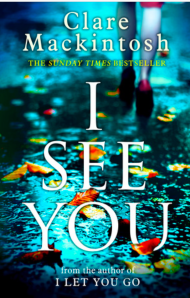
I See You – Claire Macintosh

I was a BIG fan of Claire Mackintosh’s first novel I Let You Go and so I was very 0155E57B-5748-4E40-A9CA-1BF823E44218
much looking forward to reading I See You. I think that had I discovered Mackintosh through this book, I would have likely been impressed, but ultimately it pales a little in comparison to her debut.

Zoe Walker, a divorced mother of two, lives in London with her kids and her boyfriend, Simon. She’s on the commute home one day when she sees a personal ad in the Gazette. It’s for a company called Find the One, which looks like a dating sight, and the picture in the advertisement is of her.

Zoe doesn’t pay much attention to the ad at first because, surely it’s not really her in the photo. Besides, there’s a lot of stuff going on at home. Her 22-year-old son, Justin, is just starting to get his act together, employed at a cafe owned by her next-door-neighbour and bestie, Melissa; her daughter, Katie, is growing up too fast for Zoe’s liking. Only Simon is a solid presence in her life – even though his relationship with Zoe’s kids is sometimes strained.

Mackintosh unravels the story of the mysterious advertisement through several points of view: Zoe, Kelly,  the police officer who finds a connection between Zoe’s ad and the attack of several other women, and an unnamed predator who is always watching.

I see you. But you don’t see me. You’re en grossed in your book; a paperback with a girl in a red dress. I can’t see the title but it doesn’t matter; they’re all the same. If it isn’t boy meets girl, it’s boy stalks girl. Boy kills girl.

The plot clicks along at a pretty good clip, chucking some plausible red herrings along the way, and ultimately ending up with a tidy (although somewhat implausible) conclusion. That said, I was totally invested in Zoe and her mounting suspicions about the people in her life. I will definitely read Let Me Lie.

The House on the Cliff – Charlotte Williams

Hmmm…yet another book about a therapist whose life is in shambles. This time it’sDE5C7121-EA75-4E9F-9BDC-AA702E37EEC3 Jessica Mayhew in Charlotte Williams’ novel The House on the Cliff.
Jessica is married to Bob and they live in Wales with their two young daughters. Their marriage isn’t rock-solid: Bob has recently admitted to a one-night stand, and Jessica is having a difficult time forgiving him. Understandably.

Enter  Gwydion Morgan.

I noticed immediately when he walked into the room that he was a remarkably handsome man, tall and broad-shouldered, with a natural grace in the way he carried himself. I judged him to be in his late twenties, or thereabouts.

Up close I could see that his eyes were green, fringed with thick, black lashes. I looked away. It seemed indecent to do anything else.

That instant attraction is bound to cause some professional conflict, just sayin’. Anyway, Gwydion has come to Jessica with a fear of buttons. Apparently it’s a thing: Koumpounphobia.

Gwydion is an actor on the cusp of his big break. He has a certain theatrical pedigree, too, because his father, Evan, is a brilliant but volatile theatre director. His mother, Arianrhod, is worried about her son’s mental health. Their relationship seems, to the casual observer, a tad co-dependent. When she calls Jessica concerned that Gwydion is suicidal – even though Jessica had seen no signs of this in their therapy – Jessica drives out to their house on the – you guessed it – cliff.

From the minute Jessica steps into the Morgan house, her life becomes entangled with theirs. There is definitely something going on in the house and with the family and Jessica is drawn to them, particularly Gwydion who is both erratic and impossibly attractive. The more time she tries to figure out what is going on, the more she drops the ball in her own life.

There is a Morgan family scandal at the centre of Gwydion’s story. Jessica begins behaving more like a detective and less like a therapist, but whether or not you actually believe someone would make some of the choices she makes or not  is actually beside the point. It’s all page-turning fun.


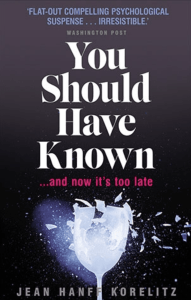
You Should Have Known – Jean Hanff Korelitz

32555CAA-AE7E-4E76-8348-87072A3324C0Grace Sachs, the protagonist in Jean Hanff Korelitz’s compelling domestic thriller You Should Have Known, is an outspoken marriage counsellor who believes that women know from the very beginning if their partners are duds.

Over and over I’ve heard women describe their early interactions with their partner, and their early impressions of their partner. And listening to them, I continually thought: You knew right at the beginning. She knows he’s never going to stop looking at other women. She knows he can’t save money. She knows he’s contemptuous of her…But then she somehow lets herself unknow what she knows.

Grace’s tough talk is easy enough: she’s married to the perfect man, Jonathan, a pediatric oncologist and they have a twelve-year-old-son, Henry.

…she had chosen him, and now, as a result, she was having the right life, with the right husband, the right child, the right home, the right work.

Turns out, though, that all those rights actually make a wrong.

When the mother of one of the students at Henry’s school is murdered, the violent act opens up a fissure in Grace’s perfect life. First, her husband, who is away at a medical conference, stops answering her calls and texts. Then,  she discovers his phone  – not with him, but hidden in his bedside table. And then the police come knocking.

Grace’s life – it turns out – is a sham, and You Should Have Known unravels like any good thriller, stringing the reader (and Grace) along. The whodunit part of the story isn’t actually what’s interesting about Hanff Korelitz’s narrative though. It’s that Grace, a therapist who tells her patients to trust their guts, didn’t trust hers.


Dear Mrs. Bird – AJ Pearce

Dear Mrs. Bird by AJ Pearce is one of those frothy, inconsequential novels that is 54A58E82-4A09-4E79-93EB-33445980025A
easily read and just as easily forgotten. I actually read the first thirty pages or so and put it down; I only picked it back up and finished it because it was a book club pick and I hate going to book club without having read the book.

Emmeline Lake lives with her best friend, Bunty, in London during WW2. Emmeline works at a solicitor’s office and volunteers at the Auxiliary Fire Service, where Bunty’s boyfriend, William is a volunteer firefighter. What Emmeline aspires to, though, is becoming a Lady War Correspondent and she thinks she’s hit paydirt when she sees an advertisement in the paper for a Junior at The London Evening Chronicle.

For the last ten years – ever since I’d won a trip to the local newspaper as a prize for writing a quite dreadful poem when I was twelve – I had dreamt of a journalistic career.

Turns out, the job isn’t much more than glorified secretary to Mrs. Bird, Woman’s Friend’s  agony aunt. (Woman’s Friend being the poor relation to The Chronicle.)  Emmy is shocked and dismayed to realize that she’s taken the wrong job, but gives a “plucky Everything is Absolutely Tip Top Smile.”

Mrs. Bird has a strict policy about the sort of letters she will and will not answer in the magazine. Letters concerning marital or premarital or extramarital relations are to be binned. Mrs. Bird will not deign to answer queries about physical relations, illegal activity, politics, religion, the war or cooking. There’s also a long document containing a list of “Words and Phrases That Will Not Be Published Or Responded To By Mrs. Bird.”

Emmy feels stifled by her inability to help the people who write to Mrs. Bird looking for a light in what is clearly often a dark time. And this might have been an entertaining story, if it weren’t for the fact that Emmy is annoying and the story is pretty much a “you-can-see-it-coming-for-a-country-mile” romp.

For starters, Pearce capitalizes random phrases in the middle of sentences so, I think, you can hear how British and, well, to steal a phrase from Emmy herself, plucky these characters are.

Bunty said rather too quickly that the army always lets you know if something awful had happened so No News Is Good News and then Bill took up the baton and said Don’t You Worry, Emmy, Edmund Is Made Of Very Stern Stuff.

I can’t tell you how annoying that got after a while. The story sort of veers away from the letter writing, too, once the ‘tragedy’ happens. It all gets knit together in the end, though, So That’s All Right.

Ultimately, Dear Mrs. Bird wasn’t my cup of tea, even though it might have been a winner in different hands. I will be passing this book on to my 80-year-old aunt. I think she will love it.