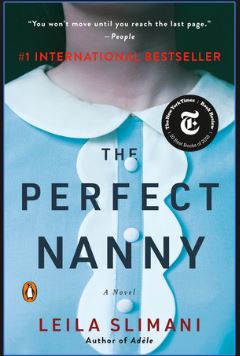
 Leila Slimani’s novel The Perfect Nanny was one of The New York Times Top 10 books of 2018. Hmmm. It was also the winner of the Goncourt Prize. (Yeah, I’d never heard of that one, either, but apparently it’s “a prize in French literature, given by the académie Goncourt to the author of “the best and most imaginative prose work of the year”. Wikipedia) To me, I thought it was going to be a quick little thriller with a pedigree that was perhaps a cut above. Because go into any bookstore these days and there are about a zillion thrillers out there. How are you supposed to know what’s good?
I’ll save you the trouble: not The Perfect Nanny.
Myriam, a French-Moroccan lawyer, and Paul, her husband who is a music producer, need someone to look after their two small children, Mila and Adam. They live in a small apartment in Paris and Myriam has recently decided to go back to work. They interview a few potential nannies, and then they meet Louise.
She must have magical powers to have transformed this stifling, cramped apartment into a calm, light-filled place. Louise has pushed back the walls. She has made the cupboards deeper, the drawers wider. She has let the sun in.
To Myriam, Louise is “a miracle worker.” Not only does she transform their living space, she “sews buttons back on to jackets…hems skirts…washes curtains…changes sheets…she is like Mary Poppins.”
She works her magic with the children, too and “When Myriam gets back from work in the evenings, she finds dinner ready. The children are calm and clean, not a hair out of place.”
But of course, not all is as perfect as it seems and we know that from The Perfect Nanny‘s opening line “The baby is dead.”
Slimani weaves Louise’s backstory throughout the novel, snippets of information about her dead husband, the horrible Jacques, her MIA daughter, Stephanie, other homes and families she has worked with. Simmering just below the surface, Louise is fragile. It seems she has buried all her own needs in service to others. She lives in a shithole; she has no friends; she has no money. Without someone else to look over, Louise is a non-person.
The Perfect Nanny has been compared to Gone Girl but I don’t think it’s an apt comparison. This book is a slow-moving, naval-gazing look at motherhood and surrogacy. It’s about how we treat people in subservient positions, about privilege. Yes, that opening line might make you think you’re about to read a thriller, but there’s never any question of whodunit and so all that remains is the why. At the end of the day, I didn’t care about any of these characters, so the why hardly mattered.
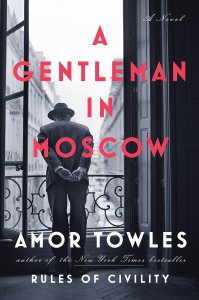 divided our group. It’s the long-winded story of Count Alexander Rostov, an aristocratic Russian in Moscow, who is sentenced to house arrest for writing the long poem Where Is It Now? which is deemed by the authorities as “a call to action”. The tribunal determines that Rostov has “succumbed irrevocably to the corruptions of his class – and now poses a threat to the very ideals he once espoused.”
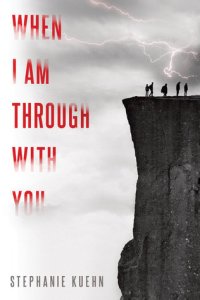 Charm & Strange
 good page-turner, I know that they are not all created equal. This is the third book I’ve read by British writer Erin Kelly and although
 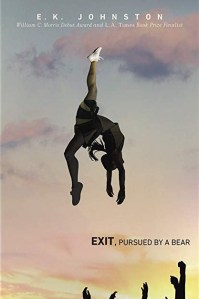 cheerleading team, she is looking forward to one last cheerleading camp, one last year of school and then the freedom her future offers her. She is smart, fun-loving and although she loves cheerleading and takes it seriously, she is not the stereotypical cheerleader. To be honest, there isn’t actually a mean or petty girl in E.K. Johnston’s YA novel Exit, Pursued by a Bear.
  I could NOT put this book down. From the moment I met Julian and Adam, the two narrators of Robin Roe’s debut novel A List of Cages, I was immediately invested. This is a book with so much to say, but its messages are never didactic. It’s horrifying and heart-warming in equal measure.
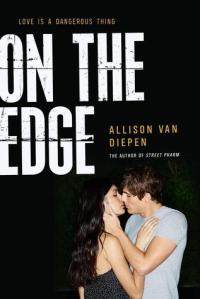 One of my favourite YA tropes is bad boy/good girl. I can’t seem to get enough of it, really, and if there’s a heaping helping of angst thrown in, well, it doesn’t really get much better than that. Allison Van Diepen’s novel On the Edge seemed like it might have the goods, but it was only just okay.
 finally picked it up. The book was well-reviewed and was a finalist for Crime Writers’ Association’s Steel Dagger Award. What can go wrong, right?
 Although I don’t usually trust author endorsements on book covers (except for Stephen King’s praise; he’s a pretty reliable reader), Simone St. James’s novel The Broken Girls had an equal number of positive reviews from places like Kirkus, Library Journal and Booklist. I felt pretty confident when I chose it as my book club pick back in March.
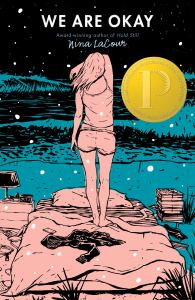 nature of grief. This is a quiet novel, and so I would caution readers not to expect histrionics or very much action. Instead, LaCour focuses on the protagonist’s interior life, which has been altered by loss.
