A Short History of the Girl Next Door – Jared Reck

shortI can’t remember the last time I cried actual tears reading a book, but Jared Reck’s debut novel A Short History of the Girl Next Door actually made me cry. And also laugh.

This is the story of 15-year-old Matt Wainwright, who is in love with his childhood bestie, Tabby, who lives – not exactly next door – but across the cul-de-sac from him.

I am completely in love with my best friend from childhood, she has absolutely no idea, and now she’s interested in older, more popular guys.

This sounds like a bad movie already.

Matt is a talented basketball player and a writer, big brother to four-year-old Murray. He is pretty awesome in every category, actually, but Tabby has definitely friend-zoned him. They’re freshmen at Franklin High and by October, she’s caught the attention of senior stud Liam Branson, starter on both the school’s football and basketball teams. Matt is consumed with jealousy, even though, as it turns out, Liam is a pretty awesome guy.

And it’s not like Tabby is flaunting her new relationship in Matt’s face. They’ve always been just friends. They like Star Wars movies and Nerds and, until Liam started picking Tabby up in the mornings, riding the school bus together. Tabby has always been a part of Matt’s family dynamic because his “mom started babysitting Tabby when she was four months old. And since my mom stayed home with me until I started school, Tabby was at our house nearly every day. She’s part of our family.”

Matt imagines a different future with Tabby, but his longings live in his head. He never actually gathers the courage to tell her how he feels, and their relationship endures some bumps along the way as she navigates her first relationship and Matt tries to tamp down his feelings about that relationship.

Their relationship starts to deteriorate and then the unspeakable happens.

Reck’s novel is everything a great YA novel should be. The characters are believable and appealing; even the adults get a fair shake. I especially loved Matt’s grandfather and this book really made me miss my own grandparents, long gone now. Matt is, often, immature, as you’d expect him to be, but he’s smart and sensitive, too. Tabby is more than just the gorgeous object of both Matt and Liam’s affections. She has feelings and depth.

I loved everything about A Short History of the Girl Next Door and highly recommend it.
 

The Handmaid’s Tale – Margaret Atwood & Renee Nault

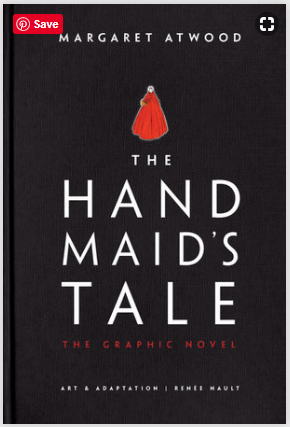
I probably shouldn’t admit this, being both a Canadian and an English teacher, but I have handmaidbestnever read Margaret Atwood’s novel The Handmaid’s Tale. I haven’t watched the series, either. I know, I know. I figured that I could rectify that by reading Renee Nault’s stunning graphic novel of Atwood’s book.

First published in 1985, Atwood’s novel explores a dystopian America. Atwood imagines a totalitarian state where women are commodities without their own names or lives. Some women are sexual servants, that is if they are of the age to bear children. Their names reflect the men they serve, so the book’s narrator is Offred or “of Fred”. In another life, Offred was married, had a daughter, but the family was separated when they tried to escape to Canada. The novel won several awards, including the Governor General’s Award and the Booker.

In many ways, Atwood’s novel was prescient. Flash forward almost 35 years and reflect on what is currently happening in the States (and around the world) and The Handmaid’s Tale  should make your skin crawl.

Nault’s beautiful drawings highlight the horrific lives lived by these handmaids.

handmaidstalegraphicnovel

They dress in red “the colour of blood, which defines us.” Their hats prevent “keep us from seeing, but also from being seen.” Offred reveals her defiance to her situation early on claiming that “I never looked good in red, it’s not my colour.” Friendships are discouraged between the handmaids. Their only job is to be an incubator.

It’s easy to see why Atwood’s novel was ground-breaking when it was first published. It’s difficult to read it even now. Nault’s adaptation should introduce a whole new generation of readers to Atwood’s acclaimed novel. I might just go read the original now.

White Rabbit – Caleb Roehrig

white rabbitRufus Holt is having a really fucking bad day. I use the expletive because, well, there’s a lot of F-bombs in Caleb Roehrig’s YA mystery White Rabbit. I’m not a prude by any stretch, but I have to admit that by the end of the novel I was getting a little tired of all the swearing. Surely teenagers as smart as the ones who populate Roehrig’s world would have the vocabularies to match.

But, really, that’s just a niggle. Overall, Roehrig has written a tightly plotted and well-written (I know what I said, it’s still a well-written book!) mystery.

Sixteen-year-old Rufus has just received a call from his half-sister April. He’s pissed because his ex-boyfriend, the handsome and thoughtful Sebastian, has just hauled him out of the 4th of July party they were attending to “talk.” But then, April tells Rufus that she’s in trouble and needs his help.

Rufus’s relationship with April is somewhat contentious. Her father is his father, but Rufus is the black sheep. His father is never anything but cruel to Rufus. His relationship with his older brother, Hayden, is downright abusive. But when April calls, Rufus feels obligated to help. What he discovers is his sister, whacked out of it,  sitting in a puddle of her boyfriend Fox Whitney’s blood surrounded by White Rabbits, “a designer drug known to cause euphoria, heightened sensory perception, and hallucinations.” But “the pills have also been linked, notoriously, to acts of extreme violence.”  April swears she didn’t kill Fox and begs Rufus to help her.

Rufus and Sebastian spend the rest of the book trying to prove April’s innocence by visiting the other people who’d attended the same party. Rufus has never been a part of the “IT” crowd, but one of the party attendees is Lia, Sebastian’s ex-girlfriend. Sebastian insists that he’s not leaving Rufus, and besides he has the car.

White Rabbit  is a carefully plotted mystery. The characters are, generally speaking, awful people – with the exception of Rufus (despite his potty mouth) and Sebastian. As the boys try to get answers to clear April’s name (and there is a financial incentive for Rufus to take on this mostly thankless task), they are lied to, shot at, chased with cars. While they try to figure out whodunit, Rufus and Sebastian also try to navigate their feelings for one another. There are red herrings galore and people with nefarious motives, but all of it makes for page-turning fun.

They Both Die at the End – Adam Silvera

theybothdieIn a not-too-distant future universe- or I don’t know, maybe it’s way in the distance – Mateo Torrez gets the call everyone dreads:
…I regret to inform you that sometime in the next twenty-four hours you’ll be meeting an untimely death. And while there isn’t anything we can do to suspend that, you still have a chance to live.

Mateo is only seventeen and he certainly doesn’t want to die.

Neither does eighteen-year-old Rufus Emeterio. He gets the call as he’s beating the snot out of Peck, his ex-girlfriend’s new boyfriend.

Death-Cast makes the call, but they can’t tell you anything more than sometime in the next twenty-four hours your number is up. That’s the premise of Adam Silvera’s philosophically astute and heart-breaking YA novel, They Both Die at the End.

Mateo and Rufus came from vastly different worlds. Mateo is introverted and lives his life from the safety of his apartment. His father in in the hospital in a coma; his best friend, Lidia and her infant daughter, Penny, are his closest friends. Rufus lives in a group home. His family had received the Death-Cast call and perished. He has a new family, now, a rag-tag group of foster kids and the foster parents who love them. Despite the fact that he was beating someone up when we meet him, he is a sweet and thoughtful kid.

Mateo and Rufus meet via the Last Friend App, an app “designed for lonely Deckers and for any good soul who wants to keep a Decker company in their final hours.” (Decker meaning those on deck to die). Although the boys come from vastly different worlds, their one night together opens them up to life’s possibilities in ways neither could have imagined.

“To live is the rarest thing in the world. Mot people exist, that’s all.” Oscar Wilde

That’s the quote that opens this much-lauded novel. It’s so true, isn’t it? We hide behind our phones, we curate our lives for social media (just look at pictures of people at concerts; everyone is holding up a phone to video the performance rather than enjoying it in the moment.) We collect stuff, not memories. We don’t really talk to each other anymore. With the specter of the end hanging over their heads, Mateo and Rufus spend the day criss-crossing NYC, having meaningful moments with their loved ones and moments of introspection with themselves.

Thornton Wilder warned audiences back in the 1930s that life was “too wonderful for anybody to realize.” In his play, Our Town, Emily asks the Stage Manager if “any human beings ever realize life while they live it? – every, every minute.” I think Mateo and Rufus would have appreciated Wilder’s sentiment.

I truly fell in love with these characters, and I kept thinking “surely they’re not going to die” but the book’s title is not misleading. Silvera’s novel is outstanding and I highly recommend it.

Paperback Crush – Gabrielle Moss

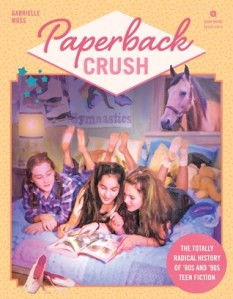
paperbackI couldn’t resist picking up Paperback Crush,  a colourful, sometimes snarky look at the Young Adult fiction published in the 1980s and 90s. Author Gabrielle Moss say that the book is “here to honor the young adult lit published after Judy Blume but before J.K. Rowling.” Those decades produced more YA than the previous decades, but the quality, I suspect, wasn’t what we’ve come to expect from modern YA. And I read a lot of YA.

It’s a hotly debated subject (okay, maybe not hotly): what’s the first YA book?

…experts don’t agree on exactly when [YA] dawned. Books from the original 1930s Nancy Drew stories to Laura Ingalls Wilder’s 1932 book Little House in the Big Woods  to the 1936 novel Sue Barton, Student Nurse by Helen Dore Boylston have all been held up as the first-ever YA novel

I like to think that S.E. Hinton’s The Outsiders  is the first true example of YA, a story written expressly for young people, but according to Young Adult Library Services Association president Michael Cart YA “all started with Maureen Daly’s Seventeenth Summer.” I actually have vague memories of reading that book, but my memories of reading The Outsiders and Hinton’s follow-up That Was Then, This is Now  are seared into my adolescent memory.

Moss tracks the trends in YA, everything from first love and love-gone-wrong to sick lit and paranormal romance. She examines teenage jobs (babysitters and camp counselors); friendships (bffs and frenemies); family (siblings and cousins and evil step-parents).  She looks at specific books and authors, flagging the more famous titles with passive-aggressive admiration (Wakefield twins!)

I wasn’t reading a lot of YA lit in the 80s and 90s, but I am a reader, so I was at least familiar with 80% of the literature Moss mentioned. I mean, you would have had to be living on another planet not to know Sweet Valley High  or The Baby-Sitters Club [sic]. I enjoyed reading about these books, and often found Moss’s commentary laugh-out-loud funny.

Literature from this time period was not without its issues. As Moss points out “a lot of these books centered on the stories of white rich thin heterosexual women with naturally straight hair.” But no matter. For better or worse “They validated girls’ stories by putting them to paper….”

I came of age in the 1970s, but as a teacher I enjoyed Paperback Crush.  It is pure nostalgia. Although I am just a bit older than the book’s target demographic, I too remember the joys of the Scholastic flyer, and the thrill of choosing my own books to read. Many of the titles mentioned caused a flood of memories. If books were a part of your life, this one will give you all the feels.

Now is the Time for Running – Michael Williams

now is thetimeIt’s amazing how sheltered I am. I remember reading The Kite Runner years ago and being shocked how little I knew about that conflict. And I know next to nothing about the conflicts in Africa. Michael Williams’ YA novel Now is the Time For Running doesn’t spend too much time talking about the politics of the conflict, but readers will soon understand the chaos and devastation it causes.
Fifteen-year-old Deo lives with his amai (mother), grandfather (Grandpa Longdrop), and older brother, Innocent. Innocent is 25, but he is ‘different’. His impairment is never specified, but it hardly matters. Deo looks out for his big brother.

Deo lives in Gutu,  Zimbabwe. He spends his spare time playing soccer with a ball his grandfather made for him.

It is no proper soccer ball. It is a pouch of cow-leather patches sewn together with twine, stuffed with tightly rolled plastic.

It’s clear that circumstances are dire for Deo and his family. When soldiers roll into their village and demand that the villagers bring them their food, Deo thinks “Does he not know we have nothing, that there is no food here?”

The situation between Deo’s village and these soldiers soon escalates and Deo and Innocent suddenly find themselves running for their lives.

Now is the Time for Running  follows Deo and Innocent as they try to make their way to the relative safety of South Africa, where they think their  father is currently living and working. It is a perilous journey and it is difficult to know who to trust. Deo is an engaging and sympathetic narrator and you will want to know that he and Innocent arrive safely, but safety is a rare commodity.

I was wholly invested in Deo and whipped through this book in record time. It would certainly appeal to anyone looking for a fast-paced story about survival, students who like soccer and anyone interested in social justice.

We Were Liars – E. Lockhart

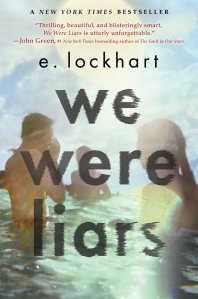
liarsCadence Sinclair, the narrator of E. Lockhart’s riveting YA novel We Were Liars, lives a seemingly charmed life. The eldest of the Sinclair grandchildren, she summers with her cousins Johnny, Mirren, Liberty, Bonnie, Will and Taft on Beechwood Island, a private island off the coast of Massachusetts, somewhere near Martha’s Vineyard. Her grandparents, Harris and Tipper, have a created a sort of kingdom on Beechwood. Each of their three daughters has their own house on the island, but everything revolves around the patriarch. There is a lot of drinking and in-fighting, all of it held together by Tipper. When she dies, the daughters and their children, who are used as pawns to secure Harris’s favour, go a little off the rails.
The summer that Cadence is eight, Johnny brings his friend Gat to the island.

His nose was dramatic, his mouth sweet. Skin deep brown, hair black and waving. Body wired with energy. Gat seemed spring-loaded. Like he was searching for something. He was contemplation and enthusiasm. Ambition and strong coffee. I could have looked at him forever.

Cadence, Johnny, Mirren and Gat, the Liars,  become an inseparable foursome. Gat is invited back every summer and by the time they are fourteen, Cadence and Gat have begun tentative steps towards crossing the friendship line. Cadence feels “the love rush from me to Gat and from Gat to me.”

But then summer fifteen happens. That’s the summer Tipper dies. It’s also the summer that Cadence goes swimming alone at the little beach. She doesn’t remember much of what happened

“I only remember this: I plunged down into this ocean,                                                          down to rocky rocky bottom, and                                                                                                      I could see the base of Beechwood Island and                                                                            my arms and legs felt numb but my fingers were cold.                                                        Slices of seaweed went past as I fell.”

It’s a summer that changes everything. Cadence is taken home to Vermont to recover and she doesn’t return to Beechwood until summer seventeen. Her memory is suspect, making her a terrifically unreliable narrator. She suffers from debilitating migraines; she starts to give away her possession. Her island has changed and so have the Liars. One thing remains unchanged though: the way she and Gat feel about each other.

I loved pretty much everything about We Were Liars. I loved the jagged edges of Cadence’s memory as she tries to piece together the mystery of her accident. I loved the dysfunctional nature of the Sinclair family. As Cadence admits in the beginning, “I am the eldest Sinclair grandchild. Heiress to the island, the fortune, and the expectations.”  And I loved the Liars.

Lockhart’s book has a big plot twist. Some might see it coming; I did not. I am not a teenage reader so while the twist wasn’t exactly shocking to me, that doesn’t mean it wasn’t effective. We Were Liars is a page-turning puzzle of a book. I read it in one breathless gulp.

Highly recommended.


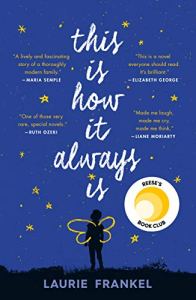
This Is How It Always Is – Laurie Frankel

Laurie Frankel tackles some compelling and timely questions in her widely-praised novel This is How It Always Is. It’s one of those “issues” novels that makes it, as the Globe and Mail suggests, “a must for your next book club discussion.”

Penn and Rosie live a somewhat charmed life in rural Wisconsin. Rosie is an ER doctor; this is how Penn is a writer-cum-stay-at-home- dad. They have five sons: Roo, Ben, the unfortunately named twins, Rigel and Orion, and finally, Claude. In almost every way the Walsh-Adamses seem to have life figured out.
As almost everyone with children knows, parenting is hard. Harder still when life throws you a curve ball and the curve ball for this family comes when, at three, Claude announces that along with being

a chef, a cat, a vet, a dinosaur, a train, a farmer, a record player, a scientist, an ice-cream cone, a first baseman, or maybe the inventor of a new kind of food that tasted like chocolate ice cream but nourished like something his mother would say yes to for breakfast. When he grew up, he said, he wanted to be a girl.

Rosie tries to put Claude’s proclamation into context. He is, after all, only three; precocious, sure, but still only three. As time goes on, though,  Rosie and Penn discover that his playing ‘dress-up’ is not a passing phase. Claude tells his parents “I’m not usually.”

Like any good parents, Rosie and Penn want their son to be happy and it turns out that what would make Claude happy is not to be Claude, but to be Poppy. Eventually that necessitates a move (to Seattle), some secret-keeping and the first real bump in the matrimonial road for the couple.

I had a few little issues with this book. Not with Claude/Poppy’s story, really. And not with the writing, which was excellent, (although I did find that the book was over-written and often bogged the story down).

I really wished that Frankel had spent a little bit more time demonstrating how Poppy’s reality impacted her brothers. Clearly, Roo struggled a little, but somehow it seemed as though we were expected to believe that all his issues were resolved…by magic? good parenting? I dunno.

I also took issue with the end of the book. Rosie runs away with Poppy to a place where ladymen are no big deal, and somehow this experience rights everyone’s ship. By the time they return to the States, people who had been mean to Poppy have seen the error of their ways in a manner far beyond what might be expected of ten-year-olds.

It’s all a little too happily-ever-after for me.

All of this aside, though, I think This Is How It Always Is  is a big-hearted book about a topic that is both timely and important. It’s worth a look.


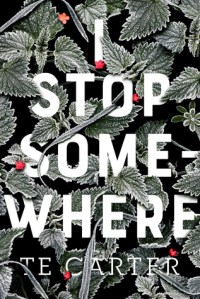
I Stop Somewhere – TE Carter

Ellie Frias, the narrator in TE Carter’s YA novel I Stop Somewhere,  is an awkward First autumn frost on Stinging Nettle leaves - France  -  -  -teenager who wants to make a good impression when she starts high school. Ellie understands that “Pretty is power.” She’s never really fit in, but she is determined that when she starts high school, things will be different.

Ellie lives with her single father on the wrong side of town. Her mother took off when she was just a baby and although she and her father have always been close, Ellie feels herself drifting away from him. She understands that he tries, but it isn’t enough, so Ellie turns to Kate, an older girl who lives in the house behind her. She needs guidance and she has no friends.

I started school with the right clothes. My curves showed where they were supposed to but nowhere else, and Kate had helped me with my hair. We’d bleached two strips down the front and dyed them blue so the color framed my face. With my new T-shirts that were a testament to my apathy, I fit in by not caring about fitting in.

Ellie does get the attention of Caleb Breward, a popular boy at school, whose father is an important figure in their town, Hollow Oaks. He tells her she’s cute and names her “Elusive Ellie.” Ellie is so desperate to be accepted and loved, that she doesn’t realize what a shark Caleb is. Or maybe she actually does know, but she finds a way to rationalize it.

…I knew very little about Caleb Breward, and most of what I did know wasn’t great. It tried to show me all the days he’d passed me in the hall and wouldn’t look at me. My brain had a long list of amazing reasons I should have walked away, but Caleb’s closeness did things inside of me I didn’t know how to process.

Carter manages to capture what it is to be an insecure girl with remarkable accuracy.  What makes Caleb such a chilling character – and trust me, he’s way more awful than just being some douche who breaks a girl’s heart – is that he plays on Ellie’s insecurities. He hasn’t really got very much going for him other than an oily charm and a seemingly bullet-proof family.

This is a novel about rape, victim-shaming and what it means to survive. I found I Stop Somewhere compelling and heart-breaking in equal measure.

In Real Life – Cory Doctorow & Jen Wang

in_real_lifeAlthough I really don’t know very much about gaming (my gaming experiences consist of playing PacMan and Asteroids at the local pin ball joint, and then a few years later staying up all night to play Scorched Earth), I do understand the appeal of an on-line persona. During my years in fandom, I had a fake name for all the fanfiction I wrote, and I met loads of other people (mostly women) who wrote fic in their spare time: mothers and teachers and lawyers and even a judge. While my persona was very much me, having met some of these ladies in real life, I know that many of them were more daring, outgoing, over-the-top online compared to the way they were in their every day lives. That aspect of Cory Doctorow and Jen Wang’s graphic novel In Real Life was familiar to me.

Anda has recently moved from California to Arizona with her parents. She hasn’t really settled in, except with the boys who play D & D, and so when Liza McCombs shows up in her computer class to invite girls to play Coarsegold, a first person game for girls only, Anda jumps at the chance. (This is the point where I admit that I don’t really know much of anything about this sort of thing.)

Anda creates an avatar, Kalidestroyer,  befriends another player, Sarge. Sarge recruits Anda to “kill some guys.” (Virtually, of course.) The guys Sarge wants Kalidestroyer/Anda to kill are gold miners, players who “collect items for gold and sell the gold to other players for cash.” Someone who actually games will probably understand the mechanics of this better than I did, but eventually Anda comes across one of these gold farmers and instead of killing him, she starts to talk to him. Turns out, he’s a boy from China.

irl2

Doctorow says in In Real Life ‘s Introduction that he hopes readers will “be inspired to dig deeper into the subject of behavioral economics and to start asking hard questions about how we end up with the stuff we own, what it costs our human brothers and sisters to make those goods, and why we think we need them.”  Doctorow believes that while the Internet doesn’t necessarily solve the injustices of the world – which we can all agree are many – it “solves the first hard problem of righting wrongs: getting everyone together and keeping them together.”

As Anda’s gaming life spills over into her real life, it’s easy to see the point Doctorow is making. This is a worthwhile book for gamers and anyone interested in justice.