You – Caroline Kepnes

EC4364B5-CF87-4ACD-9942-7867FDAC012AJoe Goldberg is crazy smart. Hmm, let me rephrase. Joe Goldberg is crazy. He works at a rare book store in New York City’s East Village and when Guinevere Beck aka Beck walks into the store one day, Joe is instantly smitten.

You didn’t walk in there for books, Beck. You didn’t have to say my name. You didn’t have to smile or listen or take me in. But you did.

Caroline Kepnes’ debut novel You has won copious praise and has also been turned into a series on Lifetime.  Is it deserving of all the accolades? Let’s break it down.

1. Joe isn’t your garden variety psycho. He’s well-read and funny and often times he’s more sympathetic than Beck. After their chance meeting, Joe sets out to learn everything he can about Beck, an easy enough task since millennials put the minutiae of their daily lives online for everyone to see. It’s pretty easy for Joe to infiltrate Beck’s life.

What do we know about Joe? Not too much. He lives in a shitty apartment, doesn’t seem to have any friends and has clearly earned the trust (and the keys to the kingdom) of his employer, Mr. Mooney.

2. Beck is an MFA student who seems to enjoy (rough) sex and is pining for a guy called Benji when Joe first meets her. Truthfully, she’s not that interesting, but I guess that’s not really the point. She’s just a vessel for Joe to pour all of his psychopathy into. Whether any of the attraction Beck feels for Joe is real, or whether the appeal of Joe’s total devotion to winning her affections is just part of her own narcissism, it’s hard to say.

3. The plot actually moves along relatively slowly for a novel that is meant to be a thriller. That’s because it’s over-written…sometimes it seems to take forever for anything to happen. Joe imagines all the times he is going to have sex with Beck before he actually has sex with her, and when they finally do the deed, it’s a horrible disappointment to them both. Talk about your performance anxiety. Other sub-plots bog down the main action of the story…the will he won’t he get the girl and from there, what’s going to happen?

That said, the writing is terrific. Kepnes does an amazing job of making Joe seem both believable, creepy and, on some level at least, likeable. He is patient and volatile in equal measure. Ultimately, it’s his obsession with all things Beck that is his undoing, and the end of his relationship with Beck, when it comes, unravels in record time.

And it’s over . You begin to yelp and spring at me and I don’t like you right now. You make me do terrible things like hold you down and clap my hand over your mouth. You make me twist your arms and bear down on you, and this is our bed.

Look, You doesn’t tread any new water, but that doesn’t mean that, of its type, it isn’t worth a look if you enjoy crazy stalkers.
Sadie – Courtney Summers

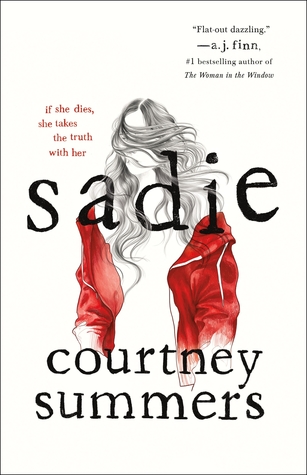
sadieI thought if I waited a few days after finishing Courtney Summers’ latest book Sadie, I would have a better chance of articulating my feelings coherently. Sadly, I don’t think I am actually going to be able to adequately express all the ways I loved (and hated) this book.

The premise is clever. West McCray, a radio producer at New York’s WNRK, is shaking up the station’s format by introducing a new podcast, The Girls. The podcast “explores what happens when a devastating crime reveals a deeply unsettling mystery.”  McCray dives headlong into the story of Mattie Southern, a thirteen-year-old whose dead body was discovered in an orchard near a burning schoolhouse, and her nineteen-year-old sister, Sadie, who is missing.

I’ve decided the gruesome details of what was uncovered in that orchard will not be part of this show. While the murder, the crime, might have captured your initial interest, its violence and brutality do not exist for your entertainment – so please don’t ask us.

Transcripts of the podcast (and you can actually listen to those here) alternate with Sadie’s first person narrative. Sadie leaves Cold Creek’s trailer park and her surrogate grandmother, May Beth, to find Keith, a man who once lived with Sadie and Mattie’s mother, Claire. Claire is currently out of the picture, an addict who’s had a steady stream of creeps in her bed.

Despite being blocked at every turn, Sadie is like a dog with a bone when it comes to tracking down Keith, a man she claims is her father. She buys a junker car, and asks fearless questions, hindered only by her stutter and youth. By about page thirty I was as invested in Sadie’s hunt as she was. She is equal parts vulnerable and tough-as-nails and 100% believable.

And this is where I have to pause and commend Summers, once again, for writing characters who are so real. Regular readers to this blog will know I am a fan of Summers and have read several of her books including Cracked Up to Be, All the Rage, This Is Not a Test, and Some Girls Are. I’ll tell you this – Summers is not writing the same book over and over. Her characters are not stereotypes. They are vulnerable, broken, tough, cynical and hopeful and every combination in between. Sometimes they say or do things that are wince-worthy, but as a mom and high school teacher, I know that Summers cuts as close to the bone as it’s possible to get. Like it or not.

So, I wasn’t surprised that I fell in love with Sadie, rough edges and all. I expected to be invested in her journey and I hated (that’s what I hated, folks) that it was a journey that she felt compelled to take. I hated that I was afraid for her the entire freakin’ time! Sadie loved her sister and made sacrifices for her that Mattie would never have the opportunity to understand. That’s what it is to love someone.

McCray is always just one step behind Sadie, but his podcasts fill in some blanks, allowing us to see how Sadie is viewed from other perspectives. Former teacher, Edward Colburn, says, “She was teased by her classmates because of the stutter and that caused her to withdraw.” Her boss, Marty McKinnon said Sadie was “a good kid, hard worker.” Mae Beth said that “The only thing Sadie was afraid of was losing the family she had left and that was Mattie.”

All of these ingredients add up to a story that McCray describes as being “about family, about sisters, and the untold  lives lived in small-town America. It’s about the lengths we go to protect the ones we love…and the high price we pay when we can’t.”

There are few moments of levity in this novel, but Sadie (the novel and the character) will haunt your dreams.

Highly recommended.


Monday’s Not Coming – Tiffany D. Jackson

Thirteen-year-old Claudia and Monday are inseparable, even though they come from twomonday different worlds. Claudia lives with her stable and loving parents; Monday lives with her single mom and three siblings in Washington’s Ed Borough Complex, a part of town Claudia isn’t allowed to visit without an adult.

After returning to DC from a summer with her grandmother, Claudia is looking forward to starting grade eight with her bestie, but Monday is a no-show. When she doesn’t show up at school all week, and when calls to her house yield no answers, Claudia gets worried. A frightening visit to Monday’s apartment only ratchets up Claudia’s concern.

Tiffany D. Jackson’s YA novel Monday’s Not Coming is part mystery and part coming-of-age story. Claudia’s life is upended by the disappearance of her friend. For one thing, Monday helped Claudia with her school work and without her, Claudia is lost and “Without her, the [lunch] line went on for eternity. Without her, I ate alone. Being alone made you a target, though, and ain’t nobody got time for stupid boys throwing food at your head.”

Life ticks along for Claudia. She joins a dance group, meets a boy at church, starts getting help with her schoolwork, but none of these things fill the hole left by Monday. The two girls shared a lot of dreams – attending the same high school, making it on the dance squad, leaving the horrors of middle school behind. The longer Monday is gone, though, the more Claudia has to move forward with her life.

Readers will turn the pages of Monday’s Not Coming desperate to know what has happened to her, but I was interested in Claudia’s personal journey. Monday is a larger-than-life character, not afraid to stand up for herself or go after what she wants including the hottest boy in school. Claudia is shocked to discover new things about her best friend and she begins to wonder just how well she actually knew her.

There’s a twist in this novel that I didn’t see coming, and I can’t say that it worked 100% for me. However, it in no way undermined my overall reading experience. Monday’s Not Coming is a worthy addition to my classroom library.

Belzhar – Meg Wolitzer

belzharJam Gallahue just hasn’t been able to recover from the death of her boyfriend Reeve Maxfield. “I loved him,” she explains, “and then he died, and almost a year passed and no one knew what to do with me.” As a last resort, Jam’s parents send her to The Wooden Barn, “a boarding school for ’emotionally fragile, highly intelligent’ teenagers.”

Meg Wolitzer’s YA novel Belzhar follows Jam on her journey of recovery, although it probably won’t be the sort of recovery readers will be expecting.

Jam is picked to take a course called Special Topics in English, the “smallest, most elite class in the entire school.” Taught by Mrs. Quenell, Special Topics has a reputation at The Wooden Barn. Jam’s roommate, DJ, tells her that students who haven taken the class act like it’s no big deal, but “when it’s over, they say things about how it changed their lives.”

Jam shares the class with Casey, a girl in a wheelchair, Sierra, Marc, and Griffin, a boy who is “good-looking but in a hostile way.” Their special topic is Sylvia Plath, who will be the only author the five students will study. In addition, they are required to write in journals that Mrs. Quenell hands out to them. Mrs. Quenell tells the students that each of them “has something to say. But not everyone can bear to say it. Your job is to find a way.”

The thing about these five students is that they have each suffered some sort of trauma and it turns out that their journals and the entries they write in them magically transport them back to a happier time in their lives. These experiences, which they call going to Belzhar (a weird take onthe title of Plath’s only novel The Bell Jar) causes them to open up to each other and to the world.

Whether you buy into the magical realism elements of this novel or not, there is certainly truth to the fact that some people get stuck in their grief or anger. Each of these teens has been trapped by their experiences  and the act of writing allows some of the poison in their lives to seep out.  “Words matter,” Mrs. Quenell tells her students, and I wholeheartedly agree.

Not everyone will appreciate Belzhar. I can see how some students might balk at the notion of Belzhar as a real place, but as a metaphor it most certainly works. Human beings do get stuck. We hold on to things and people that are not healthy. We don’t fully live; we deceive ourselves. It takes work, sometimes, to shed trauma, but surely it’s worth it.

“You’re all equipped for the world, for adulthood, in a way that most people aren’t…So many people don’t even know what hits them when they grow up. They feel clobbered over the head the minute the first thing goes wrong, and they spend the rest of their lives trying to avoid pain at all costs. But you all know that avoiding pain is impossible.

Belzhar is worth a look.


I Will Always Write Back – Caitlin Alifirenka & Martin Ganda w/ Liz Welch

I will alwaysWhen I was a kid, I had pen pals. Lots of them. I think I started writing letters when I was about seven. We moved away from Winnipeg  where we had been living for a couple years. I had to leave my best friend, Lynne, behind and we kept exchanging letters for many years – up until recently when my Christmas card to her was returned ‘address unknown.’
I came of age in the 70s, way before Facebook or email. The only way to maintain a relationship with someone who lived far away was to write a letter. Long distance phone calls were pretty expensive, but stamps were cheap. By the time I was sixteen I had at least two dozen pen pals from all over the world. I loved getting their letters and learning about their lives. I still have one of those pen pals, and although we tend to catch up via the Internet now, we have shared dozens of letters over our 40+ year correspondence.

So I was ready to love I Will Always Write Back by Caitlin Alifirenka & Martin Ganda (with help from Liz Welch). I’ll spare you the suspense: I LOVED this book.  It’s the true story of how Caitlin, a thirteen-year-old from Hatfield, Pennsylvania writes (via a school project) a letter to thirteen-year-old Martin who lives in Mutare, Zimbabwe. That letter  – as generic as it must have been – is the beginning of a beautiful friendship.

Caitlin chose Zimbabwe from a long list of countries because it sounded exotic. She really knew nothing about the country.

My knowledge of Africa consisted of what I had seen in the National Geographic magazines my mother subscribed to for our family. I loved looking at the colorful photos of tribal people who wore face paint, loincloths and beads. I didn’t think my pen pal would dress like that, but I had no idea what kids in Africa wore. Jeans, like me?

Caitlin has no idea of Martin’s circumstances, but the reader does. Martin lives with his parents and siblings in Chisamba Singles “a housing development built in the 1960s as a place for men from the rural areas to stay during the week while they worked in different factories.” Martin and his family share a room with another family, upwards of twelve people crammed into a space designed to hold two.

The story toggles back and forth between Caitlin and Martin. Caitlin’s life is mostly concerned with friends and shopping, while Martin’s life is focused on doing well at school. Education in Zimbabwe is a privilege, not a right. Martin understands that to be successful at school is a (potential) ticket out of abject poverty.

While most of Caitlin’s classmates give up their pen pals after only a couple letters, Caitlin and Martin maintain their correspondence and  Caitlin comes to understand the truth of Martin’s circumstances. If only she could have known the anxiety her asking for a photograph caused Martin. Or what he had to give up to send her some cheap earrings. It was truly heartbreaking.

And also amazing. Because once Caitlin and her family are aware of just how dire things are for Martin and his family, they do everything in their power to help. It’s pretty awesome.

In 2015, Caitlin addressed students at a high school. She said “One small act of kindness…You have no idea how powerful that can be, whose lives it can change, including your own.”

Be the change, people.

Highly recommended.

Tell Me Something Real -Calla Devlin

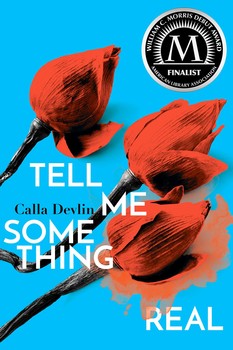
Vanessa Babcock, the protagonist of Calla Devlin’s debut, Tell Me Something Real, is sixteen. She lives with her parents, her older sister, Adrienne, andtell-me-something-real-9781481461160_lg her younger sister, Marie, in San Diego. Their mother, Iris, has leukemia, and Vanessa and her sisters often accompany her to a clinic in Mexico where she is treated with the controversial drug, Laetrile.
…the FDA’s banned Laetrile in the States, [and] a lot of people are coming to Mexico to treat their cancer. Most aren’t as lucky as we are, living in San Diego so close to the border.

Each of the girls have their own quirks. Adrienne is prone to swearing like a sailor. Marie is fascinated with the Catholic saints. Vanessa dreams of attending music school. Their father, an architect, works too much, leaving the care of Iris to his daughters, care that is taking its toll.

On one trip to the clinic Vanessa meets Caleb, a boy just a little older than she is who is also taking Laetrile. When Iris suggests that they open their home to Caleb and his mother, Barb, in an effort to make it easier for Caleb to receive his treatments, it seems like a win-win. Barb cooks real meals, and her sunny disposition improves life for everyone. And then there’s Caleb.

He looks healthy, sunburned, and rosy cheeked like me. It isn’t until he steps through the entryway – away from the protection of the flowers – that I recognize he is one of them.

Caleb becomes Vanessa’s touchstone, until one day he tells Vanessa that he and his mother are going home. Something isn’t right in the Babcock home, but he is reluctant to say just what that something is.

I have mixed feelings about Tell Me Something Real. There’s no arguing that Devlin is a talented writer, even though I didn’t feel like this debut went anyplace particularly special. Vanessa’s first person narrative is compelling enough, but her sisters seem more like a collection of quirky attributes than flesh and blood people. The plot does take an unusual turn, but even that felt somehow contrived.

What I wanted, I guess, was an emotional centre and despite the (melo)drama, Tell Me Something Real just didn’t have a beating heart. I wouldn’t discourage people from reading it, for sure, but it was just only so-so for me.

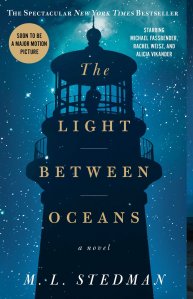
The Light Between Oceans – M.L. Stedman

lightbetweenI feel heartless for saying it – but I didn’t particularly like M.L. Stedman’s first novel The Light Between Oceans. I’ve had the book for a while, but it was last month’s book club pick, so I finally had occasion to read it. [insert long-suffering sigh]
Tom Sherbourne is a quiet man, intent on living a quiet life after having survived WW1. He’s returned to Australia and is about to take up his new post as lighthouse keeper on Janus Rock, an island off the coast of Partaguese on Australia’s western coast.

Teetering on the edge of the continental shelf, Janus was not a popular posting. Though its Grade One hardship rating meant a slightly higher salary, the old hands said it wasn’t worth the money, which was meager all the same.

Tom likes the idea of isolation thinking “If only he can get far enough away – from people, from memory – time will do its job.” It’s the horrors of war, he’s escaping, of course. But also his own childhood: a dead mother, an estranged father, a cold brother.

Just before Tom is about to leave for Janus he meets pretty, young Isabel Graysmark. Eventually the two marry and Isabel moves out to Janus. With a boat coming with supplies only about every six months, the newlyweds are certainly isolated, but they are happy.

Things start to get grim though, as Isabel suffers a series of miscarriages and then, shortly after her third, a small craft drifts into shore and in the boat a dead man and an infant. Isabel takes this as a sign from God, but Tom feels that they need to do the right thing, signal the mainland and report the incident. The decision the couple makes carries them through the rest of the novel.

So what’s not to like, you ask?

Ahhh….the melodrama. There’s boatloads of that. As Tom and Isabel wrestle with the moral, ethical and emotional questions posed by the foundling, their marriage suffers and they suffer personally, too. The constant negotiating got a little on my nerves, I have to say.

But there is another side to the story and that side belongs to the child’s birth parents. The introduction of these new characters is meant to up the emotional ante, and while it did for some of the ladies in my book club, I just felt like we were meant to wallow along with these suffering people and I just couldn’t muster any real feelings. Yes, I felt sympathy. I am a parent and I can only imagine how difficult the whole thing must have been. But to a certain degree I could see the clunky machinations of trying to fit all the pieces together and the swelling, heartfelt conclusion just left me feeling manipulated.

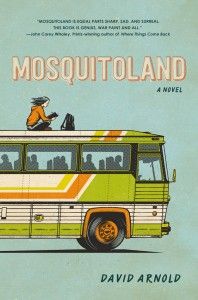
Mosquitoland – David Arnold

Mary Iris Malone, Mim for short, is not okay. Life has thrown her some curve-balls of mosquitolandlate: her parents’ divorce; her father’s quicky marriage to Kathy; their subsequent move from Ashland, Ohio to Jackson, Mississippi. When Mim overhears her father and stepmother talking to the principal, she’s convinced that her biological mother is sick and makes the decision to hop a Greyhound and travel the 947 miles back to Ohio to see her.

This is the premise of David Arnold’s debut novel Mosquitoland , a book which garnered massive praise and stellar reviews when it was published in 2015. I have to say, it’s worthy of all the fuss.

Mim’s journey is both literal, and she meets all-sorts on the bus and beyond, and figurative; this is a journey of self-discovery only a quirky, intelligent and empathetic sixteen-year-old could take.  Mim reveals herself in journal entries addressed to Isabel, and to various passengers, including Arlene, the old lady who sits next to her on the bus. Arlene turns out to be just what Mim needs because “it’s nice to sit that close to someone and not feel the incessant need to talk.”

Then there’s Walt, the boy Mim meets when she ends up getting off the bus. Walt is slightly left of center. He lives in a tent in the woods. “What are you doing?” He asks her  when he finds her asleep under an overpass. “…as a part of big things?”

Walt is a completely endearing character and Mim is “100 percent intrigued” when he says “Do you like shiny things? I have lots of shiny things there. And a pool…You’re a pretty dirty person right now. You could use a pool. Also, there’s ham.”

And then there’s Beck. Mim first notices him on the bus and then in a weird twist of fate, she meets him again at the police station (long story).

He’s older than me, probably early twenties, so it’s not completely out of the question – us getting married and traveling the world over, I mean. Right now, a five-year difference might seem like a lot, but once he’s fifty-four and I’m forty-nine, well shoot, that’s nothing.

There’s a quality about him, something like a movie star but not quite. Like he  could be Hollywood if it weren’t for his humanitarian efforts, or his volunteer work, or his clean conscience, no doubt filled to the brim with truth, integrity, and a heart for the homeless.

There is nothing I didn’t love about Mim or her journey. There is nothing I didn’t love about the other characters she meets – except for Poncho Man. (Obviously.) Mosquitoland has it all: the absurd, the laughs and the feels. It is a beautifully written book about growing up, facing your fears, what family means (both the family you are born with and the family you make) and why it is okay to admit that you are not okay.

Mad love for this book, so of course it is highly recommended.


The Marrow Thieves – Cherie Dimaline

marrowGah! This book, you guys.

Francis, though everyone calls him Frenchie, is on the run from the “recruiters”.  Pretty much every Indigenous person is because their bone marrow holds the key to dreaming, which is something white folks no longer have the ability to do.

“Dreams get caught in the webs woven in your bones. That’s where they live, in that marrow there.”

“You are born with them. Your DNA weaves them into the marrow like spinners….That’s where they pluck them from.”

It’s sometime in the not too distant future and we’ve pretty much wrecked the Earth. Because of course we have. When Cherie Dimaline’s YA novel The Marrow Thieves opens, Frenchie is holed up in a tree house with his older brother, Mitch. But then the recruiters show up, and the boys are separated, and Frenchie finds himself on the run once more.

The characters in The Marrow Thieves are all too aware of their rocky history with the Canadian government, and sharing those stories is part of what keeps them focused on getting to safety, which in this case is north where they hope they will find fresh water and clean air and freedom.  So north is the direction Frenchie heads and it isn’t long before he meets a group of travelers. Frenchie joins this ad hoc family and his adventure begins.

The dystopian nature of this novel is really only the story’s framework. It’s enough to know that these people are considered ‘other’ and useful only for what they can provide to the government. Their current plight mirrors the whole residential school debacle, a part of my country’s history, I am ashamed to admit, I was grossly ignorant of until recently.  Those places were less about assimilation (and even that is abhorrent)  and more about annihilation.

The real story, the heartbeat of Dimaline’s novel, is the characters and their stories – both individually (which they tell in their own ‘Coming-To’ stories) and collectively. Getting to know these people felt like a privilege; I fell in love with them and the way they looked out for each other. I experienced a real fear for their safety and on the few occasions they were rewarded with something good, I felt that, too.

I will not forget these people, their connection to the Earth and each other, for a long time. The Marrow Thieves should be required reading for all Canadians…and, trust me, once you start reading, you won’t want to put it down anyway.

Highly recommended.


Savage Bonds – Ana Medeiros

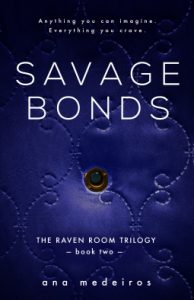
Savage-Bonds-cover-194x300Canadian author Ana Medeiros’ The Raven Room Trilogy follows the sexcapades of Dr. Julian Reeve, a child psychologist, and journalism student Meredith Dalton. Sometimes you can jump into a series without having read the first book, but I really felt like I was at a severe disadvantage reading book two in Medeiros’ trilogy. Savage Bonds picks up where The Raven Room leaves off, but for a newbie reader, I literally had no sweet clue what was going on and I never felt as though I was sufficiently caught up.

This is what I do know:

Julian Reeves is addicted to the darker side of sex which, as a card-carrying member of The Raven Club, he has access to. He’s also addicted to drugs. And he has a troubled and complicated past which is somehow connected to Tatiana and Alana. And when Savage Bonds opens he is being questioned by the cops (one of whom just happens to be Meredith’s step-mother, Pam) because Alana is dead and Tatiana is missing.

When another woman with connections to The Raven Room (and Julian) turns up dead, Meredith decides that she needs to investigate. That’s because Julian is Meredith’s lover (or was her lover; they don’t get it on in this book although Meredith gets around and shares Julian’s predilection for rough sex, or at least sex of the non-vanilla variety.)

Many of these relationships seem to have been established in the first book – so it’s really difficult for me to give this book a fair shake considering I spent  lot of time just trying to keep these people straight; I was definitely missing backstory. Although, ultimately, I wonder if backstory would have helped me enjoy this story any more.

I have read a lot of erotica. And a fair amount of BDSM-flavoured erotica…and Savage Bonds didn’t really up the ante. I mean if  The Raven Room is supposed to be this super-sekrit underground club, shouldn’t it be special? A little bloodplay and anonymous blow jobs don’t really scream exclusivity to me. Worse, without the benefit of what came before I just didn’t care about any of these players and all their interactions with each other seemed shrill or forced. Am I supposed to be rooting for Julian because of his troubled past? Am I supposed to be shipping Julian and Meredith?

From what I could tell on the Internet, readers seemed to really enjoy The Raven Room and were quite anxious to read Savage Bonds. A few of them, though, had some of the same issues with this book that I did…and they were invested going in.

So – maybe start with The Raven Room and see how you feel. I won’t be backtracking because, honestly, the whole thing was just meh for me.

Thanks to TLC for the opportunity to review this book.