Rape: A Love Story – Joyce Carol Oates

Joyce Carol Oates wastes no time cutting to the chase in her novella, Rape: A Love Story.

After she was gang – raped, kicked and beaten and left to die on the floor of the filthy boathouse at Rocky Point Park. After she was dragged into the boathouse by the five drunken guys – unless there were six, or seven – and her twelve-year-old daughter with her screaming Let us go! Don’t hurt us! Please don’t hurt us!

Teena  Maguire and her 12-year-old daughter, Bethie, leave a July 4th party after midnight and cut through Rocky Point Park.  They take a short-cut through the woods and encounter the group of drunken men, many of whom are known to Teena from around her Niagara Falls neighbourhood.

Although Bethie is beaten, she manages to escape and hide under a boat. She listens as her mother is raped and savagely beaten and left for dead. The reader is not spared from the horror of this crime, but Oates — skillful writer that she is — never crosses the line into gratuitous.

Bethie manages to attract the attention of a police officer and it happens to be Officer Dromoor, a man who knows Teena because of an encounter they’d had one night at a local bar. Dromoor is a good man– a married father-to-be with a finely attuned sense of justice.

Teena survives the attack, but her life is forever altered. Rape: A Love Story sets about examining the ways in which this horrific incident changes her and Bethie and Dromoor and even three of the perpetrators and their families. It asks questions like was Teena dressed inappropriately and thus ‘asking for it’? Oates doesn’t offer any answers, though.

I have a love/hate relationship with Oates. There’s no denying her considerable talent, but sometimes I find her hard work. It’s not style over substance — although, no question she has some stylistic tics which take some getting used to. In Rape, she employs second person narrative (always a risky choice, imho, although clearly well-handled here), choppy sentences, and a narrative that jumps around. But, let’s face it, she’s Joyce Carol Oates.

I always want to like her more than I actually do.
The House at Riverton – Kate Morton

I’m sure many of you have already read Kate Morton’s debut novel, The House at Riverton, but I only just finished it yesterday afternoon. If you haven’t already found a book to while away the dog day’s of summer, might I suggest you run to your bookstore immediately and purchase this one. Whew. What a read!

Grace Bradley is fourteen years old when she comes to Riverton House to work. Her mother had also worked at the sprawling Essex manor house, but had to leave under mysterious circumstances.  It is through Grace that we learn of Riverton and its inhabitants.

I have been thinking about the day I started at Riverton. I can see it clearly. The intervening years concertina and it is June 1914. I am fourteen again: naive, gauche. terrified, following Nancy up flight after flight of scrubbed elm stairs. Her skirt swishes efficiently with every step, each swish an indictment of my own inexperience.

The story, though, starts in the present. Grace is an old woman now. Her husband is dead; her daughter is in her sixties and her beloved grandson, Marcus, has been missing for several weeks. When a filmmaker from America writes to ask if Grace would consult on a film she’s making about a tragedy at Riverton, Grace is pulled back into her memories.

Fans of Downton Abbey will be able to picture Grace’s life perfectly: the servants downstairs, their dedication to service, their hierarchy. But Grace is more concerned with the Hartford siblings: David, Hannah and Emmeline. Over the years she becomes particularly close to Hannah and  when Hannah marries, she is whisked off to London to live.

The House at Riverton is about an aristocratic family in decline. Set between the two great wars, characters go off to their deaths, or come home damaged. The Roaring Twenties usher in an era of shifting sensibilities. Morton does a spectacular job of evoking a time and place. It’s easy to sympathize with the female characters who yearn for  a different life and although criticism has been leveled at Grace for choosing service over personal happiness, I believe I understand her choice.

Because Grace is looking back, the reader knows early on that some tragedy has befallen the Hartford family. That alone would be enough to turn the pages. But the novel takes its time arriving at its conclusion. Perhaps some readers found the novel slow and the prose over-written; I know it took me a while to settle into the story.

However, when I left Grace, 468 pages later, it was with great sadness because even though this is the story of Riverton, Grace’s own story is inextricably linked.

So Much Pretty – Cara Hoffman

I rarely pick up a book randomly anymore, but So Much Pretty was calling my name. Not only was it calling my name, it actually jumped the pile instead of languishing on my bookshelf for months and months. Still, despite the endless glowing praise I had a hard time settling into the book. Perhaps it was the time of year I started to read it — late June, when school is busy. I took the book with me on a family holiday and while the kids were swimming, I sat on a beautiful screened porch and lost myself in Cara Hoffman’s small-town drama.

Told from multiple perspectives, So Much Pretty flips over the small town of Haeden, NY and exposes its creepy underbelly. When the body of a missing teenager, Wendy White, is discovered in Tern Woods, it kick starts an examination of several lives particularly Flynn, the brittle newspaper reporter and  Claire and Gene and their daughter, Alice, transplants from NYC. The book also includes police reports and interviews. In this way, the book is difficult to navigate at first. It really deserves to be read in one sitting because once I made time for it, it really wouldn’t let me go.

Although there is a horrific crime at the center of this book, the real crime has more to do with the ways in which people are often complicit.  Parents misreading their children; neighbours turning away from each other; individuals looking for the spotlight. The story unfolds at a leisurely pace, making sure the reader understands all the players and their connections, but I feel like I missed a lot of clues — no, not even clues — signs that things were not quite right in Haeden because my mind was occupied trying to figure out how Alice was connected to Wendy. I got it horribly wrong, btw.

There are questions to be answered here, but Hoffman’s  feelings are opaque. She masterfully navigates all the pieces, but I never got the preachy feeling I often get with, say, a Jodi Picoult novel. The bulk of what happens to Wendy is left to the reader’s imagination, and her fate is far worse because of it. This would be a fantastic book club pick because of the inherent opportunities  for discussion. So, while it took me a bit to get into, I ended up loving So Much Pretty. Its copious praise is well-deserved.

The Sense of an Ending – Julian Barnes

I didn’t get a chance to write my thoughts about Julian Barnes’ Booker Prize winning novella, The Sense of an Ending, back when I actually finished it – which was in June.  The book deserves a much more thoughtful review than I am likely to give it here.

Narrated by Tony Webster, a divorced father with a grown daughter, The Sense of an Ending is a meditation on youth and the ways in which our memories are often skewed by our desire to remember ourselves differently from how we actually were.

“We live in time – it holds us and moulds us – but I’ve never felt I understood it very well,” Tony says. He also tells the reader that he is “not very interested in his schooldays, and don’t feel any nostalgia for them. But school is where it all began…”

It is at school that Tony and his friends meet Adrian Finn, “a tall, shy boy who initially kept his eyes down and his mind to himself.” Adrian is bright, clearly smarter than Tony and his friends – or perhaps just more thoughtful, more willing to question the subjects (particularly history) that he is being taught.

History is the certainty produced at the point where the imperfections of memory meet the inadequacies of documentation.

At the end of school, the four boys go their separate ways.  Tony  meets a girl, Veronica Ford, and it is this relationship which sets  the story in motion. Things with Veronica end badly and when she ends up dating Adrian, Tony is hurt and angry.

How this threesome plays out makes up the bulk of the story, but it isn’t a traditional love triangle. This is really a story about who we were, who we become and how we alter our memories to accommodate our own version of ourselves.

The Sense of an Ending is one of those books which would certainly benefit from repeat readings – and trust me, it wouldn’t be a hardship. Barnes’ prose is precise and devastating. The book reads like a mystery and in a way it is – we are often mysteries to ourselves and it is only when our memories are challenged that we see the person we have been.

Nothing But Ghosts – Beth Kephart

For anyone who has lost their mother, Beth Kephart’s YA novel, Nothing But Ghosts is a gift. In it, 16 year-old Katie navigates the lonely and traumatic days after her mother dies of cancer by solving the mystery of what happened to Miss Martine, the shut-in who lives in the estate down the road. When Katie is hired to help dig a spot for a new gazebo at the estate, the experience draws her out in the present – even as she investigates the past.

Kephart’s novel is beautifully written and Katie is a thoughtful and likeable character. Kephart expertly weaves a story that casts a light on several characters who have been broken by  events in the past. Katie’s own story, and that of her parents, is told through her memories of a family trip to Spain. In remembering she thinks:

She’d kept her secret the whole trip long. She stood in the strange, chill mist, alone, alive, but knowing what would come. History is never absolute truth. It isn’t just the thing that was. It’s the thing that could have been.

Her father, a brilliant art restorer, is drowning in his own grief. The librarian who helps Katie dig into the history of Miss Martine’s life has had her own heartache. Even Sammy, the little boy who lives across the street has had his share of disappointments.

Nothing But Ghosts is a story about loss, but it is also a story about love and rebirth and hope. Katie must travel the road to acceptance on her own, but she does it with a grace that belies her age.

I very much enjoyed this book.

Things You Either Hate or Love – Brigid Lowry

Georgia is the 15-year-old narrator of New Zealand  novelist Brigid Lowry’s YA book, Things You Either Hate or Love. I was smitten with her almost as soon as she opened her mouth to announce:

I like to think of myself as a brilliant creative person, but sometimes I just feel like a sad lonely girl with a big bum.

Georgia is madly in love with Jakob, the lead singer of a funk band called Natural Affinity. She spends long hours talking to his poster – free therapy – and plotting ways to earn money so she can fly off to Brisbane to see his band in concert.

In an effort to make some money, Georgia tries (and fails) at babysitting, working in a video store and then a bakery, before finally landing as a cashier at the local supermarket. When she isn’t moaning about regular teenage stuff (her mother, school, friends) she’s trying to navigate the fraught path from childhood to adulthood.

Georgia is charming and funny, but lacks any real confidence. She is a character that would definitely speak to a lot of girls. She certainly spoke to my former self. When she ends up working with Hunter, the gorgeous boy who used to come into the bakery, she can’t help but develop a bit of a crush. But she’s sure Hunter could never be interested in a girl like her.

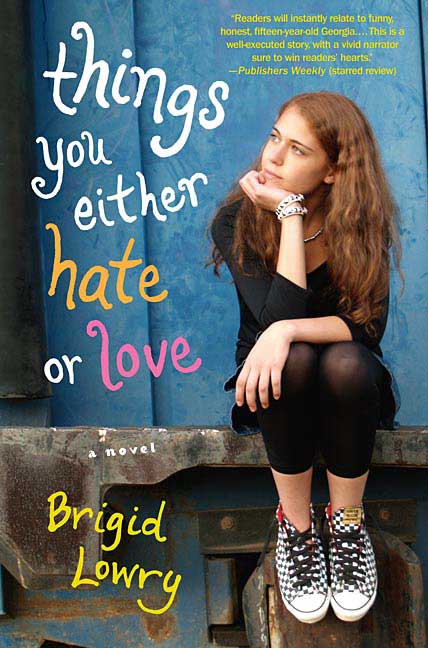
If I have any complaints about the book it’s that the girl on the cover is a misrepresentation of the Georgia in the book  – although I have no doubt that Georgia is nowhere near as plain as she thinks she is. Also, Georgia contracts glandular fever and loses a lot of weight…just in time for the book’s happy ending.

That said, I really enjoyed Things You Either Hate or Love. Georgia is lovely and her trials are relate-able without being overwrought. It is a skilled writer who can make a book without an overabundance of teenage drama compelling and entertaining.

Monsters of Men – Patrick Ness

My love affair with Patrick Ness’s Chaos Walking trilogy began with The Knife of Never Letting Go. The next book, The Ask and the Answer was also fabulous. Last night I finished the third book, Monsters of Men. I am not ashamed to say that I cried.

Monsters of Men begins on the eve of war. Todd and the Mayor, and  Viola and Mistress Coyle are not only at a stand-off with each other, The Spackle (the indigenous people of New World) have risen up to annihilate them. War proves to be frightening and messy and dangerous.

The flames spill out from the top of the horned creacher and cut thru the middle of soldiers and men are screaming  and burning and screaming and burning and soldiers are turning back and running and the line is breaking and Angharrad is bucking and bleeding and squealing and we’re slammed by a wave of men retreating and she bucks up again and–

The lines between hero and villain, good and evil, are  blurred in Monsters of Men. I found my feelings about the Mayor constantly changing. Is he a decent man caught up in extraordinary times? Is he a master manipulator? Is he a monster? Mistress Coyle didn’t fair much better in my estimation. Viola and Todd ask the same questions about the adults nearest them and as they aren’t physically together for much of this book, they also ask it of each other. How have circumstances changed them?

There’s also a new point of view to consider in Monsters of Men: the Spackle. For the first time we get to hear their noise. Truthfully, I found some of this bothersome because of the names they ascribed to things: the Burden, the Clearing, the Knife, the Sky, the Source. I was caught up in the narrative and it slowed me down trying to figure out who or what  they were talking about. Nevertheless, the Spackle are no longer a faceless enemy — if they ever were the enemy at all.

There are big questions to be considered in this novel, in the series as a whole. Despite the fact that Chaos Walking is marketed as a Young Adult series, Ness doesn’t shy away from asking them. Why do we fight? What does it mean to be human? I even think there is something in the books about this information age — the constant bombardment of data and noise we endure every day. With no quiet space to think, don’t we all have the potential to be driven a little mad? Alternatively, can’t we use this information to better understand and empathize with each other?

As the Mayor says to Todd near the end of the book, “War makes monsters of me, you once reminded me.” It is messy business, to be sure. But there is great humanity in these books. And Todd and Viola, as characters, will be with me for a long, long time.

A Must Read series!

The Possibility of You – Pamela Redmond

Pamela Redmond admits in the  introduction to her novel The Possibility of You that she “had bookclubs in mind” when she wrote the book. And that’s exactly how this novel reads – like a book written to get women talking.

The novel tells the story of three women: Bridget, Billie and Cait and spans several decades. Cait’s present-day  story begins when she falls into bed with another journalist while they are on assignment to cover the story of a missing boy. Later, Cait discovers that she is pregnant and she decides she needs to locate her birth mother.

Bille’s story takes place in the 1970s. Orphaned after the death of her drug-addicted father, she heads to New York City with her best friend, Jupe. There she meets, for the first time, her eccentric and wealthy grandmother, Maude.

Going back even further is the story of Bridget, an Irish immigrant who works in Maude’s house caring for Maude’s young son, Floyd.

That these three women’s stories should be intertwined will come as no surprise to the reader. There isn’t actually anything surprising about that – or even all that original about their stories at all, actually. And I understand that that makes me sound sort of heartless. I think Redmond’s intent was that women of all stripes should find at least one of these women, and their stories of birth and death, to be compelling and relateable. The idea that women make sacrifices and mistakes isn’t riveting in and of itself, unless the characters are somehow sympathetic.

Maude was the most modern of the characters, a famous singer in her day, she married a much older man, had affairs which she openly bragged about and sent her maid, Bridget, to get birth control so she could sleep with her boyfriend without the complications of getting pregnant or having to get married. While she seems thoroughly forward thinking in 1915, at the end of the day, she is reprehensible and selfish.

The Possibility of You seemed like it should have added up to a lot more than the sum of its parts, but for me it just seemed like a cobbled-together story with all the talking points necessary for a good book club evening over a glass of wine.

My book club discussed the book last night and none of us were all that enamoured with it. In fact once we dispensed with the book’s central idea – how do women cope with giving up a child – we veered into a much more lively discussion of local politics. Despite the book’s positive reviews, we just weren’t moved by the novel or its characters.

Fifty Shades of Grey – E L James

E L James’s novel Fifty Shades of Grey has caused something of a stir in the literary world. First published as fanfiction called “Master of the Universe” under James’s pseudonym Snowqueen’s Icedragon (and, really, fanfiction writers need to give their pen names a lot more consideration before they choose them!), the original story was set in Stephenie Meyer’s Twilight universe. Yeah – there’s your first problem.

For those of you  unfamiliar with fanfiction, writers (of varying degrees of proficiency) pen stories based on characters and situations created by other writers.  Wikipedia has a competent explanation of its origins here. Really good fanfic writers can make their stories seem almost like canon. And really good fanfic is out there; but so is really, really bad fanfic. Back in the day I read (and wrote) a lot of it, so I can actually say this with some degree of authority.

Anyway, E L James publishes this wicked long Twilight-based fic – which I suspect is long gone from places where it was originally posted…although fans of the series can still be found gushing about it online. Someone (many someones, probably) suggested that she change the names of the characters and publish it — which James did, in eBook format and print on demand in June 2011 using  The Writers’ Coffee Shop. Word of mouth (ahem) fanned the flames and the rights to the book were purchased by Vintage. Suddenly, everyone was talking about Fifty Shades of Grey and weighing in on its subject matter. I talked a little bit about that here.

If you are a fic reader, I suspect that you’ll find Fifty Shades of Grey relatively tame.  Seriously. I’ve never read Twilight fic, but I’ve read the first two and a half books (and could barely manage that) and I’ve seen the movies (I have a 14- year-old daughter, although her literary tastes are, thankfully, more advanced than Twilight). Despite the name changes, there’s enough of Bella/Edward in Anastasia/Christian that even a casual reader will recognize them. They are, at the very least, completely derivative characters: she the winsome, beautiful-but-doesn’t-know-it, feisty yet innocent virgin and he is the over-the-top rich, fantastically beautiful (and like Meyer’s Edward, the reader has to be reminded of his beauty virtually every time he appears) control freak with a sad/complicated — or, as Christian himself says “fifty shades of fucked up”– past.

Bella Ana does her roommate a favour by going to interview the reclusive Christian for the university paper. She  literally falls into his office — she’s kinda klutzy — and we are to believe that Christian is instantly smitten. He tries to stay away– unsuccessfully. But does he really like her, or does he just recognize in her a submissive personality?  Because one of Edward’s Christian’s dark secrets is that he likes to tie women up. And other stuff. Stuff that requires a contract and a safe word.

If you’ve read fanfic, you’ve read this scenario a bazillion times. If you’re going to pay for it, it wants to be good. So, is Fifty Shades of Grey good? For me, it was okay. The writing is okay. The sex is okay. The characters are okay. It didn’t particularly shock me, nor did it, you know, rev my engine.

Ana is prone to saying: Holy fuck! and Holy shit! and Holy crap! a whole lot. A whole lot! She also channels her inner goddess in what I suspect is her way of trying to decide whether or not the amazingly mind-blowing orgasms make up for the occasional spanking. Ana and Christian say, “Laters, baby” to each other.  It’s weird. Noticing this stuff is always a sign that I am not really invested in the story. Oh come on, who reads a book like this for the story anyway?

I suspect that lots of people will find Fifty Shades of Grey shocking. I suspect a lot of the soccer moms who were reading it were clutching their pearls as they perspired daintily.  But, truly, it’s pretty tame. If you want the really good stuff, you can read it online. For free.

The Heights – Brian James

Ask anyone, I am a sucker for stories about star-crossed lovers. I love angst with a capital A. So the premise of Brian James’s YA novel The Heights would seem like a perfect fit for me. I mean the tagline was “theirs was a love that would last forever.”

Sadly, for me, this book was a pale cousin to its predecessor, Wuthering Heights. James sets his novel in foggy San Francisco where Catherine Earnshaw and her older brother, Hindley, live with their widowed father. Henry lives there too. He’s the orphaned Mexican boy Catherine’s father scooped off the mean streets and raised as his own. Now, years later, Mr. Earnshaw is dead and Hindley, a big shot lawyer, has come home to make sure Henry doesn’t get anything he’s rightfully entitled to (as Mr. Earnshaw preferred Henry to Hindley – and no wonder, Hindley is a misogynistic asshat.)

Hindley is also intent on splitting up Catherine and Henry, siblings on the cusp of admitting that their feelings for each other might be just a teensy bit more complicated than they should be. Of course, they never get around to admitting their feelings to each other before Hindley throws his oar in and muddies the waters.

Told in alternating view points, we see Catherine mooning over Henry and Henry mooning over Catherine – but nothing much comes of it, especially once Hindley banishes Henry to the basement of their huge house in The Heights (a tony neighbourhood in San Francisco) and sends him to a rough school way across town where Henry is constantly in danger of being beat up. Make no mistake, he’s tough and can handle himself – and without Catherine’s calming influence, he’s more likely to swing than swoon.

James tries at Bronte’s themes: obsession, class, revenge – but the problem with The Heights, for me at least, is that the novel’s contemporary setting makes the characters seem sort of inert. I never wanted them to be together because neither of them seemed all that sympathetic. And yes, you could make the same case for Catherine and Heathcliff – but Bronte’s sweeping tale somehow elevates those characters to mythic, romantic heights in a way James never quite manages.

I will be happy to encourage my students to read The Heights, but even happier if they go on to read Wuthering Heights.