Reality Check – Peter Abrahams

realityI loved Peter Abraham’s novel End of Story. It was fast paced and well-written and had a right-out-of-left-field curve ball that was suspense-thriller awesome. His YA thriller Reality Check doesn’t have quite the same punch, but young readers, particularly boys, will likely find this story fast-moving and quite exciting.

Seventeen-year-old Cody has it pretty good. He’s captain of the football team and he’s dating Clea,  the prettiest (and smartest) girl at his Colorado high school. His life’s not perfect, though. His mom died of cancer and his father tends to drink a little too much. Then Clea’s father decides his daughter needs to go to boarding school in Vermont – separating the teenagers. Things go from bad to worse when Cody does some serious damage to his knee and Clea suddenly disappears. Cody does the only thing that makes sense: he quits school, hops in his car and drives to Vermont to join in the search.

That’s the basic premise of Reality Check.  It has the requisite twists and turns, the shady characters who aren’t quite what they seem and just enough character development to keep the average reader invested.

Cody is central to the story. The third person narrative is limited to his perspective and that’s a good thing because Cody is likable. He’s tenacious and fearless, too. Because he knows Clea intimately, he’s not willing to accept the party line – that she’d somehow fallen off a horse and had somehow gotten lost in the woods. He keeps digging, looking for clues and then answers.

I suspect that many teens won’t figure out the mystery too early and that they will root for Cody and Clea’s reunion as I did. There is some language in the book, so it’s perhaps not for younger teens, but it’s an enjoyable book for those who like fast-paced page-turners.

Chasing Boys – Karen Tayleur

Chasing Boys is the story of Ariel, El for short, who has moved from her swanky school and big house to a new school and an apartment with her older sister, Bella, and her mom. Dad – whereabouts unknown, but clearly he’s left a void in Ariel’s life which she is in desperate need of filling. So, there’s this boy. His name is Eric and he’s a star basketball player and practically the most perfect boy at school. Everyone has a crush on him, but he has a girlfriend. And not just any girlfriend, but the popular and pretty (and, as it turns out, decent and nice) Angelique.

So, is Karen Tayleur’s first YA novel anything more than your standard girl chases boy teen romance? Well, no and yes. For starters, El is a likeable character and the first person narration is swiftly paced and often quite funny. El is smart and attractive, but doesn’t really feel like she fits in anywhere other than with her two best friends, Desi and Margot. She’s also trying to work through abandonment issues and for that she meets with a therapist, Leonard, once a week. The thing is, she can’t actually talk to Leonard.  “If I was talking to Leonard,”  she muses, “which I am not, I would ask him a question.”

Eric isn’t the only boy orbiting El’s life. There’s also Dylan.

Dylan slumps in the seat and glances at me. I realize he’s the newest guy at school and I give him my catatonic stare – the one I use when I want the other person to look away. It’s usually pretty effective. He has a thin white scar, almost invisible, that travels from his bottom lip and disappears under his chin, and just for a moment I wonder how it got there. His lips curl into a sneer and I look straight ahead.

El tries to balance school and home and her crush on Eric and Dylan’s passive-aggressive interference in her life with varying degrees of success.  For the teen reader who is looking for a book that is entertaining and not particularly challenging, Chasing Boys will likely fit the bill.

Nevermore – @Kelly_Creagh

I’ve been trying to finish Kelly Creagh’s debut YA novel Nevermore for the past few nights. Kids in bed, kitchen clean,  email answered. Check, check, check. With my cat Lily curled beside me, I finally settle down to the book and read until my eyes are burning.  I actually finished it during my 4th period Writing class today. (We read for the first 30 minutes on Tues and Thurs!) I have SO much love for this book.

Isobel Lanley is a popular sixteen-year-old cheerleader. In many ways she is just what you’d imagine her to be; she’s pretty, dates a hunky football player and sits with the ‘in’ crowd at lunch. But Isobel’s world takes a flying leap from normal when she is paired  with Varen Nethers to do an English project.

He sat in the back row against the far corner, slumped in his seat and staring straight ahead through shreds of inky locks, his thin wrists lined in black leather bands specked with hostile silver studs.

Isobel can’t believe her crappy luck. Not only are they going to have to work together, but they are going to be researching Edgar Allan Poe. And Varen is clearly hostile towards her. A simple (although slightly unconventional) phone number exchange sets off a chain of events that isolates Isobel in ways she couldn’t ever imagine. And then things start to get really weird.

Kelly Creagh’s book is so much fun, I couldn’t wait to read it every day. Voya called it an “English teacher’s jewel box,” and it’s easy to see why. Although I am not an expert on Edgar Allan Poe (and I don’t mean to imply that you have to be in order to enjoy this book), I did catch many of the allusions. Nevermore is a well-written, intelligent, puzzle of a book that will appeal to any reader – young or old – who likes a novel with a little meat on its bones.

Although it’s likely that Nevermore will get stuck with the ‘paranormal romance’ tag, I think that label actually does the book a disservice. Yes, there is romance – but you wait for hundreds of pages before Isobel and Varen even kiss. Ratchet up the angst, why don’t you. (And, Ms. Creagh, was that some Buffy speak I caught in there?) There were moments in this book when I was seriously creeped out. One menacing character, Pinfeathers, is super-creepy. Reynolds is another character that is difficult to figure out. Is he good? Is he deceitful?

And, best of all, Isobel is a terrific character. She’s smart and brave and resourceful. And I can’t wait to see what happens to her  in Nevermore‘s sequel, Enshadowed.

I am really looking forward to passing this one on to students in my class.


The Year of Magical Thinking – Joan Didion

Joan Didion’s well-regarded memoir The Year of Magical Thinking recalls the year following the death of her husband and writing partner John Gregory Dunne. Didion and Dunne were married for 40 years and were literary royalty. They counted many other famous writers and celebrities among their friends. It would seem that theirs was a charmed life. John Gregory’s famous brother, Dominick, writes about his brother’s death here.

“Life changes fast. Life changes in an instant,” Didion writes. And while we certainly all know this is true, Didion experiences it first hand at a particularly trying point in her life.

She and her husband have just returned from the hospital where their only daughter Quintana is recovering from a particularly virulent flu. They’ve just sat down to dinner  when Didion looks up from her salad and sees him slumped over the table.

I have no idea what subject we were on, the Scotch or World War One, at the instant he stopped talking.

I only remember looking up. His left hand was raised and he was slumped motionless. At first I thought he was making a failed joke, an attempt to make the difficulty of the day seem manageable.

I remember saying Don’t do that.

As it turns out, Dunne had a bad heart and was living on borrowed time. None of that lessens the shock of his sudden passing for Didion. Although her prodigious skill with the written word is apparent in this memoir, her grief over the loss of her husband is as raw for her as for any of us. Death is the great equalizer. Didion is forced to come to terms with Dunne’s death even as she continues to deal with her daughter’s illness. (In a sad post script, Quintana died just a couple years later from the complications of her illness. There has also been some speculation that Quintanta died, ultimately, of acute pancreatitis caused by alcoholism. She was just 39.)

In the early days after Dunne’s death, Didion tries to keep it together. She keeps expecting Dunne to walk through the door; she continues to store information to share with her husband at a later date. She says: “Of course I knew John was dead…Yet I was myself in no way prepared to accept this news as final: there was a level on which I believed that what had happened remained reversible. That was why I needed to be alone…I needed to be alone so he could come back.”

The Year of Magical Thinking is not a romantic memoir. Didion, despite her sorrow, turns a clear, at times even dispassionate, eye on the nature of grief. She’s been trained to do that, of course. Does it lessen the impact of the story she has to tell? Not really. But was I as emotionally engaged as I thought I would be. Not really.


The Day I Killed James – Catherine Ryan Hyde

People die of love.

Eighteen-year-old Theresa believes this to be true, or at least she claims she does in Catherine Ryan Hyde’s YA novel, The Day I Killed James. We meet her at the beginning of her therapy sessions with Dr. Grey. She doesn’t like him very much.

I’ve thought about dumping him and getting  somebody else, but that would be the easy way out, which I’m not entirely sure I deserve.

So why is Theresa in therapy? Well, James, the buff boy next door – who has been trying to get her attention forever – ends up dead after she takes him to an end-of-year party in an effort to make her boyfriend, Randy, jealous. It isn’t until weeks after his death that Theresa can admit to perhaps liking him…just a little bit.

If I had felt it any more strongly, I might have cracked like a china cup. It was like a pressure inside me, like an old steam boiler, and I just lay there hoping it would hold. Hoping I would hold.

Theresa isn’t a horrible person and taking James to the party to make Randy jealous isn’t the worst thing she could have done, but the aftermath of that event sends Theresa off on a journey of self discovery that is actually long overdue.  Theresa has some things to work out and while James might be the catalyst, some of her problems pre-date him.

I didn’t like the beginning of The Day I Killed James very much. The story is told mostly as a series of journal entries prescribed by Dr. Grey. Things improve a little bit in the novel’s second part. Theresa is now Annie and she’s left home not so much to sort out her life, but to escape it. She soon discovers that it’s almost impossible to avoid all human contact. Her sudden ‘relationship’ with a precocious eleven-year-old girl named Cathy ups the ante a little – but also seems slightly forced.

However, when all is said and done, I think teens will quite like the story of what it means to love and how important it is to take care of each others’  heart.

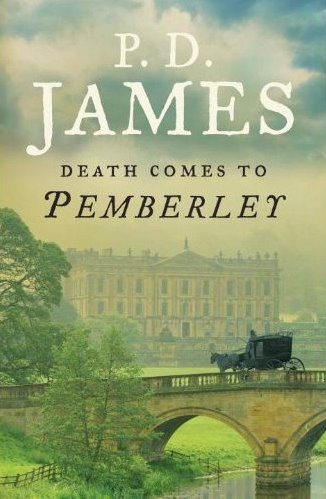
Death Comes to Pemberley – P.D. James

Death Comes to Pemberley by famous British crime novelist P.D. James is fan fiction. That’s right: P.D. James borrowed characters and settings made famous by Jane Austen and wrote them into a new story which takes place six years after Elizabeth and Darcy marry. That’s essentially what fan fiction is; writers (albeit, generally amateur writers) find new ways to breathe life into familiar characters. Because James is a crime writer, she wrote a mystery (although a relatively tame one, even by my standards.)

Fan fiction is (according to Wikipedia) “a broadly-defined term for fan labor  regarding stories about characters or settings written by fans of the original work, rather than by the original creator. Works of fan fiction are rarely commissioned or authorized by the original work’s owner, creator, or publisher; also, they are almost never professionally published.”  I would have agreed with that definition except for all the fan fiction that has found its way into bookstores recently (Fifty Shades of Grey, for example, literally started its life as Twilight fanfiction; Pride and Prejudice and Zombies and Android Kareninaare two examples from Quirk Classics). Perhaps I am misinterpreting the definition of fan fiction, but to me when you borrow another writer’s characters and just give them a new plot — that’s fan fiction. Yes, even if it’s a parody. (Fan fiction writers write parodies all the time.)

But, hey, I’m a huge fan of fan fiction and so pointing it out isn’t meant as a criticism. Even Pulitzer Prize winning author, Michael Chabon understands the merits of derivative fiction. In his book of essays Maps and Legends: Reading and Writing Along the Borderlands he says:

 …all literature, highbrow or low, from the Aeineid onward, is fan fiction. That is why Harold Bloom’s  notion of the anxiety of influence has always rung so hollow to me. Through parody and pastiche, allusion and homage, retelling and reimagining the stories that were told before us and that we have come of age loving – amateurs – we proceed, seeking out the blank places in the map that our favorite writers, in their greatness and negligence, have left for us, hoping to pass on to our own readers – should we be lucky enough to find any – some of the pleasure that we ourselves have taken  in the stuff we love to get in on the game. All novels are sequels; influence is bliss.

No matter the source material, all literature, ultimately, has to stand on its own two feet. Readers needn’t be a fan of Austen — or even know who she is — to read Death Comes to Pemberley because in the opening chapter James fills us in on the backstory. Once readers have the lay of the land, they can jump into the mystery which for me was only so-so. I like Austen fine, although I wouldn’t say I am a huge fan. I love a good mystery. I don’t have any problem with dense, old-fashioned prose (really good fan fiction mimics the original author’s style and recreates characters that are recognizable to readers of the original work). But Death Comes to Pemberley was a big YAWN. Seriously: nothing happens.

Elizabeth and Darcy are madly in love — although they spend virtually no time together. Elizabeth is preparing for Pemberley’s yearly Lady Anne’s ball when her younger sister, Lydia, arrives screaming that her husband George Wickham has been murdered in Pemberley Wood. Wickham is a bad apple and has been a constant source of embarrassment for Darcy. When it turns out it’s not Wickham who is dead but another male who was traveling with him, Darcy isn’t sure Wickham actually committed the crime.

It’s not much to make a mystery meal out of, but James fills page after page with lengthy descriptions of relationships and manners and protocol and the moon on the woods and it was so S-L-O-W. If it hadn’t been our first book club pick (and by a new member, no less) I would have abandoned it, for sure. I kept plodding along, but for me, the original charm of the Elizabeth/Darcy relationship was absent and the rest of the book just wasn’t my cup of tea.

Reading, Writing and Leaving Home – Lynn Freed

Although I have never read any of Lynn Freed’s fiction, I was interested in her collection of essays, Reading, Writing and Leaving Home: Life on the Page because as a high school writing teacher I am always looking for writing advice to share with my students. You know, something like King’s “If you don’t time to read, you don’t have the time or tools to write.” While there aren’t necessarily any pithy quotes in this collection, it was an interesting book because Freed herself has had an interesting life.

Born and raised in South Africa, Freed’s parents were actors, and she grew up – the youngest of three girls – surrounded by books.

Most of the books in the house were kept in my parent’s study, a cosy room with leather chairs, teak bookshelves, leaded windows, and piles of scripts stacked around on the floor. It was there that my mother was to be found during the day, either timing scripts or drilling a new actor. And there that I was allowed to read whatever was available – mostly plays, but also opera libretti, the odd history, a few biographies, a selection of popular novels – as long as I didn’t interrupt.

Her writing career began when she wrote “ninety tedious pages” for an AFS scholarship application. The following year, when she actually landed in New York after having won the scholarship, she was told that the organization had put a two-page limit on the essay because of her entry. That story and those characters continued to swirl around in Freed’s head and eventually found their way into her novel. But none of it was easy.

The world I was writing about was the same world I had tackled for AFS, but now  could life it from the restraints of myth and detail and report and do with it anything I pleased. Or, at least, so I thought.

Freed writes about writing as I believe writing is: hard freakin’ work. Frustrating. Painstaking. A labour of love, sure, but it’ll kick your sorry ass.

…I would suggest that one should never overlook two essential elements in the development of the writer: long years of practice and a ruthless determination to succeed. Writers come to their material in different ways, but come they must if they are to succeed.

Even though this sounds like advice, Leaving Home isn’t actually a how-to book. The book chronicles Freed’s journey from girlhood to adulthood and covers everything from her relationship with her sisters to a trip back to the house she’d once called home – and all if it is fodder for her writing. If, as she claims, she has chosen truth over safety in her writing – I suspect her novels would be worth a look. I certainly enjoyed this collection of essays.


Room – Emma Donoghue

Today I am five. I was four last night going to sleep in Wardrobe, but when I woke up in Bed in the dark I am changed to five abracadabra. Before that I was three, then two, then one, then zero. “Was I minus numbers?”

Jack is the narrator of Emma Donoghue’s stunning novel, Room. (Yes, I am late to the bandwagon; everyone and their dog was talking about this book when it first came out. But you all know I buy more books than it will ever be possible for me to read, right?)

From the book’s opening scene until I closed the novel a few hours later I was totally mesmerized by Jack and his Ma and the eleven by eleven world they lived in, their ‘Room.’  Jack and Ma live in this Room because of Old Nick, a predator who kidnapped Ma when she was 19 and has held her captive for seven years. Room is a prison, but it’s also the only home Jack has ever known. He doesn’t understand Outside, but he’s curious and  Ma knows that time is running out. They must find a way to escape.

Jack is a mesmerizing character and although it was risky to allow the story be told entirely through him, it’s a risk that pays off.  His worldview is so naive. He has no real concept of time (his sixth birthday will happen next week, his birthday cake takes hours and hours to make) and he believes that the people in TV “are made just of colors.”  His world is structured: sleep, eat, exercise, watch TV, read. His only playmate is his mother, but even through his innocent eyes he can see that Ma is struggling. Sometimes she spends entire days “Gone.” Sometimes she displays emotions Jack is unable to understand.

What wakes me up is a noise over and over. Ma’s not in bed. There’s a bit of light, the air’s still icy. I look over the edge, she’s in the middle of Floor going thump thump thump with her hand. “What did Floor do?”

Ma stops, she puffs out a long breath. “I need to hit something,” she says, but I don’t want to break anything.”

“Why not?”

“Actually, I’d love to break something. I’d love to break everything.”

“I don’t like her like this. “What’s for breakfast?”

Room is a remarkable achievement. It reads like a thriller; I couldn’t turn the pages fast enough. But it is also a beautiful testament to the power of love. What wouldn’t Ma do for Jack? Even more amazing, is what Jack is willing and able to do for Ma. I’ll be thinking about this book for a long time.

Highly recommended.

I’ll Be There – Holly Goldberg Sloan

Holly Goldberg Sloan is a screenwriter/director (Angels in the Outfield, Made in America) and maybe that’s the problem with her debut novel, I’ll Be There. It’s the story of Emily and Sam who lock eyes in a church where Emily is singing, badly, her first solo, The Jackson Five’s hit I’ll Be There.

Emily is the daughter of Tim, a music professor, and Debbie, an ER nurse. Her younger brother is Jared. She leads a nice life. She believes in order and destiny.

Emily’s interest in personal histories made her accessible to people’s deepest emotions. It was as if she had some kind of magnet that pulled at someone’s soul, often when he or she least expected it.

And that same magnet, which had to have been shaped like a horseshoe, allowed someone to look at her and feel the need to share a burden.

Hers was a gift that didn’t have a name.

Even she didn’t understand what it all meant.

Emily just knew that the grocery store clerk’s cousin had slipped on a bathmat and fallen out a second-story window only to be saved because the woman landed on a discarded mattress.

But what interested Emily the most about the incident was how the cousin had subsequently met a man in physical therapy who introduced her to his half brother who she ended up marrying and then running over with her car a year later after a heated argument. And that man, it was discovered, had been the one to dump the mattress in her yard.

He’d saved her so that she could later cripple him.

Emily found that not ironic but intriguing.

Because everything, she believed, was connected.

I quote this passage because it’s a great example of how Sloan’s omnipotent narrator does the work for the reader. This character is like this; here is a story to illustrate that.

Sam is the son of Clarence,  a  psychotic criminal. Sam’s brother, Riddle, is somewhere on the autism  spectrum. He is also plagued with constant colds. Sam and Riddle have been on the run with their father for the last ten years. They sleep in their truck or in run-down houses. Sam looks after Riddle as best he can. They don’t go to school; they don’t eat properly. Everything they know they’ve learned from books they’ve found. Riddle is artistic. He draws intricate mechanical drawings in a phone book. Sam is a self-taught musical genius. He’s also beautiful, selfless and perfect.

So, Emily and Sam’s eyes meet and that sets off a chain of events which propels the novel forward. Not everyone gets what Emily sees in Sam. Yes, he’s good-looking and polite, but he’s not forthcoming with details about his life and that’s worrying to Emily’s parents. Until Tim hears Sam play the guitar and then all bets are off. Suddenly Sam and Riddle are pulled into the Bell’s warm and welcoming circle and it’s unlike anything they’ve ever experienced. So, clearly, it can’t last.

There are reasons to like I’ll Be there. Riddle is a terrific character and the relationship between the brothers is lovely. The narrative moves along quickly, perhaps because it’s written in short little scenes. But that happens to be one of the book’s weaknesses for me. The omniscient narrator doesn’t take the trouble to develop any one character particularly well. The novel is like a bunch of soundbites strung together. Worse, even minor characters (the hairdresser who cuts Sam’s hair; an old lady who finds Clarence’s stash of stolen goods; the guy who buys his stolen penny collection) get their moment in the sun. Do I really need to know how their stories pan out? I guess I do if I want to wholeheartedly buy into Ms. Sloan’s over-arching theme of destiny.

The tone of the novel is off-kilter for me, too. It careens from swoony romanticism to lives-in-peril to  slap-stick comedy.

Will young adults enjoy this novel? Probably. It’s easy to read and Sloan does most of the work for you – right down to putting white hats on the heroes and tying the whole thing with a pink bow.

Oh, wait, that’s just destiny.


Divergent – Veronica Roth

The dystopian landscape is popular in young adult fiction. If it’s not vampires and werewolves, angels or fairies – it’s likely some future version of our world where society has run amok and children are often left to fend for themselves. The most famous recent example is likely Suzanne Collins’ beloved book,  The Hunger Games. Veronica Roth’s popular novel Divergent has gained its own rabid fans and while I understand the book’s appeal, I didn’t like it as much as The Hunger Games.

Beatrice is sixteen. When you turn sixteen you must choose a faction: Abnegation (selflessness), Amity (peaceful harmony), Candor (frankness, honesty), Erudite (seeking knowledge) or Dauntless( fearless). Beatrice has grown up in an Abnegation household with her parents and older brother (by just a few months, so  her brother, Caleb, must also choose a faction), but she has never felt like she belonged. Selflessness doesn’t come easily to Beatrice.

When I look at the Abnegation lifestyle as an outsider, I think it’s beautiful. When I watch my family move in harmony; when we go to dinner parties and everyone cleans together afterward without having to be asked; when I see Caleb help strangers carry their groceries, I fall in love with this life all over again. It’s only when I try to live it myself that I have trouble. It never feels genuine.

So when it comes time to choose a faction, Beatrice chooses Dauntless. Most of Divergent is concerned with Beatrice’s (renamed Tris) training at the Dauntless compound. It’s a bit like a reality show: candidates are put through a series of tests and the best man (or woman) wins. Those who don’t make it – because they either quit or fail – suffer worse fates. You can’t go home again so you’re factionless, left to scrounge for food or do the most menial jobs available.

Tris is smart, no question, but what was missing for me was the back story which Katniss Everdeen had in spades. Katniss is a beautifully written character, someone I rooted for and understood. Tris, despite her upbringing, adapts relatively easily to her new faction – learning how to fight and lie with relative ease. Perhaps Roth was thinking of the nature versus nurture debate: how much of what we are is because of environment and how much is because of biology?

My issues with the book are minor quibbles, though. Despite being almost 500 pages long, I breezed through it. Sometimes I felt like the plot was being served rather than unraveled in a meaningful and organic way. Characters turned up conveniently and were dispensed with equally trouble-free. I know many will argue that Divergent offers lots of talking points, but I didn’t leave that shattered Chicago landscape feeling all that inclined to revisit.

All that said, I know there will be students in my class who will enjoy the novel and I would have no trouble recommending it – even if only as a way to talk about characterization: it’s difficult to mourn for people you don’t feel you know.