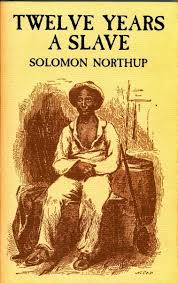
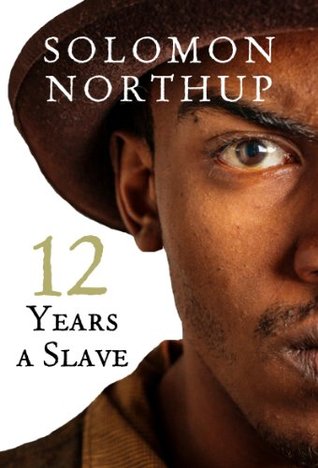
12 Years A Slave – Solomon Northrup

12 years I can’t say that I was thrilled when 12 Years a Slave, Solomon Northrup’s true-life account of slavery, was chosen for book club. I haven’t seen the much-lauded film because I’ve heard it’s quite violent and my tolerance for violence seems to be on the decline these days and I didn’t really have any desire to read this book either. I understand its importance but, truthfully, this isn’t a book that I’d ever pick up.

“Having been born a free man,” Northrup writes, and having “been kidnapped and sold into slavery, where I remained, until happily rescued in the month of January, 1853, after a bondage of twelve years – it has been suggested that an account of my life and fortunes would not be uninteresting to the public.”

Northrup intends to offer up “a candid and truthful statement of the facts: to repeat the story of my life, without exaggeration, leaving it for others to determine, whether even the pages of fiction present a picture of more cruel wrong or severer bondage.”

And factual it is — which I think might be part of the problem.

My first and most powerful experience with the subject of slavery came in 1977. I was in high school and there was a television event known as Roots. This mini-series was really must watch television and it had a profound impact on me. The story, based on the life of author Alex Haley’s grandmother, was shocking and horrific to me — a middle-class white girl from Eastern Canada. My experience with people of African-American descent was really limited; I could count the number of Black kids at my school on one hand. I distinctly remember watching Roots and being ashamed of the colour of my skin. I still remember the characters Kunta Kinte and Chicken George. Such is the power of fiction.

Northrup is married with three small children when he is duped by a couple of white men and taken from his life in New York to a plantation in Louisiana.  His account of the  journey and his time spent as a slave is  — I don’t know — instructive. Once in New Orleans he is purchased by a relatively kind man, William Ford. Northrup describes him as “kind, noble, candid, Christian.”

The influences and associations that had always surrounded him, blinded him to the inherent wrong at the bottom of the system of slavery. He never doubted the moral right of one man holding another in subjection. Looking through the same medium with his fathers before him, he saw things in the same light. Brought up under other circumstances and other influences, his notions would undoubtedly have been different. Nevertheless, he was a model master…

Unfortunately, he is sold again to a less charitable master, Mr. Epps, a man whose manners are “repulsive and coarse.” When drinking, Epps’ chief delight was “dancing with his “niggers,” or lashing them about the yard with his long whip, just for the pleasure of hearing them screech and scream.” It is with Epps that Northrup spends the bulk of his incarceration. 12 years_a
Perhaps modern readers have been spoiled by today’s memoirs, which often read like fiction. Northrup’s motivation for writing this book was, I believe, to instruct — and while I understand the merits of his tale, I felt it was missing a key ingredient: character. Yes, Northrup was clearly a good, intelligent, brave man, but there was something distancing about the very formal language of this tale. I think in his effort to report the facts, the story loses some of its impact. For example, when Eliza (someone else who has been kidnapped) is separated from her young children Northrup remarks “never have I seen such an exhibition of intense, unmeasured, and unbounded grief.” Imagine how that scene might have played out in fiction.

I am not sorry that I read Northrup’s story, but is it great literature? Is it a book I would press into the hands of my friends and say “you’ve got to read this.” No.
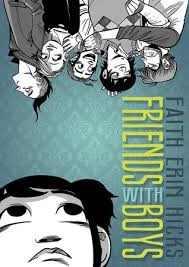


Friends with Boys – Faith Erin Hicks

friends I didn’t know that the author and illustrator of the graphic novel Friends with Boys, Faith Erin Hicks, was  from Halifax until I finished the book. I am not going to let the fact that we are practically neighbours (well, by Canadian standards we actually are!) influence my thoughts about Friends with Boys.

…which overall I liked (although I am by no means an authority on graphic novels and have really only started to read them in any number since I started building my classroom library.) I did feel the novel missed some great opportunities and had some structural problems – but, yeah, liked it.

So, Maggie is starting grade nine. This is a pretty big deal because she has been homeschooled her whole life. She’s super nervous about it. When her dad asks how she’s feeling she says  “It’s only my first day of high school. Nothing to be nervous about. I’m not nervous. I’m not.”

Maggie’s three older brothers, twins Lloyd and Zander and Daniel have already made the transition to high school and as Daniel admits to Maggie, he likes being at school better than learning at home. Of course he’s been there a few years, and is well-known and liked.

School isn’t the only thing complicating Maggie’s life – her mother has left home. Her father says “It’s exactly seventeen years since your mom started homeschooling you lot,” to which her brother Zander replies “Yeah and to celebrate she took off.” There is all sorts of unspoken angst in this situation, which is never satisfactorily dealt with.

And she has a ghost. An actual ghost that she met when she was a kid and whom occasionally follows her around. We never quite find out what the deal is there, either.

Then there’s Lucy and Alistair, the brother and sister who befriend Maggie.  At least we learn why Alistair is a social piranha.

That’s a lot of stuff on the plate of a fourteen-year-old and any of it would could have made a rich and compelling story on its own. I was intrigued by the ghost, loved Maggie’s older siblings and wondered what had happened to the mom. Ultimately, though, I felt like Hicks only scratched the surface of all these stories.


Saturday Sum Up

Here’s what I found bookish & interesting around the Internet this week:

Anyonw who loves books already knows the truth of the matter:
Bookworms Do It Better

I am a long time Stephen King fan, but maybe you have to be of a certain age to really understand how Mr. King changed the horror landscape. In the 1970s, he was pumping out books a mile a minute – and I read them as fast as he wrote them. I don’t know what it is about horror and teenagers – they’re sort of a match made in creepy-heaven. I evenually stopped reading King, though, and hadn’t read anything by him in yeras until a few weeks ago when I read Joyland, which I loved. I’d forgotten how masterful King is at evoking a forgotten time and place. If you are just getting started with King’s massive catalogue, here’s a list of eleven books you should start with. I haven’t read eveything on this list – but I’ve read the vast majority. These are mostly old-school titles and all of them are terrific.

Essential Stephen King

Here’s something worth considering: is owning books as good as reading them? I was happy to read about someone who has even more books than I do on my TBR shelf! I’d love to hear about your TBS shelf? Do you buy more books than you’ll ever read? I have to admit – I don’t feel even remotely guilty about it.

Feel like taking a quiz? (I am not even going to tell you how badly I did on this one.)

Literary Beginnings.

Enjoy your day.


Saturday Sum Up

Here’s what I found bookish & interesting on my tour around the Internet this week:

Let’s start off with a little John Green.  Here’s his quickfire list of 18 books he loves, but which you probably have never heard of. Love him.

These List Challenges were flying all over the Internet this week and they’re fun to do because instead of just an actual list – you get book covers and a satisfying sound every time you check one you’ve read.

I have embraced all sorts of social media, even giving in to my long-held belief that Facebook is the devil and rejoining, but one thing I don’t have is Tumblr. If I was so inclined, though, this would be a terrific place to start: The 25 Best Tumblr Accounts for Book Nerds.

Tomorrow is the last day for the Twitter Fiction Festival.

Have a great day.


Saturday Sum up – Feb 29

I am a regular bookstore visitor. Generally on Friday night, after we drop my daughter off at ballet, my son and I head over to Indigo and while away a couple hours, browsing and barely resisting the copious books. I have a Kobo. I don’t even know how to set it up and have no real desire to. We don’t actually have an independent bookstore in my town, although we do have a couple second-hand bookstores, which I try to visit when I can.

This article by Canadian Writer David Bidini is, I think, a sad reflection on the state of independent bookstores.

Reading between the times to understand the death of indie bookstores

Speaking of indie bookstores, The Bookseller posted a disheartening article about the decline of independent bookstores in the UK. Read it here.

But just so you don’t think all is lost – read this awesome story about a young boy who wants to start a library for homeless people.

Enjoy your day!

Saturday Sum-up – February 15

Here’s what I found bookish & interesting on my tour around the Internet this week:

6fa389c166845d58b0b214b55af9eccd

I’m celebrating my 500th post with today’s Saturday sum up.  That’s a lot of book talk, people!

Do you judge a book by its cover? Of course you do. Buzzfeed has posted 22 Absolutely Stunning Victorian Book Covers

ca7d632dd0ddbade22edddec8f6c6cbaI actually love this idea for the classroom – at the end of the year, I’ll have have students choose a book from my library that they loved and wrap it up for students to choose the following year. It’s something I actually planning on doing in the spring.

I watch my students choose books all the time. The students who don’t really care about reading just walk over to the shelves and grab a book – barely even looking at the cover. The keen readers do what I do: look at the cover, read the blurb on the book, maybe even check out the first paragraph before deciding to take it. More and more students are asking me for my advice – and they all know that I LOVE to offer it.

Not that I ever have any trouble deciding what to read next – I practically have a bookstore’s worth of unread titles in my house – but if you’re someone who isn’t sure what should be next on your tbr pile, check out What Should I Read Next, a handy site that lets you enter your current read into a search engine and then spits out a variety of titles which might interest you. It’s very cool.

And did you know there is actually a book cover archive? lr shelves

Book covers are actually one of the reasons (okay, call me superficial) that I prefer physical books over virtual ones. My reading life is like art…and looking at my heaving bookshelves never fails to give me pleasure.

I’d like to celebrate my 500th post with a little contest. Leave a comment below, or follow my Ludic Reader Facebook page (link on the right) and I’ll enter your name in a draw to win a bookish prize pack. Contest closes tomorrow (Feb 16) at midnight (Atlantic time).

Have a great Saturday!

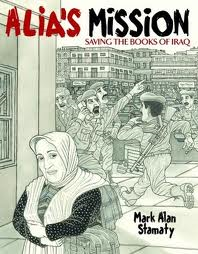
Alia’s Mission: Saving the Books of Iraq – Mark Alan Stamaty

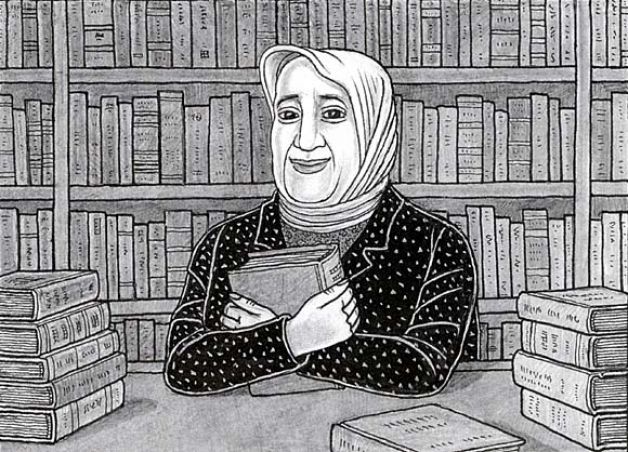
aliaMark Alan Stamaty’s graphic story will resonate with anyone who has ever visited a library. Its simple black and white drawings tell the story of Alia, a woman who lives and works in Iraq during Saddam Hussein’s reign. Iraq is on the verge of chaos as Britain and the U.S. are planning to invade the country and remove Hussein from power.

Alia is the head librarian at the Basra Central Library. We are told that “ever since she was a little girl, books have been a source of happiness and adventure for her.”  When she reads the story of how the Mongol Invasion destroyed the Baghdad library resulting in the loss of  “irreplaceable treasures” Alia worries that something similar could happen to her beloved library. alia1 When the fighting starts in Iraq, Alia feels compelled to save the books in the library. When she can’t get her own government to help her, she starts moving the books herself.

Alia’s Mission: Saving the Books of Iraq is a simple story, geared for younger readers.  It only took me about ten minutes to read, but don’t let that deter you from checking it out. Alia’s story proves what book lovers already know: books are worth fighting for.

Saturday Sum-up – Feb 8

Here’s what I found bookish & interesting on my tour around the Internet this week:

Bfz5b4yCQAADeUU

The above picture will never happen to me. That’s because this is my to be read shelf!  IMG_0211

It is both awesome and daunting to have so many books waiting to be read, especially when I also have a little notebook filled with hundreds more titles

Not nearly as often as I should, I visit the blogs I’ve linked to (see right) to see what other bloggers are reading and talking about. One click led to another and suddenly I came across this fabulous page: 100 Essential Sites for Voracious Readers. I’m just – gah! Where has this page been all my life?

I suspect that many of you are already familiar with Book Drum, a wonderful site that allows readers to offer (academic) insight into the books they love by way of pictures, video, footnotes etc. I actually submitted a project – for lack of a better word – on Helen Humphreys’ magnificent novel, The Lost Garden. For teachers out there – try Teaching with Book Drum.

I suspect that everyone and their dog has seen this sweet little video – but just in case you missed it:

Happy Saturday!


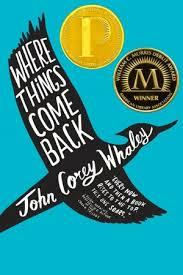
Where Things Come Back – John Corey Whaley

wherethingsThe members of the English department at my school decided before Christmas that it might be fun to have a book club to look specifically at Young Adult fiction. There’s so much great fiction for teens…and this will be a no-pressure way to look at some of the titles.

Last night I hosted the first meeting where we discussed John Corey Whaley’s much-lauded debut novel Where Things Come Back. Seriously, this book has won several prizes including two of the biggest: Michael L. Printz and William C. Morris. I’ve learned that prize winners don’t always live up to the hype and I am sad to say that I’d put this book in that category.

It started off okay.

I was seventeen years old when I saw my first dead body. It wasn’t my cousin Oslo’s. It was a woman who looked to have been around fifty or at least in her late forties. She didn’t have any visible bullet holes or scratches, cuts or bruises, so I assumed that she had just died of some disease or something; her body barely hidden by the thin white sheet as it awaited its placement in the lockers. The second dead body I ever saw was my cousin Oslo’s

Intriguing enough. And the character’s voice was distinct and I was interested. But to say that Where Things Come Back fulfilled its early promise would be a lie. And my fellow teachers agreed; not a single one of them liked it either.

The first question I asked at last night’s gathering was whether or not we should hold YA  to the same rigorous standards we hold other literature to. And the answer is – of course. As a teacher I want my students to read the really, really good stuff, but I also know that often times they will read stuff that is below my lofty standards. Geesh – I often read stuff that is below my lofty standards! I have many books on the shelves in my classroom that are just…yuck. But someone will read those books and love them and as long as they are reading I feel like they are walking that path towards better literature.

Once we determined that no one liked the novel, we set about trying to determine why.

“Fiction is driven by character,” said Karen. (Karen is a colleague and has also been one of my dearest friends for the past 30-odd years. Our philosophies are quite similar when it comes to teaching and reading.) “I just didn’t like any of the characters in this book.”

Other teachers had problems with the novel’s narrative structure.

And who cares about the woodpecker? None of us.

Where Things Come Back  is mostly Cullen  Witter’s story. He lives with his parents and younger brother, Gabriel, in Lily, Arkansas. Lily is a backwater little town where nothing ever happens. One day Gabriel just vanishes.  Where Things Come Back is also, superficially at least, the story of Benton Sage, a teenager doing missionary work in Ethiopia who suddenly has a crisis of faith. How Cullen and Benton’s stories connect finally becomes apparent in the novel’s final pages – but by then I didn’t care. And that’s a failing of two things: character and telling. So much of this story is told to the reader.

Perhaps there was just too much story to handle. Cullen’s journey after Gabriel’s disappearance might have made for some riveting reading.  Benton’s story, too, had potential. But the clunky denouement tipped over into melodrama that didn’t serve either character, really.

One teacher had a student who read this book and loved it and I will happily add it to my classroom bookshelf – but I won’t be rushing to recommend it.


I’ve made up with Facebook

I recently rejoined the land of FB, after years of saying it was ‘the devil.’ (I have my reasons; I am working through it.) Anyway, I thought FB might be a great way to share The Ludic Reader with people, so please drop by and like the brand-spanking new fb page for The Ludic Reader  I’ll be sharing some content with this blog, but also posting lots of other book-related content exclusively to FB as well.

While you’re at it, there are loads of fabulous writers/bookish things on FB and you should like their pages, too.

Lauren B. DavisOur Daily Bread

Jennifer McMahonPromise Not to Tell

John Connolly – The Book of Lost Things

Gillian FlynnDark Places, Gone Girl

Nikki Gemmell – With My Body, Cleave, Shiver, I Take You

John GreenThe Fault in Our Stars, Paper Towns

Stephen King – Joyland

Book Outlet

The New York Times Review of Books

And I am sure this is just the tip of the toppling bookpile of stuff to like on FB.