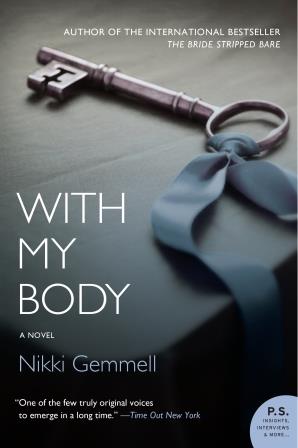
With My Body – Nikki Gemmell

With My Body Full disclosure: I am a Nikki Gemmell fan and have read three of her previous novels including The Bride Stripped Bare, Cleave and Shiver. So when TLC Book Tours offered me the opportunity to review Gemmell’s novel With My Body  I jumped at the chance.

Gemmell is one of those writers who somehow seems to burrow into the very heart of things and her stories – mostly about (at least those I’ve read) complicated, messy, consuming love – always seem to make me nod my head in agreement. Yeah – that’s right, Nikki. It’s just like that.

The unnamed narrator in With My Body is at a cross-roads in her life. Married to Hugh, she’s fallen into a sort of endless to-do list life, a never-ending cycle of  “wellies and Range Rovers, school runs and Sunday church.” Three young sons keep her busy and although she’s grateful for the life she has, she also feels “infected with sourness.”  Motherhood, for her,  is a complex state of being, full of “richness…depletion…incandescence…despair aand loneliness.” I hear you, sister.

She loves her husband, but they haven’t had sex for two years and the truth is, she’d rather be “celibate from now on.” Besides, their marriage is bound by an unspoken agreement that they’ll never split up and are “in this together, for life.”

Sounds like fun, eh?

With Your Body is really two stories. In one, the second person narrator dutifully fulfills her obligations as wife and mother, but the spark is gone. In another, we see her back in Australia first at age 11, coping with adolescence and a single father about to be remarried and then, slightly older, 14 perhaps,  experimenting with sex with a teacher and then slightly older again, 17ish – estranged from her father and the stepmother who turns out not to be all that happy in the role. It’s at this juncture that she meets Tol. He consumes her thoughts:

That night the memory of him, all of it, soaked through you, like smoke; in your hair, your clothes, in the pores of your skin. The memory of his fingers, his desk, his dog, his hand on the gearstick, his waiting house.

The sky has released its payload at last. Rain pummels the tin roof. You open the canvas flaps, fling them up and breathe in the earth as you lie on your stomach on the pillow, and watch.

Your sky, his sky.

The only thing you have in common, and you are caught.

The relationship between the narrator and Tol eventually becomes sexual. She becomes “cracked open into womanhood” under Tol’s patient tutelage. And so the two pass the summer. It is this affair that shapes her and, in some ways, spoils her for the men who come later – including her husband.

While I wouldn’t exactly call With My Body erotica, it is certainly erotically charged. It’s not meant, I don’t think,  to titillate though. The second person narration puts the reader in the driver’s seat, however, and therefore  we experience what the narrator does. Sometimes it had the desired effect.

I was more interested in the older version of the narrator, though – the wistful, dissatisfied, woman who sees the “signs of slippage everywhere.”

Your body thickening after its quicksilver years of slenderness, finally you have lost control of it. Your metabolism is slowing, you cannot keep the weight off. Hair is growing in places it shouldn’t be, with vigour – the only vigour in your life it seems. You are tired, so tired, constantly.

I got this woman. I didn’t have a Tol in my life, but I did have a life filled with abandon and abundant sexual appetite. I understood her longing to recapture the woman she was before she became a wife and mother and her journey felt authentic to me. I mean, who doesn’t wonder “what if?” When the narrator decides to leave England and return to Australia, she can’t resist revisiting the place where she and Tol spent that one incredible summer. She goes there, really, to find him – both literally and metaphorically. The past, it turns out, is not so easy to reclaim.

If I have any quibbles with the book, they are minor. I love the way Gemmell writes, although I wasn’t totally enamoured with the second person narration in this instance. Curious choice and I’d love to know why she made it. (Ms. Gemmell, if you pop by – I’d love to have your thoughts!)

Thanks to TLC for the opportunity to read the book and share my thoughts on this tour. I’ll be talking about another Gemmell novel, I Take You, in January.

WITH MY BODY ebook will be $1.99 from 12/16 – 1/6 

Eleanor & Park – Rainbow Rowell

eleanor and parkEleanor & Park turned up on Kirkus’s list of Top Teen Books in 2013, and rightfully so. Rainbow Rowell is a new-to-me author, although I have been wanting to read Fangirl for a while.

Set in Omaha, Nebraska in the 1980s, Eleanor & Park is a novel about two young people who find each other and themselves despite the many obstacles in their way.

When Eleanor moves to a new house and school she’s already aware of how different she is.  Park notices her right away because she is

…big and awkward. With crazy hair, bright red on top of curly. And she dressed like…like she wanted  people to look at her. Or maybe like she didn’t get what a mess she was. She had on a plaid shirt, a man’s shirt, with half a dozen weird necklaces hanging around her neck and scarves wrapped around her wrists. She reminded Park of a scarecrow or one of the trouble dolls his mom kept on her dresser. Like something that wouldn’t survive in the wild.

Park notices something else, too. He notices that she starts to read his comic books out of the corner of her eye.

At first he thought he was imagining it. He kept getting this feeling that she was looking at him, but whenever he looked over at her, her face was down.

He finally realized that she was staring at his lap. Not in a gross way. She was looking at his comics-he could see her eyes moving.

Eleanor notices Park, too.  (“Stupid, perfect Asian kid.”) And soon, over a shared love of comic books and new wave music, the two teenagers discover a mutual appreciation for each other.

The course of true love doesn’t run smoothly, of course. It never does.

Eleanor lives with her mother, four younger siblings and her step-father, Richie, who is not a nice man. At all. In fact, Eleanor has just returned home after living with family friends for a year. She’d been kicked out and the stay was supposed to be temporary. Now Eleanor lives in a home where everyone is always walking on eggshells, especially her.

Park is half Korean and lives with his parents and younger brother, Josh. Everything about his home life is stable and ‘normal’, but Park still finds it difficult to fit in.

Eleanor is a prickly person and Park is exceedingly patient with her, but that doesn’t always prevent hurt feelings and misunderstandings. It’s impossible not to love her, though. Park, too. They are not nearly as frustrating as other ‘teens in love’ might be. I wanted to shake Eleanor’s mom  though. But then I had to take into consideration the year in which the novel takes place – 1986.

I was a young(er) person in the 1980s and I loved the pop culture references in Eleanor & Park. Setting it then also allows the reader to forgive the lack of  outside agencies (school, Child Protective Services, police) involved in Eleanor’s dreadful home life. Even Park’s dad knows Eleanor’s stepfather and offers Eleanor a safe place to be.

If I have any criticism of the book it’s that I didn’t love the ending. I’m all for ambiguity, but it just seemed a little anti-climactic after everything that happens. It’s a small thing, though. Time with Eleanor and Park is time well spent.

A Peculiar Grace – Jeffrey Lent

peculiargraceIt took me forever to finish Jeffrey Lent’s highly praised novel A Peculiar Grace. Forever. Just under 400 pages, it felt twice as long because Lent’s prose is just shy of purple and nothing happens. Nothing. Well, okay, that’s not exactly true. Stuff happens.

Forty-something Hewitt Pearce is leading a solitary life in the Vermont house he inherited from his father. Hewitt’s a blacksmith, a prickly artistic type who “had to sit there a while to see if  it was a day for iron or not. This was the essence of what his customers perceived as a great problem – the fact he refused to state a deadline however vague.”  A sign near his forge’s door states: “If you want it done your way learn how to do it & make it yourself. Your commission is not my vision.”

Well, okay then.

Into Hewitt’s insular life comes 20-something Jessica. Her VW breaks down on Hewitt’s property and he offers her something to eat and a place to clean up. So she pretty much moves in. Jessica isn’t 100% emotionally secure, and Hewitt is 100% emotionally closed off so anything that’s going to happen between them is going to be a long time coming. (No pun intended.)

There are complications. Hewitt’s still hung up on Emily, a girl he met and loved many years ago. She’d married someone else and Hewitt has worshipped and brooded from afar ever since. There are also some family skeletons including  a famous painter father, and  an older sister Hewitt’s on the outs with.  Then Emily’s husband dies and Hewitt decides it’s time to make his feelings known to her once more, but really — can these two crazy middle-aged kids overcome their past and make it? And what about Jessica?

I kept reading. I don’t know why. When Hewitt’s mother, sister and niece arrived for a visit and these family members started talking to each other it was bizarre. People don’t actually talk to each other like this, do they?

“Jesus mother. Don’t you flush?”

“I certainly do. …And haven’t you heard about conserving water? Speaking of which you need to change the gaskets in the faucets of the tub and sink upstairs. At Broad Oakes they sent around a pamphlet about the unnecessary use of water. And not just because of the drought but because there’s long-term stress on the aquifers all over the U.S. and people still want green lawns in August”

“I don’t think so, girlie. Whatever nonsense you’re up to here I want to be able to watch your face when it comes out.”

By the time Hewitt and Jessica (and Emily and Hewitt’s sister)  finally work out their messy and strangely overwrought lives,  I had reader’s fatigue. Partly it had to so with the stylistic nature of Lent’s prose — weirdly fragmented and dense — and partly it had to do with not really caring very much about any of these people.

The Missing Girl – Norma Fox Mazer

missing girlIt’s a total fluke that I am writing my review of Norma Fox Mazer’s last novel, The Missing Girl, on the anniversary of her death. She died on October 17, 2009 and although she was a very well-known and highly regarded young adult novelist, The Missing Girl was my introduction to her writing. In a career that spanned over 40 years, Mazer wrote over 30 books including Newbery Honor Book, After the Rain and National Book Award Finalist A Figure of Speech.

The Missing Girl is the story of the five Hebert sisters: Beauty, Mim, Faithful, Fancy and Autumn. They live with their out of work father, Poppy, and slightly air-headed mother, Blossom, in Mallory, New York.  Beauty, the eldest at 17, dreams of graduating high school and fleeing Mallory.

When she left Mallory, it would be for Chicago, which she had first heard about from Mr. Giametti, her seventh-grade language arts teacher who gre up there. She was going to a place where no one knew her, a place where she could become whoever it was she was meant to be…

The Hebert family dynamics would actually be quite enough to make The Missing Girl a compelling read, but Mazer had something else in mind.

If the man is lucky, in the morning on his way to work, he sees the girls. A flock of them, like birds.

Slight of build, stoop shouldered, wearing a gray coat, a gray scarf around his neck against the cold, his wire-rimmed glasses set firmly on his nose, minding his own business, he could be any man, any respectable, ordinary man.

But there is nothing ordinary about this man. He is watching the sisters carefully, biding his time, waiting for the perfect moment. The reader knows it’s coming. The girls are unaware. They have their own issues and petty grievances with each other. Their lives are chaotic and slightly ramshackle.

What struck me about The Missing Girl was the quality of the prose and the very authentic voices of the characters. Employing first, second and third person points of view, Mazer manages to create compelling lives for all the girls and without anything gratuitous makes their “admirer” a creepy predator.

Mazer said she came to write The Missing Girl via a series of short stories about the Hebert sisters which she wrote for various anthologies. It wasn’t until she lost her daughter to cancer in 2001, though, that she settled in to write this novel. “Her death was unbearable,” Mazer said,” “but of course I bear it. I must. Yet below the surface of my life, her loss remains unbearable and will always remain so.

“I still do not understand this fully, but it seems to me that after her death I was compelled to write about something hard, difficult – you might call it unbearable – and to name that ‘something’ with the three words that name my grief, my loss, my sorrow: the missing girl.”

Popular Music from Vittula – Mikael Niemi

popularmusicI didn’t get this book – at all. Everyone from the New York Times to Entertainment Weekly waxed poetic about its beauty and prose that “buzzes with wonder, fearlessness and ecstatic ignorance.” Um. I didn’t get it.

Translated from the Swedish, Popular Music from Vittula is a “novel” that actually seems more like a memoir  – or a series of loosely connected short stories –  because if there was a narrative thread here, I wasn’t seeing it.

The main character and narrator is Matti and we meet him as an adult “in a fix in the Thorong La Pass” (which is on Mount Annapurna, Nepal) where  he finds himself 17, 765 feet above sea level, with his lips stuck to  a Tibetan prayer plaque. I am sure what happens next is meant to be comical but, sadly, I didn’t laugh. And I didn’t laugh at any of the other crazy escapades Matti finds himself embroiled in from the age of five straight through to his teenage years.

Matti and his friend, Niila, meet at the neighbourhood playground and their friendship is cemented during a nose-picking session. The rest of this story traces their frienship, particularly their love for music, for the next decade or so.  Their otherwise straightforward lives are touched by elements of magical realism. (Did these two five year olds really manage to get on a plane and fly all the way to Frankfurt?)

Matti’s story dips in and out of his life, giving the reader a chance to experience the first time he ever heard Elvis Presley sing (in his sister’s bedroom), the first time he goes to school, his first kiss. I wish I could say that the book was more than the sum of its parts, but for me I just didn’t get it.

Never Fall Down – Patricia McCormick

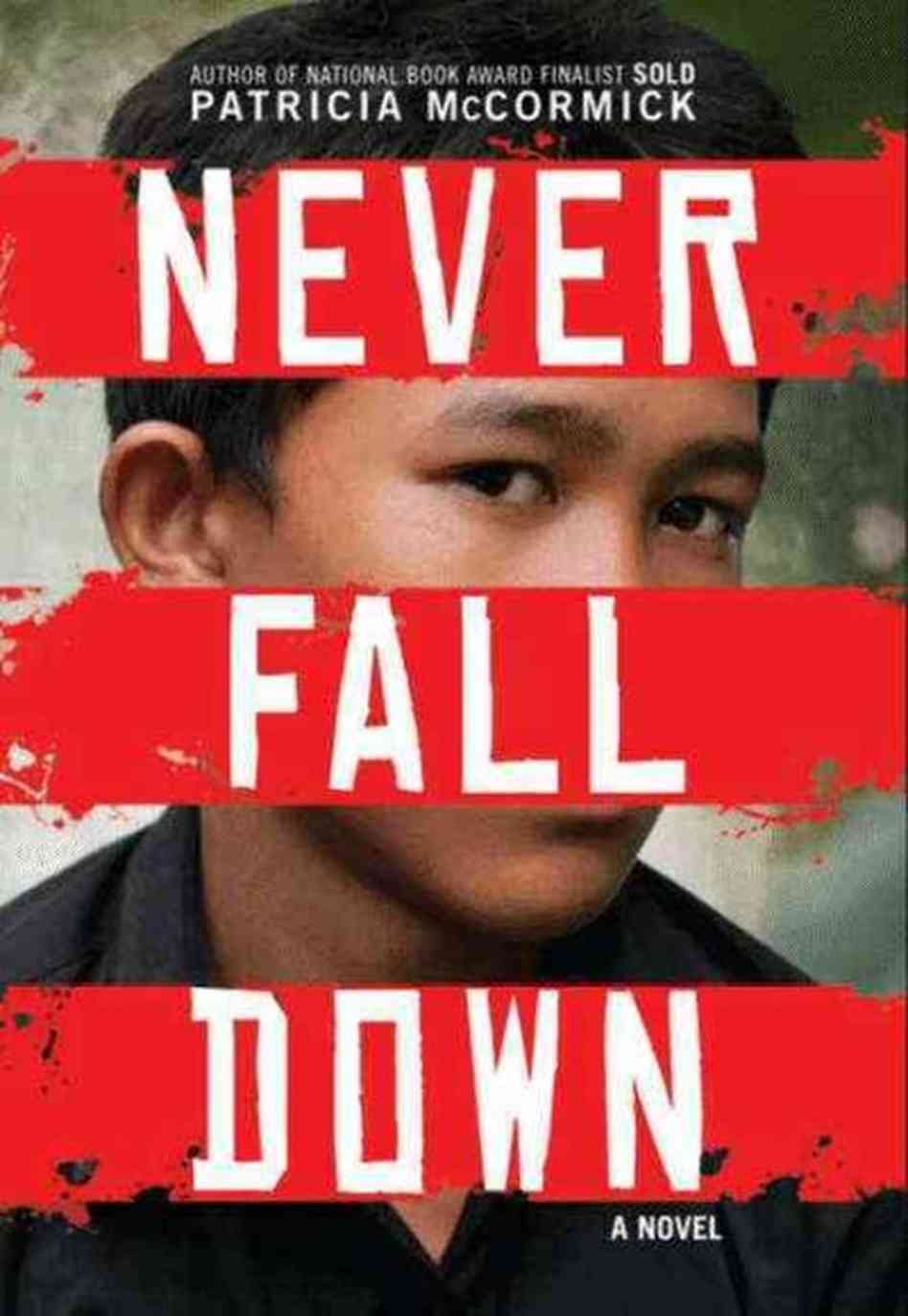
neverfalldown Arn Chorn-Pond, the young narrator of Patricia McCormick’s novel Never Fall Down, finally escapes Cambodia and  makes it to the safety of Thailand sometime in the spring of 1979.  At the very same time, I was getting ready to graduate from high school. I knew nothing of the Khmer Rouge and their violence – or if I did, I don’t remember. Reading Arn’s story has reminded me again of the priviledged life I’ve lead and of the absolute power of literature to crack open the insulated world in which we often live.

Arn is just eleven when the Khmer Rouge, a radical Communist regime, and an offshoot of the Vietnam People’s Army, sweeps through Cambodia displacing people and separating families. Arn has lived a relatively happy life up until then. He says, “At night in our town, it’s music everywhere. Rich house. Poor house. Doesn’t matter. Everyone has music.”

When the army blows through town, it’s exciting. Arn says, “…I think this is the most exciting thing to happen here. Real Americans coming. Real airplane.” But that excitement doesn’t last. Soon Arn, his aunt and his siblings (four sisters and one brother) are marching out of town with everyone else. And then the real horror begins.

And this book is horrific.

McCormick spent two years interviewing Arn and then  made the choice to tell his story as a novel because “like all trauma survivors, Arn can recall certain experiences in chilling detail; others he can only tell in vague generalities.”  It’s no wonder his mind has decided to compartmentalize; the atrocities he’s witnessed are almost unbearable.

But Arn does bear them. He survives the separation from his family, the endless work in the rice fields, the starvation, illness, walking miles and miles through the heat. He makes himself indespensible by learning to play an instrument, but even that doesn’t save him from witnessing the Khmer Rouge’s atrocities against men, women and children.

And then, even more horrible, Arn suddenly finds himself with a gun in his hand, fighting with the very people who have held him captive for more than three years. Never Fall Down is a survival story because Arn surely does that.

McCormick makes the decision to tell this story in Arn’s distinctive sing-song voice and it’s a wise choice. We see everything though his eyes and he is a truthful and unflinching narrator.

One night the girl next to me at dinner, she dies. She dies just sitting there. No sound. Just no breathing anymore. All of us, we eat so fast, no one even see this girl. Very quick, I take her bowl of rice and keep eating.

I guess we can never really know what we’re capable of until we are put in the situation where our limits might be tested. Arn was a remarkable boy and he has turned into a remarkable man, a champion for humanitarian causes around the world and the winner of many international prizes. Never Fall Down is a must read book.

This video explains  what happened during that period.

I also highly recommend the movie, The Killing Fields.

A-Z Book survey compliments of @brokeandbookish

It was the perfect day to think about books from A-Z, with thanks to Jamie who posted her own responses here

AtoZsurvey-1017x1024

Author you’ve read the most books from

Hmmm. Stephen King. I’ve read 13 novels and many, many short stories and his non-fic book On Writing. Reading King occupied much of my high school reading time, which is probably why the number is so high. I probably haven’t read a King novel in a decade, though. Back in hs I loved horror fiction and I loved the way he wrote. IT is my favourite novel by King and when one of my grade 10 students announced he’d never been scared by a book I handed him IT. He read it, loved it and, yep, was scared, too.

I have other authors I read voraciously: Thomas H. Cook, Helen Dunmore, Carolyn Slaughter, Helen Humphreys, Peter Straub are all authors I have read widely.

Best sequel ever

I loved The Ask and the Answer, Patrick Ness’s follow-up to The Knife of Never Letting Go.

Currently reading

Endangered by Eliot Schrefer

Drink of choice while reading

Tea. Or nothing. Depends on where I am reading.

E-reader or physical book

Physical books all the way, baby. eReaders do not appeal to me in the least.

Fictional character you probably would have actually dated in high school

Oh dear.  Joe Fontaine from Jandy Nelson’s The Sky is Everywhere.

Gale from The Hunger Games

I loved Augustus from The Fault in Our Stars

Henry from The Time Traveler’s Wife.

Need I go on?

Glad you gave this book a chance

The Book Thief by Marcus Zusak. It took me a bit to settle into the book, but once the fire caught there was no turning back and it ended up being one of my favourite books of that reading year. Same with Patrick Ness’s The Knife of Never Letting Go.

Hidden gem book

I don’t think Lauren B Davis’s novel Our Daily Bread got nearly as much priase as it deserved. More people need to read this book.

Important moment in your reading life

Finishing Jane Eyre when I was 11 or 12 changed my life and freed me from Trixie Beldon and The Bobbsey Twins forever. (Not that I needed to be freed from those books; I LOVED those books.)

Just finished

Every Day by David Levithan

Kinds of books you won’t read

I’m not a huge fan of straight-up Sci Fi, although Ender’s Game is on my TBR shelf. The same would be true for other genres like Westerns or historical fic. But, never say never.

Longest book you’ve read

Probably IT – 1104 pages

Major book hangover because of

Hmmm. I’m not sure what this means. I’m going to assume that this means a book that you couldn’t shake, like the dry heaves. Most recently that would be The Dark Heroine: Dinner with a Vampire, which ended up in my Book Graveyard

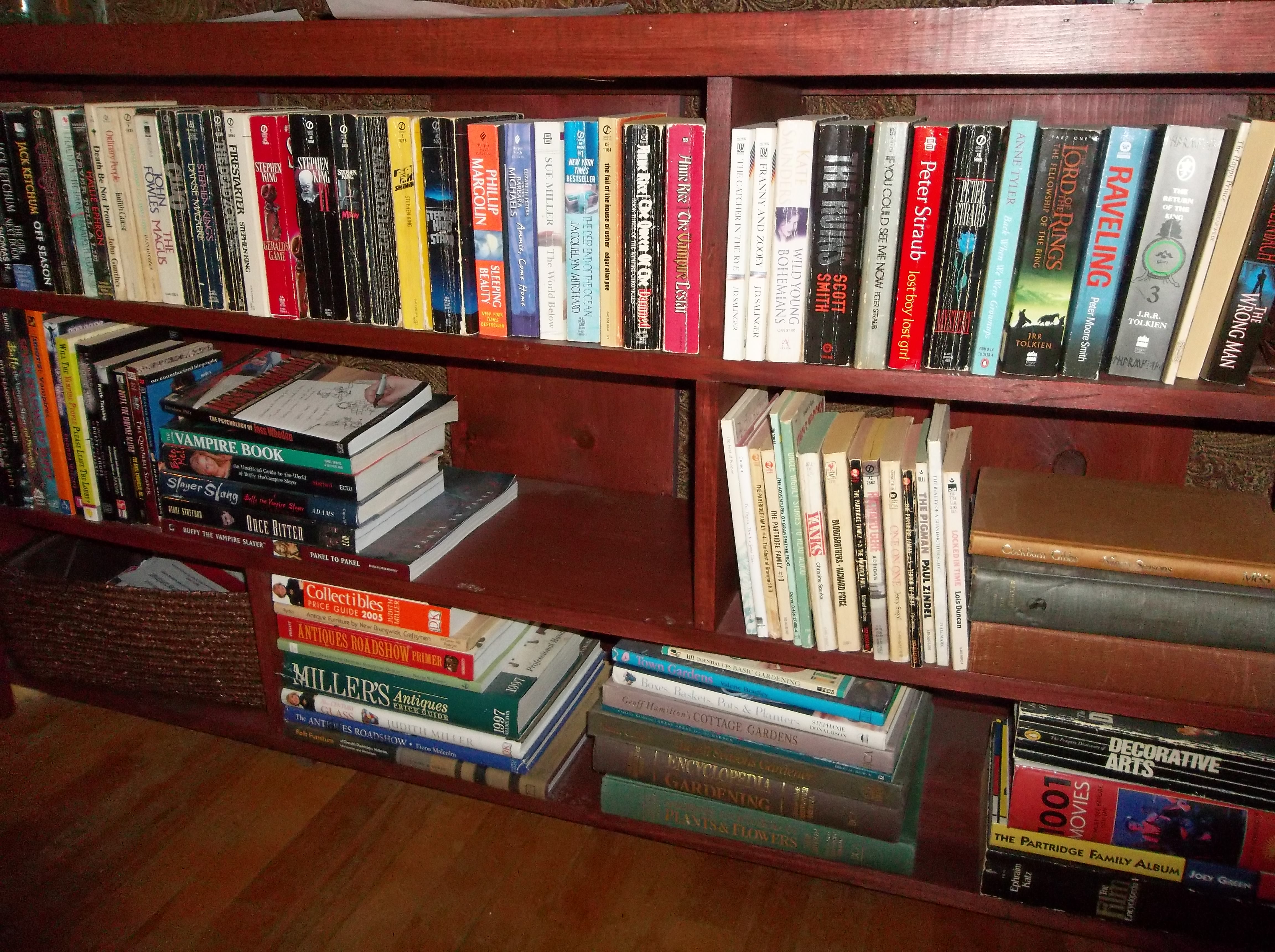
Number of bookcases you own

Not enough.

100_0365

100_0366

BHMdywxCEAAtvWR

One book you have read multiple times

Velocity by Kristin McCloy. Never tire of it…and I’ve read it many times over the past 25 years.

Preferred place to read

In bed.

Quote that inspires you/gives you all the feels from a book you’ve read

Recently – “Stories are important. They can be more important than anything. If they carry the truth.” from Patrick Ness’s A Monster Calls

Reading regret

That I really won’t have enough time to read all the books I want to. ::sigh::

Series you started and need to finish (all books are out)

The Hunger Games. I actually really liked The Hunger Games, I just didn’t read the next two immediately after finishing the first…and I should have.

Three of your all-time favorite books

A Little Princess – Frances Hodgson Burnett

Velocity – Kristin McCloy

The Time Traveler’s Wife – Audrey Niffenegger

(But to name just three is ridiculous.)

Unapologetic fangirl for

John Green. I have mad love for him. And that’s based on one book and his Crash Course YouTube series.

Very excited for this release more than all the others

I’d be very excited if Carolyn Slaughter released a new book.

Worst bookish habit

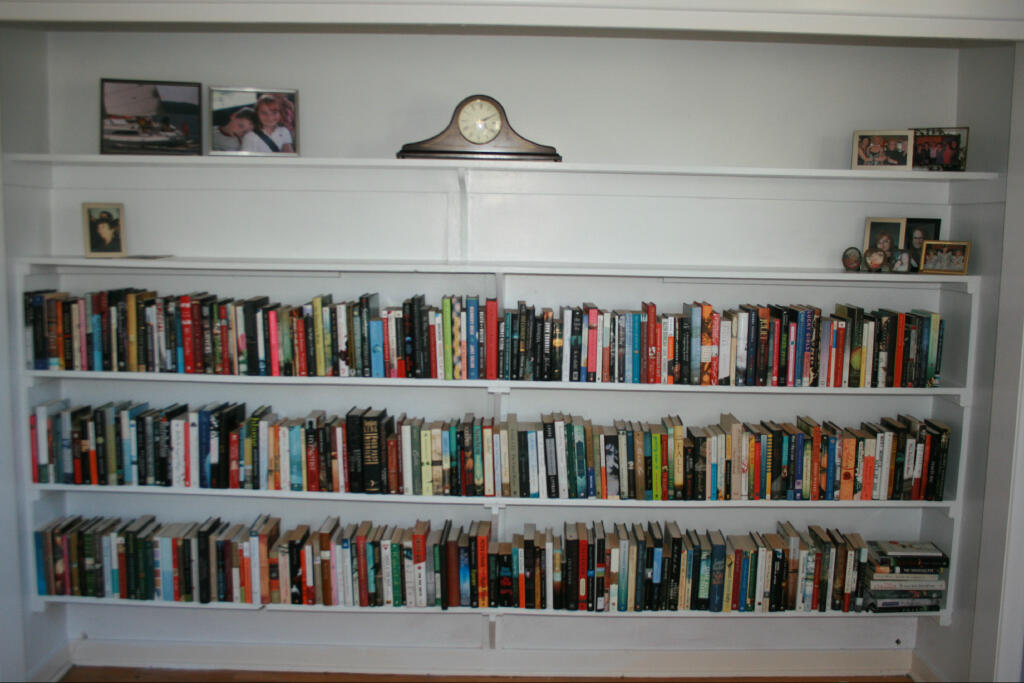
Buying more books than I can possible read. (The books on the white shelf with the clock on the top are my TBR books, plus I have a pile beside my bed.)

X Marks the spot: the 27th book of my shelf

A Recipe for Bees – Gail Anderson-Dargatz

Your Latest Book Purchase

The last book I purchased was The Madman’s Daughter by Megan Shepherd

ZZZ-snatcher book (latest book that kept you up way late)

The last book that really kept me reading way past my bedtime was The Fault in Our Stars

Blood – Patricia Traxler

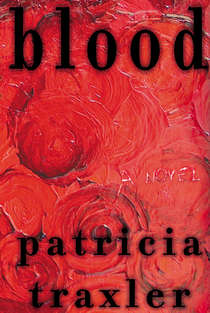
BloodNorrie Blume, the protagonist of Patricia Traxler’s debut novel, Blood, is a thirty-five-year-old painter who has taken a leave of absence from her job as a graphic artist to focus on her art. To do that, she has accepted a Larkin fellowship at Radcliffe in Boston and has moved into one of the residences. It is there that she meets two other Larkin fellows, Clara, a journalist from Chile and Devi, a poet from London. Norrie doesn’t make friends easily and she is used to a certain degree of isolation — partly because of her vocation and partly because of her relationship with Michael Sullivan, a best-selling novelist who just happens to be married. It’s not like they can hang out in public. Nevertheless, she likes Devi immediately and sees all Clara’s character flaws just as quickly.

I have mixed feelings about Blood. Generally speaking, I liked it. The writing was decent and the story moved along. My problem had to do with a certain degree of uneveness.

Norrie tells the reader, “Though it’s true there’s a killing in my story, its principal violence is, I think I’d have to say, the violence of love.”

True enough: Norrie and Michael can’t keep their hands off each other and in one respect, Blood is a relatively explicit examination of infidelity. Of course, while  there’s no real honour in adultery, Michael does genuinely seem to love Norrie and wants a future with her. On the other hand, he can’t quite seem to get his shit together enough to leave his wife of 25 years. And why should he when he can have his cake and eat it, too.

Much of Blood is given over to the push/pull of Norrie’s top-secret relationship with Michael (no one, not even her best friend Liz, knows about him even though they’ve been together for two years.) And that might have been quite enough for one novel, but Traxler also delves into the mysterious world of female relationships and that’s where Clara and Devi come in.

Clara is clearly passive-aggressive and Norrie alternates between feeling sorry for and irritated by her. When she meets Devi, however, her feelings are immediately of the warm and fuzzy variety. This strangely dysfunctional threesome makes up the other third of the novel’s narrative. It’s also what, apparently, drives the book’s suspense – not to say that I didn’t turn the pages, but towards the end it did get a little, um, silly.

Not content with all those relationships, Traxler also dips a brush into the whole world of creativity. Traxler herself is an award-winning poet and so she likely knows a thing or two about the creative process, I’m just not sure that as it was written here is added any value to this story.

I guess that’s why when I came to the end of Blood I couldn’t really say I loved the book. I might have liked it a whole lot better if it had been about just Norrie and Michael, or just Norrie and Clara and Devi or even just about Norrie and her struggles to create art. As it was, the canvas was just a little too crowded for me.

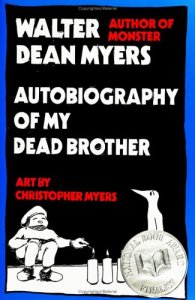
Autobiography of My Dead Brother – Walter Dean Myers

Image

9780060582913-LWhile this wasn’t a book I particularly enjoyed, I absolutely see its merits. Autobiography of My Dead Brother is the story of 15-year-old Jesse who grows up in a violent New York neighbourhood.  He’s smart, talented and although he’s got all the typical teenage issues – he’s not going to make decisions which adversely impact his life.

His best friend is Rise. Rise is seventeen and he and Jesse have been friends since they were little.

His mother likes to tell me that when Rise first saw me, he was scared of me. She said they had a puppy and a turtle and he liked to play with them both, but when he saw me he started crying.

I didn’t remember any of that, but me and Rise grew up to be really close. He was more than my best friend – he was really like a brother.

Myers’ novel opens, Jesse and his friend C.J. are at the funeral of their friend, Bobby, who has been killed in a drive-by shooting. While Jesse and Bobby are horrified by the event because, after all, Bobby wasn’t doing anything, just sitting on his stoop, Rise thinks Bobby “went out like a man.” It’s an early indication that Jesse and Rise might be heading in two different directions.

Rise wants Jesse, an artist, to draw his autobiography and so the reader starts to see Rise through Jesse’s very focused lens. We see his “funny way of walking, with one shoulder higher than the other”; we see Rise’s home life (he lives with his mom and aging maternal grandparents); we see Jesse start to feel the troubling disconnect between him and Rise.

Myers also captures the adults in this book very well. None of these kids come from uncaring families. While some come from single parent households, all the parents work and care and even the police are painted as fair and reasonable human beings. But there still manages to be trouble for Jesse and his friends.

The book is interesting; the drawings are great (done by Christopher Myers, the author’s brother) and Myers certainly writes authentically about the experience of  – in this case – African American kids who just happen to live in a neighbourhood where crappy things happen. Ultimately though, this is a story about the friendship between two kids which unravels over time.

I know a lot of boys would really enjoy it.

The Doctor’s Wife – Elizabeth Brundage

thedoctorswife_325Interesting timing. I finished Elizabeth Brundage’s novel The Doctor’s Wife just a couple days before Dr. Henry Morgentaler passed away at the ripe old age of 90.  What do a novel and a  doctor who changed the laws regarding abortion in Canada have to do with each other? Well, it’s the polarizing subject of abortion which is at the centre of Brundage’s over-written and  uneven novel.

Annie and Michael Knowles live in upstate New York. Michael is an obstetrician who practices in Albany. Annie is a journalist who teaches at the local college. When the novel opens, it is clear that their marriage is rocky: Michael is a workaholic; Annie is dissatisfied with her role as mother and the doctor’s wife.

Then there’s Lydia and Simon Haas. Simon was a renowned artist, but now he’s a bit washed up and he teaches at the same college as Annie. His wife, Lydia, is much younger and clearly unstable. She’s also found Jesus and is hanging out with a bunch of bible thumping right wing conservatives.

When Lydia discovers that Simon and Annie are having an affair and her church friends decide that Michael’s new role at the local abortion clinic is worthy of punishment, The Doctor’s Wife propels the reader into page-turner territory.  But it’s a weird mash-up of social commentary and scorned-wife-gone-wild.

None of the characters in this novel are particularly likeable. Usually when people enter into an extramarital affair it’s sort of easy to choose a side. Simon might be sympathetic if you really had a better of understanding of his relationship with Lydia. Does he love her? Is he afraid of her? (If not, he should be!) Does he love Annie?

And Annie’s feelings for her husband are equally ambiguous. She is “no longer the college girl Michael had fallen in love with.” When she and Simon hook up at a faculty party it’s like they hop a fast-moving train that’s not able to stop until it either runs out of fuel or crashes. The fact that Simon is a bit of a doofus makes you question Annie’s sense.

I actually didn’t mind the affair part of the story. And Lydia was bat-shit crazy. Where the story really  veered off the believability path was how Lydia was involved with these crazy church people and how she had the cunning to plan and execute some of these outlandish crimes.

By the end of the book, the whole thing felt a little bit like a made-for-tv-movie. Which is too bad, as there was potential there at the beginning.