Last night I dreamt I went to Manderley again.
The opening line of Daphne du Maurier’s brilliant novel Rebecca will be instantly recognizable, likely even to readers who have never read it. In that book, the unnamed protagonist meets Maxim de Winter and embarks on a whirlwind courtship. They marry and he brings her home to Manderly, his estate on the Cornish coast. It is there that the narrator’s troubles begin because Manderley is haunted by Rebecca, Maxim’s first wife, who was (apparently) beloved by all. Rebecca is a riveting read.


Lisa Gabriele treads…tromps…through du Maurier’s landscape in her novel The Winters and although I am in the minority, I am sure, I feel as though this book suffers by any comparison to its source material. But you have to compare them because Gabriele’s story is “inspired” by du Maurier’s.
In The Winters the unnamed narrator is a dog’s body for a boating company in Grand Cayman, where’s she’s grown up with her parents who were “disillusioned Americans who chose to live and work on a small fishing trawler.” Now both her parents are gone, and she is still working for Laureen, the brash Australian who owns the charter boat company.
Our plucky narrator tells us that
My features are even, my body trim, hair, eyes and skin compatible with each other in ways that make sense. Even my character, self-sufficient and serious-minded, watchful and earnest, doesn’t draw attention to itself. Men do not clamour after me.
Enter Max Winter. He’s older. Handsome. Rich. And immediately smitten with the narrator. Cue whirlwind courtship and suddenly she’s being whisked off to Asherley, Max’s Long Island version of Manderley. Instead of Manderley’s menacing housekeeper Mrs. Danvers, there’s Dani, Max’s troubled fifteen-year-old daughter.
Even though the former Mrs. Winter has been dead for almost two years, the house is still full of reminders and our narrator has trouble finding her footing. Dani, when she finally returns from Paris, takes an immediate dislike to her, and the narrator doesn’t have any experience with teenagers anyway. Dani mostly holes up in her old mother’s turret bedroom, smoking weed and (seemingly) plotting ways to make the narrator’s life miserable.
My issues with The Winters don’t really have anything to do with the story. I mean, if you’ve never read Rebecca I think you’ll probably find the plot of this one engaging enough. I was frustrated reading this book, though. I think my main problem was with the characters themselves; I just didn’t believe them. I certainly didn’t believe the way they spoke to each other. There wasn’t any real chemistry between the narrator and Max and the denouement, when it arrived, had wayyyy too many contrivances.
It’s a beach book. It doesn’t ask anything of you, and I suspect many readers will find it diverting and entertaining. For my money, though, Rebecca is a much more satisfying read.

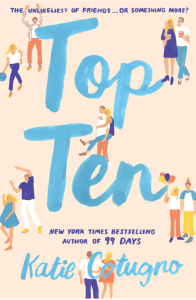 kinda awkward because Gabby isn’t really a party-goer; she’d much rather be holed up in her bedroom with her snacks and a good book. When she discovers Ryan barfing in her bathroom, though, it’s the beginning of a beautiful friendship. That’s the premise of Katie Cotugno’s YA novel Top Ten.
 Sometimes those cracks don’t appear until something remarkable happens and the catalyst in this novel is the arrival of Jonah, a mysterious young man who turns up at their cottage, claiming to have had all his camping gear stolen. Carl insists Jonah head up the road to the highway, but Jonah finagles his way into a dinner invitation and crashing on the couch for the night. In the morning, all hell breaks loose.
 Funny, or maybe not, that the book I read right after
  You know you’re getting old when…
 other books I’ve read by Cook, which have generally focused on one narrator, Peril lets the reader see the same set of circumstances through a variety of lenses.
 Of the books I read in 2019, a couple really stand out. Gabriel Tallent’s debut novel




 I stumbled upon, purely by chance, Sherree Fitch’s
  bit on social media, and in fact back when my book club read Our Daily Bread, she graciously offered to answer any questions we had in real time via Twitter.
 Catherine West wants a family — which is sort of funny once you get to know her. The narrator of Swan Huntley’s novel We Could Be Beautiful is vain, spoiled, and selfish. It’s hard to imagine she’d ever be selfless enough to have kids. Plus, she’s pushing the biological envelope: Catherine’s 43.
 The Ludic Reader