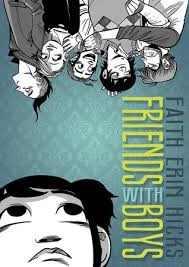
Friends with Boys – Faith Erin Hicks

friends I didn’t know that the author and illustrator of the graphic novel Friends with Boys, Faith Erin Hicks, was  from Halifax until I finished the book. I am not going to let the fact that we are practically neighbours (well, by Canadian standards we actually are!) influence my thoughts about Friends with Boys.

…which overall I liked (although I am by no means an authority on graphic novels and have really only started to read them in any number since I started building my classroom library.) I did feel the novel missed some great opportunities and had some structural problems – but, yeah, liked it.

So, Maggie is starting grade nine. This is a pretty big deal because she has been homeschooled her whole life. She’s super nervous about it. When her dad asks how she’s feeling she says  “It’s only my first day of high school. Nothing to be nervous about. I’m not nervous. I’m not.”

Maggie’s three older brothers, twins Lloyd and Zander and Daniel have already made the transition to high school and as Daniel admits to Maggie, he likes being at school better than learning at home. Of course he’s been there a few years, and is well-known and liked.

School isn’t the only thing complicating Maggie’s life – her mother has left home. Her father says “It’s exactly seventeen years since your mom started homeschooling you lot,” to which her brother Zander replies “Yeah and to celebrate she took off.” There is all sorts of unspoken angst in this situation, which is never satisfactorily dealt with.

And she has a ghost. An actual ghost that she met when she was a kid and whom occasionally follows her around. We never quite find out what the deal is there, either.

Then there’s Lucy and Alistair, the brother and sister who befriend Maggie.  At least we learn why Alistair is a social piranha.

That’s a lot of stuff on the plate of a fourteen-year-old and any of it would could have made a rich and compelling story on its own. I was intrigued by the ghost, loved Maggie’s older siblings and wondered what had happened to the mom. Ultimately, though, I felt like Hicks only scratched the surface of all these stories.


Miss Peregrine’s Home For Peculiar Children – Ransom Riggs

peregrineMiss Peregrine’s Home for Peculiar Children by Ransom Riggs is the  unusual story of fifteen-year-old Jake Portman who travels to Wales to find out the truth about his much-loved grandfather.

Growing up, Grandpa Portman was the most fascinating person I knew. He had lived in an orphanage, fought in wars, crossed oceans by steamship and deserts on horseback, performed in circuses, knew everything about guns and self-defense and surviving in the wilderness, and spoke at least three languages that weren’t English.

I had a grandfather like that. Well, at least to me, he seemed like the most exotic person ever. When I was a kid, I believed he’d been to every single country in the world. He’d been a Chief Petty Officer with the Royal Navy in the war and then worked on the tugs with the Coast Guard. He knew sea shanties and dirty jokes (which he only ever told to my brothers) and had tattoos on his arms back when they meant something. I loved being in his company.

Jacob’s grandfather had been born in Poland but shipped to Wales when he was twelve because “the monsters were after him. Poland was simply rotten with them.” It seems obvious that Mr. Portman is talking about the Nazis, and he is – but there are other monsters lurking. In Wales, he comes under the care of Miss Peregrine, a most unusual woman – as it turns out – who was also responsible for the children in Grandpa Portman’s fabulous stories. These children could do amazing things: fly, make fire, turn invisible. Grandpa Portman even had pictures of some of them. These pictures, many of which are included in the book, create a degree verisimilitude for the narrative. (The pictures have actually been culled from private collections)

miss-2But then something horrible happens to Grandpa Portman and Jacob is intent on finding the answers to many of the questions his grandfather leaves behind so he convinces his father to take him to Cairnholm Island, off the coast of Wales.

Nothing could have prepared Jake for what he finds there. The island is caught in time and Jake soon finds himself believing in things he never really thought possible. Miss Peregrine’s Home for Peculiar Children is a coming-of-age tale, an adventure, a love-story. It’s sad and funny and creepy. And as an allegory for the horrors of  the Holocaust – it works very well indeed.

Tim Burton is directing a movie version of this novel – can’t think of anyone better to capture the novel’s strange and wonderful story.


Saturday Sum Up

Here’s what I found bookish & interesting on my tour around the Internet this week:

Let’s start off with a little John Green.  Here’s his quickfire list of 18 books he loves, but which you probably have never heard of. Love him.

These List Challenges were flying all over the Internet this week and they’re fun to do because instead of just an actual list – you get book covers and a satisfying sound every time you check one you’ve read.

I have embraced all sorts of social media, even giving in to my long-held belief that Facebook is the devil and rejoining, but one thing I don’t have is Tumblr. If I was so inclined, though, this would be a terrific place to start: The 25 Best Tumblr Accounts for Book Nerds.

Tomorrow is the last day for the Twitter Fiction Festival.

Have a great day.


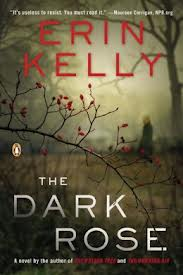
The Dark Rose – Erin Kelly

darkroseSO ANNOYED! I had an awesome review of this book written and when I posted it all that posted was what is below between the **…and I am tired and never going to be able to recreate what I had written and I could SCREAM.

So, briefly:

39-year-old Louisa and 19-year-old Paul are both working on the restoration of a ruined Elizabethan garden in Kelstice, a small town northwest of London. She’s hiding out – as she has done for the past twenty years or so – because she’s still obsessed with the guy she was in love with when she was 18. Paul’s hiding out because his best friend, Daniel, will soon be on trial for murder and he’s the star witness for the prosecution.

Paul’s had a traumatic childhood. He lost his father in a rather traumatic and gory accident which he witnessed. Then he started to get picked on in school and Daniel became his saviour.  He’s really a decent guy who just made some stupid choices because of his loyalty to Daniel.

**It’s also impossible not to relate to Louisa – at least I could relate to her. She falls madly in love with Adam Glasslake, lead singer of the band Glasslake and the more distant and unattainable he is, the more she wants him. What 18-year-old hasn’t been on that roller coaster ride?

After they make love for the first time and after Adam falls asleep, Louisa

…inhaled the thick oily skin between his shoulder blades where he smelled most like himself. If you could distill and bottle the essence of a human being, if you could crush skin like petals , then she would do this with Adam Glasslake. The vetiver scent was faint now, but his neck still bore the visible traces of the oil he had anointed himself with earlier. It was a faint dark green. Below this, on his clavicle, she had marked him for herself, a vivid red circle, half kiss, half bite. She felt intensely female and powerful, like a witch.

Louisa and Adam’s relationship is rocky at best and ends badly and years later she still gives in to a ritual that requires liquor and a few tatty mementos.   The first time she sees Paul she is so overcome that she felt that “the strength of her longing had finally called him [Adam] into being, that she had conjured his spirit.” She is so overcome she “would have smashed through the glass walls of the greenhouse to get away from him.”

When Louisa and Adam’s separate but equally compelling lives intersect, things don’t turn out at all like you might expect. And I mean that in a good way. Kelly does an admirable job making both Louisa and Paul into characters that you actually kind of root for thus elevating The Dark Rose  from run-of-the-mill thriller to literary page-turner.

The Dark Rose is my first encounter with Erin Kelly, but I will certainly be reading more of her work.**

Mason – Thomas Pendleton

masonThomas  Pendleton’s novel Mason is quite unlike any book I’ve read in recent memory. It’s a sort of strange thriller/horror hybrid populated with nasty characters without any redeeming qualities. The exceptions are Mason and Rene.

Mason’s a high school kid with developmental delays.  Mason lives with his Aunt Molly and his older brother, Gene, a sadistic psychopath who is seen as a nine-year-old trying to smother Mason in the novel’s opening chapter. Those first few pages set the tone for a novel which remains relentlessly bleak.

Rene is Mason’s childhood friend, although they’ve drifted apart.

…as children they had been best friends. They played tag in the park and chased toads out to the swamps past the Ditch, the rundown part of Marchand where Mason lived with his aunt.

But Rene had grown up, and Mason hadn’t.

Mason tries to stay out of Gene’s way, but it’s almost impossible. Whenever things don’t go Gene’s way, “someone has got to step up” and usually that someone is Mason, who endures Gene’s physical assault time and time again. Mason’s developmental delays make it difficult for him to understand that Gene is a creep and he doesn’t seem to have anyone in his corner to protect him. Aunt Molly is absent. In fact there are no real adult figures in this book, which makes Gene and his drug-dealing cronies (Hunter, Lump and Ricky) that much more menacing.

Mason, however, has a special power. He seems to be able to animate his thoughts, making gruesome images come alive. Handy skill, that, especially when something horrible happens to Rene and Mason seeks revenge.

The crows dove out of the sky as thick as a cloud. They had eyes that looked like tiny flames and beaks like wrought iron. All of the birds were wounded. They should have been dead. Even before the first one hit the windshield, Lump could see the insides hanging out of their breasts. Several of them had heads that flopped uselessly from their thick, black bodies.

Despite its violence (and it’s not too graphic, but the reader certainly gets the idea), Mason will likely appeal to readers who like straight-forward, full-speed-ahead narrative and nasty characters who get their comeuppance.


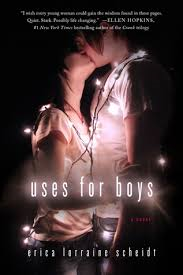
Uses for Boys – Erica Lorraine Scheidt

usesforboysHer bed is a raft on the ocean. It’s a cloud, a forest, a spaceship, a cocoon we share. I stretch out big as I can, a five-pointed star, and she bundles me back up in her arms. When I wake I’m tangled in her hair.

That’s Anna, protagonist of Erica Lorraine Scheidt’s YA novel Uses for Boys, remembering.  She remembers a time before stepfathers and step brothers, a time she calls the “tell-me-again-times.” Those were the times when her mother would gather her up and tell her how much she was wanted, “more than anything in the world.”

Unhappily for Anna, the “tell-me-again” times don’t last long. By the time Anna is eight her mother insists that she is “too big for stories.” It’s also the time that Anna’s mother decides that she is tired of being alone and ventures out to meet a man  and it seems just about any man will do. Early on Anna learns the lessons that her mother teaches: men will leave.

Despite its cover depicting kissing teens wrapped in twinkley lights, Uses for Boys is mostly the grim story of Anna’s search for unconditional love – the love she should have received from her mother if her mother had bothered to pay attention. Instead, Anna must seek it elsewhere and she does it by chasing (mostly) sexual relationships with boys.

First there’s Desmond who sticks his hand on Anna’s thirteen-year-old breast on the school bus in full view of his friends.  Then there’s Joey. And Todd. You get the picture. It isn’t until Anna meets Sam and his family that Anna realizes what she’s been looking for (and willing to give away to get it): family.

“Sam’s house is everything I wanted, but didn’t know to want.” Anna says about her first visit to Sam’s house. “I want to wrap myself in this house like a blanket.”

It’s hard not to sympathize with Anna. She has a nice home but a mostly absent mother. No one has guided her to make wise choices about her body or to value herself as a person, so it’s difficult to blame her when she makes poor decisions.  Scheidt’s writing is often poetic although I’m not sure if that makes Anna’s life any easier to bear.

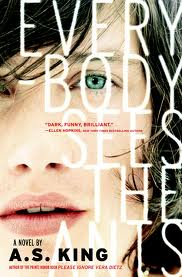
Everybody Sees the Ants – A.S. King

antsEvery night in his dreams, 15-year-old Lucky Linderman, the narrator of A.S. King’s novel Everybody Sees the Ants, visits the jungles of Vietnam in a desperate attempt to rescue his paternal grandfather, Harry, who never made it home from that conflict. In the real world, Lucky isn’t as lucky as his name. In the real world he’s been at the mercy of bully Nader McMillan since he was a little kid and Nader peed on his shoes during a horrible encounter in a restaurant washroom. Lucky wants to stand up to Nader, or at least stay out of his way, but that isn’t always possible and Nader is a huge jerk.

I used to hang out with Nader sometimes, too, because of Danny, even after all the crappy shit Nader did to me, but that was before my famous freshman year social studies suicide-questionnaire screwup, when he decided to make my life a living hell again.

Lucky is an only child. His father is a chef who doesn’t seem able to cope with anything even remotely confrontational, an unfortunate predicament when you have a teenager who is being picked on. Lucky’s mom is a little more proactive, but even she isn’t aware of everything going on in her son’s life.  After a particularly nasty incident at the community pool, Mrs. Linderman and Lucky fly out to visit family in Arizona. This summer changes Lucky’s life for a variety of reasons.

Given the fantastic nature of Young Adult literature these days, I doubt most young readers would even bat an eye at Ms. King’s use of magical realism in Everybody Sees the Ants. It’s relatively obvious that Lucky’s dreamy ventures into the jungle to save Grandpa Harry are related to his own circumstances in the real world and his inability to defend himself against Nader. The dual narrative would work just fine like this, but magical realism operates on another level, one where magical elements are a natural part of an otherwise realistic world. So sometimes Lucky wakes up with leaves in his hair or clutching tokens of his latest visit to Laos. He also sees a lot of ants.

Ants appear on the concrete in front of me. Dancing ants. Smiling ants, Ants having a party. One tells me to hang on. Don’t worry, kid! he says, holding up a martini glass. It’ll be over in a minute.

Everybody Sees the Ants is a well-written, thoughtful and thought-provoking. Lucky is a character who will resonate with young adult readers who are climbing their own hill towards adulthood, but can’t quite see over the top.


Saturday Sum-up

Here’s what I found bookish & interesting on my tour around the Internet this week:

1959634_520905814693205_161299657_n

From Coffee and a Good Book

(https://www.facebook.com/coffeandagoodbook)

I remember reading The Diary of Anne Frank when I was eleven or twelve. I was profoundly moved when I visited the Annex while visiting Amsterdam in the early 1990s. The world continues to surprise and dismay me:

Hundreds of Anne Frank’s book and other books about the Holocaust have been vandalized in dozens of libraries in Japan. Read the story here.

Dare I say it? Here’s an event even more sacred than the Stanley Cup! That’s right, it’s almost time for Canada Reads.

Do you know that there’s this whole thing on YouTube where people talk about the books they buy.  It’s compulsively watchable especially for those of us who buy multiple books at a time.

Have a great day.

More Than This – Patrick Ness

morethanthis“Here is the boy, drowning” is the opening line of Patrick Ness’s confounding, riveting, philosophical and profoundly moving YA novel More Than This. If you are a regular visitor to The Ludic Reader then you know that I am a Ness fan. I have huge love for his novels A Monster Calls, The Knife of Never Letting Go, The Ask and the Answer and Monsters of Men.

More Than This was my pick for book club and we gathered on Feb 18th to discuss the novel over dinner. The discussion was rich with differing viewpoints; the dinner itself was only moderately successful. My book club – despite the fact that three of its members, myself included, are teachers – doesn’t normally choose YA fiction. The only other book we’ve chosen from the YA canon was Marcus Zusak’s amazing novel, The Book Thief. In any case, as I was reading I had a feeling that my choice might not float everyone’s boat. Even I had trouble wrapping my head around Ness’s ‘big picture.’

More Than This is the story of a boy who, in the novel’s riveting opening, drowns. And then he finds himself, well, not dead.

He seems to be lying on a concrete path that runs through the front yard of a house, stretching from the sidewalk to a front door behind him.

The house is not his own.

And there’s more wrong than that.

For 163 pages, Seth (as the boy eventually remembers) is alone in a post-apocalyptic town in England. This is, as it turns out, the town where he grew up before he moved to America. Bits and pieces of his story come back to him when he dreams. For example, he remembers something horrible happening to his younger brother, Owen, something for which his mother never forgave him. He remembers Gudmund,  a boy for whom he has more than friendly affection. He remembers his other friends, H and Monica. As his previous life filters back to him in dreams, he tries to survive in this new wasteland.

And then he meets Regine and Thomasz. And the Driver, a creepy faceless virtually indestructible being whose sole purpose seems to be to try to catch the three teenagers. And how can there be just them? What has happened to the world?

One member of book club was certain that Seth was suffering from a psychotic break and while her argument is certainly plausible, I am happier taking Seth’s dilemma at face value. I think it’s a more interesting book if we believe in what he sees and experiences. Otherwise, it just feels like Bobby Ewing in the shower.

But believing what Seth does also proves problematic. I’ll admit: I was often confused. But that didn’t negate my love of Seth or his new friends. And, ultimately, I think More Than This has interesting things to say about the myopic lens through which teenagers view their lives. As Seth’s past and present converge, he starts to understand how his story, the story of his life, is unknowable, but that “whatever is forever certain is that there’s always more.”

The last couple of pages of More Than This are outstanding. Some members of my group felt that the novel was 150 pages too long, but I disagree. I think the novel packs a terrific punch and Seth’s journey from self-centered adolescence to manhood is memorable and magnificent.

I continue to be filled with admiration for Ness and look forward to talking about this novel with my students. But make no mistake – this novel has lots to offer thoughtful readers of any age.

Highly recommended.

Saturday Sum-up – February 15

Here’s what I found bookish & interesting on my tour around the Internet this week:

6fa389c166845d58b0b214b55af9eccd

I’m celebrating my 500th post with today’s Saturday sum up.  That’s a lot of book talk, people!

Do you judge a book by its cover? Of course you do. Buzzfeed has posted 22 Absolutely Stunning Victorian Book Covers

ca7d632dd0ddbade22edddec8f6c6cbaI actually love this idea for the classroom – at the end of the year, I’ll have have students choose a book from my library that they loved and wrap it up for students to choose the following year. It’s something I actually planning on doing in the spring.

I watch my students choose books all the time. The students who don’t really care about reading just walk over to the shelves and grab a book – barely even looking at the cover. The keen readers do what I do: look at the cover, read the blurb on the book, maybe even check out the first paragraph before deciding to take it. More and more students are asking me for my advice – and they all know that I LOVE to offer it.

Not that I ever have any trouble deciding what to read next – I practically have a bookstore’s worth of unread titles in my house – but if you’re someone who isn’t sure what should be next on your tbr pile, check out What Should I Read Next, a handy site that lets you enter your current read into a search engine and then spits out a variety of titles which might interest you. It’s very cool.

And did you know there is actually a book cover archive? lr shelves

Book covers are actually one of the reasons (okay, call me superficial) that I prefer physical books over virtual ones. My reading life is like art…and looking at my heaving bookshelves never fails to give me pleasure.

I’d like to celebrate my 500th post with a little contest. Leave a comment below, or follow my Ludic Reader Facebook page (link on the right) and I’ll enter your name in a draw to win a bookish prize pack. Contest closes tomorrow (Feb 16) at midnight (Atlantic time).

Have a great Saturday!