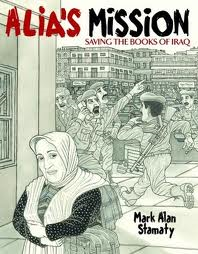
Alia’s Mission: Saving the Books of Iraq – Mark Alan Stamaty

aliaMark Alan Stamaty’s graphic story will resonate with anyone who has ever visited a library. Its simple black and white drawings tell the story of Alia, a woman who lives and works in Iraq during Saddam Hussein’s reign. Iraq is on the verge of chaos as Britain and the U.S. are planning to invade the country and remove Hussein from power.
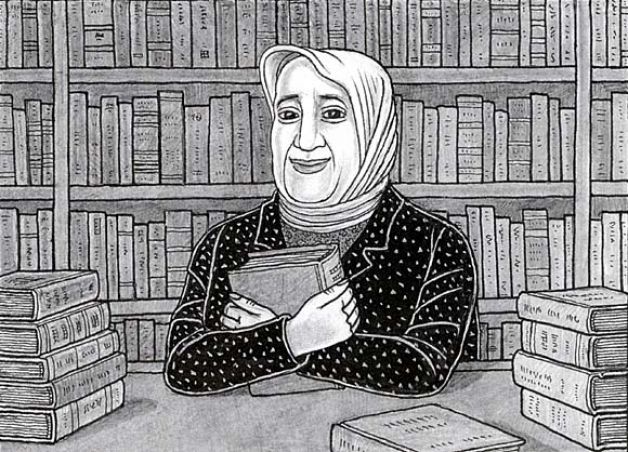
Alia is the head librarian at the Basra Central Library. We are told that “ever since she was a little girl, books have been a source of happiness and adventure for her.”  When she reads the story of how the Mongol Invasion destroyed the Baghdad library resulting in the loss of  “irreplaceable treasures” Alia worries that something similar could happen to her beloved library. alia1 When the fighting starts in Iraq, Alia feels compelled to save the books in the library. When she can’t get her own government to help her, she starts moving the books herself.
Alia’s Mission: Saving the Books of Iraq is a simple story, geared for younger readers.  It only took me about ten minutes to read, but don’t let that deter you from checking it out. Alia’s story proves what book lovers already know: books are worth fighting for.

Where Things Come Back – John Corey Whaley

wherethingsThe members of the English department at my school decided before Christmas that it might be fun to have a book club to look specifically at Young Adult fiction. There’s so much great fiction for teens…and this will be a no-pressure way to look at some of the titles.

Last night I hosted the first meeting where we discussed John Corey Whaley’s much-lauded debut novel Where Things Come Back. Seriously, this book has won several prizes including two of the biggest: Michael L. Printz and William C. Morris. I’ve learned that prize winners don’t always live up to the hype and I am sad to say that I’d put this book in that category.

It started off okay.

I was seventeen years old when I saw my first dead body. It wasn’t my cousin Oslo’s. It was a woman who looked to have been around fifty or at least in her late forties. She didn’t have any visible bullet holes or scratches, cuts or bruises, so I assumed that she had just died of some disease or something; her body barely hidden by the thin white sheet as it awaited its placement in the lockers. The second dead body I ever saw was my cousin Oslo’s

Intriguing enough. And the character’s voice was distinct and I was interested. But to say that Where Things Come Back fulfilled its early promise would be a lie. And my fellow teachers agreed; not a single one of them liked it either.

The first question I asked at last night’s gathering was whether or not we should hold YA  to the same rigorous standards we hold other literature to. And the answer is – of course. As a teacher I want my students to read the really, really good stuff, but I also know that often times they will read stuff that is below my lofty standards. Geesh – I often read stuff that is below my lofty standards! I have many books on the shelves in my classroom that are just…yuck. But someone will read those books and love them and as long as they are reading I feel like they are walking that path towards better literature.

Once we determined that no one liked the novel, we set about trying to determine why.

“Fiction is driven by character,” said Karen. (Karen is a colleague and has also been one of my dearest friends for the past 30-odd years. Our philosophies are quite similar when it comes to teaching and reading.) “I just didn’t like any of the characters in this book.”

Other teachers had problems with the novel’s narrative structure.

And who cares about the woodpecker? None of us.

Where Things Come Back  is mostly Cullen  Witter’s story. He lives with his parents and younger brother, Gabriel, in Lily, Arkansas. Lily is a backwater little town where nothing ever happens. One day Gabriel just vanishes.  Where Things Come Back is also, superficially at least, the story of Benton Sage, a teenager doing missionary work in Ethiopia who suddenly has a crisis of faith. How Cullen and Benton’s stories connect finally becomes apparent in the novel’s final pages – but by then I didn’t care. And that’s a failing of two things: character and telling. So much of this story is told to the reader.

Perhaps there was just too much story to handle. Cullen’s journey after Gabriel’s disappearance might have made for some riveting reading.  Benton’s story, too, had potential. But the clunky denouement tipped over into melodrama that didn’t serve either character, really.

One teacher had a student who read this book and loved it and I will happily add it to my classroom bookshelf – but I won’t be rushing to recommend it.


The Death of Sweet Mister – Daniel Woodrell

sweetmisterThe Death of Sweet Mister is grim and virtually unputdownable.

Woodrell’s novel is set in 1960s Ozarks. I don’t know anything about the Ozarks but Wikipedia tells me that “It covers much of the southern half of  Missouri and an extensive portion of northwestern and north central Arkansas. The region also extends westward into northeastern Oklahoma and extreme southeastern  Kansas.”

Morris “Shug” Atkins is thirteen and lives with his mother Glenda and her boyfriend, Red. “The idea that Red was my dad,” says Shug “was the official idea we all lived behind, but I wouldn’t guess that any of us believed it to be an idea you could show proof of or wanted to.”

Red is an ex-con, a mean snake of a man who drinks and does drugs and abuses both Shug and his mother.

…Red was near only the height I was at that age, but a man. He had the muscles of a man and all those prowling hungers and meanesses…

Their lives are just about as miserable as you might imagine them to be.

The three of them live in a house that “looked like it had been painted with jumbo crayons by a kid with wild hands who enjoyed bright colours but lost interest fast”  in the middle of a graveyard. In exchange for their dwelling, Shug maintains the cemetery – mowing and the like.  Red contributes to the family’s meagre existence by sending Shug off to break into houses and steal pharmaceuticals. You know it’s only going to be a matter of time before Shug gets caught.

Shug’s mother, Glenda, is the sort of woman who will never “get too plain or too heavy. Her eyes were of that awful blue blueness that generally attaches to things seen at a distance.” She copes with Red’s nastiness by drinking rum and cola, her special “tea”.

None of the characters in The Death of Sweet Mister seem to hold out much hope for a brighter future, but then into the narrative drives Jimmy Vin Pearce. His shiny green T-Bird and his flashy clothes seem to signal hope, like maybe Glenda and Shug might be able to escape the smallness and meaness of their lives. But one day Shug comes home to find blood had “whirled and whirled in the kitchen.”

I loved the language of Woodrell’s book. I loved Shug’s voice. I felt tremendous sympathy for him. He is a product of his environment and so it’s not particularly surprising how his story concludes. Doesn’t make it any less sad, though.

Highly recommended.


The Boy – Lara Santoro

theboyAnna is 42. The boy is 20. And yes, he has a name. His name is Jack. The Boy is the story of Anna and Jack’s brief but catastrophic affair and as tragic love affairs go, this one has its strengths and its weaknesses.

Anna meets Jack at a party her neighbour, Richard, is throwing.

The boy wore dark, baggy clothes so there was no discerning the profile of his body, yet Anna could tell, simply by the way he sat, that it must be a good one. She raised her eyes to his with calculated slowness and found to her surprise that they were free of fear, free of pretense, free of the myriad layers stretched by age over the human eye.

Okay, I’m not really sure what the last bit means but I’m just going to paraphrase here and say that Jack had it goin’ on and Anna was eventually unable to resist. He is pretty cocky.

There are some obstacles to their forbidden love. For one thing, Anna has an eight-year-old-daughter, Eva, who often seems like more of an adult than her mother. For another Anna has a slightly checkered past. (There were/are some issues with alcohol/drugs.) Then there’s her ex back in England. And okay, yes, there’s a huge age gap between Anna and Jack but Jack isn’t a witless sex toy.  (And there’s no graphic sex in this book anyway.) It’s all complicated and fraught, as lives often are.

When Eva goes to spend a few weeks of the summer with her dad, Anna gives in to the boy’s siren call and before you can say MILF, Jack’s moved his stuff into Anna’s house. Partly, Anna is looking for a way to reclaim her own lost youth. Partly, she seems to genuinely care for Jack. But they are living in a bubble that bursts when Eva returns from England.

Driving Eva to school one morning Anna loses her temper:

“Is this a joke?” she said. “After everything I have done for you? After all the sacrifices I’ve made for you, suddenly I have the audacity to tell you to stop ordering me around and you’re not talking to me. I have given you everything, Eva. Everything. I have traded my own life for yours. In fact, I haven’t had a life. You have. I haven’t. And this is what I get.”

This is, I think, the impetus for Anna’s affair with Jack. He’s this beautiful, motherless boy who wants her and she wants to forget, just for a little while that she has responsibilities that make it impossible for her to have whatever she wants. “We have children,” she says. “We have children, and they’re nothing we’re prepared for.”

Ain’t that the truth.


Creep – Jennifer Hillier

creepDumbest. Book. Ever.

Seriously…I can’t even believe I read it.

So, Dr. Sheila Tao, she of the velvet lips, is a psychology professor at Puget Sound State University. Apparently she’s an expert in human behaviour – except not so much because she doesn’t realize that Ethan Wolfe, the 23-year-old teaching assistant she’s been sleeping with for the past three months, is actually bat-shit crazy. That’s probably because she’d been blinded by lust. He’s HAWT. Oh, also, she’s a sex addict but until her father died (trigger) and she took up with Ethan (couldn’t resist the hawtness), she’d been living sex-free.

Anyway, she’s fallen in love – for realsies.  His name is Morris and he’s an ex NFL player and an ex-alcoholic and just an all-round great guy. He doesn’t know about Ethan, or Sheila’s addiction to sex. He’s also apparently never questioned why his 39-year-old, once-married girlfriend won’t have sex with him. He kinda likes that about her.

Okay, so Sheila’s got a problem. She’s now engaged to Morris so clearly she has to dump Ethan. Which she does…on page five. Understandably, Ethan doesn’t take it too well. Obviously: he’s a psychopath. Nevertheless, I knew I was dealing with crazy people pretty early on – like when Sheila becomes infuriated when Ethan turns the tables on her and announces that he’d “never wanted this to be a long-term thing. But you were so goddamned needy. You kept telling me not to go.” Really? Who cares who breaks up with whom? Move on, Sheila.

Anyway, Ethan threatens to expose their affair with some video he’d apparently taken of them doing the deed and so Sheila has no choice but to let him remain her T.A. But then that’s not enough for Ethan, he’s got to kidnap her and hold her hostage in the retro-fitted basement of the mansion he paid for with cash and you see where all this is going, right? Oh…and he’s a master of disguise, people. A master – with like amazing custom-made silicone masks and make-up skills etc.

It’s just all ridiculous. All of it. What does Ethan do with Sheila once he has her all chained up in his basement. Um. Nothing. He keeps her drugged and makes her wear adult Depends. That is until he finally lets her go to the bathroom and that, my friends, is one reason to steer clear of this book. It’s meant to be scary. A thriller. No, no. This is what we get:

It was ridiculous to be embarrassed about a fart – after all, she was being kept here against her will, and what could be worse than having to urinate in adult diapers – but she was ashamed nonetheless.

We get to hear about her cramps and the stench and how grossed out Ethan is.

He was looking at her with such shock and disgust that, despite her abdominal pain, she couldn’t resist a chuckle.

“Well, what did you expect? I’ve been here for days, you cocksucker.” Sheila grunted again. “I’m not done. I suggest you get the fuck out.”

Even Sheila has to admit that it was “quite possibly the world’s stupidest conversation.” One of many, Ms. Hillier.

Critics loved this book. Loved it. There was nothing frightening, suspenseful, or creep-y about it. Stock characters, a deux ex machina visit from Morris’s estranged son, Randall…I’m just…gah. Hillier is compared to Chelsea Cain. Please read Heartsick instead.

The Most Dangerous Thing – Laura Lippman

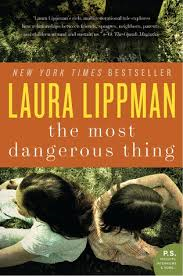
mostdangerousIt took me forever (it seems) to finish Laura Lippman’s novel The Most Dangerous Thing, a book that the Wall Street Journal called “a creepy, genre-bending, stand-alone novel.”

Lippman’s novel is the overly long story of five childhood friends, Gwen, Mickey, Tim, Sean and Go-Go who are reunited as adults after Go-Go is killed in a car accident that may or may not have been deliberate.  The real story, though, is about what happened to these five when they were kids – a bit of nasty business that is alluded to and then covered up. It’s the seventies, after all.

The story bounces between then and now and the big reveal  – which comes in the novel’s final pages – doesn’t really equal the sum of its parts. My problem with the book is that it took forever to get anywhere and when I finally arrived I was just sort of meh about the whole affair. As a novel of “psychological suspense,” as the Globe and Mail purports it to be, it was lacking the actual suspense.

Actually, I think the real mystery in The Most Dangerous Thing is  who is telling the story because Go-Go is dead and the remaining four are all referred to in the third person. In the author’s notes at the back of the book Ms. Lippman says: “I don’t want to tell you.”

As another kind of story, The Most Dangerous Thing is quite compelling.  The children are children only in flashback; we are actually dealing with them as adults and their lives are messy and complicated – as lives tend to be. We also spend time with their parents and those lives aren’t much better. But the thing is – is The Most Dangerous Thing a family drama  times three or is it a mystery, or a thriller, Maybe it’s social commentary?

Ms. Lippman says it’s her most autobiographical novel – geographically speaking. She says “I have been circling the unusual neighbourhood in which I grew up, determined to write about it, but wanting to wait for the right time and story.”

If I hadn’t been itching for the book to move along already, I would probably have enjoyed it more. Ms. Lippman is a wonderful writer, no question…but this book was only just okay for me. Maybe if I hadn’t been expecting something different, I would have been less disappointed.

Me Before You – Jojo Moyes

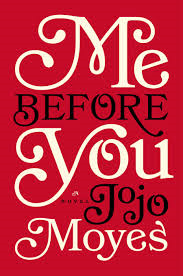
mebeforeyouLast night, my book club met to discuss Jojo Moyes’ novel Me Before You.  I was the only member of the group that didn’t love the book. I liked the book a lot, but it won’t go down in my personal annals as one of the most amazing, romantic, beautiful, (insert other appropriate adjective here) books ever. Trust me, I am the gushiest romantic on the planet so it came as just as much of a shock to me when I didn’t get all weepy and heartbroken at the end.

Me Before You is the story of  26-year-old Louisa Clark, an ordinary girl from an ordinary family. Until recently, she’d been working at the local cafe in the little market village she lives in in England. She lives at home with her parents and her younger sister, Treena and Treena’s young son, Thomas. Their house is too small; they don’t have much money and so when Louisa loses her job at the cafe she is desperate to find new employment so she can continue to contribute to the family coffers.

Enter the Traynors.  They live in Granta House which is on the other side of Stortfold Castle – I presume that’s the posh side. Camilla Traynor hires Louisa as a companion to her son Will who, two years ago, had been in a serious motorcycle-meets-pedestrian accident that has left him as a quadriplegic. He’s a bit of a git.

Circumstances being what they are, Louisa doesn’t feel like she’s in a position to quit, even when Will is arrogant and unkind. Instead, Louisa is determined to make friends with Will and so, of course, that is what happens. Will softens because of Louisa’s friendship; she  flourishes because of his. They are both irrevocably changed.

Me Before You was an easy book to read. I motored through 200 pages on Saturday night. I liked Louisa and I liked Will and I liked their story. Although I didn’t agree with the stylistic choice Moyes made to interrupt the story’s predominantly first person narrative to give readers a glimpse into the heads of a few other characters, I did appreciate this observation by Will’s mother:

It’s just that the one thing you never understand about being a mother, until you are one, is that it is not the grown man – the galumphing. unshaven, stinking, opinionated offspring – you see before you, with his parking tickets and his unpolished shoes and complicated love life. You see all the people he has ever been rolled into one.

I am a mom and so I knew what she was talking about. Could I have lived without her insights?  Absolutely.

I also took issue with the epilogue. It felt cheap to me. Way, way too tidy. But no matter.

One of the questions  posed last night was whether or not Me Before You was a great book. Define great. That’s the cool thing about reading. Everyone’s definition of what makes a great book is going to be different. I am going to have to figure out how to articulate what makes a book great for me and get back to you.

As for Me Before You – it was a very enjoyable book to read. Could I niggle over a bunch of little things? Sure, but none of them really detracted from my reading experience which was totally pleasant. I didn’t shed any tears, but I did well up once or twice. So, almost, Ms. Moyes.


I Take You – Nikki Gemmell

tlc tour hostThanks to the folks at TLC, I’m back with another book by Nikki Gemmell. You’ll recall that I took a look at her novel With My Body last month and today I am going to talk about her book I Take You. Beginning with The Bride Stripped Bare, With My Body and I Take You form a trilogy of sorts, although the characters and plots don’t really overlap so each book could be read independently of the others. I Take You

I Take You is the story of Connie Carven, wife to Clifford, a banker who has been seriously injured in a skiing accident and can no longer – erm – perform certain husbandly duties. No matter, Cliff has found other ways to satisfy his wife, most of them involving his Mont Blanc pen and a wicked imagination. At first Connie seems like a willing participant in her husband’s increasingly perverse sexual games, but one night Cliff takes things a teensy bit  (okay, a lot) too far and something in Connie–I don’t want to say snaps–changes.

Truthfully, I didn’t get Connie’s relationship with Cliff. Like, at all. Pre-accident he was  “her American…someone to be laughed at and admired and feared in equal measure.” Cliff is over-the-top rich and Connie “grew quickly addicted to this way of living — loved the sparkly, unthinking splash of it.”

When she tries to explain her relationship with Cliff to her father she says:

“We’re happy , Dad. As we are. I’m his wife and I have a job to do. A very important one. Now more than ever. Only I can help him, only me. I’ve become crucial to him in a way that’s impossible to explain.”

We are meant to believe that Cliff’s accident was the impetus for her to fall in love with her husband because “it tipped their sex life into something else. Because Cliff gouged out — patiently, gently, beseechingly — the very marrow of his impenetrable wife. It had been the trigger that now tipped him into something else.”  But the thing is, I don’t see these two as having very much of anything at all except perhaps for a co-dependent relationship and a penchant for kinky sex. And I never saw Cliff as a nurturing, kind man and he can’t kiss worth a damn, apparently.

Then, matters get more complicated when Connie meets Mel — he’s the gardener who takes care of the private communal garden that belongs to the houses on their square. It was at this point that I had a ‘wait a minute’ moment. I Take You was starting to sound suspiciously like another book: D.H. Lawrence’s novel Lady Chatterly’s Lover.  According to the blurb on the back (which I hadn’t bothered to read) Gemmell was indeed inspired by Lawrence’s infamous book.

Everything you think is going to happen, happens. Mel and Connie start an illicit affair; Cliff gets all bent out of shape about it; Connie chooses personal happiness over marital responsibility.

So how does I Take You compare with the other erotica out there? Well, Gemmel’s writing is still lovely (although I think I might have appreciated this book a bit more if I’d had more of a breather between this one and With My Body.) It’s often quite graphic, so if that’s not your cup of titillation tea — perhaps this isn’t the book for you.

I can’t say I was quite as enamoured with I Take You as I was with With My Body. I may need a little while longer to figure out why Connie’s journey just didn’t resonate with me the way the narrator in With My Body did.

Easy – Tammara Webber

easyEasy was easy to love. So easy, in fact, that I started it and finished it in pretty much one sitting – abandoning all else yesterday after I got home from school and fed my kids –  reading until I’d turned the last page…about midnight. This novel by Tammara Webber hit all my guilty-pleasure buttons and a few others besides.

I think Easy is one of those novels that belongs in this New Adult category I see everyone talking about.  I actually wish we didn’t spend so much time shelving books into these categories  but, anyway, I can see how this book just crosses over the line from YA. For those of you unclear about the New Adult designation, Goodreads defines it as ” fiction [that] bridges the gap between Young Adult and Adult genres. It typically features protagonists between the ages of 18 and 26.” I also think that New Adult is a little more forthcoming with details of a sexual nature. (I should also add that at Indigo, this book is filed in the Adult section.)

Okay, so now that we’re all on the same page with regards to New Adult, let’s get to the good stuff.

Easy is narrated by Jacqueline Wallace,  a sophomore (for Canadians who don’t know what that means because we don’t use those terms it’s 2nd year) at an unnamed university. She’s there because she followed her high school sweetheart, Kennedy.  He’s just dumped her. She’s heartbroken. But that’s not how Easy starts.  It starts with Jacqueline leaving a frat party and getting jumped by someone she knows and always considered benign. Buck has other things on his mind, though, and the relatively graphic nature of the attack is an early indication that we’re leaving strictly teen fiction behind.

Jaqueline has a knight in shining armour, though. The stranger, Lucas,  pulls Buck off Jaqueline before he actually rapes her and beats the crap out of  him. After Jaqueline declines a trip to the hospital or police station, he whisks her to her dorm and safety.  I pretty much fell in love with Lucas from this moment on.

I stared back into his clear eyes. I couldn’t tell their color in the dim light, but they contrasted compellingly with his dark hair. His voice was softer, less hostile. “Do you live on campus? Let me drive you. I can walk back over here and get my ride after.”

Easy is a lot of things, but what it isn’t is the clichéd bad boy, good girl story we’ve all read a thousand times. Yes, Lucas has a pierced lip and lots of tattoos and a body to die for (I wish Ms. Webber’s editor had told her it was biceps not bicep though – even when referring to one) but anyway – that’s beside the point. He’s HOT. Smokin’ hot. And smart. And kind. And mysterious. And tragic. And sometimes, when he speaks, there was swooning – and I’m not just talking about Jaqueline’s reaction.

There’s more than just a love story going on in this novel. To Ms. Webber’s credit she’s created several other compelling minor characters including Jaqueline’s roommate bestie, Erin, and, Benji,  a boy in Jacqueline’s Economics class. The book offers lessons about personal safety and girl power without being didactic. In addition, there’s enough push/pull between Jaqueline and Lucas to sustain Easy through its 310 pages and I never once found myself screaming “just get on with it.”  If Lucas sounds just a tad too mature for his age – his childhood experiences will explain all. He’s a keeper and Jacqueline deserves him.

Will it go in my classroom library?  Yep. I can think of a dozen girls who will love it as much as I did.

Some Girls Are – Courtney Summers

somegirlsareSome girls are bitches. In Courtney Summers’ compelling and disturbing YA novel Some Girls Are, calling the characters bitches is an extreme understatement. Some of these girls are psychopaths.

Regina Afton used to be one of the Fearsome Fivesome – a pack of girls led by Anna Morrison. Every high school has them, I suppose, that group of mean girls who take extreme pleasure in ruining the lives of others. That said, I don’t recall any from my high school days (yeah – okay, it was a million years ago!) and I don’t know of any at the school where I teach – at least none as venomous as this. And man, these girls are really, really awful.

The novel opens at a party where “everyone is wasted.” Everyone except Regina, that is,  because it’s her turn to be the designated driver, a job she takes relatively seriously even though it’s “boring.”  When she tries to rouse a passed out Anna, she encounters an obstacle of another kind: Anna’s equally intoxicated boyfriend, Donnie.

I’d turned him down in the ninth grade. Anna says we’ve been close to hate-fucking ever since, which is too gross for me to even contemplate. It’s a gunshot kind of thing for her to say – a warning. The way she says it, it’s like she can see it happening, and the way she says it lets me know I better not let it happen.

But then the unthinkable almost does happen and when Regina turns to another member of the Fearsome Fivesome for help and advice, she suddenly finds herself frozen out of the group she was once an integral part of.

The interesting thing about Regina is that she isn’t all that likeable. She’s mean. She wasn’t always mean, though. That would have to be true for readers to root for her even a little bit, but her exterior is so prickly it takes a while to warm up to her. Like, a long while. And I found that interesting. She’s an anti-hero.

Life becomes almost unbearable for Regina once Anna and Kara, Regina’s replacement, get going. It’s not just covert tactics they employ to ostracize Regina – they humiliate her, physically abuse her and truly make her life a living hell. Regina has no allies because when she was part of the clique, she’d been horrible to just about everyone in the school.

I’m  used to everyone’s eyes on me; that’s nothing new. When you’re Anna Morrison’s best friend, people look. We’re the kind of popular that parents like to pretend don’t exist so they can sleep at night, and we’re the kind of popular that makes our peers unable to sleep at night. Everyone hates us, but they’re afraid of us, too.

There’s really no relief for Regina until Michael  Hayden – one of her former victims – slowly lets her into his life. And with his friendship comes Regina’s redemption.

Okay, I’m a teacher – I know that the vast majority of teens aren’t like the people portrayed in this book – but some of them are. Some teenagers are nasty, messy, insecure, and hateful. And hopefully some of those will, like Regina, have the opportunity to make amends for the damage they do.

Some Girls Are crackles with real energy and I couldn’t put it down.