The House of Mirth by Edith Wharton

Edith Wharton’s novel, The House of Mirth, seems every bit as relevant now, some 105 years after it was first published. The novel follows the fortunes (and misfortunes) of Miss Lily Bart, a stunningly beautiful woman about town. The town in question: New York City.  Despite her attractiveness, Lily is without a husband and without a fortune. In order to maintain her lifestyle – which up until now has depended on the kindness of her rich friends – Lily must marry…soon and to her financial advantage.

Wharton’s novel trails after Lily and her consorts, following them to the Hamptons and Monte Carlo, in and out of fabulous homes where words are carefully chosen and one small misstep can cost someone their standing in society. This is a novel about class and entitlement. Lily has nothing but her beauty and although it is clear from the beginning that she is in love with someone else, and he her, marrying is out of the question.

Lily is a wonderful creation and Wharton’s novel is filled with the minutia of the time. My copy even had footnotes to help me navigate some of the more unfamiliar terms of the day. For that reason, the novel certainly isn’t a quick read. The prose is dense and often seems artificial; surely people didn’t speak this way?

As a heroine, Lily might be hard to sympathize with. Modern women might find her quest to marry for money reprehensible. She uses her looks to her advantage, spends money she doesn’t have and seems impossible naive for someone who is pushing 30. But then, really, I know lots of women who play the very same games nowadays, always looking for an advantage and willing to climb the ladder (social or otherwise) by any means necessary.

I thoroughly enjoyed Wharton’s novel and am glad it was chosen as one of our ‘classic’ reads for this year’s book club.

My copy of the novel is one of Penguin’s Product Reds, an imprint where 50% of the profits from sales go towards  the Global Fund to help eliminate Aids in Africa. About bloody time, don’t you think?

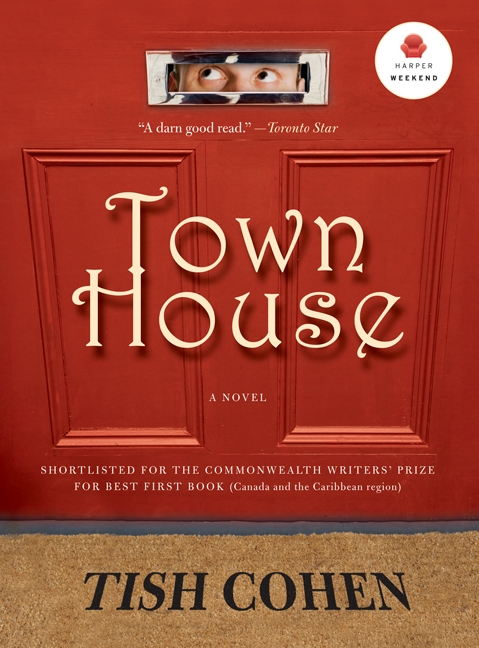
Town House by Tish Cohen

You can’t help but think that Tish Cohen is going for Hollywood with her novel Town House. There’s the wacky ensemble cast: Jack Madigan, son of deceased rock legend Baz Madigan; Jack’s son, the eccentric stuck-in-the-70’s teen, Harlan;  Jack’s ex-wife, Penelope, and her soon- to- be new husband, Yale; the strangely mature girl-next-door, Lucinda and Dorrie, the real estate agent so inept and adorable you just know she and Jack will end up together. (It will come as no surprise that Town House is, in fact, destined for the big screen.

As for the plot, well, Jack’s agoraphobic; he can’t leave the house without having a meltdown – so he doesn’t leave.  He rigs up a ‘groper’ to retrieve the paper and the mail; Harlan looks after the groceries and Jack lives quite happily in the huge (albeit, slightly decrepit) Boston town house his father left for him. The hilarity starts when the money stops and the bank decides that the house must be sold.

Town House isn’t all that funny, though. Sure, it ticks along, but the characters didn’t really interest me. And some of the plot twists just seemed contrived and unrealistic. I absolutely hated the ending. Cue music, already.

Sometimes the plot seems to be pointing in one direction – for example Jack is apparently a master paint mixer. He has discovered (and understands) the perfect white. A subplot involving that goes nowhere.  Also, I thought his love-interest was spineless. And, despite his illness, of which, I admit, I know nothing, Jack isn’t all that likable. How is he, after all, able to bust free of his illness when Lucinda needs him, but can’t do the same for his own son?

So – I didn’t love this book. It was moderately entertaining, and might make an amusing film, but it wasn’t my cup of tea.

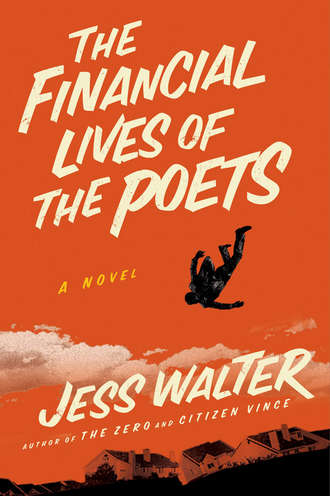
The Financial Lives of Poets by Jess Walter

Here’s a book I never would have chosen for myself in a million years, but which actually turned out to be better than I thought it would. The Financial Lives of Poets follows one week in the life of a middle-aged guy named  Matt Prior. Matt lives somewhere in America with his wife, two young sons and senile father. Matt used to be a newspaper business writer, but he took a buy-out so he could start a website which would deliver financial advice through poetry. It’s no surprise that it flopped. A couple bad investments and the economy’s belly flop later and Matt (and his family) are in serious financial trouble.

The plot of The Financial Lives of the Poets really begins when Matt hits the 7-11 to buy a gallon of milk. He’s not sleeping much these days – his mind is in a constant state of chaos trying to figure out how he’ll pay the bank the $30,000 plus he’s missed in mortgage payments, how he’ll keep his two young sons in private Catholic school and how, most importantly, he’ll keep their dire situation from his wife, a woman he loves but is sure is having an Internet relationship with an old boyfriend. At the 7-11 he meets a couple of low-level thugs. He ends up getting stoned with them and before you know it, Matt’s selling hydroponic weed.

Despite its serious subject matter, The Financial Lives of Poets is often laugh-out-loud funny.

Should anyone doubt that our miserable time here on Earth is just a sad existential joke, here is the cruelest thing I can imagine describing: my father (who is obsessed with sex, like a lot of dementia sufferers) – at seventy-one years of age, frail, balding, with a paunch that looks like it should wear its own pair of jockey shorts –  recently had ten days of crazy sex with a twenty-one-year-old stripper with long smooth legs and two big round silicone funbags, and the poor son-of-a-bitch doesn’t remember a thing about it.

Despite the often comical narrative, Walter tackles some weighty issues: how do people cope with the failing health of their parents, (Matt’s desire for his father to have just one moment of lucidity is heartbreaking); how do you save a marriage, why are we so concerned with having more stuff The Financial Lives of Poets doesn’t necessarily offer solutions, but time spent with Matt as he works through his problems is time well-spent. Funny and intelligent.

The Shadow of the Wind by Carlos Ruiz Zafon

This novel has been on my tbr list for a long time so I was thrilled when it was chosen as our book club pick.  Zafon’s  novel has been universally praised by famous writers (Stephen King called it “one gorgeous read”) critics  (Booklist said the book was “rich, lavish storytelling”) and everyone in my book club loved it. Except me. I didn’t hate the book; I enjoyed reading it.

Let me explain.

Ten-year-old Daniel, son of an antiquarian bookseller, is still suffering from the death of his mother – whose face he can no longer remember. His father decides to take him to The Cemetery of Forgotten Books, a labyrinth of passages and shelves – almost impossible to navigate.

This is a place of mystery, Daniel, a sanctuary. Every book, every volume you see here has a soul. The soul of the person who wrote it and of those who read it and lived and dreamed with it. Every time a book changes hands, every time someone runs his eyes down its pages, its spirit grows and strengthens.

Traditionally, when someone visits the Cemetery, he or she is allowed to choose one book and then they must promise to safeguard that book for all time. Daniel chooses The Shadow of the Wind by Julian Carax.

Daniel falls in love with the novel, a story about a man searching for his real father. He is so enchanted by the novel that he decides he must read everything by Carax and it is this quest that kick starts the novel.  Carax is something of a mystery himself and Daniel’s quest to learn more spans several years, introduces him a cast of broken and sinister characters and leads the reader on an adventure.

I think that’s what my problem was with this book.

I heard a regular customer say that few things leave a deeper mark on a reader than the first book that finds its way into his heart.

I think my expectations for the book and what the book was actually about didn’t actually jibe.  I had no trouble turning the pages, but ultimately The Shadow of the Wind was more of a stuffed-to-the-brim melodrama than a meditation on first books or even books in general.

As Daniel begins his quest to track down further Carax novels, a strange and somewhat threatening man offers to buy The Shadow of the Wind. Of course, this just redoubles Daniel’s efforts –  a quest that yields some surprises.

I guess, ultimately, my reservations about this book come from the hype. If I hadn’t heard so much, I might have been swept along. The writing is great (despite the fact that it’s a translation), the characters are sympathetic…but for me…the book was too long, and sometimes I felt that all the pieces just locked into place just a little too neatly. Daniel explained it best when he said:

the structure of the story began to remind me of one of those Russian dolls that contain innumerable ever-smaller dolls within.

Despite my own personal feelings, however, I would certainly encourage other readers to check this book out. It’s a lot of fun – the kind of book you can truly lose yourself in.

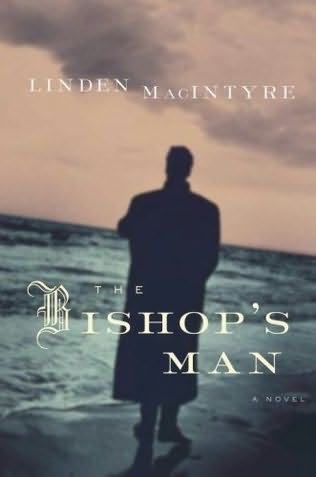
The Bishop’s Man by Linden MacIntyre

The Bishop’s Man was the 2009  Giller Prize winner. For those of you who aren’t familiar with the Giller, it’s Canada’s largest annual prize for fiction, netting the winner $50,000. MacIntyre, a well-known Canadian journalist who has won nine Geminis for broadcast journalism, beat out Anne Michaels, Colin McAdam, Annabel Lyon, and Kim Echlin.

I’m not sure The Bishop’s Man is a book I’d pick up on my own, but it’s this month’s book club pick. Still, the novel’s opening pages had me intrigued.  Its narrator, Father Duncan MacAskill,  is an intriguing character, but then he starts to spiral out of control and so does the book.

MacAskill is known as the “Exorcist.”  The Bishop  sends him to clean up after fallen priests – men who have sullied the name of the priesthood by engaging in sexual relationships with – well – anyone. As we all know, celibacy is one of the tenets of the priesthood.

MacAskill isn’t without his own secrets, though. When the bishop decides to send him back to his childhood home, MacAskill is forced to confront his own demons. Isolated from the world in backwoods  Cape Breton MacAskill suddenly realizes how lonely he is and he begins to drink heavily.

The Bishop’s Man is a page-turner. Lots of things are hinted at, enough to make the reader wonder: about the suicide of a young man and his relationship with a charismatic priest who has since left the order and married; about MacAskill’s time  in Honduras, revealed in snippets from his diary; about where his relationship with Stella, a woman in the village, might be headed; about his childhood.

MacIntyre juggles all these various threads and I guess this is where the book failed for me. I’m not a moron,  but sometimes the out of sequence narration was really a pain-in-the-ass. I’m all for the elliptical, but I’m not sure it served the story in this instance (unless MacIntyre was trying to mimic the disordered state of MacAskill’s mind.)

I haven’t read the other novels on the Giller shortlist and so I’d be curious to see how they stack up against this one. I guess the one thing The Bishop’s Man has going for it is a sense of immediacy. The Catholic Church has certainly had its share of troubles. Whether or not the novel’s verisimilitude is enough to overlook its other issues is up to the reader, I suppose.

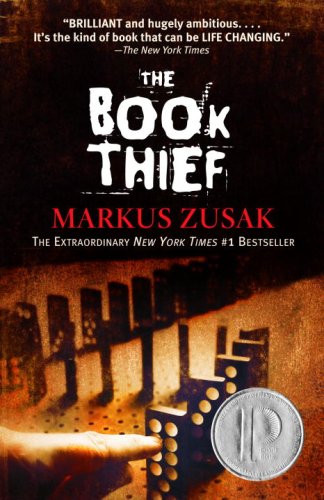
The Book Thief by Markus Zusak

I still remember the feeling I had the first time I read The Diary of Anne Frank. I was probably about 11 or 12. No teacher could have explained the horrors of Nazi Germany to me as well as Anne did. She was speaking to me. Many years later, I visited her attic annex and it was a profound experience.

Reading The Book Thief was also a profound experience for me.

I don’t even know how to begin to talk about The Book Thief. The New York Times said it was “the kind of book that can be life changing.” I mean, you start a book like that with a little trepidation: can it really live up to all the hype? For the first 30 pages or so I thought, “no.” Last night, as I closed the book and wiped the tears away I thought, “every person alive should read this book. I want to teach this book.”

The Book Thief has so many things going for it, I’m not sure where to start singing its praises.

The Book Thief is the story of Liesel Meminger.  Liesel is almost ten when she ends up in Molching with Hans and Rosa Hubermann, her new foster parents. It is 1939. In Nazi Germany.

Readers are either going to be totally enchanted or annoyed by the story’s central conceit: the novel is narrated by Death. “Here is a small fact, ” Death tells us. “You are going to die.” For the next 500-plus pages, Death is our constant companion. Sometimes the action unfolds without commentary, other times he weighs in.  Although I found the first 30 pages or so a bit of a slog, I soon settled into the book’s rhythms.

Then I fell in love with Liesel. And Hans. And Rudy. And Rosa.

Liesel is extraordinary. She and Hans bond late at night, when Liesel’s nightmares wake her, and Hans teaches her to read. Books and words are central to Liesel’s story. So is her friendship with Rudy, the boy next door. Through their eyes we see Hitler and Nazi Germany; we experience the atrocities and the small kindnesses. Zusak’s story is mostly about everyday things: hunger, pettiness, laughter, hope, cruelty and kindness.

Liesel is sustained by the books she steals and anyone who loves words will appreciate and understand their ability to comfort Liesel. But she is also intelligent enough to understand how words can be used to hurt and coerce.

Where is Death in all this? He carts the souls of the dead off and is, in this story at least, a loving and benign figure.

Death gets the last word. He always does.

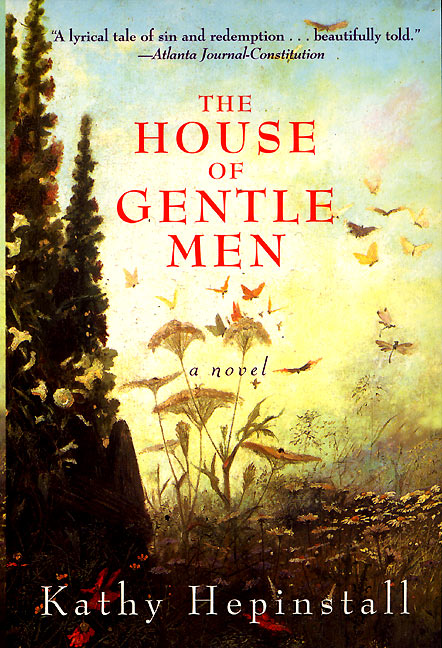
The House of Gentle Men by Kathy Hepinstall

My book club meets once every five weeks or so. It’s organized so that each of the ten members chooses one book per year…and the rule is that it has to be a book you haven’t read. The reveal is a big deal to us – we all love to see what’s coming next. Although we do have a big book store in town now, it’s still not always possible to stray too far off the beaten track. That’s why, when I was preparing my reveal in December, I took advantage of the great fiction sale at Book Closeouts. com. I read reviews and blurbs and blogs and finally made my decision. Book Closeouts had 12 copies of the book and they were $1.24 each…for a hard cover! So, I was able to buy a copy for everyone in the group and hand them out – gift-wrapped – at our Christmas meeting. So much fun!

Last night we discussed my pick. The House of Gentle Men has been on my radar for a long time. A few years back I read Hepinstall’s novel The Absence of Nectar which I liked quite  a lot.  There was something intriguing about the premise of The House of Gentle Men so I took a chance. I’m not sure that everyone in my book club would agree, but this book paid off for me.

The House of Gentle Men is actually the name of an establishment run by Mr. Olen, a single father who is hoping that if he makes up, in some way, for neglecting the wife who subsequently left him, she’ll return to him. He opens a house for Gentle Men, offering men who have the need to atone for some past wrongdoing the opportunity to redeem themselves.

“You think you could spend all night with someone, just kissing? Touching? Whispering sweet nothings? Maybe a little waltzing?”

These are the questions he asks, Justin, a young man who wanders into the house looking for a way to right his own wrongs.  Justin, as it turns out, has a lot to atone for. Seven years previous, while he was a young soldier on maneuvers, he came upon two fellow soldiers raping a young girl in the woods. Instead of doing the right thing, he took his turn.

Several lives intersect at the house for gentle men. Hepinstall deftly creates interior lives for even minor characters. All of them are damaged in some way; some of them are reprehensible; many of them deserve the redemption they so ardently seek.

This book took a few pages (about 75) to work for me. It seemed somehow cheesy –  this whole idea of a place where tired, frustrated, broken women could go to find comfort – not from sex  (although everything but intercourse is allowed), but from companionship. But, in the end, it did work . I grew attached to the characters, Charlotte in particular – who loses her voice (or chooses not to speak) after the attack. As she navigates her way out of her pain and anger, into the light offered by forgiveness, it’s almost impossible not to feel something for her.

So The House of Gentle Men may require a suspension of disbelief, but I think it’s worth it in the end.


Here’s a challenge for you…

If you check out my page On My tbr Shelf…oh dear, you’ll see that I have more than enough books to keep me reading for the next year (or three). My goal this year is to watch less TV and read more…and also to try not to buy any books other than what’s required for my book club.

Currently my tbr list is organized alphabetically. I’d love it if you’d take a look and help me prioritize my reading list. What’s on that list that I should be reading straight away because it’s awesome? What should I relegate to the bottom because, quite frankly, you have no idea why I’d want to read that.

I’d love to compile a list of 50 because that’s my reading goal for the year, so by all means…tell me what I should be reading in 2010.

Traveling with Pomegranates by Sue Monk Kidd and Ann Kidd Taylor

Having read The Mermaid Chair and  The Secret Life of Bees, both by Sue Monk Kidd,  I was excited when this was chosen as one of our book club selections. That was in November. I just finished reading the book now. What does that tell you?

Traveling with Pomegranates should have been a better book than it actually is. This is a mother(Sue)/daughter(Ann) memoir about travel, faith, love, creativity and writing. At the beginning, as I settled in, I thought that it was going to be quite compelling. I felt a kinship with Sue:

“I didn’t understand why I was responding to the prospect of aging with such shallowness and dread, only that there had to be more to it than the etchings on my skin” (4).

In Sue’s capable hands, this journey is – if not always engaging – at least well written and thoughtful. Sadly, I can’t say the same for Ann’s part. I found her whiny and entitled. I never warmed up to her.

Mother and daughter visit Greece together in 1998. Ann is 22 and Sue mourns the loss of the little girl she was. She is also acutely aware that something troubling is going on with her daughter. At first glance it might seem that Ann’s disappointment has to do with the fact that she didn’t get into graduate school, but as the mother/daughter writers unspool the story it turns out that they are both looking for something more complicated. And they spend the rest of the book kneeling at the feet of Madonnas (and other powerful female icons) in Greece and Crete and France…trying to find it.

Ultimately, it turns out that graduate school was never what Ann truly wanted; she wants to be a writer. And how wonderful for her that her mother is and that they could do this book together.

Out Stealing Horses by Per Petterson

Out Stealing Horses has been on my tbr list for ages, so I was happy when it was chosen as the December read for my book club. I was also surprised because the woman who chose generally dislikes translations and this novel was translated from the original Norwegian. Anyway, I settled in and finished the book (one of the few in the group who actually did) and even after discussing it – I am not sure how I feel about the book.

The story concerns 67 year old Trond Sander who is living in isolation after the death of his second wife. The novel moves seamlessly between Trond’s every day concerns (getting his driveway plowed and stacking wood) and his memories of his youth. The summer he was 15 he and his father had left Trond’s mother and sister in Oslo and come to a cottage quike like the one Trond is currently inhabiting. It was there that Trond’s world was knocked off-kilter – not only by a tragedy that occurred in his friend Jon’s family, but also by events in his own life.

It took my a while to settle into this book. It’s a quiet novel and while the writing is quite powerful (particularly Pettersen’s descriptions of the natural world), I found the long sentences strangely difficult…too many commas or something. Still, I eventually stopped wanting to add full stops and gave myself over to Trond’s remarkable childhood recollections.

I’m not sure this book will appeal to everyone and so it’s not one that I can whole-heartedly recommend. That said – I do think it achieves something quite remarkable. As Trond’s story unfolds we learn a universal truth – sometimes there are no satisfactory explanations for life’s mysteries.