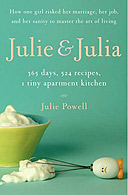
Julie and Julia by Julie Powell

Julie Powell had me at : “we both recognize the genius of Buffy the Vampire Slayer.” That revelation comes early on in her book Julie & Julia, a  memoir that builds upon the “Project” she embarked on just before she was about to turn 30. Disheartened with her life as a government drone in New York City, Powell was, as many of us were, looking for meaning in a post 9/11 world. But further to that- she was looking for meaning in her own life. Or at the very least, she was looking for something meaningful to do.

While visiting her parents in her native Texas, Powell confiscates her mother’s copy of Mastering the Art of French Cooking (MtAoFC) by Julia Child.

“Do you know Mastering the Art of French Cooking? You must, at least, know of it,” Powell says. “It’s a cultural landmark, for Pete’s sake!”

And from this cookbook…and a conversation with Powell’s long-suffering (and incredibly supportive) husband, Eric, springs the Julie/Julia Project. Powell decides to cook every single recipe from the book and blog about it.

Blogging. Ahh, yes. Curious thing, that. You write and people read and the next thing you know you have a book deal. Or something like that.

Julie & Julia follows Powell’s project from beginning to end- and includes everything from her failures in the kitchen to her friend’s extramarital affairs. It is laugh-out-loud funny and occasionally self-indulgent (but what blog isn’t?). It’s peppered with expletives and bits of strange insight.

So this search for meaning (personal meaning, at least) has been done before. Elizabeth Gilbert (whom Powell thanks in her acknowledgments) did it in a little best-seller called Eat, Pray, Love. I liked Powell’s book better and here’s why…

I could relate to Powell. And, no, it’s not just because of her Buffy-love (although that certainly earned her free points.) Where Gilbert took a year off to spend four months each in three different countries, Powell could only afford the occasional day of playing hooky from her crap job while she cooked her way to enlightenment. Her house was unkept, she drank too-much and swore even more. She didn’t set off on the Project for fame and glory- she wanted to find an essential piece of herself that she thought was missing.

And she does…one recipe at a time.

Late Nights on Air by Elizabeth Hay

“Psychologically astute, richly rendered and deftly paced. It’s a pleasure from start to finish.” – Toronto Star

Canadian author Elizabeth Hay won the Giller Prize for her novel, Late Nights on Air. Obviously, you begin a book like this- one with a certain pedigree already attached- with a little trepidation. I mean, what if you hate it?

I am happy to report that this is a beautiful book.

Set in Yellowknife in 1975, the novel tells the story of the intersecting lives of Harry (a CBC radio station manager), Dido (a beautiful announcer who has fled to the North to escape a complicated, but profound, relationship), Eleanor (the station’s secretary), Eddy (the station’s technician), Ralph (a local photographer and on-air book reviewer) and Gwen (a newcomer, who had come to the North inspired by the tragic story of an explorer named John Hornby.) Although Gwen is clearly the central character of the book, Hay deftly manages the interior lives of all the characters and, in doing so, makes us yearn to know more.

The last third of the book takes four of the characters on a tremendous canoe trip, inspired by the life of Hornby. That trip and the consequences of it forever change the lives of these characters.

I have always said that I hate a book that flashes us forward in time and shows us where the characters are now. Hay employs this device, but it seems almost organic. And at the book’s conclusion, I felt truly sad to be parting company with these people.

Ultimately, though, this book is about silence, longing, isolation, community and what love looks like.

I highly recommend it.

The Thirteenth Tale by Diane Setterfield

“The Thirteenth Tale is a cleverly plotted, beautifully written homage to the classic romantic mystery novel… Gothic elements are skilfully re-imagined in a peculiar tale of madness, murder, incest and dark secrets…. It is a remarkable first book, a book about the joy of books, a riveting multi-layered mystery that twists and turns, and weaves a quite magical spell for most of its length.” –The Independent

Diane Setterfield’s first novel is a wonderful accomplishment. This is a book lover’s book- even the book’s cover and the weight of the pages appealed to the bibliophile in me. But beyond the aesthetics of the book, Setterfield tells a rip roarin’ tale, an old-fashioned tale filled with mystery and intrigue and personal ghosts.

Margaret Lea lives a quiet life, working with her father in their little antiquarian bookstore. We know very little about Margaret other than the fact that she is close to her father, but not to her mother. She is unmarried. We don’t know how old she is. We do learn, early on, that she is a surviving twin- a fact she stumbles upon, quite by accident when she is young, a piece of her family history which haunts her throughout her life.

Then Vida Winter, the most celebrated writer of the time, writes to Margaret inviting her to hear the truth of her life- a life which has been largely reclusive. This story is the subject of The Thirteenth Tale. And it is a tale that is Gothic, relying on the conventions of literature from the 18th and 19th centuries: ghosts and secrets and unrequited love abound in its pages. It’s a page-turner in the very best sense.

And as the story’s mystery unravels, you’ll find yourself wondering whether all the clues were there from the very beginning…and want to go back to trace the breadcrumb trail.

Bel Canto by Ann Patchett


I wasn’t sure I was going to like Ann Patchett’s novel Bel Canto when I started reading it. I mean – it didn’t seem like a book that would either grab my interest or hold it. But a funny thing happened to me about 75 pages in…I started to care about these characters.

Bel Canto is actually based loosely on something that happened in Lima, Peru. On December 17, 1996, the terrorist organization Tupac Amaru took over the Japanese embassy there. From this nugget of truth, Patchett unspools the story. It’s Mr. Hosokawa’s birthday and the government of  an unnamed South American country are hoping he will open an electronics plant there. They have hired Roxane Coss to sing and the only reason Mr. Hosokawa has agreed to attend the party is because she will be there; he is an opera fan and she is the best soprano in the world. The party is being held at the home of the country’s Vice-President; the President had to attend to ‘matters in Israel’. In the middle of the festivities, the house is taken over by a group of terrorists.

What happens when a group of wildly different people are forced to share close quarters? The book forces the characters- a wonderful, eccentric group- to be both more and less than they are. A priest, for example, finally has the opportunity to hear confession; Mr. Hosokawa’s translator, a central character named Gen Wantanabe, gets to converse in Spanish, German, French, English, and Russian and because of it- is privy to people’s most private thoughts and Roxane Coss uses the power of her voice to tame the savage beast- so to speak.

The terrorists themselves are also central to the story and we learn much about them…and I dare say, we come to care for them every bit as much as we care for the privileged party-goers. There is a message to be had in this book and Patchett’s fine prose illustrates that without hitting the reader over the head. This was a book club selection and, truthfully, not everyone loved this book.

For me, though, this is a book about love- how it shapes us and changes us, how beauty transforms and transports and how you just might take a risk if you thought it might be your last opportunity to do so.

Eat, Pray, Love by Elizabeth Gilbert

Elizabeth Gilbert’s well-received book, Eat, Pray, Love tells the story of the author’s own search for meaning in the world. Personal meaning, that is. In order to find it, she takes a year off from her very successful writing career (she’d have to be successful, wouldn’t she) to spend four months in each: Italy (for pleasure), India (for prayer) and Indonesia (for balance).

This book is huge– practically every woman alive will have read it. or plans to– and don’t let my cynicism dissuade you. Gilbert is a wonderful writer. It’s hard to sustain the perfectly pitched conversational tone her book does and not be a skilled craftsman, but…

But, here’s the thing. Lots of people wish they could stop their hectic, horrible, messy, complicated, screwed up lives in order to find their deeper purpose; in order to mend their broken hearts and psyches, in order examine their place in the world, their connection to the people with whom they share the planet…and their relationship with a higher power (God, in Gilbert’s case, although she says “I could just as easily  use the words Jehovah, Allah, Shiva, Brahma, Vishnu or Zeus.”) Not everyone has the means. Plus, although Gilbert’s journey was preceded by a divorce, she has no children. Trust me, I’d love four child-free months in Italy, too.

That said, the book is so engaging that even though I didn’t internalize Gilbert’s search, I certainly enjoyed listening to her talk about hers.

Fingersmith by Sarah Waters

There are always novels that you envy people for not yet having read, for the pleasure they still have to come. Well, this is one. Long, dark, twisted and satisfying, it’s a fabulous piece of writing…and unforgettable experience.” Julie Myerson, Guardian

Fingersmith
was my choice for book club. As always, I deliberated endlessly over what to choose and wanted to pick something off my ‘to read’ shelf. Despite the book’s length, reviews had promised a page-turner and they were right.

Fingersmith
is a difficult book to talk about without giving anything away – there are more plot twists and deceptions packed into its 500 plus pages than any other book in recent memory.

Set in Victorian England, it concerns the life of Sue Trinder, who was orphaned at birth and  raised by Mrs Sucksby and her ‘family’ of fingersmiths or petty thieves. At 17, Sue is drawn into a plot to bilk Maud Lilly, another orphan who lives in a remote estate with her Uncle, out of her fortune. This plot and the effect it has on Sue’s life (and Maud’s as well) is told first from Sue’s point of view and then from Maud’s and it is intricate and filled with intrigue.

There are some Dickensian elements – Waters makes some social commentary, although not overtly, and there is melodrama galore- but, ultimately, Fingersmith is a highly satisfying read populated with intriguing characters and more chilling dips than a roller coaster.

Highly recommended!

The Story of My Face by Kathy Page

An elegantly compelling story of how a young girl’s obsession forever changes the lives of those around her…a disciplined exploration of the complexity of human motivation and our need for redemption. – Lynne Van Luven, Vancouver Sun

Kathy Page’s The Story of My Face is at once compelling and confounding. Page is a skilled enough writer that you are pulled into the mysterious events surrounding Natalie’s disfigurement– the cause and extent of which you learn little about until the book’s final pages– from the beginning. But the central event of Natalie’s life is buried in adult-Natalie’s search for meaning and understanding.

We meet Natalie Baron as an adult on her way to Finland to research Tuomas Envall, the leader of a strict religious sect. Natalie’s own connection to the cult comes in the form of Barbara Hern, her husband, John, and son, Mark. These three people have important roles to play, particularly Barbara for whom Natalie has a possessive affection.

Page weaves past and present together, but for me– the story was at its most compelling during the time Natalie is with the Herns on a retreat with other members of this religious sect.

The story of what happens to her face is actually not as startling as how she impacts the lives of the Hern family, most specifically Barbara.

Saturday by Ian McEwan

I am not a McEwan newbie. Saturday is the 4th of his books I have read and, thus far, my least favourite. But even though I didn’t love this book, I would still have to praise McEwan’s ability to write. If I have a criticism of Saturday it’s that it’s over-written. That may be the fault of McEwan’s decision to set the novel in one day in the life of neurosurgeon, Henry Perowne.

Saturday is Henry’s favourite day. He plays squash, does some shopping and on this particular Saturday– anticipates the homecoming of his daughter, Daisy. But, of course, this Saturday isn’t going to be like all the others. He awakens in the middle of the night and watches from his bedroom window as a plane– streaming fire, cuts across the sky to (crash, he assumes) land at Heathrow.

This event wouldn’t be the cause of so much concern if this story wasn’t set post 9/11 and on the very day when hundreds of thousands on people are set to march in London’s streets to protest the war against Iraq.

As Henry sets out to accomplish his long list of things to do before his daughter arrives he gets into a minor fender bender that will propel (although not quickly) the book towards its denouement. Whether or not you find the ending, or the book for that matter, satisfying, will depend on how much you care for Henry and the minutia of his Saturday.

Sweetness in the Belly by Camilla Gibb

British born, Canadian-raised writer Camilla Gibb’s stunning new novel Sweetness in the Belly divided my book club. I was among those who loved it. The book tells the story of Lilly, born to hippie parents and brought up as a Muslim, after their death, in the city of Harar. Her story is told by layering her young years in a politically charged Ethiopia with her life as a nurse in London. It’s a fascinating picture of a world torn apart by poverty and prejudice and by Lilly’s own beliefs. It is also a love story as we wait with Lilly to learn the fate of her lover, Aziz.

I know nothing of the politics of Ethiopia under Emperor Haile Selassie. I know very little about the Muslim religion, but Gibb’s beautiful prose and attention to detail (she conducted fieldwork in Ethiopia for her PhD in social anthropology) makes this book a page-turner. The characters are complex and interesting and the day-to-day struggles of the women, in particular, are riveting. I was both gutted and elated by book’s end.

Rise and Shine by Anna Quindlen

Anna Quindlen’s book Black and Blue, was the first novel my book club ever read together- almost eight years ago now. I remember liking it quite a lot, so when her novel Rise and Shine was chosen for last month, I was quite happy.

Until I started reading.

Meghan and Bridget are sisters living in New York City. They couldn’t be more opposite. Meghan is the famous host of a morning TV show, Rise and Shine, and her sister, Bridget, the dowdier and less confident one, is a social worker. You can already see where this is going, can’t you?

Although Meghan seems to have it all- a wonderful husband and a fabulous son, both of whom Bridget adores, there are cracks in her seemingly perfect life and one day she utters something wholly inappropriate on live television and her world comes crumbling down. And the problem with the book is  I could care less.

What follows is 269 pages of Meghan and Bridget trying to sort through their personal baggage and come to terms with each other on a different level. And all of that was okay- not great, but okay…until the last 50 or so pages when Quindlen does what I hate….takes all the lives she’s dangled in front of us and propels them into the future giving us the ‘happily ever after’ she so clearly thinks they deserve.

Ugh.