The Widow – Fiona Barton

Although I often enter book giveaways on Good Reads, I never win. That is until a couple weeks ago when an ARC of Fiona Barton’s novel The Widow showed up at my door compliments of Penguin Random House Canada. The book was cleverly packaged in an ‘evidence bag’ along with a package of Skittles. Awesome to get a book in the mail, but Skittles, too. Jackpot!
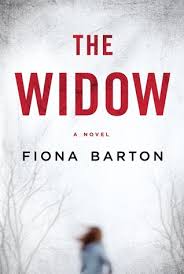
widowI seem to be on a roll these days, reading books I can’t seem to put down. I motored through The Widow in a couple of days.  Although the subject matter (porn) may not appeal to everyone, rest assured that there’s no graphic content in Barton’s book. Your imagination will fill in the gaps, trust me.

Jean and Glen Taylor are an average thirty-something couple living in England. Jean is a hairdresser and Glen, a banker. They are unremarkable  until they come under the scrutiny of the police because of the disappearance of a little girl, Bella, who has gone missing from her front garden.

Told from various viewpoints, The Widow mostly revolves around Jean as she decides whether or not to share her story with the press. Glen has been killed, “knocked down by a bus just outside Sainsbury’s” and now Jean no longer has to keep his secrets or put up with his “nonsense.”

When we are not with Jean, we’re with Kate, the reporter who is trying to convince Jean to tell her side of things or Bob Sparkes, the police detective trying to figure out what happened to little Bella. It’s Bella’s disappearance that drives Kate and Bob, although each of them views the crime from a different perspective. As Sparkes follows a trail of clues, many of which don’t pan out, Jean reveals her own misgivings about Glen and what he does on the computer in the spare room. Slowly she unravels the story of her marriage and while she may seem like a victim, there is something unreliable about her narrative. She admits “I had to keep his secrets as well as mine.”

The Widow delves into the sordid world of online pornography, skeezy Internet clubs where men hide in booths to pay-per-view and magazines sold out of the back of trunks at gas stations on the motorway. When Jean finally learns about her husband’s preferences

he told me it wasn’t his fault. He’d been drawn into online porn by the Internet – they shouldn’t allow these things on the Web. It was a trap for innocent men. He’d become addicted to it – “It’s a medical condition, Jeanie, an addiction.” But he’d never looked at children. Those images just ended up on his computer – like a virus.

Whether or not Jean suspected Glen of anything is one of the key elements that will keep you turning the pages. Barton’s crisp, no-nonsense prose is another. The Widow will keep you turning the pages way past your bedtime.


The Replacement – Brenna Yovanoff

Brenna Yovanoff’s YA novel The Replacement is quite unlike anything I have read before, which is a good thing. It was well-reviewed when it debuted in 2010 and I have been wanting to read it for a while. I was particularly intrigued by the cover, which is creepy, although I try not to chose books based on their cover alone – that has lead me down a few crap book paths.

Gentry isn’t like other places and Mackie isn’t like other 16-year-olds. He’s a replacement,  left in the crib of a human baby who was spirited away by the strange inhabitants of the the labyrinthine world beneath Gentry.

7507908Mackie lives with his older sister, Emma and his parents. He has a best friend, Roswell. He has a crush on a pretty girl, Alice. But he also can’t abide blood. Or get close to anything made of stainless steel. Or go to church, even though his father is a preacher.
Mackie knows he is different. “I dream of fields,” he says, “dark tunnels, but nothing is clear. I dream that a dark shape puts me in the crib, puts a hand over my mouth, and whispers in my ear. Shh, it says. And, Wait. “

The way his sister tells it, someone took her real brother in the middle of the night when she was four years old.

When she reaches her hand between the bars, the thing in the crib moves closer. It tries to bite her and she takes her hand out again but doesn’t back away. They spend all night looking at each other in the dark. In the morning, the thing is still crouched on the lamb-and-duckling mattress pad, staring at her. It isn’t her brother.

When the little sister of Mackie’s classmate, Tate,  goes missing, Mackie is forced to confront his own origin story and this leads him the The House of Mayhem and The Morrigan, a girl who rules there and whose “jagged teeth and tiny size made her seem more implausible, more impossible than all the rest.” All the rest of what, you might ask? Yeah, that would be the living dead girls. The Morrigan  tells him “We were so pleased that you survived childhood. Castoffs generally don’t.”

When Tate asks for Mackie’s help, he is reluctant; he’s got his own problems. But when The Morrigan offers to help Mackie feel better even he can’t resist. There is a strange barter system between Mayhem and Gentry: Mayhem thrives on adulation. But Mayhem isn’t the only world beneath the town. The Morrigan has a sister, and she thrives on blood sacrifice.

Mackie doesn’t fit in, but  whether or not Yovanoff meant for his journey to be a metaphor (like Joss Whedon’s monsters in Buffy the Vampire Slayer) hardly matters because The Replacement is a thrill ride.

Great book.

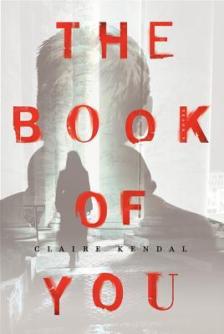
The Book of You – Claire Kendal

You know how sometimes you start a book and you just can’t put it down – that’s what happened when I started reading Claire Kendal’s debut novel The Book of You. I mean, it’s not an original story – woman sleeps with guy after a bad break up and guy turns out to be a psychopathic stalker – but Kendal’s novel had an extra layer of creep, plus some interesting things to say about victim-blaming.

Thirty-eight-year-old Clarissa works as an administrator at the university in Bath. Her book of youaffair with Henry, a professor, has recently ended. Rafe also works at the university and has just published a new book on fairy tales and it is at his book launch that Clarissa drinks too much. She hadn’t really wanted to go, but he’d sent her three invitations. Hello, alarm bells.
“It is the night that I make the very big mistake of sleeping with you,” she writes in her journal. She has decided to follow the advice from the literature on stalkers and document everything. Clarissa knows she has to build a case before she can even consider going to the police.

I am trying to piece it all together. I am trying to fill in the gaps. I am trying to recollect the things you did before this morning, when I started to record it all. I don’t want to miss out a single bit of evidence – I can’t afford to. But doing this forces me to relive it. Doing this keeps you with me, which is exactly where I don’t want to be.

Everything about Rafe is skin-crawlingly-creepy.

“It makes me want to scream, the way you say my name all the time,” Clarissa writes. And Rafe has plenty of opportunities to say it. He is everywhere: outside her apartment, lurking at train stations, waiting for her outside the court room where she is on jury duty. He sends her things: chocolates, notes, flowers. He calls and texts her dozens of times. He rallies her friends against her, isolates her further. He makes Clarissa question her own sanity.

If there is a bright spot in Clarissa’s day, it is the time she spends in court, listening to the rather horrific details of a violent drug-related rape. It is here where she meets fellow-juror, Robert, a firefighter who recently lost his wife. As she and Robert become closer, Rafe becomes more aggressive.

The Book of You is an edge-of-your-seat thriller which also happens to be well-written. Clarissa refuses to let herself be a victim, but she is human and doesn’t always make the right choices. I never once thought “What?! Don’t do that!” though – which is certainly due to Kendal’s skill.

It’s a bit graphic, so if that’s not your thing perhaps this isn’t the book for you. However, I couldn’t put it down and highly recommend it.


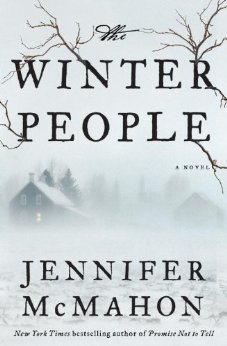
The Winter People – Jennifer McMahon

A few years back I read Jennifer McMahon’s debut novel Promise Not To Tell, and I enjoyed it a great deal. A couple years after that I read McMahon’s novel Dismantled, a book I did not like one bit. Now I’ve just finished reading The Winter People, and I have to say it falls sort of in between.winterThe Winter People is a story which bounces between present day and 1908. In the past, Sara Harrison Shea lives on the farm where she grew up with her husband, Martin, and her little girl, Gertie. West Hall, Vermont is well-known for its mysteries and ghost stories, many of which center around Sara and her family farm, a house filled with secret places and, well, secrets.
In her diary, Sara writes “The first time I saw a sleeper, I was nine years old.”

I had heard about sleepers; there was even a game we played in the schoolyard in which one child  would be laid out dead in a circle of violets and forget-me-nots. Then someone would lean down and whisper magic words in the dead girl’s ear, and she would rise and chase all the other children. The first one she caught would be the next to die.

Turns out, though, there is dark magic and Sara’s Auntie, an Indian woman who cared for Sara’s dying mother before she started sleeping with Sara’s widowed father promises to “write it all down, everything I know about sleepers.” In case it’s not obvious, sleepers are people brought back from the dead, but they only exist for seven days, you, know, unless they shed blood during that time – then they live forever.

In the present, nineteen-year-old Ruthie lives in Sara’s farmhouse with her mother, Alice, and her little sister, Fawn. One morning Ruthie gets up to discover her mother is missing. Cold tea on the table, truck in the barn – vanished into thin air.

Then there’s Katherine. She’s still grieving the loss of her son, Austin, when her husband, Gary, is killed in a car accident. Thing is, he told her he was going to be one place and he was actually in West Hall. Last seen: Lou Lou’s Cafe with Alice.

These disparate threads do come together by novel’s end, but I lost interest about half-way through. The Winter People is clearly meant to be a ghost story, but once crazy Candace shows up, intent on getting the missing pages of Sara’s diary so she can sell the secret of raising the dead so she can fight for custody of her son -yeah, right about then I was…c’mon. Oh, plus there’s a gun. Two guns actually. And other crazy shenanigans. And then, a lot of exposition to tie up those pesky loose ends.

When McMahon stuck to the ghost stuff…there were some creepy moments, but The Winter People is nowhere near as good as Promise Not To Tell.

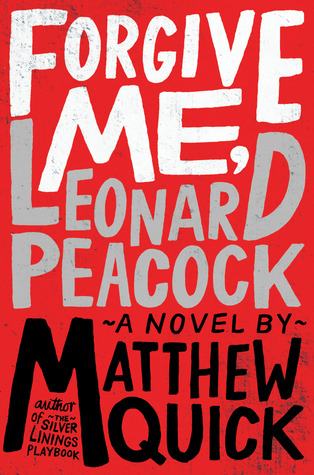
Forgive Me, Leonard Peacock – Matthew Quick

forgive meToday is Leonard Peacock’s 18th birthday. It’s also the day he has elected to kill himself – but first he has to kill his former best friend, Asher Beal.  Before he can do that, though, he has some gifts to deliver, gifts he’s wrapped in pink paper and packed in his knapsack along with his grandfather’s P-38 WWII handgun.

I want to give them each something to remember me by. To let them know I really cared about them and I’m sorry I couldn’t be more than I was  – that I couldn’t stick around – and that what’s going to happen today isn’t their fault.

Forgive Me, Leonard Peacock is a smart, funny, heartbreaking novel by Matthew Quick, perhaps better known for Silver Linings Playbook. I was immediately enchanted by Leonard’s charming, wry and honest narrative – he is immediately believable and sympathetic.

Leonard isn’t your run-of-the-mill teenager. He’s a thinker. He’s also in real emotional distress. It’s no wonder. His father, a former rock star currently on the run from the IRS, and his mother, a fashion designer who lives in NYC with her French boyfriend, are clearly terrible parents.

As Leonard makes his way through his day and we meet the four people he deems worthy of parting gifts, it’s easy to see how lonely and isolated he is.

First there’s Walt, the old man who lives next door. “I met Walt during a blizzard” Leonard tells us in one of the novel’s frequent (and often caustic) footnotes. Leonard’s mother, Linda, had asked him to go “shovel the driveway, even though it was still snowing, because she had to go out to meet another fake designer or some bulimic model.” Walt is an old movie aficionado and soon enough he and Leonard are quoting Bogart and Bacall back and forth at each other.

Then there’s Baback, a kid Leonard has known since grade nine. When Leonard discovers that Baback is an extremely talented violinist, he bribes Baback to let him sit and listen because listening to Baback play is “by far the best part of my day.”

Then there’s Lauren, the home-schooled Christian who hands out pamphlets at the train station. (Sometimes Leonard rides the train into the city, following random adults to see whether there is, in fact, any potential for happiness once you’re out of high school.) That’s where he first sees Lauren and he dreams of kissing her, although they can’t seem to overcome the obstacle in their way: Jesus.

Finally, there’s Herr Silverman, Leonard’s favourite teacher. Herr Silverman encourages his students to think for themselves, a quality Leonard feels is lacking in other faculty members. Also,

There have been days when Herr Silverman was the only person to look me in the eye.

The only person all day long.

It’s a simple thing, but simple things matter.

I’m a teacher; that hit me in the gut.

Leonard goes through his day, hinting at something horrible that happened between him and Asher, the something that necessitates his rash decision to end both their lives. With each gift, he half hopes someone will notice that something is wrong and, thankfully, someone does.

For anyone who has ever felt ‘other’, for anyone who ever considered ending their own life, for anyone who has ever felt neglected, unseen, or desperate, Forgive Me, Leonard Peacock is the book for you.

Highly recommended.

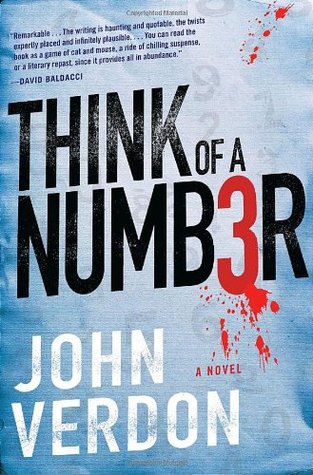
Think of a Numb3r – John Verdon

numberJohn Verdon’s debut novel Think of a Numb3r introduces readers to retired NYC detective Dave Gurney, the man responsible for catching several well-known serial killers. Now he lives a quiet life in Walnut Crossing with his second wife, Madeleine. He spends his time “enhancing, clarifying, intensifying criminal mug shots” which he sells through gallery owner Sonya Reynolds, a woman he spends just a tad too much time thinking about.

Out of the blue he receives a message from an old college classmate, Mark Mellery. Mellery is ” the director of some sort of institute in Peony and he did a series of lectures that ran on PBS.” Mark needs Dave’s help. He’s received a cryptic note:

Do you believe in fate? I do, because I never thought I’d see you again – and then one day, there you were. It all came back: how you sound, how you move – most of all, how you think. If someone told you to think of a number, I know what number you’d think of. You don’t believe me? I’ll prove it to you. Think of any number up to a thousand – the first number that comes to your mind. Picture it. Now see how well I know your secrets. Open the little envelope.

The note is creepy; the fact that the envelope contains the very number that Mark thought of, creepier still. Mark claims that the number he thought of –  658 – “has no particular significance to me.” The note also asks Mark to send $289.87 to  a post office box in Connecticut.  Mark has sent the money, but the check has not been cashed. It’s a perplexing situation and Mark is looking for some guidance.

Think of a Numb3r is a well-written mystery but I found it just a tad slow. Even after the bodies start to pile up, I felt like the same evidence was being recounted  too often. A lot of names to remember- DAs and other detectives and such. As for Dave, he just seems pissed off all the time. Okay – yes, there’s been  tragedy in his life which may explain some of it away, but then the reconciliation with Madeleine at the end seems a little trite. We get to hear just a little too often how famous Dave is and , yeah, we get it – he’s caught some monsters.

As far as the mystery – it’s good enough. There are certainly some compelling elements – footsteps in the snow which vanish into thin air, clues left for the police which are clearly meant to demonstrate how smart the villain is. I just wish it had all unfolded a teensy bit quicker.

Everything I Never Told You -Celeste Ng

everythingLydia is dead.

It’s been quite a while since I’ve had such a visceral reaction to a book.  I read the bulk of Celeste Ng’s debut novel, Everything I Never Told You, on my snow day (a gift for a teacher, even if it’s only because we get to catch up on  marking/yearbook/planning – and, yeah, reading). I don’t think I will ever  be able to adequately explain how I feel about this book or these characters.

Lydia is just sixteen when she is found at the bottom of the lake across the street from her home in small-town Ohio. It’s the 1970s, the decade in which I, too, was coming-of-age. On the morning she is discovered missing (and it is this “innocuous” fact that sets the story in motion) we see the Lee family dynamic.

As always, next to her cereal bowl, her mother has placed a sharpened pencil and Lydia’s physics homework, six problems flagged with small ticks.

Hannah, Lydia’s younger sister is “hunched[ed] moon-eyed over her cornflakes, sucking them to pieces one by one.” Lydia’s older brother, Nathan, is sitting on the stairs trying to wake up. James, their father, has already left for his job as a professor at the local college.

Lydia is never late. She is never anything but compliant. She is a “yes” girl, the favoured daughter. It is only after her body is found that her story, and that of her family, begins to unravel. And yes, you will want to know what happened to Lydia, but trust me, it’s just one of the many things that will break your heart in this magnificent novel.

While every family has their own secrets and burdens, the Lee family is further set apart because Marilyn is white and James is Chinese. Their story is integral to Lydia’s story. Marilyn herself was a gifted student, earning a scholarship to Radcliff, and there – while she heads towards a degree in medicine – she meets James, a fourth year graduate student in history. She is ‘other’ because she is a woman studying in a field that is dominated by men; he is ‘other’ because he’s Chinese. All Marilyn knows is that “she wanted this man in her life. Something inside her said, He understands. What it’s like to be different.”

Marilyn’s career plans are pre-empted when she gets pregnant. She and James marry and move to Ohio.  Of course, their union wouldn’t be quite so problematic now (I’d like to think, but there are always some people….), but it’s the late 50s when they marry. Another world, another time. And life, fraught as it is, moves on. But why is it fraught? Because James grew up attending private school for free because his mother worked there as the cook and his father the janitor? Because he never fit in anywhere?  Because Marilyn didn’t want the life her mother had? Because of dreams deferred? And what happens when our parents’ lives are complicated and damaged by their own childhoods? Ah, we all know the answer to that question, right? It all trickles down.

Everything I Never Told You is an astounding, complex and heart-breaking look at the secrets we keep, not only from our families but from ourselves. Why we keep them, and the damage caused because of it, is just part of what happens in Ng’s book. The horrible longing we feel to crack ourselves open, the desire for true communication and intimacy, is another part. There wasn’t a single character in this novel I didn’t want to hug – I loved them all. That they were so fabulously human and fragile is a testament to Ng’s talent.

Highly (times a billion) recommended.

Descent – Tim Johnston

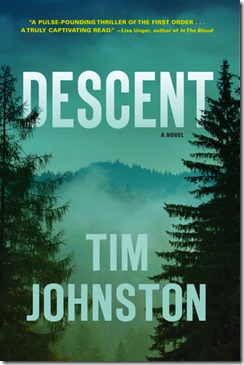
descent_thumbI love it when a book lives up to its hype…and if you believed the accolades plastering the back cover and the first three pages of Tim Johnston’s novel Descent, you’d certainly be expecting great things. The Washington Post said “Read this astonishing novel. The magic of his prose equals the horror of Johnston’s story.” Esquire called it “Outstanding” adding that “the days when you had to choose between a great story and a great piece of writing” are “gone.”

I don’t even know how this book came to be on my radar – I just know that I had a picture of it on my phone and a couple weekends ago I was pleased to discover that Indigo had topped up my Plum Points and I had $100 to spend…but only that weekend to spend it. So, I flipped through the pictures of covers and chose five, Descent being one of them. A couple of weeks ago, I mentioned the book on Information Morning and decided that since I had, I should probably read it. Once I started, I couldn’t stop.

The Courtlands are spending a little family time in the Rocky Mountains – a holiday before Caitlin, 18, heads off for her first semester of college. Her mom and dad, Angela and Grant, are clearly in crisis and then there’s Sean, Caitlin’s 15-year-old brother.

Caitlin is a runner and on the morning the story opens, she and her brother are heading up a mountain trail – Caitlin on her feet, Sean on his bike. Johnston meanders up the mountain with the pair as they bicker and share confidences. Then the unthinkable happens: Sean is hit by a jeep

…it came, monstering through the trees at an incredible speed, crushing deadfall, the whip and scream of branches dragged on sheet metal and then the suddenly unobstructed roar that made her wrap her head in her arms, the sound of tires locking and skidding and the thing slamming into what sounded like the sad tin post of a stop sign and then the meaty whump and the woof of air which was in fact the boy’s airborne body coming to a stop against the trunk of a tree.

When Grant and Angela get a call from the local police, they learn Sean’s been badly injured;  Caitlin is missing.

Fast forward a year or so. Grant has moved to the area and is living on the property owned by the local sheriff’s father, Emmet. Sean is on the road, driving from place to place picking up odd jobs. Angela is living with her sister when she isn’t hospitalized for depression/mental health issues. Caitlin’s disappearance has fractured the Courtland family.  It’s mostly the men that Johnston spends time with, allowing the reader a glimpse into their own personal hells: the father who can’t and won’t give up hope that Caitlin will be found and the son who can’t forget what happened that morning on the mountain.

The characters in Descent are trying to get on with it, but their personal pain is palpable. Grant works around Emmet’s property, sometimes pausing to “stare into the hills beyond the ranch, up into the climbing green mountains.” He hears his daughter’s voice and  “take[s] his skull in his hands and clench[es] his teeth until he [feels] the roots giving way.”

As for Sean, he is closed off from the world. In one particularly horrific scene, he puts himself in harm’s way in an effort to save a young girl – perhaps in an effort to atone for the ultimate crime of not being able to save his sister. It’s not the only time he does something selfless, albeit, foolish.  I just wanted to hug him.

We do spend less time with Angela, but that doesn’t mean that we know less about her. She moves through her much diminished world like a whisper. Only a parent who has suffered the loss of a child could truly understand Angela’s debilitating sadness.

The girls’ heartbeat still played in her arms. In her chest. She remembered the hour, the minute, she was born: precious small head, the known, perfect-formed weight of it. All her fears of motherhood – of unreadiness, of unfitness– vanishing at the sight of that plum-colored face mewling in outrage. My child, my life.

Secondary characters, Emmet’s  black-sheep son, Billy, for example, are equally well-drawn. Billy arrives back in town, much to the chagrin of his father and older brother, and swaggers his way into everyone’s bad graces. But even Billy is allowed his shades of gray – there are no stock characters here.

Into these complicated interior lives, Johnston deftly weaves the mystery of Caitlin’s disappearance. She is not a footnote, trust me. The story of her disappearance is unraveled with excruciating care and her story is definitely one of the things that will speed your journey through this book.

Descent is fantastic on every level and I highly recommend it.


Jumpstart the World – Catherine Ryan Hyde

When Elle’s mother’s boyfriend decides he doesn’t like her, Elle’s mother sets her up in an apartment across town. The town happens to be New York and Elle is just 16.  Catherine Ryan Hyde takes an almost unbelievable premise (like, what mother turns her kid out because she wants to placate her boyfriend?) and spins it into the beautiful and moving coming-of-age story Jumpstart the World.

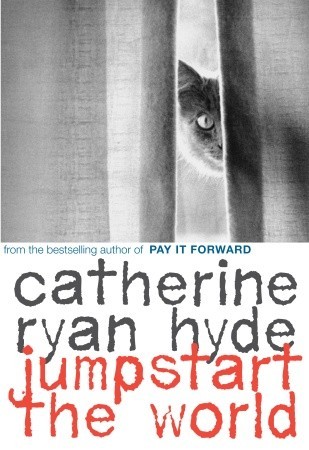
jumpstartOn moving-in day, Elle meets Frank Killborne, her next door neighbour.

He had a big, friendly smile and there was something cute about him, but in a soft sort of way. Hard to explain what I mean by soft. Gentle, I guess I mean. He made you try not to find fault with him for some reason. The kind of guy it’s hard not to like.

Frank lives with his girlfriend, Molly, and it doesn’t take long for them to become Elle’s de facto family. It also doesn’t take long for Elle to develop more complicated feelings about Frank.

Jumpstart the World is populated with other interesting and sympathetic characters, too, particularly the group of friends Elle makes at her new school. There’s Shane aka Larissa, blue-haired and gay; the Two Bobs – a gay couple; there’s Wilbur, a quiet guy who wears make-up.  These friends have varying degrees of influence on Elle’s life and are also responsible for the novel’s conflict. When they meet Frank,  they point out what is not obvious to Elle: Frank is transgender.

It’s pretty remarkable that there’s a book like this available for teens. It’s the first book I’ve ever read featuring a transgender character, but the fact that Frank is doesn’t mean that Ryan Hyde starts to get all preachy. We might expect that since this story takes place in NYC, the world is filled with individuals ready to embrace everyone’s differences, but – of course – the world isn’t quite so open-minded and, as it turns out, Elle has some reconciling of her own to do.

Jumpstart the World actually tackles the questions of trust and family and what it means to give your friendship and love to another human being, regardless of their sexual orientation. There aren’t any easy answers in life and it might be a bit much to expect a teenager to figure them out, but each of the characters in this book have had their own life-altering experiences. And interestingly, Elle’s journey – painful as it is – also helps her to make a kind of peace with her mother.

I enjoyed this book. I liked spending time with Elle. I appreciated that her journey was a little left of center, but that she discovered – as she does with her cat, Toto, that sometimes “you just have to take a deep breath and let somebody love you.”

Highly recommended.


The Grownup – Gillian Flynn

Gillian Flynn is best known for her smash hit Gone Girl , but her two other novels Dark Places and Sharp Objects are also excellent. Flynn is a masterful writer and her protagonists are generally prickly women with dark pasts.

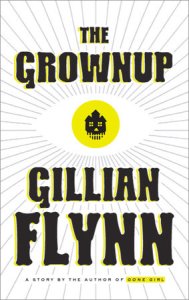
The Grownup is Flynn’s latest literary offering, a slender little story you could polish off over a cup of tea and a biscuit. (Literally – it’s 62 pages long.) She thanks George R.R. Martin (author of Game of Thrones) for asking her to “write him a story.” This particular story actually won an Edgar, a prestigious award given by the Mystery Writers of America.grownup

“I didn’t stop giving hand jobs because I wasn’t good at it. I stopped giving hand jobs because I was the best at it,” says our narrator. Now she has painful carpal tunnel syndrome and needs to find another way to make money. She’s been a grifter her entire life, learning at her now-absent mother’s hem.

“I came to my occupation honestly,” she tells us. Raised by her mother “the laziest bitch I ever met”, the narrator now guarantees satisfaction at Spiritual Palms: tarot readings in the front, hand jobs in the back.

One day Spiritual Palms’ owner, Viveca asks the narrator if she’s clairvoyant and before she can say poltergeist, the narrator is giving readings to the public. That’s where she meets Susan Burke, a harried woman who proclaims “my life is falling apart.”

Wanting to help, imagining a life where she does, the narrator goes to Susan’s home, Carterhook Manor, and there things take a decidedly creepy turn.

I can’t say much more than that, really. After all, in the time it would take you to read this review, you could be half way through The Grownup. What are you waiting for? Go on.