Twisted River – Siobhan MacDonald

I was that customer at Indigo a couple weeks ago when I sent  Matt and Jerrod looking25810336 for a book that I described as “blue” and “used to be on the front table.” Yep. So ridiculous, right, thinking that those descriptors would help them locate a book in a store filled with books. Talk about the proverbial needle in a haystack. Strangely enough, I found it on my own in the mystery section – although the book’s cover is definitely not blue.  (And it might have helped if I’d remembered the keys on the cover.)

Kate and Mannix O’Brien and their children Izzy and Fergus, and Hazel and Oscar Harvey and their children Elliot and Jess, are the central characters in Siobhan MacDonald’s novel Twisted River. We meet them separately, the O’Briens in their house in Limerick, Ireland and the Harveys in their Manhattan apartment. Each family has their own domestic rhythms and  difficulties. For example, Fergus is being bullied at school. Hazel is lying to her children – and herself – about her damaged cheekbone and her eye which “had swollen a mix of red and purple.” Mannix and Oscar each have work-related troubles. Then there’s Mannix’s brother Spike, a nightclub owner who’s mixed up with a local crime family.  When the families’ crises reach a boiling point, the moms take matters into their own hands and arrange a vacation. Using a house swap site they connect and swap houses; the O’Briens head to New York and the Harveys to Limerick, Hazel’s place of birth.

And a family vacation sounds great – except the novel starts with Oscar stuffing the body of a woman into the trunk of a car. (Not a spoiler – the novel’s opening line is “She would never have fit as neatly into the trunk of his own car.”) From that compelling opening line, the story weaves past and present, revealing secrets and lies.

Twisted River is twisted, all right. It’s really one of those books where things are not entirely as they seem. MacDonald’s layered narrative reveals characters and their motives with slippery-eel finesse. I didn’t feel duped by MacDonald’s  plot as much as I did by the novel’s kind of fallen souffle ending.  But as  far as being a page-turner, yes, I turned the pages.


The Girl With All The Gifts – M.R Carey

Joss Whedon (Buffy the Vampire Slayer, Angel) called The Girl With All The Gifts “Heartfelt [and] painfully human.”   Without really knowing I was buying a zombie book, I picked up M.R. Carey’s novel  a few weeks ago  and finally settled down to read it.  I am not a huge fan – or even a fan at all really – of zombies. I am, however, a fan of Joss Whedon, and an endorsement from him is enough for me to read outside of my comfort zone. Zombies, unlike vampires (Joss Whedon’s vampires at any rate), are just not sexy, and while I am still not a fan of zombie novels, I did really like this book.

17235026Melanie is ten. She lives at some sort of army base, dubbed ‘Hotel Echo’ in an area of the U.K. known as region 6. The base is about thirty miles north of London, and just beyond that is Beacon. Welcome to life since the Breakdown.

Most of region 6 is clear, but the only thing that keeps it that way is the burn patrols, with their frags and fireballs. This is what the base is for, Melanie is pretty sure. It sends out burn patrols, to clear away the hungries.

Melanie is not an ordinary girl. For one thing, she is kept locked in a cell. For another, she and the other children at Hotel Echo exist on a diet of grubs.  Every morning, she is strapped, wrists, ankles and neck, into a chair and taken, along with the other children,  to the classroom where their teacher – usually Helen Justineau – teaches them. Those are Melanie’s favourite days because when Miss Justineau is teaching “the day is full of amazing things.” The children learn math and spelling; sometimes they are read to. Melanie is keen to learn as much as she can, but it’s difficult to know just what the lessons are for because as Mr. Whitaker (another one of the teachers) explains “None of this stuff matters anymore…it’s irrelevant. It’s ancient history! There’s nothing out there any more. Not a damn thing. The population of Birmingham is zero.”

Dr. Caldwell also lives at Hotel Echo. She’s busily working on a cure for the infection that causes people to become ‘hungries’ (and you’d be right in thinking that what they’re hungry for is humans). She sees the children as test subjects, nothing more. Helen Justineau strenuously disagrees with Caldwell’s methods and the relationship between the two women is fraught with ethical disharmony.

When Hotel Echo is attacked by junkers (violent scavengers taking advantage of the chaotic state of the world) Justineau, Caldwell and Melanie end up on the run with two soldiers, Parks and Gallagher.

I don’t really have a frame of reference for a zombie apocalypse book. I don’t watch The Walking Dead, which I have been told is really good, but really gory. I read and loved Courtney Summers’ This Is Not a Test, but despite the fact that it’s a zombie novel it is zombie-lite compared to The Girl With All The Gifts. So I don’t have any preconceived zombie notions, not like when I read vampire fiction and get all annoyed when they sparkle.

But make no mistake, The Girl With All The Gifts is more than a zombie novel. It’s a novel that asks us to consider what makes us human and whether or not we can be more than our nature allows. Caldwell views Melanie as a test subject, someone with the biological potential to save the world. Justineau views Melanie as a little girl. Parks views Melanie as a monster. They are all right. And wrong. The journey they take together will horrify and break the hearts of any reader prepared to go with them.

Highly recommended.

Read it before the movie comes out!


The Vanishing Act of Esme Lennox – Maggie O’Farrell

Maggie O’Farrell’s novel The Vanishing Act of Esme Lennox is the story of sisters Euphemia (Esme) and Kitty and while the novel’s first line announces that the story begins “with two girls at a dance”, the story really begins in India, where Kitty and Esme live with their parents. There, one hot afternoon, Esme, aged four and a half,  recalls an insect getting caught in her ear and letting “out another piercing shriek.” She staggers around the lawn until the insect crawls out of her ear. “Could this be her earliest memory?” she wonders. “It might be. A beginning of sorts – the only one she remembers.”

250729This is also the story of Iris, Kitty’s granddaughter, owner of a small vintage clothing store, and half-heartedly involved with a married man.
The narrative jumps around a lot: present day, India,  Edinburgh in the 1930s after Esme and Kitty and their parents return from India. To confuse matters even more, Kitty now suffers from dementia and her fragmented thoughts are part of O’Farrell’s narrative. If it sounds complicated, it’s actually not.

The main part of the story is Esme’s. The psychiatric hospital where she has spent the last sixty years of her life is closing and she needs to be moved. Kitty clearly can’t care for her – she’s in a nursing home herself. It falls to Iris to look after a woman she’s never met and knows nothing about. When Iris finally meets her great aunt, she seems quite sane.

Iris had, she realises, been expecting someone frail or infirm, a tiny geriatric, a witch from a fairy tale. But this woman is tall, with an angular face and searching eyes. She has an air of slight hauteur, the expression arch, the eyebrows raised.

Esme is a fascinating character and her story is both heartbreaking and compelling. She is a victim of the time, of family tragedy and the will of others, yet she remains somehow sane. She wanted an education, but her parents wanted her to make a good marriage.  The circumstances of her incarceration are revealed to the reader through the novel’s layered narrative and it’s more than enough to keep you turning the pages.

However, I do feel there was more to be said. I was particularly drawn to Iris’s story and her relationship with her brother, Alex, and that felt (in some ways) like another book entirely. Some people probably won’t like the way The Vanishing Act of Esme Lennox finishes, but I didn’t mind how it ended. I think my overall reaction to the book was that it was lightweight despite the novel’s more serious themes. Easy to read, sad, but somehow sort of superficial.

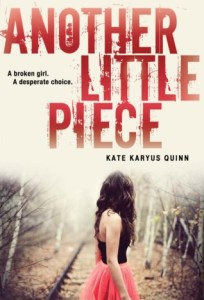
Another Little Piece – Kate Karyus Quinn

It’s been a long time since I’ve read a book as whackadoodle as Another Little Piece. But I kinda mean that as a compliment because even though I often didn’t have a sweet clue how all the disparate pieces of Kate Karyus Quinn’s novel worked together, I couldn’t seem to stop reading.

12665819A teenage girl wanders out of a field, her feet “bare and bloodied” tugging at the “garbage bag she’d refashioned as a poncho.” She doesn’t know who she is or where she is. It turns out she’s Annaliese, missing and presumed dead for the past year.

Her identity and what happened to her is just one part of the mystery and quite frankly I’m not sure I’m up to trying to untangle the messy threads of Annaliese’s life because it’s not just Annaliese’s life. In fact, Annaliese isn’t actually Annaliese at all. It’s hard to say much, but  there’s definitely something not quite right about her. She’s a girl who watches a football player across the field and feels, of all things, a pang of hunger.

I could see the beads of sweat on his golden brown skin. Except it didn’t resemble sweat so much as the juices dripping from the crisp and crackling skin of a roasted chicken. I wanted to sink my teeth into him.

As Annaliese (let’s call this one Annaliese Two) tries to reconcile her new life in this body that isn’t hers, she starts to have flashes of memory. In the first memory she is standing in the woods watching a girl (the real Annaliese, let’s call her One) have sex with a football player (same as the juicy  chicken one) and when they are done and the boy has left her, Annaliese Two steps out from her hiding place and tells  Annaliese One that “It’s time to pay.” Payment, as it turns out, is pretty gruesome, but that’s how Annaliese Two gets from body-to-body. And she’s been doing it for a long time.

Despite the desire to bite someone, Annaliese isn’t a vampire, but she is something very old (I think) and very deadly. That said, she isn’t altogether unsympathetic. When she meets Dex, the reclusive boy next door, she starts to wonder if she might not have another kind of life, a real life, one that actually belongs to her.

I had a hard time keeping all the girls straight in the story and I think that after a while I just stopped caring so much about the logistics of the plot. I followed the through-line of Annaliese and glossed over the bits that made me go WTF. Another Little Piece is well-written, creepy and original. There’s lots for careful readers to gnaw on…and that line will be really funny once you’ve read the book.


Connected Underneath – Linda Legters

Celeste, the wheelchair-bound narrator of Linda Legter’s novel Connected Underneath,  promises to tell us everything, even the parts too terrible to share. Then she admits “there, already: I’ve hardly begun and I’m already lying.” Whether or not Celeste’s lies are as pivotal to the story as she’d like to think is open to debate and, truthfully, she’s the least interesting part of the story, anyway. Connected Underneath cover

Celeste lives in Madena, a tiny town in upstate New York. She introduces the reader to the novel’s key players: Theo and Natalie – high school friends, although Theo had definitely hoped for more. Natalie, however, liked boys like Mike Teague, high school basketball star, because “Theo was from the wrong side of town, her side, and she wanted a different side.” When she becomes pregnant, Natalie turns to Theo for help and he ends up adopting her daughter, whom he names Persephone. (A fitting name, as it turns out -Persephone was the goddess of the underworld – because Seph, at fifteen, is a little off the rails.)

Theo and Seph are actually disconnected these days. Seph is in love with a girl called Krista, but she trades sex for tattoos. Billie, the tattoo artist, is “sweet, gentle, swift, so it never seemed like a very big deal, not even the first time, the time that drew blood.” Of course, Seph keeps the tattoos and the sex from her father, but even so, Theo is beginning to worry about his daughter; “he was sure his girl was in trouble.”

So that’s the impetus for a visit to Natalie’s house across town. She lives with her husband, Doug, and their son, Max. Natalie doesn’t really want anything to do with Theo and shows little interest in the daughter she gave up fifteen years ago. In fact, when Theo admits he’s afraid of losing her, Natalie’s response is callous and decidedly un-motherly: She tells him, “You’re too late. Not my fault.”

Connected Underneath is a story about secrets – those we keep from each other and those we keep from ourselves. It is also a story about the damage we can do, both willfully and inadvertently. Everyone in Connected Underneath seems to operate, ironically, without actually realizing how they are connected and when the secrets  bubble to the surface, discretion is abandoned and truth is used as a weapon.

Theo is definitely the most sympathetic character. Despite a fraught childhood, he has always tried to do the right thing. He loves his daughter, even if he isn’t quite sure how to keep her safe. Natalie is another story. I didn’t like her and also, more importantly, didn’t believe her. Not for a  minute. And then there’s Celeste. As she watches Theo’s world unravel, her world – miraculously – begins to right itself. Can’t say that I was all that invested in her, either.

On the plus side – Connected Underneath is an elliptical, strangely compelling story about the ways we try to save each other, even when we can’t. It is well-written, even if I didn’t believe in some of the characters. It is almost relentlessly grim, but sometimes life is just like that.

tlc logoThanks very much to TLC Book Tours for  inviting me to be a part of the book tour for Connected Underneath and to Linda Legters and Lethe Press for providing my review copy.


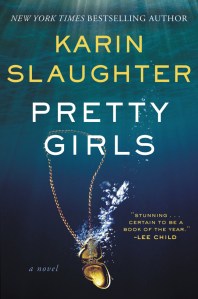
Pretty Girls – Karin Slaughter

So my son asked me how I liked Karin Slaughter’s novel Pretty Girls and I really had to think about my answer. I couldn’t just say “yes” because that isn’t exactly true. I couldn’t say “not really” because that isn’t true either. I read about 300 pages of it last night, turning the pages to get to the end, my skin crawling and my eyes burning.PrettyGirls_HC

Pretty Girls is the story of  sisters Julia, Lydia and Claire – actually it’s mostly about Lydia and Claire because twenty years back Julia, then 19, went to a bar with friends, and disappeared. Claire is married to Paul, successful architect and doting husband; Lydia is single mom to 17-year-old-Dee. She’s 19 1/2 years sober.  Lydia and Claire have been estranged for twenty years, but when Claire’s husband is brutally murdered in a botched alleyway robbery Claire turns to her sister to help her make sense of her unraveling life. And trust me – Claire’s life is about to go belly up, big time.

That’s pretty much all I can tell you about the plot without giving too much away.

The one other voice we hear in Slaughter’s novel is the girls’ father. He never gives up trying to find Julia and keeps track of his search and his feelings in journals. “When you first disappeared,” he writes, “your mother warned me that finding out exactly what had happened to you would be worse than never knowing…’The details will tear you apart.'” She wasn’t wrong.

There’s some bad blood between Claire and Lydia, but soon enough they find themselves in a heap of trouble and they have no choice but to put the past aside. The plot catapults along and if you don’t care too much about the quality of the prose (not that there’s anything wrong with it – Slaughter’s writing is more than up to the task at hand) you’ll fly through the pages unhindered by flowery language. What will give you pause are the gruesome crime details – or maybe not. Maybe we have been desensitized to that sort of thing. I’m not easily bothered, but this book bothered me.

There’s nothing pretty about Pretty Girls. If there is redemption to be had, it comes at a high price for Claire and Lydia and readers will have to have a strong stomach to go along.

What She Left Behind – Tracy Bilen

13040715Sara’s mom finally has a plan to get the two of them out of Dodge – okay, they don’t actually live in Dodge, they live in Scottsfield, a town so small it doesn’t even have traffic lights. Life with Sara’s dad, Ray, an ex-cop cum hardware store owner, has passed the point of impossible and taken a right turn at scary. He’s abusive and a tad on the crazy side considering he still thinks his son, Matt, lives at home. Matt’s dead.

This is what we know at the beginning of Tracy Bilen’s YA novel What She Left Behind. Getting away is a good plan, Sara thinks, until her mother fails to pick her up at the appointed time and place. When she gets home from school her father tells her that her mother was called away on a last minute training course, but every time Sara tries to call her cell it goes straight to voice mail and the duffle bag she’s packed and stowed under her bed, well, that’s been unpacked and everything returned to its place.

Sara was always the invisible one in the family. Her mother and brother took the brunt of Ray’s abuse. Now all eyes are on Sara and she’s desperate to find out what’s happened to her mother and to avoid her father’s ire.

Two boys come to her aid: Zach, her brother’s best friend and Alex Maloy, hot boy from school. Zach knows Sara’s family history; Alex is new on the scene and seems to be interested in Sara, for real, and although Sara likes Alex she also knows there’s no point in pursuing anything with him since she and her mom are leaving…just as soon as her mom returns. He’s cute, though.

I read What She Left Behind in one sitting. Seriously. The plot clicks along at a good clip; Sara is likeable and sympathetic. Ray is one brick short of a chimney. Alex is too-good-to-be-true, but don’t you kinda want that for the girl whose life is pretty much shit.

I’d have no trouble recommending this book to my students.

The Paris Wife – Paula McLain

I wouldn’t consider myself an Ernest Hemingway fan by any stretch. Perhaps I read him when I was too young to appreciate his spare and muscular prose. For some reason I always thought of him as a misogynist, although I couldn’t say how I came to that conclusion. He has been criticized for his portrayal of women in his work, so my opinion has clearly been borrowed from something else I’ve read. I do know, however, that he is a significant figure in American literature even if neither the man nor the myth was all that interesting to me as a reader.

parisNow, after reading Paula McLain’s novel The Paris Wife I have to admit to being quite curious about Hemingway and his writing. I think I might come at it a little differently now compared to the way I approached him as a young university student.

The Paris Wife is a fictional account of the relationship between a young Ernest Hemingway and his first wife, Hadley Richardson. The pair meet through mutual friends in Chicago in 1920. “The very first thing he does,” Hadley says, “is fix me with those wonderfully brown eyes…”

Hadley is 28 and has come to Chicago from St. Louis after the death of her mother. Hemingway is just 20 and “seemed to do happiness all the way up and through. There wasn’t any fear in him…just intensity and aliveness.” For Hadley, who says that her life was “stuck” long before her mother’s death, Hemingway is a revelation. When Hemingway announces that he intends on being an important writer, Hadley remarks “I thought poets were quiet and shrinking and afraid of sunlight.” Hemingway is a force and Hadley has no choice but to be swept along with him.

After Hadley returns to St. Louis, the two begin a correspondence which ends in a wedding proposal.  Once they are married, the two return to Chicago briefly before setting sail for Paris. Why Paris? Sherwood

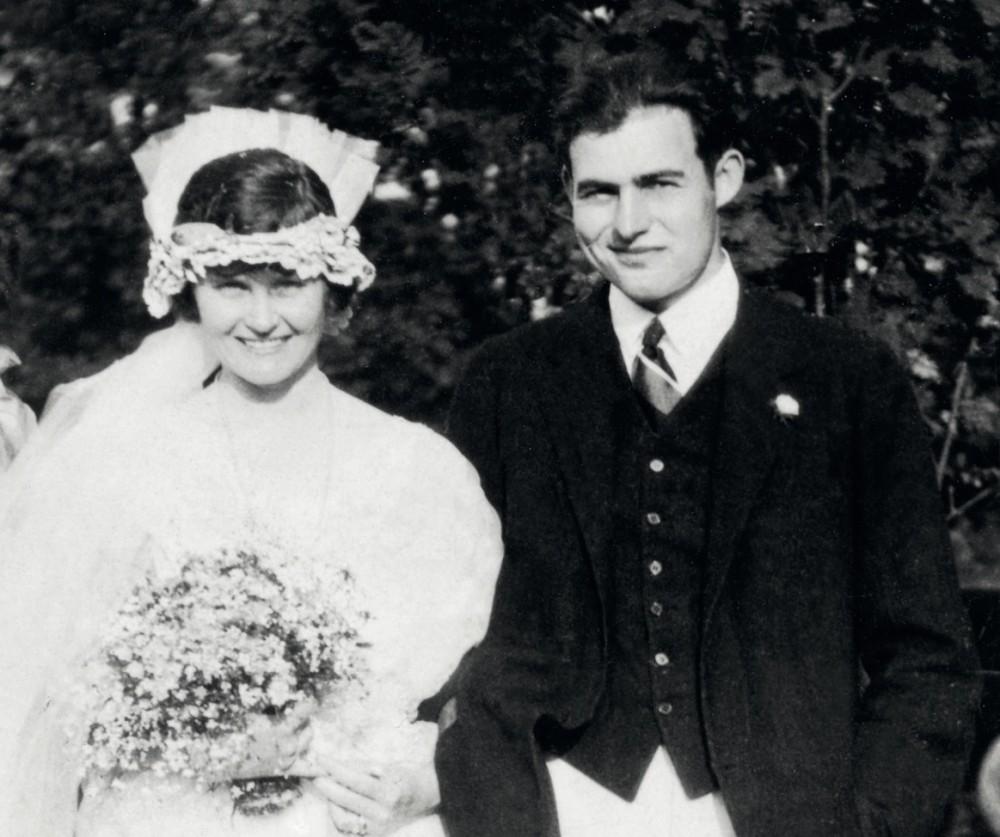
Hadley and Ernest on their wedding day Sept 3, 1921.

Hadley and Ernest on their wedding day Sept 3, 1921.

Anderson (author of the book Winesburg, Ohio, which I’ve never heard of but apparently both the writer and the book were a big deal back in the day) tells Hemingway “…if you want to do any serious work, Paris is the place to be. That’s where the real writers are now.”

Anderson was right, of course. Paris in the 20’s was a mecca for writers and artists, a literary (and artistic) who’s who. Gertrude Stein, Ezra Pound, F. Scott Fitzgerald,  and Archibald MacLeish are just a few of the celebs who enter the Hemingways’ orbit once they find themselves in the City of Light at the end of 1921. This collection of literati came to be known as “The Lost Generation,” a term coined by Stein but made popular in Hemingway’s novel The Sun Also Rises. The term refers to those who came of age after the First Word War.

McLain’s novel does an exceptional job of capturing the literary scene of the time – its parties and squabbles, jealousies and intrigues – but also the relationship between Ernest and Hadley. There is no question they loved each other deeply and in Hemingway’s own memoir about his time in Paris, A Moveable Feast, he writes “I wish I had died before I loved anyone but her.”

I may have to rethink my position on Hemingway. I may have to read A Moveable Feast. I certainly recommend The Paris Wife especially if you love literary name dropping and Paris. Even if you don’t love those things, McLain’s novel is a delight.

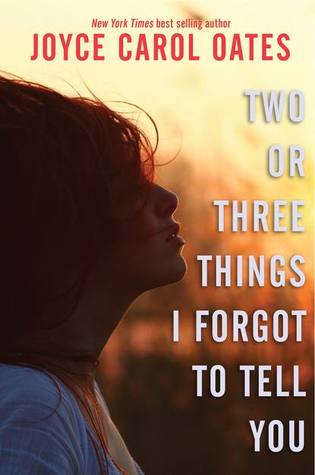
Two Or Three Things I Forgot To Tell You – Joyce Carol Oates

I have a love/hate relationship with Joyce Carol Oates. Sometimes I read her and after I’ve settled into the odd rhythm of her writing I think, yeah, that was pretty good (We Were the Mulvaneys; Beasts) and then sometimes I read her work and think, that was a lot of effort for nothing (Rape: A Love Story) and then there’s this time, when I read Two Or Three Things I Forgot To Tell You and about two thirds of the way in I thought, what the hell just happened? 13501407

Merissa Carmichael has just been accepted into Brown, her first Ivy League choice. Merissa, M’rissa to her friends, has it all going on: good students, good athlete, good friend, pretty and popular, but she is also deeply troubled.

…in the little bathroom adjoining her room, with trembling hands – trembling with excitement, anticipation! — opening a drawer beside the sink, and, at the very back of the drawer, seizing the handle of a small but very sharp paring knife – bringing out the knife, and pressing its tip against the inside of her wrist, where the skin was pale and thin…

Nadia Stillinger, Merissa’s friend, “hadn’t a chance of getting into Brown, or any Ivy League university” has her own problems including a father who works too much and a too young step-mother. She’s fat, too, weighing in at a whopping 119 pounds. And everyone knew that  it was “utterly, utterly disgusting to be fat.”

The one thing Nadia and Merissa share is Tink, the child-star who moved to their town of Quaker Heights, New Jersey during their junior year. Tink is a “short, fiery-haired girl” whose  “face was pale and plain, as if it had been scrubbed, and even her freckles looked bleached.” She’s unlike any other girl at Quaker Heights High.  She talks back to teachers, doesn’t give a rat’s ass for fashion and doesn’t even seem all that interested in making friends, which is why the girls in Merissa’s circle so desperately want to fly in Tink’s orbit. She seems fearless. Until she kills herself — which actually happens before the story begins – so much of the story is told in flashback.

Two Or Three Things I Forgot To Tell You  isn’t your average YA novel. First of all, the narrative is  Joyce Carol Oates wacky. The narrator is one of the girls — but not Merissa and not Nadia and not Tink. Lots of personal pronouns, though, like “We were stunned” and  “We laughed because Tink laughed”. Still, the first part of the novel is tightly focused on Merissa and her penchant for cutting and the trauma of her parents’ crumbling marriage. Then, Merissa is abandoned (presumably in a much better emotional place than when we meet her) and the focus switches to Nadia and her problems – mostly to do with an incident at a party and her inappropriate feelings for her kind (and handsome) Science teacher.

You either get used to the way Oates writes or you don’t. This book is rife with parentheses and asides couched in dashes. Perhaps the writing is meant to mimic the frenetic minds of its characters, but whatever the case I read the novel quickly. I can’t say I didn’t like it, but I can’t say I loved it, either. There is potential for discussion because the book is topical and in many ways captures the complicated and fraught time in a young woman’s life just before she is about to step over that imaginary line into adulthood. Sadly, some don’t make it.

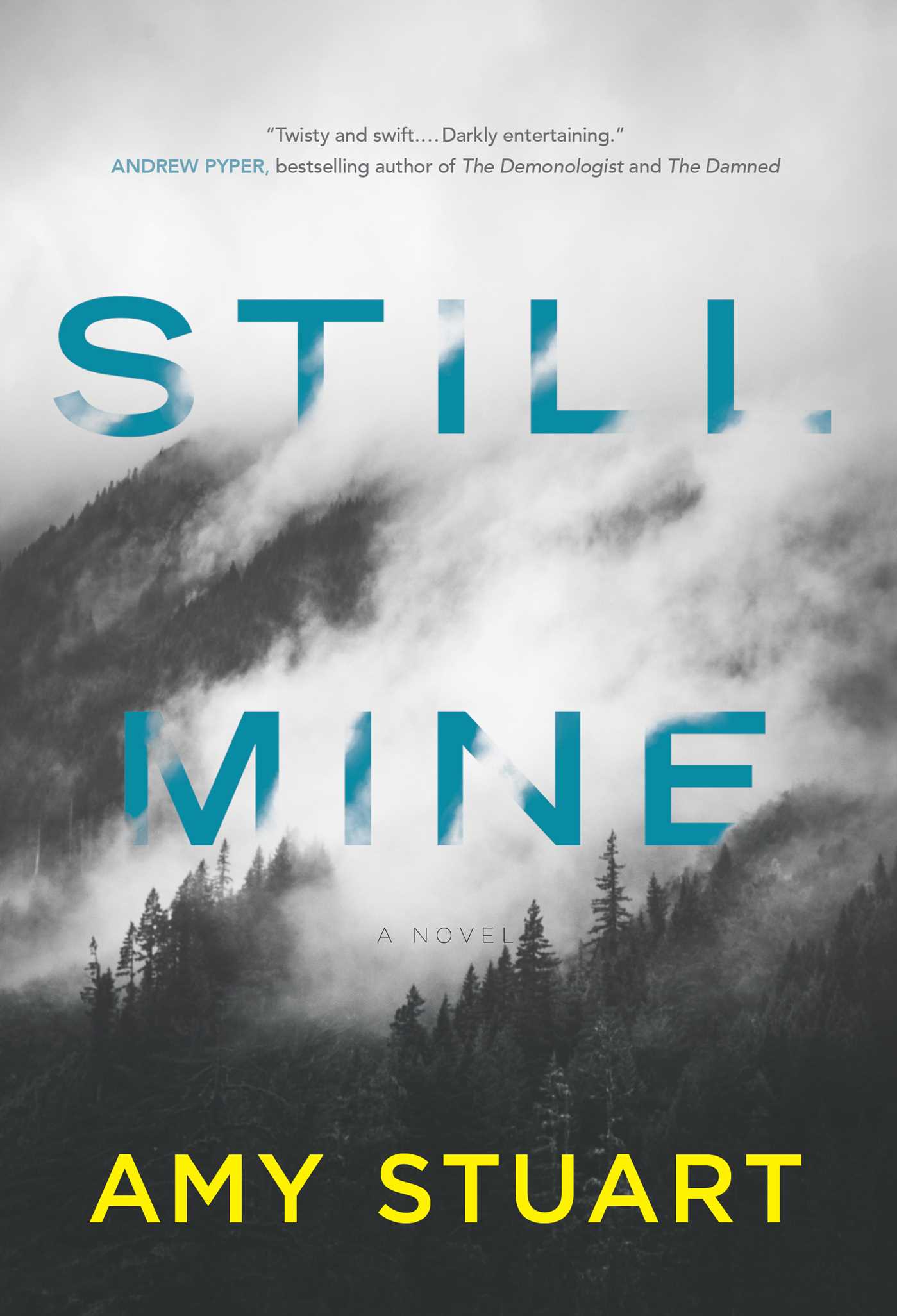
Still Mine – Amy Stuart

I haven’t read a book quite as weird as Amy Stuart’s Still Mine  in a long time and I still can’t decide whether it was good weird or just weird. It reminded me a little of Go With Me – a quirky, but affecting novel by Castle Freeman Jr.

still-mine-9781476790428_hrClare O’Dey has run away from her abusive husband, Jason. In an unusual twist, the man Jason sends to find her, Malcolm Boon,  hires Clare to go to Blackmore, a remote mining town in the mountains, to look for another missing woman, Shayna Fowles.  For reasons that won’t be immediately clear, Clare invests wholeheartedly in the search for Shayna, a woman whose past is as tricky and messed up as Clare’s.

Blackmore is a shriveled up nothing of a town. “A blast at the Blackmore Coal Mine five years ago killed thirty-two men and trapped  eighteen others underground for three weeks,”  Malcolm’s notes tell Clare. She pretends to be a photographer in town to take pictures, but it’s a ruse no one buys. The only hotel in town is closed and so Clare rents a trailer on Charlie Merritt’s property. Charlie is the town drug dealer and his property (his father and brothers were killed in the mine) butts up against Shayna’s parents’ place.  Clare figures it will be a good place to snoop.

Blackmore is filled with broken people: Jared, Shayna’s ex-husband; Sara, her friend; Derek, the town’s only doctor and Shayna’s parents, Louise (who is suffering from early onset Alzheimer’s) and Wilfred, her father, the man responsible for saving the eighteen men who did make it out of the mine alive (but also the man Charlie holds responsible for the deaths of his father and siblings). None of them seem to know what happened to Shayna and with no police in town, no one is looking for her.

As Clare attempts to find out what has happened and which of the town’s odd assortment of outcasts might be responsible for Shayna’s disappearance, her own past is revealed; her own frailties are exposed. Like Shayna, Clare has a penchant for drugs and alcohol, making Charlie particularly dangerous to her. She also finds herself strangely attracted to Shayna’s ex-husband, Jared. She forges a bond with Louise, replacing the mother she recently lost to cancer. In many ways, Clare steps into the life Shayna has abandoned. Even so she realizes

These people in Blackmore, they are not Clare’s friends. Derek and Jared and Sara and Charlie. They are not even one another’s friends. They are only characters in Shayna’s story and Shayna is not here.

Still Mine is an unusual, albeit strange, psychological mystery. Apparently there is a sequel on the way, but I was quite content with how the book ended.

Definitely worth checking out.