The Possessions – Sara Flannery Murphy

Eurydice (Edie) is a “body” for the Elysian Society. As a body, she works with clients who possessions1seek to speak with loved ones they have lost. Dressed in a simple white dress, she sits in Room 12 and once in possession of an item belonging to the deceased, she swallows a lotus – a pill that  summons the spirits of the deceased – and the living communes with the dead. That’s the general principle of Sara Flannery Murphy’s debut novel The Possessions.

Edie has been working at the Elysian Society for five years, a long time for a body. She leads a very quiet, private life. “Since I joined the Elysian Society,” she says, “my emotions have evolved. They’ve gone from unwieldy to finely attuned. ready to snap into nothingness.”

That ability, to become a blank slate, is perhaps one of the reasons that Edie has been able to do this job for as long as she has. But then Patrick Braddock walks into her life. Patrick wants to speak with his wife, Sylvia. She drowned in a lake. The circumstances of Sylvia’s death are part of what propels the plot forward, but the relationship between Patrick and Edie is definitely the driving force.

Although Edie tells Patrick that she is not privy to the conversations that take place between a client and their loved ones, the line between Edie and Sylvia definitely blurs.

I was evasive with Patrick in Room 12 today. The truth is that Sylvia’s memories have lingered. One image in particular, clear and deep. I remember Patrick’s hand against me, at my waist. The golden hairs at his wrist, his long fingers holding the ghost of a summer tan. One or two fingernails endearingly frayed, as if he bites them when no one is watching. I could reach right into the memory, interlace my fingers with his. Feel the light calluses of his fingertips.

Before long, Edie and Patrick’s professional relationship crosses a line and Edie experiences the burgeoning weight of desire. As it often does, it clouds her judgment and drives her to find out what really happened to Sylvia.

The Possessions is a well-written literary hybrid: part mystery, part sci fi (the world seemed slightly off-kilter to me, not the far future but certainly not present day), part love story. It is certainly intriguing and yet…I found it slow going.

Edie’s past is a mystery. Her past is certainly alluded to, but we don’t learn much about her until the very end of the novel and by then it feels more like expository backfill. She’s really a non-entity and that makes it difficult to feel any empathy for her.

Patrick fares only a little bit better. As the grief-stricken husband trying to move on, he’s serviceable enough. Ultimately, neither he nor Edie are well-rounded enough to make me root for their relationship.

So in the plus column: great writing, intriguing plot, lots of potential. In the minus column: slow-moving, lackluster characters, some clunky plot machinations.

That said, Sara Flannery Murphy is definitely an author to keep your eye on.

Thanks to Harper Collins for my review copy and to TLC Book Tours for the chance to participate in this tour.


The Best Kind of People – Zoe Whittall

I have never returned a book to the bookstore before. In the past, if I read a book and the-best-kind-of-people_jpg_size_custom_crop_427x650didn’t like  it, I would normally just donate it to goodwill. Zoe Whittall’s The Best Kind of People comes with Heather Reisman’s money back guarantee, though. Reisman is the CEO of Indigo, Canada’s largest book retailer. If she endorses a book with her Heather’s Pick sticker and you don’t like it, you can return the book – no questions asked – for a full refund. So, that’s where The Best Kind of People is going.
Although I was intrigued by the premise of Whittall’s novel, there were some negative reviews on Litsy and so I didn’t purchase it. Then it was chosen as our book club book and I had no choice but to read it.

George Woodbury is a local hero in Avalon Hills, a sleepy bedroom community in Connecticut.

George could be recognized by his trademark brown tweed jackets with the corduroy elbow pads, and his perpetual armload of books and papers. Everybody knew him, from school or from the many boards and committees he sat on. He was a fixture in town. He remained the man from Woodbury Lake who saved the children.

Ten years ago, George stopped a lone gunman who entered a school to kill his girlfriend. Now George is a beloved and respected teacher at the local private school. George has the added privilege of being extremely wealthy because of his father’s business acumen: doctor turned real estate tycoon. His two children, adult lawyer Andrew, who lives in New York City with his partner, Jared, and seventeen-year-old, Sadie, are used to being part of the inner circle. Joan, George’s wife, is a nurse who dotes on George and loves him without question. Until there’s something to question.

And there is. In present day, the police come to the Woodbury estate to arrest George for “sexual misconduct with four minors, attempted rape of a minor.” Of course, everyone believes it’s a huge misunderstanding. George assures his wife that “it’s just an error.” But it’s an error that throws everything Joan has ever believed about her marriage and her life into question. It also throws Andrew and Sadie’s life into turmoil.

It’s a pretty good hook for a book. And it might have been a pretty good book, too, if Whittall had written characters that were even remotely believable.  There’s the “stand by your man” wife who is so overwhelmed she lets her daughter move in with her boyfriend, Jimmy, and his mother. There’s Andrew, the angry gay son who races to his mother’s side but who hates the small-minded town he grew up in. (The town, by the way, where he came of age in a relationship with one of his teachers.) There’s Clara, Joan’s shrill sister who used to be a “staple on the 1990s New York City party scene.” There’s Kevin, the parasitic writer who lives with Jimmy’s mother. There’s Amanda, Sadie’s supposed best friend, whose younger sister is one of the complainants. Her comment to Sadie: “I know your dad is a fuckin’ perv and all, but you don’t have to act like I’m dead.”

The dialogue is one of the things that irked me the most about Whittall’s narrative. I read whole sections out loud to my son because it was just so…unrealistic. For example, when Kevin moves out of the house, Elaine, Jimmy’s mother explains his absence by saying: “Right now he’s staying at the Hilton while we work through some…grown-up issues.” It’s a ridiculous comment to make to the son for whom she is providing condoms and looking the other way while he sleeps with Sadie.

The Best Kind of People offered a good opportunity to raise all sorts of questions…without being didactic (which the book often is). Instead, wooden people moved through a series of hoops towards a conclusion which is neither satisfying or brave.

Don’t waste your time.

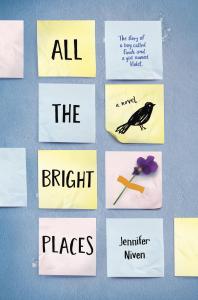
All The Bright Places – Jennifer Niven

Not all YA books are created equal. When I was a teen in the 70s YA was barely a thing. Basically I went from reading The Bobbsey Twins and Trixie Beldon to reading Jane Eyre and A Tree Grows in Brooklyn. The Scholastic flyer at school offered some options and I can all-the-bright-places-jktspecifically remember reading and falling in love with S.E. Hinton’s That Was Then, This is Now (a book I loved way more than I loved The Outsiders), and Judy Blume’s Forever, but the reading choices certainly weren’t as varied as they are for teens today.  I read a lot of YA now because I teach teens. Lots of it is mediocre. Lots of it is good. Then, every so often, you read a book you just want to tell all your students about. You want every single teen you know on the planet to read it. Jennifer Niven’s All the Bright Places is one of those books.

Theodore Finch is seventeen. He begins his story by asking “Is today a good day to die?” He’s considering this question from “a narrow ledge six floors above the ground.” That’s when he sees the girl, Violet Markey. “She stands a few feet away on the other side of the tower, also out on the ledge…”

This is how Niven begins to tell the story of Finch and Violet. Finch ‘rescues’ Violet, but because he has a reputation as being a freak, a loser, and unstable, the rumour around school is that Violet saved him. From this unlikely scenario, a beautiful friendship springs.

After Finch talks Violet off the ledge he asks her: “Do you think there’s such a thing as a perfect day?…A perfect day. Start to finish. Where nothing terrible or sad or ordinary happens. Do you think it’s possible?”  Just typing that now makes me feel as though I want to cry.

Violet doesn’t seem like a likely match for Finch. She’s “cheerleader popular” and dates Ryan Cross, a movie-star-handsome baseball star. Still, when the two are paired to participate in a “Wander Indiana” project (part of a course in U.S. Geography), they discover a kinship neither expected. As they travel to various points of interest, they start to trust each other. Violet begins the painful process of shedding the grief of a tragic accident and Finch finds more and more reason to stay “awake.”

One of the things that makes a YA novel great for me is characterization. I want the teens to feel authentic, not like stereotypes. Finch and Violet are beautifully crafted creations, and the people who circle their lives (parents and siblings and friends) are also well-drawn and nuanced. Finch’s mom is broken from her failed marriage; Violet’s parents are over-protective. As a mom of teens myself, I like to see parents in YA portrayed as real people — flawed and messy and trying to do the best they can even when they can’t fix anything at all.

The other element of the novel that Niven handles so well is the issue of mental illness. All the Bright Places is not a “sick lit” book. Finch’s struggles are authentic and nuanced and painfully rendered in prose that is a joy to read. I can’t remember the last time a character has broken my heart, but Finch most certainly did.

I can’t recommend All the Bright Places highly enough. Buy it for every teen you know. Buy it for yourself.


Winger – Andrew Smith

It is so much easier for me to read YA books that are geared for girls, but since it’s often the boys who are reluctant readers in my classes, I really make an effort to buy and read books I think might appeal to them. Andrew Smith’s book Winger is one book which has garnered copious praise, and it is definitely a book I can highly recommend to those boys who say they don’t like to read.

Ryan Dean West attends a private school called Pine Mountain in Oregon. He’s in Grade Eleven winger-smitheven though he’s only fourteen. He’s super smart. He’s also a talented artist (many of his drawings, cartoons and graphs are included in this novel) and he’s also a terrific rugby player. His nickname, “Winger”, comes from the position he plays on the team.
But despite a whole list of things in Ryan Dean’s plus column, there’s a few things on the negative side. For one, this year he’s living in Opportunity Hall, O-Hall, where they stuck him “after they caught me hacking a cell phone account so I could make undetected, untraceable free calls.” Living in O-Hall sucks for two reasons: 1. Ryan Dean isn’t living with his two best friends Seanie and J.P. and 2. His new roomie is Chas Becker “a friendless jerk who navigated the seas of high school with his rudder fixed on a steady course of intimidation and cruelty.”

The one thing in Ryan West’s life that is both blessing a curse is Annie Altman.  Annie is also in grade eleven, but she’s sixteen. She’s Ryan Dean’s best friend, but he is also desperately in love with her.

…most people would think there couldn’t possibly be anything between us beyond a noticeable degree of friendship, even if I did think she was smoking hot in an alluring and mature “naughty babysitter” kind of way

This year at Pine Mountain turns out to be a year of firsts for Ryan Dean, but it is also a year when he makes a lot of mistakes. He capitulates to teen pressure and drinks for the first time. He gets into fist fights. He makes out with another guy’s girlfriend. But through it all, he remains self-deprecating. In his words: “I am such a loser.”

Ryan Dean is just one of the many lovely things about Smith’s book. I am not a fourteen-year-old-boy, nor have I ever been, but Ryan Dean’s voice feels authentic to me. He is constantly walking that fine line between making a smart choice and doing something he knows he shouldn’t. His narrative is filled with inappropriate talk about sex (just about every girl/woman he encounters makes his acute sexual radar) and expletives which he only ever uses “in writing, and occasionally in silent prayer.”

Winger is filled with laugh-out-loud moments — mostly due to inappropriate sex-talk– but also really lovely moments between Annie and Ryan Dean and Ryan Dean and Joey, another guy on the rugby team who also happens to be gay.

You couldn’t pay me to be a teenager today. But spending time with them is always a delight, even when they break my heart.

Highly recommended.

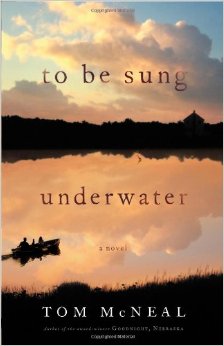
To Be Sung Underwater – Tom McNeal

Judith Toomey’s life “swerved” (her word) when she was forty-four. At the time she is a  Los Angeles film editor, married to a successful banker, Malcolm, and mother to a teenage daughter, Camille. Life is okay. Sometimes better than okay.underwater

…there were  whole hours and even days when Judith was visited by a dull ace that in spite of its unspecific origin seemed symptomatic of yearning, but there were also whole hours and days of productivity, good cheer, and reasonable warm fellow-feeling that she presumed she should, to be fair about it, call happiness, or something within inches of it.

But then one day, the “bird’s-eye maple bedroom set, handed down to Judith’s father by his grandparents, and by Judith’s father to Judith, and by Judith to Camille” ends up in a heap by the pool, ready to be collected and disposed of, and something in Judith unfolds, “a slow blossoming of resentment.”

To Be Sung Underwater is the story of a woman who suddenly finds herself in a life she doesn’t understand anymore. It’s not that she doesn’t love Malcolm or Camille, it’s just that a choice she’d made twenty-seven years earlier is something she can no longer ignore. Instead of allowing the furniture to be taken to the dump, Judith rents a storage facility and recreates her teenage bedroom. The space becomes an oasis for Judith –  a place where she can dream and sleep and remember.

And what Judith remembers is her time living with her father in Nebraska. Judith’s parents are separated because, as her father says “Our marriage, like all marriages, was happy until it wasn’t.” Judith’s mother is a free-spirited woman and her lifestyle irks Judith, so she eventually joins her father, an English professor at a small college. They live a quiet existence, sharing music and literature and stories from her father’s past.

Then, when Judith is sixteen, she meets Willy Blunt. He calls her “dangerous” and “his eyes, reaching in, exerted on Judith what felt like a subtle but actual pull, which alarmed her.” A year later, when they meet again, there is no denying their connection.

To Be Sung Underwater resonated with me in ways I am not sure I will be able to articulate. Judith makes her living piecing frames of film together to make a coherent whole, but the pieces of her own life no longer make sense to her. She wants to go back, but as Thomas Wolfe famously said, “You can’t go home again.” She wants to see Willy, and we know from the prologue that she does.

It has been a long time since he has seen her, a very long time, but he would have known her in a second. A fraction of a second. For a moment he feels he might soon waken from a dream, but for once, at last and after all, it is not a dream.

Reading that again, after having spent a few hours with Judith and Willy, is deeply moving. I loved everything about Willy. I loved his wry sense of humour and his deep and abiding love for Judith. I loved Judith, too. She’s smart and thoughtful; she cares about the past. I loved how McNeal’s book  tapped into the everyday moments that make up a life: eating and reading and sleeping and falling in love.

To Be Sung Underwater magnificently captures that very human impulse to revisit what we have lost and to try, where possible, to make ourselves whole again. This is a beautiful novel and I highly recommend it.

Mercury- Margot Livesey

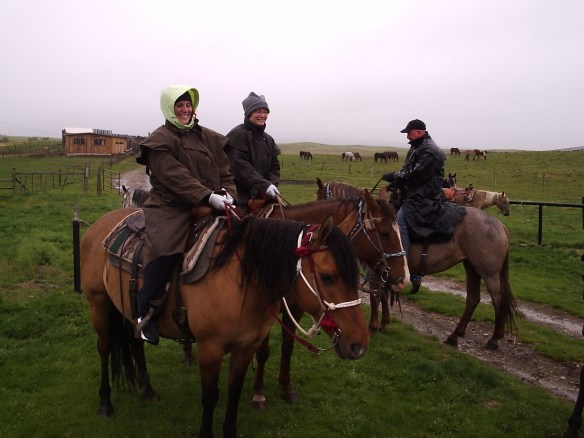
When I was about twelve,  I wanted a horse. Don’t ask me why; I certainly couldn’t tell you now. I’ve had three horseback riding experiences in my life – none of them involved me racing along a forest path or a stretch of beach, one with the horse. The one common theme of those riding experiences is me being terrified. In two instances, the horse decided to run (trot? gallop?) and I was unable to stop the bloody beast. In my 40s, while working for The Canadian Antiques Roadshow, I spent a freezing May afternoon  with some of my colleagues at a ranch outside of Lethbridge. A two-hour trail ride left me with bruises on the inside of my legs. I couldn’t sit comfortably for a week. So horses, after all, not my thing.

OLYMPUS DIGITAL CAMERA

That’s me in the middle. I am only smiling because we haven’t started our journey.

I tell you these stories so you’ll understand why I didn’t relate at all to Viv, one of the two narrators in Margot Livesey’s novel Mercury. Viv and her husband, Donald (the second, and predominate, narrator) live in a rural community outside Boston. Don is an optometrist; Viv runs a stable with her best friend, Claudia. They have two children.

28446368The first section of the novel is narrated by Don, a somewhat stoic Scotsman, who is still grieving over the loss of his father whom he admits he missed “in every way imaginable.” Perhaps this is meant to explain how things at home start to shift without him noticing: finances, his son’s trouble at school, his wife’s growing obsession with Mercury, a new horse being boarded at the stable.
Mercury, true to his name, was unmistakably hot-blooded. The lines of his body, the arch of his neck, the rise and fall of his stride, were, I agreed with Viv reluctantly, beautiful.

And obsession just about sums it up, too, as Viv tries to jumpstart her dream of competing with Mercury. Even though the horse doesn’t belong to her, Viv feels a kinship with him.

At the gate Mercury fixed his large dark eyes on me a nickered softly.  Then he scraped the ground, twice, with his right front hoof, choosing me.

Sadly, for me, I didn’t feel this kinship. Mercury is a novel with a billion things going on and a cast that, even though I read the book over the course of a handful of days, had me flipping back to figure out who they were. And all these characters have stories, too. There’s Don’s mom, feisty widow ready to love again; Jack, a blind (literally) professor who takes up with Hilary, owner of Mercury;  there’s Charlie, stable-girl who also covets the horse; Bonnie, a blip on Don’s devoted husband radar. The only thing keeping all these threads pulled together is Livesey’s prose. I’ve been a fan since Eva Moves the Furniture.

And, yeah, I get the whole Don’s an optometrist (irony!) but doesn’t actually see his wife. And I get that Viv’s devotion to Mercury blinkers her to everything else. And I also understand that Viv feels that Don’s grief over his father is isolating. But for me, there  wasn’t any emotional center in Mercury. I just didn’t buy that a horse could cause such a fuss.

I thank HarperCollins for providing me with my review copy and TLC Book Tours for inviting me to participate in this book tour.


The Wicked Girls – Alex Marwood

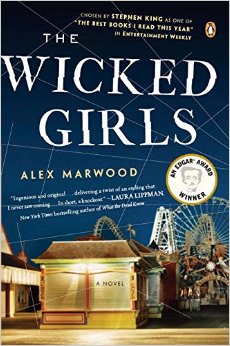
wicked.jpgIt’s 1986 when eleven-year-olds Jade and Bel meet in the village store. Their paths weren’t likely to have crossed before because Jade is one of the notorious Walkers – a family from the far side of the tracks – and Bel lives in a fancy house with servants. This fateful meeting is to change the course of the girls’ lives forever because by the end of it another little girl will be dead and Jade and Bel will be arrested for the murder.
This isn’t the only thing happening in Alex Marwood’s novel The Wicked Girls, though.

There’s Amber, head cleaner of Funnland, a boardwalk amusement park in the seaside town of Whitmouth (I imagined Blackpool only smaller and seedier). She lives with Vic, a handsome but slightly passive-aggressive carny. Amber lives a quiet, tidy life. She takes pleasure in overseeing her crew of cleaners and helping them when she can. When Amber discovers a dead girl in the park’s  hall of mirrors, her life becomes significantly more complicated.

Then there’s Kirsty , a freelance journalist married to Jim, an out of work  IT guy, and mother to a couple children. When the body is found at Funnland, Kirsty finds herself on assignment and inevitably comes face-to-face with Amber, the last person she’d ever expected to see again.

The reason: after their release from prison,  Jade and Bel were given new identities and cautioned about ever making contact with each other again. Not that the girls were likely to meet; they barely knew each other to begin with.

Marwood balances the story of Jade and Bel, unspooling the narrative of what happened that long ago day with the present day  Amber and Kirsty, two women who have made a desperate attempt to reinvent their lives.

As if that weren’t enough, let’s not forget Martin, creepy Whitmouth resident. He’s been rebuffed by Jackie, one of the Funnland cleaners. He’s clearly deranged and

the rage of rejection crawls beneath his skin; invisible, unscratchable. All she needs to do is text him back. He doesn’t want to go out, but if she refuses to respond he’s going to have to. As his mother was always assuring him, persistence is the most important quality in life. And he knows he is the most persistent of all.

The seemingly disparate threads of Marwood’s novel do come together, but whether you find the ending satisfying or not will depend on how you like your mysteries. There were a few super tense moments in The Wicked Girls, but there were also moments I found really slow going – not superfluous exactly. I guess I just like a little more ass-kicking and a little less naval-gazing in my thrillers. That said, the characters were definitely nuanced and sympathetic and the writing was good, but over-all I would have to say  The Wicked Girls is more slow burn than page-turner. That’s not necessarily a bad thing, though.

Vanishing Girls – Lauren Oliver

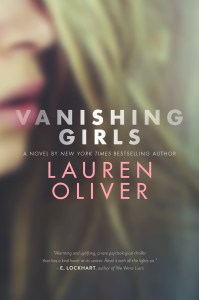
Now that I am back at school, it’s time to start reading YA fiction again. I give it a little  break in the summer so that I can tackle my own mammoth tbr pile. I started this year by reading Lauren Oliver’s highly praised book Vanishing Girls. It’s pretty un-put-down-vanishing-girls-jacketable, folks.

Nicole (Nick) and her younger sister, Dara, couldn’t really be more unalike. Nick is the responsible one; Dara is the wild child and for as long as Nick can remember, people have been comparing the sisters.

She’s not as pretty as her younger sister…shyer than her younger sister…not as popular as her younger sister.

But despite their differences, Nick and Dara are close. Dara recalls that they’d spent

practically our whole lives sneaking into each other’s rooms to sleep in the same bed, whisper about our crushes, watch moon patterns on the ceiling and try to pick out different shapes…cut our fingers and let them bleed together so we’d be bonded forever, so we’d be made not just of the same genes but of each other.

Parker is Nick’s best friend – the boy from the neighbourhood who has shared every single milestone in Nick’s life. Then he and Dara hook up and things get awkward. Dara goes off the rails – drinking and doing drugs – and then there’s the car accident.

Oliver has written a novel that is both an exciting page-turner (a young girl goes missing and then Dara disappears and Nick is convinced the two disappearances are somehow connected) and a moving family drama. Nick and Dara’s parents have separated and the accidents adds extra emotional weight to the already damaged family.

The narrative unfolds in dual first-person narratives, through diary entries and police reports and photographs and illustrations. Each sister has her own version of the truth of what happened on the night of the accident and the time-shifting narrative will yield important clues to careful readers, but the truth is that when all is revealed, you’ll probably still be scrambling to figure out how Oliver’s pulled it off.

Oliver is well-known in the YA world. She wrote the popular Delirium series and I have been looking forward to reading her adult novel, Rooms. After reading Vanishing Girls, I think I’ll have to move Rooms up my reading list. That’s pretty much the highest praise I can give.

*Edited Sept 2026 to add link to Rooms review.

Bittersweet – Miranda Beverly-Whittemore

18339743Mabel Dagmar, the seventeen-year-old narrator of Miranda Beverly-Whittemore’s stunning novel Bittersweet is attending an upper-crust East Coast college on a scholarship. Her roommate, Genevra “Ev” Winslow is from an  influential blue blood family. The two girls couldn’t be any more different and yet somehow Mabel finds herself invited to spend the summer at Winloch, the Winslow family compound in Vermont. Mabel has no interest in returning home to Oregon for the summer, so she gratefully agrees even though she has to help Ev prepare Bittersweet, Ev’s personal cottage, for her father’s “inspection”.

“…if we don’t get that little hovel in shipshape in less than a week, I won’t inherit it,” Ev tells Mabel on the train to Vermont.

Winloch is a strange out-of-time place comprised of an assortment of cottages and a communal Dining Hall set around a beautiful lake,  inhabited by Ev’s immediate family including her parents, Birch and Tilde. It’s isolated and idyllic and Mabel is enchanted. This, she decides, is the life she wants.

Her visit to Birch and Tilde’s cottage only reaffirms her admiration:

Upon the honey-colored floor stood antique wood sideboards and a large mahogany table. An exquisite burgundy Oriental rug tied the furniture together, ending before a large fireplace sporting a brass fender and matching andirons. Canapes were arranged in colorful formations upon hand-painted porcelain platters: crab cakes and mini-lobster rolls and demitasses of chilled pea soup.

Even more impressive, the Winslow’s cottage boasts an impressive Van Gogh, “the most beautiful painting I’d ever seen.”

But there is also something slightly sinister about Winloch. For one thing, Ev installs bolts on the bathroom and bedroom door at Bittersweet. Then Mabel meets Indo, Birch’s sister, who enlists Mabel’s help in locating some important documents lost somewhere in the attic of the Dining Hall, claiming she’d been “looking for a friend like [Mabel] for a while.”

Mabel soon finds herself negotiating a landscape of shifting loyalties and strange tensions. It makes for compelling reading, that’s for sure; I couldn’t turn the pages quickly enough.

Although the bulk of Bittersweet takes place during that one summer, Mabel is actually remembering the events from a vantage point many years later. This will, in part,  help explain why Mabel seems older than seventeen. Her own personal history, revealed in tantalizing snippets, will also help the reader understand her motivations. Bittersweet is Shakespearean in its scope.

Highly recommended.

I Let You Go – Clare Mackintosh

There have been a lot of books in the suspense thriller vein of late and I love them, especialllet you goy in the summer when I just want to give my brain a break from school.  Publishers always want to draw comparisons to Gone Girl, which is the book that perhaps kick-started this newest craze, but I think it’s better to let a book stand on its own bookish merits.

Clare Mackintosh’s novel I Let You Go is definitely top of the thriller heap. I couldn’t put this book down and galloped through it in just a couple of sittings.

In the book’s opening pages, a mother is walking home in the pouring rain with her young son. Just at the road across the street from their home, he lets go of her hand and runs across the street. Out of nowhere, a car comes barreling down the street and hits the boy. From this point on, I Let You Go is a grab-you-by-the-throat suspense thriller that follows Jenna Gray as she goes to the Welsh coast to escape the tragic death and the police detectives, Ray and Kate, who are trying to find the driver behind the wheel.

Jenna’s grief is palpable. “Everything has changed,” she muses. “The instant the car slid across the wet tarmac, my whole life changed.” She stays until she can’t anymore and then, packing only what will fit into her holdall, including a box of treasures from her life, she runs away.

Unable to resist, I open the box and pick up the uppermost photo: a Polaroid taken by a soft-spoken midwife on the day he was born. He is a tiny scrap of pink, barely visible beneath the white hospital blanket.

As a mom, it’s hard to imagine how Jenna will ever survive this tragedy, but survive she must. She finally settles in a tiny tourist town called Penfach, somewhere outside of Swansea. There she rents an isolated, dilapidated cottage and begins the arduous process of overcoming her grief.

In the meantime, Ray and Kate sift through the non-existent evidence, hoping for a break in the case. Mackintosh spent twelve years as a police officer and so these sections are authentic, but don’t weigh the narrative down with unnecessary police jargon. In addition, Ray and Kate – especially Ray – are given interesting personal lives, which add another dimension to the story.

It doesn’t always work, but it does here – Mackintosh pushes the story along and months pass. Jenna starts to make a life for herself; Ray and Kate are taken off the hit and run case because they’ve done all they can do and then all hell breaks loose in a totally WTF fashion. You’ll know what I mean when you get there and from that moment on, it is a breathless race to the book’s conclusion.

LOVED IT!