Uses for Boys – Erica Lorraine Scheidt

usesforboysHer bed is a raft on the ocean. It’s a cloud, a forest, a spaceship, a cocoon we share. I stretch out big as I can, a five-pointed star, and she bundles me back up in her arms. When I wake I’m tangled in her hair.
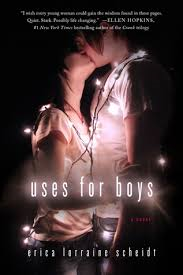
That’s Anna, protagonist of Erica Lorraine Scheidt’s YA novel Uses for Boys, remembering.  She remembers a time before stepfathers and step brothers, a time she calls the “tell-me-again-times.” Those were the times when her mother would gather her up and tell her how much she was wanted, “more than anything in the world.”

Unhappily for Anna, the “tell-me-again” times don’t last long. By the time Anna is eight her mother insists that she is “too big for stories.” It’s also the time that Anna’s mother decides that she is tired of being alone and ventures out to meet a man  and it seems just about any man will do. Early on Anna learns the lessons that her mother teaches: men will leave.

Despite its cover depicting kissing teens wrapped in twinkley lights, Uses for Boys is mostly the grim story of Anna’s search for unconditional love – the love she should have received from her mother if her mother had bothered to pay attention. Instead, Anna must seek it elsewhere and she does it by chasing (mostly) sexual relationships with boys.

First there’s Desmond who sticks his hand on Anna’s thirteen-year-old breast on the school bus in full view of his friends.  Then there’s Joey. And Todd. You get the picture. It isn’t until Anna meets Sam and his family that Anna realizes what she’s been looking for (and willing to give away to get it): family.

“Sam’s house is everything I wanted, but didn’t know to want.” Anna says about her first visit to Sam’s house. “I want to wrap myself in this house like a blanket.”

It’s hard not to sympathize with Anna. She has a nice home but a mostly absent mother. No one has guided her to make wise choices about her body or to value herself as a person, so it’s difficult to blame her when she makes poor decisions.  Scheidt’s writing is often poetic although I’m not sure if that makes Anna’s life any easier to bear.
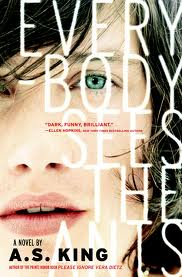
Everybody Sees the Ants – A.S. King

antsEvery night in his dreams, 15-year-old Lucky Linderman, the narrator of A.S. King’s novel Everybody Sees the Ants, visits the jungles of Vietnam in a desperate attempt to rescue his paternal grandfather, Harry, who never made it home from that conflict. In the real world, Lucky isn’t as lucky as his name. In the real world he’s been at the mercy of bully Nader McMillan since he was a little kid and Nader peed on his shoes during a horrible encounter in a restaurant washroom. Lucky wants to stand up to Nader, or at least stay out of his way, but that isn’t always possible and Nader is a huge jerk.

I used to hang out with Nader sometimes, too, because of Danny, even after all the crappy shit Nader did to me, but that was before my famous freshman year social studies suicide-questionnaire screwup, when he decided to make my life a living hell again.

Lucky is an only child. His father is a chef who doesn’t seem able to cope with anything even remotely confrontational, an unfortunate predicament when you have a teenager who is being picked on. Lucky’s mom is a little more proactive, but even she isn’t aware of everything going on in her son’s life.  After a particularly nasty incident at the community pool, Mrs. Linderman and Lucky fly out to visit family in Arizona. This summer changes Lucky’s life for a variety of reasons.

Given the fantastic nature of Young Adult literature these days, I doubt most young readers would even bat an eye at Ms. King’s use of magical realism in Everybody Sees the Ants. It’s relatively obvious that Lucky’s dreamy ventures into the jungle to save Grandpa Harry are related to his own circumstances in the real world and his inability to defend himself against Nader. The dual narrative would work just fine like this, but magical realism operates on another level, one where magical elements are a natural part of an otherwise realistic world. So sometimes Lucky wakes up with leaves in his hair or clutching tokens of his latest visit to Laos. He also sees a lot of ants.

Ants appear on the concrete in front of me. Dancing ants. Smiling ants, Ants having a party. One tells me to hang on. Don’t worry, kid! he says, holding up a martini glass. It’ll be over in a minute.

Everybody Sees the Ants is a well-written, thoughtful and thought-provoking. Lucky is a character who will resonate with young adult readers who are climbing their own hill towards adulthood, but can’t quite see over the top.


More Than This – Patrick Ness

morethanthis“Here is the boy, drowning” is the opening line of Patrick Ness’s confounding, riveting, philosophical and profoundly moving YA novel More Than This. If you are a regular visitor to The Ludic Reader then you know that I am a Ness fan. I have huge love for his novels A Monster Calls, The Knife of Never Letting Go, The Ask and the Answer and Monsters of Men.

More Than This was my pick for book club and we gathered on Feb 18th to discuss the novel over dinner. The discussion was rich with differing viewpoints; the dinner itself was only moderately successful. My book club – despite the fact that three of its members, myself included, are teachers – doesn’t normally choose YA fiction. The only other book we’ve chosen from the YA canon was Marcus Zusak’s amazing novel, The Book Thief. In any case, as I was reading I had a feeling that my choice might not float everyone’s boat. Even I had trouble wrapping my head around Ness’s ‘big picture.’

More Than This is the story of a boy who, in the novel’s riveting opening, drowns. And then he finds himself, well, not dead.

He seems to be lying on a concrete path that runs through the front yard of a house, stretching from the sidewalk to a front door behind him.

The house is not his own.

And there’s more wrong than that.

For 163 pages, Seth (as the boy eventually remembers) is alone in a post-apocalyptic town in England. This is, as it turns out, the town where he grew up before he moved to America. Bits and pieces of his story come back to him when he dreams. For example, he remembers something horrible happening to his younger brother, Owen, something for which his mother never forgave him. He remembers Gudmund,  a boy for whom he has more than friendly affection. He remembers his other friends, H and Monica. As his previous life filters back to him in dreams, he tries to survive in this new wasteland.

And then he meets Regine and Thomasz. And the Driver, a creepy faceless virtually indestructible being whose sole purpose seems to be to try to catch the three teenagers. And how can there be just them? What has happened to the world?

One member of book club was certain that Seth was suffering from a psychotic break and while her argument is certainly plausible, I am happier taking Seth’s dilemma at face value. I think it’s a more interesting book if we believe in what he sees and experiences. Otherwise, it just feels like Bobby Ewing in the shower.

But believing what Seth does also proves problematic. I’ll admit: I was often confused. But that didn’t negate my love of Seth or his new friends. And, ultimately, I think More Than This has interesting things to say about the myopic lens through which teenagers view their lives. As Seth’s past and present converge, he starts to understand how his story, the story of his life, is unknowable, but that “whatever is forever certain is that there’s always more.”

The last couple of pages of More Than This are outstanding. Some members of my group felt that the novel was 150 pages too long, but I disagree. I think the novel packs a terrific punch and Seth’s journey from self-centered adolescence to manhood is memorable and magnificent.

I continue to be filled with admiration for Ness and look forward to talking about this novel with my students. But make no mistake – this novel has lots to offer thoughtful readers of any age.

Highly recommended.

The Death of Sweet Mister – Daniel Woodrell

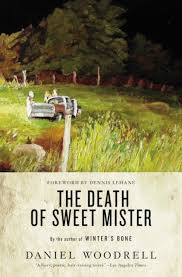
sweetmisterThe Death of Sweet Mister is grim and virtually unputdownable.

Woodrell’s novel is set in 1960s Ozarks. I don’t know anything about the Ozarks but Wikipedia tells me that “It covers much of the southern half of  Missouri and an extensive portion of northwestern and north central Arkansas. The region also extends westward into northeastern Oklahoma and extreme southeastern  Kansas.”

Morris “Shug” Atkins is thirteen and lives with his mother Glenda and her boyfriend, Red. “The idea that Red was my dad,” says Shug “was the official idea we all lived behind, but I wouldn’t guess that any of us believed it to be an idea you could show proof of or wanted to.”

Red is an ex-con, a mean snake of a man who drinks and does drugs and abuses both Shug and his mother.

…Red was near only the height I was at that age, but a man. He had the muscles of a man and all those prowling hungers and meanesses…

Their lives are just about as miserable as you might imagine them to be.

The three of them live in a house that “looked like it had been painted with jumbo crayons by a kid with wild hands who enjoyed bright colours but lost interest fast”  in the middle of a graveyard. In exchange for their dwelling, Shug maintains the cemetery – mowing and the like.  Red contributes to the family’s meagre existence by sending Shug off to break into houses and steal pharmaceuticals. You know it’s only going to be a matter of time before Shug gets caught.

Shug’s mother, Glenda, is the sort of woman who will never “get too plain or too heavy. Her eyes were of that awful blue blueness that generally attaches to things seen at a distance.” She copes with Red’s nastiness by drinking rum and cola, her special “tea”.

None of the characters in The Death of Sweet Mister seem to hold out much hope for a brighter future, but then into the narrative drives Jimmy Vin Pearce. His shiny green T-Bird and his flashy clothes seem to signal hope, like maybe Glenda and Shug might be able to escape the smallness and meaness of their lives. But one day Shug comes home to find blood had “whirled and whirled in the kitchen.”

I loved the language of Woodrell’s book. I loved Shug’s voice. I felt tremendous sympathy for him. He is a product of his environment and so it’s not particularly surprising how his story concludes. Doesn’t make it any less sad, though.

Highly recommended.


The Boy – Lara Santoro

theboyAnna is 42. The boy is 20. And yes, he has a name. His name is Jack. The Boy is the story of Anna and Jack’s brief but catastrophic affair and as tragic love affairs go, this one has its strengths and its weaknesses.

Anna meets Jack at a party her neighbour, Richard, is throwing.

The boy wore dark, baggy clothes so there was no discerning the profile of his body, yet Anna could tell, simply by the way he sat, that it must be a good one. She raised her eyes to his with calculated slowness and found to her surprise that they were free of fear, free of pretense, free of the myriad layers stretched by age over the human eye.

Okay, I’m not really sure what the last bit means but I’m just going to paraphrase here and say that Jack had it goin’ on and Anna was eventually unable to resist. He is pretty cocky.

There are some obstacles to their forbidden love. For one thing, Anna has an eight-year-old-daughter, Eva, who often seems like more of an adult than her mother. For another Anna has a slightly checkered past. (There were/are some issues with alcohol/drugs.) Then there’s her ex back in England. And okay, yes, there’s a huge age gap between Anna and Jack but Jack isn’t a witless sex toy.  (And there’s no graphic sex in this book anyway.) It’s all complicated and fraught, as lives often are.

When Eva goes to spend a few weeks of the summer with her dad, Anna gives in to the boy’s siren call and before you can say MILF, Jack’s moved his stuff into Anna’s house. Partly, Anna is looking for a way to reclaim her own lost youth. Partly, she seems to genuinely care for Jack. But they are living in a bubble that bursts when Eva returns from England.

Driving Eva to school one morning Anna loses her temper:

“Is this a joke?” she said. “After everything I have done for you? After all the sacrifices I’ve made for you, suddenly I have the audacity to tell you to stop ordering me around and you’re not talking to me. I have given you everything, Eva. Everything. I have traded my own life for yours. In fact, I haven’t had a life. You have. I haven’t. And this is what I get.”

This is, I think, the impetus for Anna’s affair with Jack. He’s this beautiful, motherless boy who wants her and she wants to forget, just for a little while that she has responsibilities that make it impossible for her to have whatever she wants. “We have children,” she says. “We have children, and they’re nothing we’re prepared for.”

Ain’t that the truth.


Creep – Jennifer Hillier

creepDumbest. Book. Ever.

Seriously…I can’t even believe I read it.

So, Dr. Sheila Tao, she of the velvet lips, is a psychology professor at Puget Sound State University. Apparently she’s an expert in human behaviour – except not so much because she doesn’t realize that Ethan Wolfe, the 23-year-old teaching assistant she’s been sleeping with for the past three months, is actually bat-shit crazy. That’s probably because she’d been blinded by lust. He’s HAWT. Oh, also, she’s a sex addict but until her father died (trigger) and she took up with Ethan (couldn’t resist the hawtness), she’d been living sex-free.

Anyway, she’s fallen in love – for realsies.  His name is Morris and he’s an ex NFL player and an ex-alcoholic and just an all-round great guy. He doesn’t know about Ethan, or Sheila’s addiction to sex. He’s also apparently never questioned why his 39-year-old, once-married girlfriend won’t have sex with him. He kinda likes that about her.

Okay, so Sheila’s got a problem. She’s now engaged to Morris so clearly she has to dump Ethan. Which she does…on page five. Understandably, Ethan doesn’t take it too well. Obviously: he’s a psychopath. Nevertheless, I knew I was dealing with crazy people pretty early on – like when Sheila becomes infuriated when Ethan turns the tables on her and announces that he’d “never wanted this to be a long-term thing. But you were so goddamned needy. You kept telling me not to go.” Really? Who cares who breaks up with whom? Move on, Sheila.

Anyway, Ethan threatens to expose their affair with some video he’d apparently taken of them doing the deed and so Sheila has no choice but to let him remain her T.A. But then that’s not enough for Ethan, he’s got to kidnap her and hold her hostage in the retro-fitted basement of the mansion he paid for with cash and you see where all this is going, right? Oh…and he’s a master of disguise, people. A master – with like amazing custom-made silicone masks and make-up skills etc.

It’s just all ridiculous. All of it. What does Ethan do with Sheila once he has her all chained up in his basement. Um. Nothing. He keeps her drugged and makes her wear adult Depends. That is until he finally lets her go to the bathroom and that, my friends, is one reason to steer clear of this book. It’s meant to be scary. A thriller. No, no. This is what we get:

It was ridiculous to be embarrassed about a fart – after all, she was being kept here against her will, and what could be worse than having to urinate in adult diapers – but she was ashamed nonetheless.

We get to hear about her cramps and the stench and how grossed out Ethan is.

He was looking at her with such shock and disgust that, despite her abdominal pain, she couldn’t resist a chuckle.

“Well, what did you expect? I’ve been here for days, you cocksucker.” Sheila grunted again. “I’m not done. I suggest you get the fuck out.”

Even Sheila has to admit that it was “quite possibly the world’s stupidest conversation.” One of many, Ms. Hillier.

Critics loved this book. Loved it. There was nothing frightening, suspenseful, or creep-y about it. Stock characters, a deux ex machina visit from Morris’s estranged son, Randall…I’m just…gah. Hillier is compared to Chelsea Cain. Please read Heartsick instead.

The Most Dangerous Thing – Laura Lippman

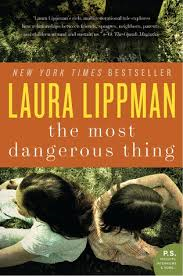
mostdangerousIt took me forever (it seems) to finish Laura Lippman’s novel The Most Dangerous Thing, a book that the Wall Street Journal called “a creepy, genre-bending, stand-alone novel.”

Lippman’s novel is the overly long story of five childhood friends, Gwen, Mickey, Tim, Sean and Go-Go who are reunited as adults after Go-Go is killed in a car accident that may or may not have been deliberate.  The real story, though, is about what happened to these five when they were kids – a bit of nasty business that is alluded to and then covered up. It’s the seventies, after all.

The story bounces between then and now and the big reveal  – which comes in the novel’s final pages – doesn’t really equal the sum of its parts. My problem with the book is that it took forever to get anywhere and when I finally arrived I was just sort of meh about the whole affair. As a novel of “psychological suspense,” as the Globe and Mail purports it to be, it was lacking the actual suspense.

Actually, I think the real mystery in The Most Dangerous Thing is  who is telling the story because Go-Go is dead and the remaining four are all referred to in the third person. In the author’s notes at the back of the book Ms. Lippman says: “I don’t want to tell you.”

As another kind of story, The Most Dangerous Thing is quite compelling.  The children are children only in flashback; we are actually dealing with them as adults and their lives are messy and complicated – as lives tend to be. We also spend time with their parents and those lives aren’t much better. But the thing is – is The Most Dangerous Thing a family drama  times three or is it a mystery, or a thriller, Maybe it’s social commentary?

Ms. Lippman says it’s her most autobiographical novel – geographically speaking. She says “I have been circling the unusual neighbourhood in which I grew up, determined to write about it, but wanting to wait for the right time and story.”

If I hadn’t been itching for the book to move along already, I would probably have enjoyed it more. Ms. Lippman is a wonderful writer, no question…but this book was only just okay for me. Maybe if I hadn’t been expecting something different, I would have been less disappointed.

Me Before You – Jojo Moyes

mebeforeyouLast night, my book club met to discuss Jojo Moyes’ novel Me Before You.  I was the only member of the group that didn’t love the book. I liked the book a lot, but it won’t go down in my personal annals as one of the most amazing, romantic, beautiful, (insert other appropriate adjective here) books ever. Trust me, I am the gushiest romantic on the planet so it came as just as much of a shock to me when I didn’t get all weepy and heartbroken at the end.

Me Before You is the story of  26-year-old Louisa Clark, an ordinary girl from an ordinary family. Until recently, she’d been working at the local cafe in the little market village she lives in in England. She lives at home with her parents and her younger sister, Treena and Treena’s young son, Thomas. Their house is too small; they don’t have much money and so when Louisa loses her job at the cafe she is desperate to find new employment so she can continue to contribute to the family coffers.

Enter the Traynors.  They live in Granta House which is on the other side of Stortfold Castle – I presume that’s the posh side. Camilla Traynor hires Louisa as a companion to her son Will who, two years ago, had been in a serious motorcycle-meets-pedestrian accident that has left him as a quadriplegic. He’s a bit of a git.

Circumstances being what they are, Louisa doesn’t feel like she’s in a position to quit, even when Will is arrogant and unkind. Instead, Louisa is determined to make friends with Will and so, of course, that is what happens. Will softens because of Louisa’s friendship; she  flourishes because of his. They are both irrevocably changed.

Me Before You was an easy book to read. I motored through 200 pages on Saturday night. I liked Louisa and I liked Will and I liked their story. Although I didn’t agree with the stylistic choice Moyes made to interrupt the story’s predominantly first person narrative to give readers a glimpse into the heads of a few other characters, I did appreciate this observation by Will’s mother:

It’s just that the one thing you never understand about being a mother, until you are one, is that it is not the grown man – the galumphing. unshaven, stinking, opinionated offspring – you see before you, with his parking tickets and his unpolished shoes and complicated love life. You see all the people he has ever been rolled into one.

I am a mom and so I knew what she was talking about. Could I have lived without her insights?  Absolutely.

I also took issue with the epilogue. It felt cheap to me. Way, way too tidy. But no matter.

One of the questions  posed last night was whether or not Me Before You was a great book. Define great. That’s the cool thing about reading. Everyone’s definition of what makes a great book is going to be different. I am going to have to figure out how to articulate what makes a book great for me and get back to you.

As for Me Before You – it was a very enjoyable book to read. Could I niggle over a bunch of little things? Sure, but none of them really detracted from my reading experience which was totally pleasant. I didn’t shed any tears, but I did well up once or twice. So, almost, Ms. Moyes.


Some Girls Are – Courtney Summers

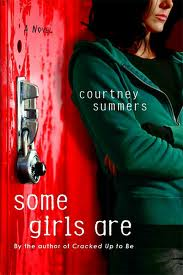
somegirlsareSome girls are bitches. In Courtney Summers’ compelling and disturbing YA novel Some Girls Are, calling the characters bitches is an extreme understatement. Some of these girls are psychopaths.

Regina Afton used to be one of the Fearsome Fivesome – a pack of girls led by Anna Morrison. Every high school has them, I suppose, that group of mean girls who take extreme pleasure in ruining the lives of others. That said, I don’t recall any from my high school days (yeah – okay, it was a million years ago!) and I don’t know of any at the school where I teach – at least none as venomous as this. And man, these girls are really, really awful.

The novel opens at a party where “everyone is wasted.” Everyone except Regina, that is,  because it’s her turn to be the designated driver, a job she takes relatively seriously even though it’s “boring.”  When she tries to rouse a passed out Anna, she encounters an obstacle of another kind: Anna’s equally intoxicated boyfriend, Donnie.

I’d turned him down in the ninth grade. Anna says we’ve been close to hate-fucking ever since, which is too gross for me to even contemplate. It’s a gunshot kind of thing for her to say – a warning. The way she says it, it’s like she can see it happening, and the way she says it lets me know I better not let it happen.

But then the unthinkable almost does happen and when Regina turns to another member of the Fearsome Fivesome for help and advice, she suddenly finds herself frozen out of the group she was once an integral part of.

The interesting thing about Regina is that she isn’t all that likeable. She’s mean. She wasn’t always mean, though. That would have to be true for readers to root for her even a little bit, but her exterior is so prickly it takes a while to warm up to her. Like, a long while. And I found that interesting. She’s an anti-hero.

Life becomes almost unbearable for Regina once Anna and Kara, Regina’s replacement, get going. It’s not just covert tactics they employ to ostracize Regina – they humiliate her, physically abuse her and truly make her life a living hell. Regina has no allies because when she was part of the clique, she’d been horrible to just about everyone in the school.

I’m  used to everyone’s eyes on me; that’s nothing new. When you’re Anna Morrison’s best friend, people look. We’re the kind of popular that parents like to pretend don’t exist so they can sleep at night, and we’re the kind of popular that makes our peers unable to sleep at night. Everyone hates us, but they’re afraid of us, too.

There’s really no relief for Regina until Michael  Hayden – one of her former victims – slowly lets her into his life. And with his friendship comes Regina’s redemption.

Okay, I’m a teacher – I know that the vast majority of teens aren’t like the people portrayed in this book – but some of them are. Some teenagers are nasty, messy, insecure, and hateful. And hopefully some of those will, like Regina, have the opportunity to make amends for the damage they do.

Some Girls Are crackles with real energy and I couldn’t put it down.

Always Something There to Remind Me – Beth Harbison

alwaysI’m not a book snob. I like a good ‘chick lit’ book as well as the next gal. I know Beth Harbison is a much-loved, best-selling author of women’s fiction…but Always Something There to Remind Me will have the distinction of being both my first and last book by Ms. Harbison. Blech.

Erin Edwards is a beautiful, successful party planner in Washington D.C., where she lives with her precocious sixteen-year-old daughter, Camilla. She and Camilla’s father are no longer together…not that we know much about their relationship (and not that it matters anyway). Always Something There to Remind Me is Erin’s story to tell and we get the then (in third person) and now (in first person).

Then happened twenty years ago. Sixteen-year-old Erin has her heart set on eighteen-year-old Nate Lawson.

From the first time she’d seen him, his image had been emblazoned on her mind, and when he stepped into view it was as if her mind closed over it like a trap. She didn’t want to think about him, but she couldn’t stop.

His eyes met hers and something clicked.

Ahh. Young love.

Erin and Nate’s teenage romance has all the requisite twists and turns: silly fights, jealousy, sneaking around in the dead of night to have sex on basement floors. But even though Erin really, really, really loves Nate, she still can’t help doing childish things and eventually he dumps her, breaking her heart and leaving her to wallow (however secretly) for the next twenty years.

Fast forward twenty-odd years and she is in a relationship with smart and perfect and handsome Rick who has just asked her to marry him. Erin’s hesitating though because she can’t stop thinking about Nate…even though she hasn’t seen him in forever.

Until the day she’s visiting her mother in the old neighbourhood and she decides to take a walk which invariably leads her past Nate’s parents’ house and – as luck (or fate) would have it – there’s Nate.

I just watched the shock in his eyes as he took me in, and knew mine probably looked the same. Shocked, glad, scared…it was hard to read both what I saw and what I felt.

But I couldn’t look away. And when I saw him try, I realized he couldn’t either. He glanced down, a muscle in his jaw tensed, but then he looked back at me, still unspeaking.

People – you can see where this story is going from like a mile away and that would all be fine except that WHO CARES? Seriously. Erin is annoying as a teen and not even remotely self-aware as an adult. Her daughter, Cam, sounds like a therapist and the treacley ending made my teeth ache.

I bought this book because it sounded like it might have something significant to say about regret and love, but if you want a book that looks backwards at what you’ve left behind, read Losing the Moon instead.