The Wheat Field by Steve Thayer

So, cutting back on the television really does promote reading. On Sunday I started and finished Steve Thayer’s book The Wheat Field. Mostly I read in the evening, after the kids had gone to bed and my husband had gone to work. Blissful silence!

The Wheat Field, as it turns out, is one of those lightweight page turners. I am particularly conscious of this because I’ve just finished reading Cook’s Instruments of Night, a book that has all the bells and whistles of literary fiction.

The Wheat Field is the tale of small-town Wisconsin, 1960. The naked bodies of married couple Mike and Maggie Butler are found in a crop circle and it’s up to Deputy Pennington to discover just what happened. Just what happened turns out to be a sordid tale of sex, politics and guns.

Deputy Pennington has  been in love with Maggie his whole life, so solving the mystery surrounding her death is personal to him. Leaving no stone unturned, however, turns out to be dangerous in Kickapoo Falls and Pennington often finds his own life in danger.

The book is straightforward in every way.

Labor Day came and went. The kids went back to school. The tourists went back home. The valley returned to what passed as normal. The September days stayed sunny and warm. But the nights cooled. And so did my investigation.

Thayer doesn’t make much of an attempt to examine the interior lives of his characters, not even our (anti)hero, Pennington. Still, it doesn’t matter. The book races along to its conclusion – a pleasant enough journey if you’ve got a few hours to kill.

Instruments of Night by Thomas H. Cook

There’s a really great interview with mystery writer, Thomas H. Cook, in the September ’09 issue of January Magazine. In the article Ali Karim asks the very question that puzzles me every time I finish one of Cook’s novels. Why is this man not enormously famous? I mean, perhaps he is famous in mystery circles – but even if you’re not a fan of the genre, I think you should still give Cook a go.

I picked up Instruments of Night on Friday night and read about 30 pages. It was late when I started and so eventually my eyes gave out. On Saturday I picked it up again and didn’t put it down until I finished – with a gasp, I must add – the book.  I stumbled on Cook totally by accident three or four years back. I picked up, at a second hand bookstore, his novel Breakheart Hill and read these lines: “This is the darkest story I ever heard and all my life I have labored not to tell it.” Hooked. 

Instruments of Night is the fifth novel I’ve read by Cook. It’s the story of writer Paul Graves, a man who has spent his career writing about the horrible dance between serial killer and sadist Kessler (and his accomplice, Sykes) and the man who has spent his career chasing him, Detective Slovak. Instruments of Night operates on more than one level, though. Graves has almost completed the 14th installment of his series when he is invited to upstate New York to meet with Allison Davies, mistress of an estate known as Riverwood. Fifty years ago, Allison’s best friend, Faye, was murdered on the grounds and now Allison wants Paul to “imagine what happened to Faye. And why.”

But that’s not all. Paul Graves is a tortured man. His own past is filled with ghosts, horrible ghosts. He is a beautifully nuanced character and I particularly admired the glimpse we got into his head as a writer. Perhaps Cook was revealing a little bit about himself there, I don’t know, but Paul’s imagination allowed him to write scenes, and adjust them as needed, on the fly. Using this technique, he attempts to solve the question of who killed Faye.

The way Cook juggled the three threads of this story: the mystery of Faye’s death, the stand-off between Kessler and Slovak and the past that is creeping up on Paul is nothing short of amazing. But Cook is an accomplished writer. And this is literature. Truly. Page-turning, white-knuckling, horrifying literature. In every book I’ve read by him, I’ve been amazed at how complex his characters are and Paul is no exception.

If you haven’t read Cook yet, I beg you to give him a go. He’s fabulous!

Disgrace by J.M. Coetzee

J.M. Coetzee is a South African writer and former winner of the Nobel Prize for Literature. Disgrace is the first novel I’ve read by Coetzee. It won the Booker Prize in 1999.

Disgrace is the story of Literature Professor, David Lurie. Lurie is a man who answers only to himself. Twice divorced, Lurie has “solved the problem of sex rather well.” But then his life starts to unravel; he pursues a student who seems ambivalent (but not altogether resistant) about his advances. When she accuses him of impropriety, Lurie does nothing to defend himself.  He packs himself off to his adult daughter’s farm on the Eastern Cape. His relationship with his daughter, Lucy, isn’t a particularly close one. Lurie, it seems, has been a haphazard father. He loves her, but he doesn’t know her. One day a horrific event changes their lives forever.

On the surface it would seem that Disgrace is about one man’s midlife crisis. Lurie chases beauty. He’s attractive and charming enough to grasp it – however fleetingly. What Lurie doesn’t have, however, is substance. And it isn’t until he’s forced to reorder his self-centered world that he gains real insight into what makes him human. That compassion, when it comes, is hard-earned. One of the interesting things about Lurie is that as a teacher of Romantic poetry (a movement that reveres nature), he actually finds all things natural distasteful – so life on the farm isn’t comfortable at all for him.

Disgrace was an easy book to read, but don’t let the prose fool you. This book is jam-packed with thoughtful ideas: how does a parent love a child; how does a man, at the mid-point of his life, reconcile who he thinks he is with who he is in actuality; how do the white people of South Africa co-exist peacefully with the Blacks – can they?

Disgrace isn’t a feel-good book. I did, however, feel that Lurie attained a certain grace by the novel’s final pages and, while in his company, I felt a little like it might be possible for everyone to achieve a similar state – although the trip is often unpleasant.

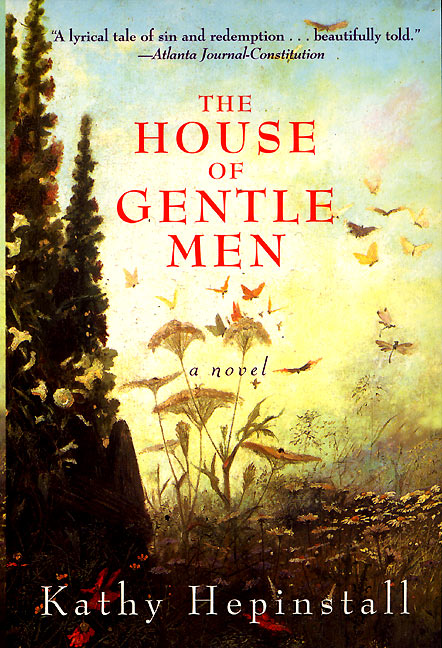
The House of Gentle Men by Kathy Hepinstall

My book club meets once every five weeks or so. It’s organized so that each of the ten members chooses one book per year…and the rule is that it has to be a book you haven’t read. The reveal is a big deal to us – we all love to see what’s coming next. Although we do have a big book store in town now, it’s still not always possible to stray too far off the beaten track. That’s why, when I was preparing my reveal in December, I took advantage of the great fiction sale at Book Closeouts. com. I read reviews and blurbs and blogs and finally made my decision. Book Closeouts had 12 copies of the book and they were $1.24 each…for a hard cover! So, I was able to buy a copy for everyone in the group and hand them out – gift-wrapped – at our Christmas meeting. So much fun!

Last night we discussed my pick. The House of Gentle Men has been on my radar for a long time. A few years back I read Hepinstall’s novel The Absence of Nectar which I liked quite  a lot.  There was something intriguing about the premise of The House of Gentle Men so I took a chance. I’m not sure that everyone in my book club would agree, but this book paid off for me.

The House of Gentle Men is actually the name of an establishment run by Mr. Olen, a single father who is hoping that if he makes up, in some way, for neglecting the wife who subsequently left him, she’ll return to him. He opens a house for Gentle Men, offering men who have the need to atone for some past wrongdoing the opportunity to redeem themselves.

“You think you could spend all night with someone, just kissing? Touching? Whispering sweet nothings? Maybe a little waltzing?”

These are the questions he asks, Justin, a young man who wanders into the house looking for a way to right his own wrongs.  Justin, as it turns out, has a lot to atone for. Seven years previous, while he was a young soldier on maneuvers, he came upon two fellow soldiers raping a young girl in the woods. Instead of doing the right thing, he took his turn.

Several lives intersect at the house for gentle men. Hepinstall deftly creates interior lives for even minor characters. All of them are damaged in some way; some of them are reprehensible; many of them deserve the redemption they so ardently seek.

This book took a few pages (about 75) to work for me. It seemed somehow cheesy –  this whole idea of a place where tired, frustrated, broken women could go to find comfort – not from sex  (although everything but intercourse is allowed), but from companionship. But, in the end, it did work . I grew attached to the characters, Charlotte in particular – who loses her voice (or chooses not to speak) after the attack. As she navigates her way out of her pain and anger, into the light offered by forgiveness, it’s almost impossible not to feel something for her.

So The House of Gentle Men may require a suspension of disbelief, but I think it’s worth it in the end.


How I Live Now by Meg Rosoff

How I Live Now by Meg Rosoff  has been on my tbr shelf for a few months. Coincidentally, a friend gave a copy of the book to my 12-year-old daughter, Mallory, for Christmas. We decided it would be cool to read the book at the same time and then share our thoughts about the novel here. This is actually something I’d like to do on a semi-regular basis because there are a lot of YA novels I’d like to read and Mallory is a voracious reader. In any case, we’ll start with this book and see how we make out.

I’ll start by letting Mallory tell you a little bit about herself:

Hi, everyone! I’m a grade seven student in French immersion. Besides reading, I enjoy drawing, dancing, (I study ballet and modern dance ten hours a week), and hanging out with my friends. I do love to read. Some of my favourite books are: Airborn, Skybreaker, A Little Princess, The Twilight Saga, Little Women, and The Little House on the Prairie books.

Christie: Thanks, Mal. So, I’m going to let Mallory tell everyone what How I Live Now is about.

Mallory:  Basically,  How I Live Now is about a teenage girl named Daisy who goes to England to live with her cousins after her father remarries. Once she’s there, two life-changing things happen: she falls in love with her cousin, Edmond, and war breaks out.

Christie: That’s it in a nutshell, Mallory. But this is a pretty remarkable book; it’s certainly not like anything that I’ve ever read before. What did you like about it?

Mallory: You know how when you read you can hear the author’s voice? Well, this book had the strongest voice of any I’ve ever read. Meg Rosoff created an incredible character, and when Daisy spoke she could make you believe anything.

Christie: I think Mal’s touched on the main reason this book is so wonderful. Daisy is a breathless, intelligent, self-deprecating, emotional fifteen-year-old girl whose personal world has been turned upside down….and then she has a catastrophic war to contend with.

When she arrives at the airport and meets her cousin, Edmond, she tells the reader “Now let me tell you what he looks like before I forget because it’s not exactly what you’d expect from your average fourteen-year-old what with the CIGARETTE and hair that looked like he cut it himself with a hatchet in the dead of night, but aside from that he’s exactly like some kind of mutt, you know the ones you see at the dog shelter who are kind of hopeful and sweet and put their nose straight into your hand when they meet you with a certain kind of dignity and you know from that second that you’re going to take him home? Well that’s him.” (3)

The whole story spins out of Daisy’s amazing brain and everything that happens to her is skewed by her needy intelligence.

Mallory: Her relationship with Edmond was really interesting to me. At first, I thought it was sort of freaky because I couldn’t imagine falling in love with my cousin. But after the war starts, and things get more complicated, I began to believe, like Daisy did, that they were meant to be together– related or not.

Christie: The war certainly made the story interesting. What did you think of the way we didn’t really know too much about who was fighting whom?

Mallory: When I was reading any bits where the war is described, my mind was never thinking of who was fighting or what they were fighting for. Mostly the whole time I was on edge with fear for Edmond and Daisy and whether they would make it through.

Christie: I was worried for them too, but I thought it was really interesting to see this war through Daisy’s eyes. Even though she didn’t really understand the hows and whys, she was able to articulate how people were affected by the fighting and the deaths she witnessed were horrific.

Mallory: I agree. Daisy seemed to be in the know and completely out of it at the exact same time — but it didn’t seem to matter. I was just wondering, what were your thoughts on Isaac and Osbert, who didn’t seem to play a big role in this story. And about Piper, who did.

Christie: We should tell people that Isaac is Edmond’s twin, Osbert is his sixteen-year-old brother and Piper, his nine-year-old sister. Their mother, Daisy’s Aunt Penn, goes off to Oslo very early in the book, leaving the children on their own. I think that’s one of the interesting aspects of this book — how these kids have to fend for themselves when the war is relatively distant and how all that changes when it suddenly shows up in their back yard. You’re right, though; Isaac and Osbert don’t really have a large part to play although Isaac does have an impact at the novel’s conclusion. Piper, on the other hand, is extremely important and I think gives Daisy a reason to go on. She’s a great character.

Who should read this book, Mal?

Mallory: Well, this book is suggested for 12 and up- but it’s a pretty intense read. It might not appeal to everybody, but if you’re a strong reader, and aren’t easily upset or offended, I recommend this book. Before I read How I Live Now, The Twilight Saga were my favourite books. I stayed faithful to them for a long time, and was almost positive that I’d never find a book (or series) that was better. How I Live Now was a pleasant surprise. It ended up overtaking Twilight by a longshot– and it’s now the reigning champ.

Christie: That warms my heart Mal because, as you know, not a fan of the sparkly vampires! Now we have to decide what we’re going to read next. Stay tuned!
Thirsty by Kristin Bair O’Keeffe

Kristin Bair O’Keeffe’s debut novel, Thirsty, professes to be a novel about domestic abuse, its horrible legacy and one woman’s struggle to get out from under its damaging fist.

The novel opens in Croatia in 1883: “In the beginning, Drago smelled of dirt and bloom, the odor that would rise if you peeled the erath back at its seams.”

Klara is just 16 when Drago arrives on her doorstep. Her mother is dead; her father is mean; she’s responsible for looking after five younger siblings and she dreams of a better life somewhere else. Drago is handsome and he’s going to America.

Thirsty is a pretty compelling story, but there’s too much story here for 200 pages. I never felt like I knew any of the characters well enough to really understand their motivations, fears, dreams. The book covers 40 years and, honestly, it felt unfinished to me.

Klara learns pretty early on in her marriage that Drago is just as violent as her father. Why? Who knows. We do learn, half way through the book, that he loved someone else –  a blonde woman who married his brother. When Klara decides, out of the blue, to get her hair dyed – of all things – blonde and Drago beats the crap out of her, Drago’s reminiscence  seems less like character development and more like plot contrivance.

Klara’s daughter, Sky, grows up to be promiscuous – clearly searching for something to take away the pain of having watched her mother be her father’s punching bag. Then she marries an abusive man. We get a page and a half of his story and then eight years zip by and Sky and her two young daughters arrive on her parent’s doorstep. She’s a mess.

Thirsty felt like a string of little set pieces, strung together, rather than a novel with a central character we understood or could root for. My frustration with Klara wasn’t because she didn’t leave Drago. I understand well enough the psychology of battered wife syndrome. My problem was that I just didn’t care.

I might have given up on the novel all together if it hadn’t been for the fact that the writing was quite lovely at times.  But as a story of abuse and one woman’s efforts to break free – it falls short. The ending is not a triumph for Klara. Ultimately Klara’s new life, when it begins, has more to do with good luck than good management.

Thirsty, the web site

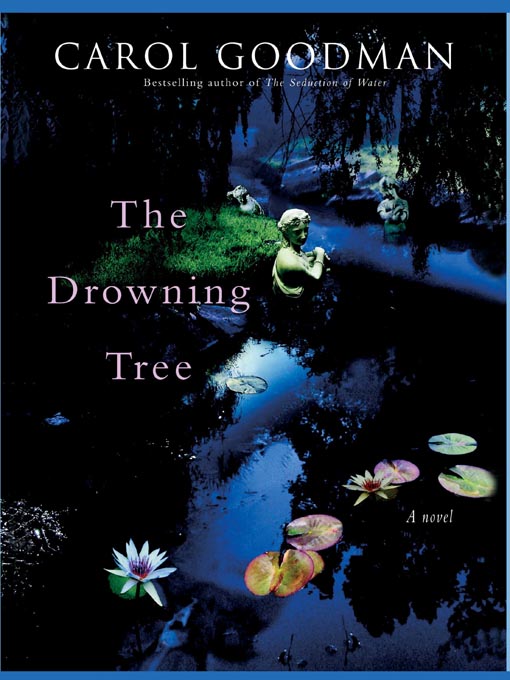
The Drowning Tree by Carol Goodman

It’s been thirteen years since I last saw Neil – and fourteen years since we both nearly drowned in the river – and I still dream about him every night, and because he told me once that he believed that we could visit each other in our dreams, I always have the feeling that that is what he’s doing – coming to me in my dreams each night. – The Drowning Tree

Carol Goodman’s interest in Latin and Art and Literature is obvious. The first novel I read by her, The Lake of Dead Languages concerned a Latin teacher at a private girls’ school. The Drowning Tree tells the story of Juno  McKay, a woman who runs a glass business (she’s in the business of building and restoring stained glass windows and is currently working on the reconstruction of a beautiful window from her old  school, Penrose College.) The novel is steeped in Greek and Roman mythology.

Juno’s best friend from college is the beautiful and wildly smart, Christine. She blows into town to deliver a lecture about Augustus Penrose and his wife Eugenie and her sister, Clare and the very window Juno is currently restoring. After the lecture, Christine disappears. Juno spends the next 300 pages trying to figure out what happened to Christine and why.

My feelings about The Drowning Tree are lukewarm, I’m sad to say. Goodman is a fine writer. She clearly cares about the craft and her work has depth…but she’s supposed to be a writer of literary thrillers and her books (at least the two I’ve read) move slower than cold molasses. Nothing. Happens.

In fact, in The Drowning Tree, it isn’t until Juno’s long- institutionalized husband, Neil, makes a reappearance some 200 pages into the book that things start to perk up a little. I guess Juno herself just isn’t engaging enough to carry the novel all on her own. And the book’s central mysteries –  what happened to Christine and what was the deal with Eugenie and her sister –  aren’t compelling enough to hold 338 pages aloft.

Perhaps it’s the publisher that does Goodman a disservice by calling the book a “literary thriller”. Literary for sure; thrilling, no way.

Traveling with Pomegranates by Sue Monk Kidd and Ann Kidd Taylor

Having read The Mermaid Chair and  The Secret Life of Bees, both by Sue Monk Kidd,  I was excited when this was chosen as one of our book club selections. That was in November. I just finished reading the book now. What does that tell you?

Traveling with Pomegranates should have been a better book than it actually is. This is a mother(Sue)/daughter(Ann) memoir about travel, faith, love, creativity and writing. At the beginning, as I settled in, I thought that it was going to be quite compelling. I felt a kinship with Sue:

“I didn’t understand why I was responding to the prospect of aging with such shallowness and dread, only that there had to be more to it than the etchings on my skin” (4).

In Sue’s capable hands, this journey is – if not always engaging – at least well written and thoughtful. Sadly, I can’t say the same for Ann’s part. I found her whiny and entitled. I never warmed up to her.

Mother and daughter visit Greece together in 1998. Ann is 22 and Sue mourns the loss of the little girl she was. She is also acutely aware that something troubling is going on with her daughter. At first glance it might seem that Ann’s disappointment has to do with the fact that she didn’t get into graduate school, but as the mother/daughter writers unspool the story it turns out that they are both looking for something more complicated. And they spend the rest of the book kneeling at the feet of Madonnas (and other powerful female icons) in Greece and Crete and France…trying to find it.

Ultimately, it turns out that graduate school was never what Ann truly wanted; she wants to be a writer. And how wonderful for her that her mother is and that they could do this book together.

The Bright Forever by Lee Martin

Lee Martin’s novel The Bright Forever has restored my faith in fiction. After a long drought, The Bright Forever accomplished what all good novels should: it held me spellbound. It is beautifully written, has a cast of damaged and damned characters and is almost impossible to put down.

Nine-year-old Katie Mackey goes missing one hot July night in small-town Indiana. She’s the youngest child of Patsy and Junior Mackey. Junior is a man about town; he owns the glass factory. Katie and her older brother, Gilley, are not spoiled rich kids, though – they are smart and kind.

The Bright Forever is told from the viewpoints of Gilley, Mr. Dees (the bachelor math teacher who is helping Katie improve her math skills that hot summer) and Raymond and Clare, a couple of misfits who live on the other side of town, close to Mr. Dees. Occasionally, the story drops into 3rd person omniscient, allowing us to see how the town is reacting to Katie’s disappearance. These transitions are handled effortlessly and the various voices are distinct and original. Each perspective adds to the story’s central mystery – what happened to Katie – but also allows us to see how fragile and broken these people are.

It’s clearly early on that Mr. Dees and Ray are the prime suspects in this case, but what the reader isn’t suspecting is their complicated complicity and the way their story unfolds. Suffice to say – there is more than one victim in this story.

The Bright Forever is remarkable – it moves at a suspenseful clip and yet, ultimately, it’s a tragedy.  A worthy read, indeed.

Where the River Runs by Patti Callahan Henry

A while back I read Henry’s novel Losing the Moon and although I had misgivings when I started the novel, it won me over in the end. Sadly, I can’t say the same about Where the River Runs. I wanted to like it, I really did…but I just had so many problems with it.

Where the River Runs is the story of Meridy Dresden, lawyer’s wife and mother to a teenage son, BJ. She has a strained relationship with her mother and sister and a big secret that she’s kept since the summer she graduated from high school and her boyfriend, Danny, was killed in a fire. When she’s asked to write a curriculum based on Gulluh (descendants of African slaves) culture, she goes back to her childhood home to interview Tulu, her childhood housekeeper.

What this novel expects us to believe is that 20 years after the tragic fire that killed Danny,  Meridy’s best childhood friend, Tim, is being asked to pay for the damage to an old historically significant cottage that burned down. The novel also asks us to believe that people’s strained family relations can be miraculously resolved over iced tea on the porch. Meridy’s struggle to reconcile her past was real enough except that the secret she built her life around was ridiculously inconsequential.  I just didn’t buy into her angst. It all seemed contrived and convenient and forced.

For me, the best parts of Where the River Runs were the Gulluh sayings at the start of every chapter. Things like Death is one ditch you cannot jump and the heart doesn’t mean everything the mouth says.

Where the River Runs is part of the New American Library Accent series, novels which are meant to touch on subjects close to a woman’s heart, or as the tag line says: “Fiction for the way we live.” I don’t know anyone who lives this way.

Didn’t like this one at all…read Losing the Moon instead.