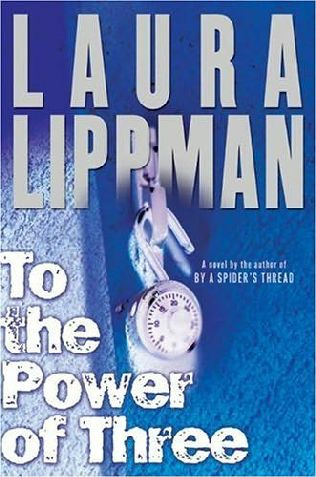
To the Power of Three by Laura Lippman

To the Power of Three was my first novel by Laura Lippman. It’s hard to know what to say about it because while I didn’t love it, I certainly appreciated its merits.

To the Power of Three tells the story of Kat, Perri and Josie, childhood best friends. One June morning, one of the three  brings a gun to school, shoots two of the girls (one fatally) and then herself. The novel then begins to unravel the story of what would have caused this horrible act of violence.

Lippman is an accomplished writer. In some ways, her work reminds me of Carol Goodman. Lippman’s characters were complicated and well drawn – even minor characters have interior lives, hopes and fears. We come to understand these three girls and share their bond through the years of their friendship, but we only come to understand what caused one of the girls to take such drastic measures at the novel’s conclusion.

For me, that was the novel’s weakness. The book’s over 400 pages long – too long, perhaps, for such a mediocre resolution. As a reader, we’ve invested a great deal in these characters (and their parents and peripheral friends) that it’s a let down to discover what actually happened on that fateful day – and why it happened. (After giving this more thought, I think the reason why the ending didn’t work for me is because it gives one of the characters a moral compass that – while not exactly coming out of nowhere – doesn’t seem earned either.)

To the Power of Three wasn’t a page-turner in the way that some mysteries are. Perhaps that balancing act is hard to achieve: literature and suspense; a well-written story that you speed through because you can’t bear not to know whodunit. For my money, no one manages that sort of book better than Thomas H. Cook. Still, Lippman’s skills are apparent and I’d certainly read her again. In fact, I have What the Dead Know waiting on my tbr shelf.

The Shadow of the Wind by Carlos Ruiz Zafon

This novel has been on my tbr list for a long time so I was thrilled when it was chosen as our book club pick.  Zafon’s  novel has been universally praised by famous writers (Stephen King called it “one gorgeous read”) critics  (Booklist said the book was “rich, lavish storytelling”) and everyone in my book club loved it. Except me. I didn’t hate the book; I enjoyed reading it.

Let me explain.

Ten-year-old Daniel, son of an antiquarian bookseller, is still suffering from the death of his mother – whose face he can no longer remember. His father decides to take him to The Cemetery of Forgotten Books, a labyrinth of passages and shelves – almost impossible to navigate.

This is a place of mystery, Daniel, a sanctuary. Every book, every volume you see here has a soul. The soul of the person who wrote it and of those who read it and lived and dreamed with it. Every time a book changes hands, every time someone runs his eyes down its pages, its spirit grows and strengthens.

Traditionally, when someone visits the Cemetery, he or she is allowed to choose one book and then they must promise to safeguard that book for all time. Daniel chooses The Shadow of the Wind by Julian Carax.

Daniel falls in love with the novel, a story about a man searching for his real father. He is so enchanted by the novel that he decides he must read everything by Carax and it is this quest that kick starts the novel.  Carax is something of a mystery himself and Daniel’s quest to learn more spans several years, introduces him a cast of broken and sinister characters and leads the reader on an adventure.

I think that’s what my problem was with this book.

I heard a regular customer say that few things leave a deeper mark on a reader than the first book that finds its way into his heart.

I think my expectations for the book and what the book was actually about didn’t actually jibe.  I had no trouble turning the pages, but ultimately The Shadow of the Wind was more of a stuffed-to-the-brim melodrama than a meditation on first books or even books in general.

As Daniel begins his quest to track down further Carax novels, a strange and somewhat threatening man offers to buy The Shadow of the Wind. Of course, this just redoubles Daniel’s efforts –  a quest that yields some surprises.

I guess, ultimately, my reservations about this book come from the hype. If I hadn’t heard so much, I might have been swept along. The writing is great (despite the fact that it’s a translation), the characters are sympathetic…but for me…the book was too long, and sometimes I felt that all the pieces just locked into place just a little too neatly. Daniel explained it best when he said:

the structure of the story began to remind me of one of those Russian dolls that contain innumerable ever-smaller dolls within.

Despite my own personal feelings, however, I would certainly encourage other readers to check this book out. It’s a lot of fun – the kind of book you can truly lose yourself in.

Bird by Bird by Anne Lamott

I’ve been a writer for as long as I can remember. At first I typed my stories on a little portable Brothers typewriter. I remember that it was blue and that you had to really hit the keys hard. When I graduated from high school, my parents gave me an electric typewriter that weighed at least 50 pounds. At the time it was state-of-the-art, honest.

I have always wanted to be a writer, a published writer and I guess I am. I’ve written and had things published and even been paid for what I’ve written.

Of course the writer’s carrot is the novel and I’ve been slogging away at one – never with the dedication and determination to actually finish it, of course, just enough to say that I’m writing one – for over a decade.

Anne Lamott’s book Bird by Bird speaks to writers who care more about the craft and less about the imagined glory. This is not a how-to book. It’s not a book filled with prompts and practical advice about how to write pithy dialogue or set the scene. Still, it’s a wonderful book.

The very first thing I tell me new students on the first day of a workshop is that good writing is about telling the truth.

Bird by Bird offers  “some instructions on writing and life.” It’s Lamott’s love letter to the written word – and she clearly does love them – the words, I mean.  It  is laugh – out – loud funny and tender, too.  Lamott navigates the writer’s world with a great deal of affection and a healthy dose of tough love. She’s honest about her jealousy when faced with the success of writers she believes to be less talented than she is;  she discusses the pitfalls of the blank page;  she talks about how to negotiate with your characters. But mostly she talks about why we write (and why we read). She says:

Writing and reading decrease our sense of isolation. They deepen and widen and expand our sense of life: they feed the soul.

Writing, says Lamott, is important work. Writers should write, not for the notoriety which they assume comes with publication (and Lamott tells some funny stories about the so-called status of the published author) but because they have to. They want to. They must.

What You Have Left by Will Allison

Will Allison’s debut novel What You Have Left, reads like a series of connected short stories. When the book opens, five year old Holly has just been dropped off at her grandfather’s dairy farm. Her father says he’ll be back, waves good-bye and disappears from her life for thirty years. What follows are alternating narratives of the years both before Holly’s birth (concerning her parents Wylie and Maddy) and after, concerning Holly’s relationship with Lyle.

Holly is a bit of a train wreck. She drinks too much and abuses Lyle both before they marry and after. Of course, she has abandonment issues.

I really liked the first chapter of What You Have Left. Allison captured young Holly’s voice (although I have to admit that at first I thought the narrator was a young boy) beautifully. The first chapter mainly concerns Holly’s relationship with her grandfather, Cal, a kind man who tries to be both mother and father to Holly. His death sends Holly on a course of recklessness that seems to take her years to pull out of.

It’s not always easy to  like Holly. She’s one of those chip-on-her-shoulder types of characters who doesn’t seem to take into account anyone else’s feelings but her own. Her husband, Lyle, is a saint – even when he, too, seems to make stupid decisions.

I also appreciated hearing her father’s story. I think we tend to forget that parents have lives before they become parents and sometimes it’s hard to reconcile that. Children can be selfish. Parents, too.

In the end, I liked What You Have Left. Perhaps not everyone will like the narrative, but the voices are distinct and compelling and this slim novel has a lot to say about family and forgiveness.

Girls by Frederick Busch

The best word I can think of to describe Frederick Busch’s novel Girls is muscular. The novel has certainly received much higher praise than that. Glamour Magazine called it “powerful,” and went on to describe it as an intriguing crime story although the novel’s real strength lay with the main character’s  “growing insight about his marriage, his town, and himself [which] transforms this page-turner about lost children into a tender and eloquent examination of the even greater mystery that is the human heart.”

Jack is a somewhat cantankerous Vietnam veteran who is currently a campus cop at a small college in upstate New York. His wife, Fanny, is an emergency-room nurse. Jack and Fanny are mourning the recent loss of their infant daughter, Hannah. They can barely be in the same room with each other and so they work opposite shifts, drifting past each other in a haze of exhaustion and grief.

Then a local girl goes missing and someone suggests Jack help out with the investigation, ostensibly as a way of working through his own issues.

The characters in Busch’s novel are all messed up.  Jack and Hannah are locked in a grief-fueled stalemate and neither seems to know how to make the first move. As Jack observes:

I thought, as I stayed where I was, that somebody ought to walk around the table and hug this woman hard and just hold on.

Instead, Jack fills his days helping cars up icy hills, rescuing suicidal co-eds, drinking sour coffee with his confessor, Archie, and trying to figure out just what happened to the missing girl.

Girls is a  atmospheric and tragic story and the characters, particularly Jack, are well-drawn and convincing. The novel is often funny, too. In one scene, where Jack runs a drug-dealer off the campus, I laughed out loud.

Busch is a new-to-me writer, but he’s written 20 other novels and he’s impressed me enough to look for more.

The New York Times has a terrific review of the novel here.

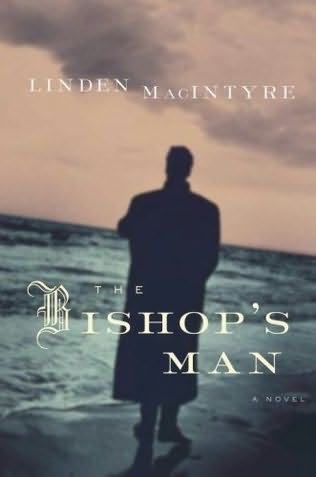
The Bishop’s Man by Linden MacIntyre

The Bishop’s Man was the 2009  Giller Prize winner. For those of you who aren’t familiar with the Giller, it’s Canada’s largest annual prize for fiction, netting the winner $50,000. MacIntyre, a well-known Canadian journalist who has won nine Geminis for broadcast journalism, beat out Anne Michaels, Colin McAdam, Annabel Lyon, and Kim Echlin.

I’m not sure The Bishop’s Man is a book I’d pick up on my own, but it’s this month’s book club pick. Still, the novel’s opening pages had me intrigued.  Its narrator, Father Duncan MacAskill,  is an intriguing character, but then he starts to spiral out of control and so does the book.

MacAskill is known as the “Exorcist.”  The Bishop  sends him to clean up after fallen priests – men who have sullied the name of the priesthood by engaging in sexual relationships with – well – anyone. As we all know, celibacy is one of the tenets of the priesthood.

MacAskill isn’t without his own secrets, though. When the bishop decides to send him back to his childhood home, MacAskill is forced to confront his own demons. Isolated from the world in backwoods  Cape Breton MacAskill suddenly realizes how lonely he is and he begins to drink heavily.

The Bishop’s Man is a page-turner. Lots of things are hinted at, enough to make the reader wonder: about the suicide of a young man and his relationship with a charismatic priest who has since left the order and married; about MacAskill’s time  in Honduras, revealed in snippets from his diary; about where his relationship with Stella, a woman in the village, might be headed; about his childhood.

MacIntyre juggles all these various threads and I guess this is where the book failed for me. I’m not a moron,  but sometimes the out of sequence narration was really a pain-in-the-ass. I’m all for the elliptical, but I’m not sure it served the story in this instance (unless MacIntyre was trying to mimic the disordered state of MacAskill’s mind.)

I haven’t read the other novels on the Giller shortlist and so I’d be curious to see how they stack up against this one. I guess the one thing The Bishop’s Man has going for it is a sense of immediacy. The Catholic Church has certainly had its share of troubles. Whether or not the novel’s verisimilitude is enough to overlook its other issues is up to the reader, I suppose.

The Secret of Lost Things by Sheridan Hay

The Secret of Lost Things is a quiet book inhabited by a cast of eccentric characters who all work in a labyrinthine book store in New York City.

If I start with my own beginning you will understand how I came to the Arcade, and how it came to mean so much to me.

18-year-old Rosemary Savage leaves her homeland of Tasmania after the death if her mother. Rosemary really only knows two things: the hat business (her mother was a milliner) and books (her mother’s only friend , Chaps, owned a bookstore.) Upon her arrival in New York, Rosemary stumbles across the Arcade and lands a job.

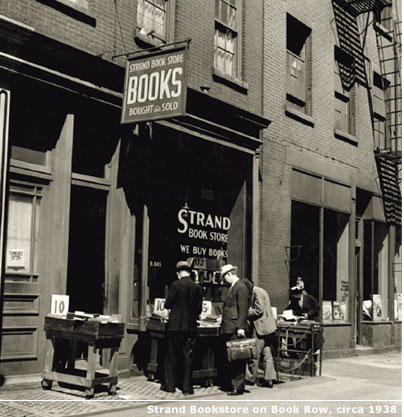
The Arcade reminded me immediately of The Strand. Any book lover who’s spent time in NYC has likely visited The Strand. It’s a sprawling, book-crammed paradise for bibliophiles.

As it turns out, Sheridan Hay actually worked at The Strand for nine months, so the similarities I saw in her fictionalized  bookstore were no doubt based on her real-life experiences at The Strand.

Rosemary’s colleagues are a strange crew. There’s Pearl, the man transitioning to become a woman. There’s Oscar, the beautiful gay man in charge of the Non-Fiction section. And there’s Walter Geist, the bookstore’s manager who is an albino.

Although the blurb on the back of The Secret of Lost Things makes it sound like a literary thriller, that’s not what the book is really about.  The characters who work at the Arcade are bookish types, more comfortable with the dusty tomes they sell than with each other. Each of them guards their little book store nook like jealous lovers. Rosemary’s arrival awakens all sorts of feelings and pettiness and passions. Rosemary develops a crush on Oscar even though he’s clearly not interested in her. (In fact, he’s downright mean.) But it’s Geist whose life is forever changed by Rosemary’s arrival. In retrospect she remarks:

Walter Geist’s blindness is important, but it’s my own with regard to him, that remains a lasting regret.

The Secret of Lost Things is a coming of age story. It’s a story about loss and grief. And it’s a story about the transformative power of literature. While there is a literary mystery at the book’s core, it’s not nearly as interesting as the mysteries of the heart.

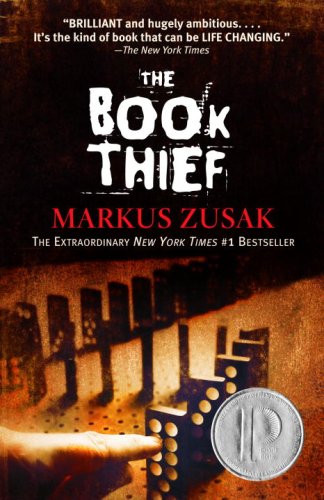
The Book Thief by Markus Zusak

I still remember the feeling I had the first time I read The Diary of Anne Frank. I was probably about 11 or 12. No teacher could have explained the horrors of Nazi Germany to me as well as Anne did. She was speaking to me. Many years later, I visited her attic annex and it was a profound experience.

Reading The Book Thief was also a profound experience for me.

I don’t even know how to begin to talk about The Book Thief. The New York Times said it was “the kind of book that can be life changing.” I mean, you start a book like that with a little trepidation: can it really live up to all the hype? For the first 30 pages or so I thought, “no.” Last night, as I closed the book and wiped the tears away I thought, “every person alive should read this book. I want to teach this book.”

The Book Thief has so many things going for it, I’m not sure where to start singing its praises.

The Book Thief is the story of Liesel Meminger.  Liesel is almost ten when she ends up in Molching with Hans and Rosa Hubermann, her new foster parents. It is 1939. In Nazi Germany.

Readers are either going to be totally enchanted or annoyed by the story’s central conceit: the novel is narrated by Death. “Here is a small fact, ” Death tells us. “You are going to die.” For the next 500-plus pages, Death is our constant companion. Sometimes the action unfolds without commentary, other times he weighs in.  Although I found the first 30 pages or so a bit of a slog, I soon settled into the book’s rhythms.

Then I fell in love with Liesel. And Hans. And Rudy. And Rosa.

Liesel is extraordinary. She and Hans bond late at night, when Liesel’s nightmares wake her, and Hans teaches her to read. Books and words are central to Liesel’s story. So is her friendship with Rudy, the boy next door. Through their eyes we see Hitler and Nazi Germany; we experience the atrocities and the small kindnesses. Zusak’s story is mostly about everyday things: hunger, pettiness, laughter, hope, cruelty and kindness.

Liesel is sustained by the books she steals and anyone who loves words will appreciate and understand their ability to comfort Liesel. But she is also intelligent enough to understand how words can be used to hurt and coerce.

Where is Death in all this? He carts the souls of the dead off and is, in this story at least, a loving and benign figure.

Death gets the last word. He always does.

Cleave by Nikki Gemmell

I am not a Nikki Gemmell newbie. I first discovered her a few years ago when I stumbled across her book The Bride Stripped Bare. I liked that book enough to track down more of Gemmell’s work. Cleave is the third novel I’ve read by her.

Cleave is the story of Snip Freeman, a 30 year old Australian artist. The novel opens with Snip making a long journey from Sydney to Alice Springs in Central Australia.  Snip’s  grandmother has died and left Snip enough money to buy a ute (which I gather is the Australian version of a pick up truck), but she has one request: Snip has to return to Alice and find Bud. Bud, as it turns out, is Snip’s father. Finding him isn’t a problem: Snip knows where he is.

Alice (and Bud) have an emotional hold on Snip. Well, lots of things have an emotional hold on Snip. She’s prickly and needy and in desperate need of the answers to some of the big questions of her life.

The distance between Sydney and Alice Springs is roughly 2700km and Snip doesn’t want to make the journey alone so she puts an ad in the paper: Girl plans ute, Sydney to Alice, share the lot, now. Dave is intrigued by the ad and ends up sharing the journey with Snip. Dave becomes a major player in Snip’s life. She’s always reckoned herself a free spirit, bouncing between friends, setting up makeshift studios wherever she lands. Although he’s slightly younger, Dave is settled and he wants Snip to settle, too.

Cleave means to break or come apart. Cleave is a story about fathers and daughters, mothers and daughters, husbands and wives, lovers. Although that might be familiar territory, Gemmell’s story is made new by her original and fresh prose and, for this Canadian at least, the unfamiliar terrain. Gemmell’s characters are intriguing, particularly Snip and her father. I think Gemmell’s a brave writer, too. She takes chances with her words and pushes the reader along ground that is often uncomfortable, but all the more rewarding because of it.

I am happy to say that I have now completed the first book in the Aussie Author Challenge.

Before the Knife by Carolyn Slaughter

The Betty and Boo Chronicles is hosting a Memorable Memoir Reading Challenge and as I actually have a few memoirs on my tbr pile, I thought I could manage to fulfill the challenge’s requirements: read four memoirs in one year. That’s doable.

I just finished my first memoir, Before the Knife by Carolyn Slaughter.

Before I talk about the book, let me say a few words about the author. I discovered Carolyn Slaughter 20 odd years ago, purely by accident. I came across her novel, The Banquet in a book store and its tag line “a taut and powerful story of obsessive love” caught my attention.  Well of course it did. At the time I was madly (and a little obsessively) in love myself. I devoured the book and then went looking for more. In a second hand store I came across her novel Relations (which is also known as The Story of the Weasel in that weird way books have their name changed between the UK and North America). That book was stunning. That book caused me to write a letter to Ms. Slaughter, the first and only fan letter I have ever written to an author. A letter to which she replied. In total I have read six novels by Ms. Slaughter (I highly recommend Magdalene as well as the two I have already mentioned) and I count myself a huge fan. She is an immensely talented writer.

Her memoir wasn’t what I expected, however, and I can’t say I loved it. Born in India, her parents moved to Africa when Slaughter was very young. Her father had some sort of government job; her mother was mostly emotionally unavailable and Carolyn, her older sister, Angela and her younger sister, Susan had a weird and unhappy childhood.

Carolyn prefaces her story by telling the reader of a horrific incident that happened to her when she was six. Then she goes on to say that Before the Knife isn’t a memoir about that. Except it is —  because Carolyn was clearly shaped by what happened to her. She does her best to survive her cruel mother and horrible father and much of her survival depends on her affinity with the land. She clearly loves Africa, its wild and exotic landscape a place of  refuge for her.

The story covers Slaughter’s life from her arrival in Africa to her return to England when she’s 16 or so. The pages in between are filled with striking images of the land, the people (Black and white) who occupied it, and Slaughter’s complicated and strained relationship with her siblings and parents. She’s not entirely likable — prone to violence against others and herself.

It’s not until years later, when she herself remembers what had transpired when she was just a little girl, that her story comes into focus. By then, though, I felt disconnected from her — the strange little bits of revealed life never really coming together. And I really wish she’d talked about writing.

Nevertheless, I have no regrets about reading her story. There was certainly nothing ordinary about it!