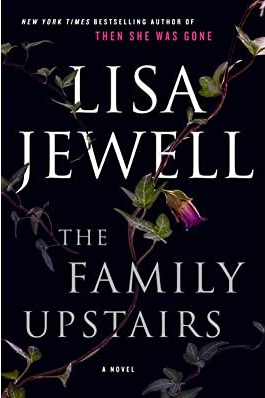
The Family Upstairs – Lisa Jewell

familyupstairsJust when I thought nothing was going to really distract me from this Covid-19 craziness, I dove into Lisa Jewell’s novel The Family Upstairs. I am a Jewell fan to begin with and I usually have a couple unread books by her on my shelf…you know, in case of a reading emergency. I think this pandemic qualifies and, Holy Smokes, did this book ever deliver.

There are three separate narratives in this novel. There’s Libby, a twenty-five-year-old kitchen designer who lives in St. Albans, a commuter suburb just north of London. On her birthday, she receives notice that she has inherited a house in Chelsea, an extremely desirable London neighbourhood. (And by desirable I mean the house is worth millions…of pounds.) The thing is, the house comes with some baggage…including three dead bodies.

That’s Henry Lamb’s story to tell. He grew up in that house with his parents and younger sister. His father was “the sole beneficiary of his own father’s fortune” and his mother was “a rare beauty.” When Henry is eleven and his sister nine, their lives begin to unravel. First of all, Mr. Lamb has squandered the family fortune and then Birdie Dunlop-Evers and her partner, Justin,  arrive.

It all happened so slowly, yet so extraordinarily quickly, the change to our parents, to our home, to our lives after they arrived. But that first night, when Birdie appeared on our front step with two large suitcases and a cat in a wicker box, we could have never guessed the impact she would have, the other people she would bring into our lives, that it would all end the way it did.

The third story belongs to Lucy, a woman we meet in Cote d’Azure where she is living rough with her two young children, Marco and Stella. With no money, and no passport, Lucy must make a difficult choice to protect her children and save herself.

What do these three very distinct and separate stories have to do with each other? Obviously I am not going to tell you, but let’s just say this…I literally could NOT put this book down. Jewell’s trademark is writing twisty plots filled with secrets dying to be revealed. The added bonus is that she’s a great writer and her characters are always believable. Sometimes with books that depend on plot twists, characters get short shrift. Not when Jewell writes them. I happily followed the three separate story threads, trying to race ahead to see if I could figure out how they all belonged together.

The Family Upstairs has everything I love in a book: great writing, an unreliable narrator, sinister characters, secrets galore and a not-too-tidy ending. Story perfection – pandemic or not.

Highly recommended.
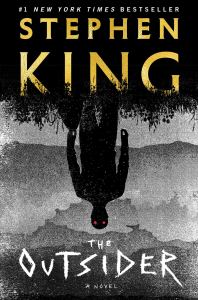
The Outsider – Stephen King

I haven’t read anything by Stephen King since Joyland but I am a fan from wayyyyy back. Despite the often creepy subject matter, King is like book comfort food. I know when I read him, I will not be disappointed (The Tommyknockers aside). The Outsiders delivers in every category…and lucky for me I started it at the beginning of my March Break because I could not put that 560 page sucker down. 

Flint City, Oklahoma is a quiet little ‘burb, but something horrific has happened there. outsider Eleven-year-old Frank Peterson has been found dead in the woods. The crime is unspeakable – so I won’t speak of it here, you’ll get enough of it in the book – and Detective Ralph Anderson is determined to catch the psycho who committed the crime posthaste.
It actually turns out to be a pretty easy case to crack: the DNA evidence is ironclad and there’s a handful of reliable eye-witnesses. Soon, Anderson is arresting Little League coach Terry Maitland.  Maitland, a high school teacher and well-respected member of the community, maintains his innocence, and there’s irrefutable evidence to prove that he didn’t kill Frankie. Like the detectives and the District Attorney, you’ll be trying to figure out how any of this is possible. And then, about half way through the book,  you’ll be reminded that you’re in King territory and he doesn’t play by the rules.

The Outsider is a puzzle of a book and in some ways it sort of reminded me of It, which is probably my favourite King novel. I mean, there’s not really a lot of similarities, except that a strange assortment of people gather together to fight evil, but the showdown at the end of The Outsiders gave me all-the-feels.

Here’s what I have always admired about Stephen King. He writes a cracking good story. The writing is unpretentious. It doesn’t get in the way, as writing often can. Story is king (excuse the pun) and he just lets his characters go about their business. And his characters are believable. You’ll root for them; you’ll care for them; you’ll want them to be safe. (Can’t help you with that, unfortunately. As King famously said in his memoir On Writing, “Kill your darlings, kill your darlings, even when it breaks your egocentric little scribbler’s heart, kill your darlings.”)

If I have one niggle – and it’s so tiny and insignificant it’s hardly worth mentioning, but I will just so I don’t go full-on fangirl – sometimes, occasionally, the dialogue made me wince just a teensy bit.

But who cares?! Seriously. I had a ball reading this book. It’s all kinds of awesome. And the HBO series looks pretty dang good, too.


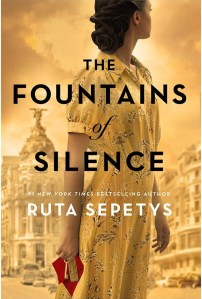
The Fountains of Silence – Ruta Sepetys

Ruta Sepetys has a gift. Well, she has many gifts, to be fair, but I particularly admire her ability to write characters that absolutely lift off the page and linger in your imagination long after the last page has been turned.

At my high school, we introduce readers to Sepetys in grade nine, when we read Between Shades of Gray. I have yet to encounter a student, even  those who identify as non-readers, who doesn’t rip through that book, many reading way ahead of the class. In grade ten, when we introduce Salt to the Sea there are very few groans. Again, students quickly become wholly invested in the stories of the characters. When I read the final few pages out loud to my grade ten classes in the fall, I had to stop several times because I was so close to tears I couldn’t get the words out. That’s how you know these characters have become real to you, I guess: you care about their fate.

fountainsI was very excited to read Sepetys’s latest book, The Fountains of Silence, because I just knew that I was going to meet a new cast of characters to fall in love with, and I wasn’t wrong.


Daniel Matheson is almost nineteen when he travels to Madrid with his parents during the summer of 1957. His father is an oil tycoon from Texas, and his mother is originally from Spain. Daniel’s dream is to become a photo journalist, but his father disapproves. While Mr. Matheson does business, Daniel takes pictures, and in doing so he starts to see that sunny Madrid is one city to tourists and another to people who struggle beneath Francisco Franco’s yoke.

Ana works in the hotel and is assigned to help the Mathesons. Her story is one of poverty and struggle. Her father was executed and her mother imprisoned and “Her parents’ offense has left Ana rowing dark waters of dead secrets. Born into a long shadow of shame, she must never speak publicly of her parents. She must live in silence.”

Ana and Daniel feel an instant attraction to each other, but it’s the classic case of being from opposite sides of the social spectrum. There is so much Ana wants to say and can’t, and so much that Daniel doesn’t understand, but certainly will.

Although Ana and Daniel’s story is central to the plot, there are other compelling characters in this book, including Ana’s older brother Rafa and his childhood friend, Fuga; Ben, a seasoned journalist who takes Daniel under his wing, and Puri, Ana’s cousin who works at a local orphanage. Although Ana and Daniel will take up most of the space in your heart, all the characters you’ll encounter are compelling and interesting.

Once again, Sepetys has mined history to find her story. This one concerns the thousands of children who were stolen from their parents and adopted by more ‘suitable’ families. It also provides a window into the period of the Spanish Civil War and the years immediately following, when “Helpless children and teenagers became innocent victims of wretched violence and ideological pressure.”

Their stories deserve to be told and Sepetys does them, and us, a great service by telling them.

Highly recommended.


The Damned – Andrew Pyper

223C2A3B-A2C4-455F-AEFE-1A58DF3297B0Canadian writer Andrew Pyper is often compared to Stephen King and I can see why.  Both writers skillfully find the scary in the every day, and in relationships which should be sacrosanct. Pyper mined that territory in his novel The Guardians  and he does it again in The Damned which hooks you in pretty much from page one.

Danny Orchard has come back from the dead on more than one occasion. He wrote about the experience in a memoir called The After a book that, many years later, keeps him busy at “dentists’ conventions and service club fundraisers” where he talks about what’s at the end of the long tunnel. Danny’s experience has inspired a group known as The Afterlifers, “a community for those who’ve traveled to the other side and returned.”

When Danny was sixteen he and his fraternal twin, Ashleigh (Ash), were killed in a house fire. Well, Ash was killed; Danny was saved. If saved is what you want to call it. I guess Danny would have a different opinion about it since he’s been haunted by his sister ever since. Although on the surface, it looked like Danny and his family had it all

My father, mother, and I were aware that a monster lived with us, however photogenic, however scholarship-guaranteed. And because she was only a girl, because she was one of us by name, because we feared her, there was nothing we could do about it.

Ash is clearly a psychopath and death doesn’t change that, so Danny’s life is pretty solitary until he meets Willa and her ten-year-old son Eddie.  He believes that he can keep them safe, but Ash isn’t about to let go that easily and Danny soon realizes that he is going to have to face her on her terms. If heaven is reliving the best day of your life over and over, hell is quite the opposite.

Pyper has created a compelling and nightmarish hellscape and, in Danny, a character readers will actually want to root for. At first he thinks that Ash just wants him to solve the lingering questions about her death. (Why was she in that abandoned house and what happened to the three friends she was supposedly with that day?) But Ash’s motives are far more sinister and when Danny returns to Detroit looking for answers he finds far more than he bargained for.

The Damned would make a terrific movie, but I’ve got a great imagination and Pyper is a great writer. I could see everything just fine, thanks very much. If you don’t mind white-knuckling it through a book, this is the story for you.

Peril – Thomas H. Cook

My first finished book of 2020 is Thomas H. Cook’s 2004 novel Peril. Unlike most of the perilother books I’ve read by  Cook, which have generally focused on one narrator, Peril lets the reader see the same set of circumstances through a variety of lenses.

Sara Labriola is hoping to disappear. After nine years of marriage to Tony, she can’t go on and so one day she packs her clothes, leaves her wedding ring and takes the bus into Manhattan.

Tony is devastated when he discovers Sara missing, but his father, Leo, is furious. Leo is a thug who berates everyone around him, including Tony who has never had the nerve to stand up to him. Leo tells his guy Caruso to find Sara and Caruso leverages the help of Mortimer Dodge because he owes Leo money. Dodge works for a guy named Stark, a guy whose job it is to find people.

Need a chart yet? Let’s recap.

Sara runs away from Tony.

Tony wants to find his wife before his father does because he knows that if Leo finds her first the consequences will be grim. He tasks his employee and friend Eddie with helping him.

Leo gets Caruso on the job. Caruso gets Mortimer on the job. Mortimer gets Stark on the job.

Sara is in NY and thinks she has found a job singing in a night club owned by Abe, who happens to know Mortimer.

It all sounds way more complicated than it is and it’s actually way more compelling than this, too, and that’s because, well, Thomas H. Cook wrote it.

You know how you can read some thrillers or mysteries and they’re just straight ahead books that are driven by plot but not much else? Yeah, that’s not Cook. There is not a character in this novel who doesn’t have a totally believable backstory that makes them, even when they are not particularly likeable, sympathetic. (The exception here is Leo Labriola, who is a misogynistic asshat.) And I mean every character, even characters we only meet a couple times, like the mother of Sara’s neighbour, Della.

And if you think all this backstory is going to bog down the plot – which would be bad, too – forget about it. You’ll turn the pages lickety-split because, well, Thomas H. Cook. He balances character and story and even if some of what happens here seems a tad too coincidental, you won’t care. At all.

There’s something old school about Peril. It’s like a noir film, peopled with shadowy gangsters in crumpled hats, a beautiful, fragile heroine who earns the good will of the men she meets, and a bunch of guys who ultimately, turn out to be loyal and decent.

You will NEVER be wasting your time reading a Cook book. (Couldn’t resist.)

The Dutch House – Ann Patchett

dutchI think some authors could write about paint drying and it would be worth reading. Ann Patchett is one of those authors. The Dutch House  is the third book I’ve read by Patchett (Bel Canto, Commonwealth),  and it did not disappoint.

Danny and Maeve grow up in the Dutch House, a gorgeous jewel-box of a house in Elkins Park, a suburb of Philadelphia. The house seems to “float several inches above the hill it sat on.”  Danny and Maeve’s father, Cyril,  had bought the house as a surprise for their mother, Elna, but she didn’t like the house – or so the story goes – and left the family for parts unknown. When the novel opens, Danny and Maeve are 8 and 15 respectively, and being introduced to their father’s ‘friend’, Andrea and her two young daughters Norma and Bright. The arrival of Andrea into their lives changes everything for the siblings.

The Dutch House is not a linear story. It bounces back and forth through time, covering roughly fifty years. Not every writer could manage this sort of narrative as easily as Patchett does. Although the perspective is Danny’s, readers will come to know and love (or hate) many other characters, most notably Maeve, who is the centre of Danny’s world.

She taught me the proper way to hold a fork. She attended my basketball games and knew all my friends and oversaw my homework  and kissed me every morning before we went our separate  ways to school and again at night  before I went to bed regardless of whether or not I wanted to be kissed. She told me repeatedly, relentlessly, that I was kind and smart and fast, that I could be as great a man as I made up my mind to be. She was so good at all that, despite the fact that no one had done it for her.

When Andrea turfs them from their house, their lives are thrown into chaos. They find themselves parking in front of the Dutch House over the years, reminiscing about and redacting their past, never quite able to let go. In some ways, their lives are halted by this connection to a place.

Not much happens in the novel, but at the same time everything happens. Danny and Maeve’s  lives and relationship are the story,  which makes sense, really. As we’re waiting for our own plots to unfold, life is actually happening all around us. The bitter feelings Maeve clings to derail her life, but we don’t really understand that until her mother turns up out of the blue. Or we see what ends up happening to Andrea.

Patchett has written characters you will absolutely come to care about and given them lives which should remind us to care more deeply about our own, and the people we share them with.

Highly recommended.

The Current – Tim Johnston

the currentI was so excited to get my hands on Tim Johnston’s novel The Current. I gazed longingly at the hardcover every time I went to the book store, but I rarely spring for a hardcover unless they’re on sale. Then one day: paperback. I dropped everything that I was reading to deep dive into it.

I read Johnston’s novel Descent three years ago and I loved it. I often recommend it to others because it is the perfect combination of page-turning-thriller and thoughtful family drama. The Current examines some of the same themes but is, in some ways, even more ambitious.

College students Caroline and Audrey are on their way to Audrey’s hometown in Minnesota. Audrey’s father, former sheriff,  is dying of cancer and Audrey wants to spend some time with him. They are almost there when they have an ‘accident’ and their vehicle is plunged into the icy river. Only Audrey survives. That seems spoiler-y. I know, but that much information is provided for the reader on the back of the book.

As Audrey recovers, her father, Tom,  sets out to discover just what happened to the girls because, well, this wasn’t quite an accident. And this wasn’t the only time the river had claimed a life. Ten years ago, Holly Burke, 19, had turned up dead in the river. Her father, Gordon, shows up at the hospital to remind Audrey’s father about the fact that his daughter’s murder was never solved.

…I just kept asking myself: What would Sheriff Sutter do differently now, if it was his girl instead of that other one who didn’t make it? What would he do for himself that he didn’t do for me?

Holly’s murder has haunted Tom Sutter and as Audrey recovers, it begins to haunt her as well, although she was only a child when Holly was killed. Their stories, though, begin to twine around each other, and many other people are swept along in that current.

Unlike Descent, which is very tightly focused on the Courtland family, The Current, drifts in and out of the lives of other characters, specifically Rachel Young and her sons Mark and Danny. Danny was a prime suspect in Holly’s murder, but there’d never been enough evidence to convict him. Gordon and Rachel had been close, but of course that friendship had ended.

Danny and Mark are characters that will really stay with me. Danny’s whole life is changed by the accusations made against him and even when he returns to visit his mother, the past is always nipping at his heels. Mark is somewhere on the spectrum and is tasked with filling in for his brother when he leaves. I worried about these guys. A lot. That’s saying something since in some ways they are peripheral to Audrey’s story. Still, I loved them.

Johnston is gifted when it comes to characterization. These people seem wholly human: frail and foolish, damaged and determined. The whole town seems stuck, somehow; no one has recovered from Holly’s murder. The novel is filled with moments of heartbreaking kindness, bravery and selflessness. And the town they live in: secrets galore.

And yes, you’ll want to know whodunit, but that’s actually the least interesting part of this masterful book.

If Tim Johnston is not yet on your reading radar, he should be. Highly recommended.

Mortal Memory – Thomas H. Cook

cook-e1564403930383.jpgIf you are regular reader of this blog, then you know that I am a huge fan of American mystery/crime writer Thomas H. Cook. I found his book Breakheart Hill by chance well over a decade ago and I look for his books whenever I am in a book store. The problem is, he’s very rarely to be found on the shelves even though he is an Edgar Award winner (The Chatham School Affair) and a much-lauded writer. The Los Angeles Times Book Review  said that “Cook is an important talent, not simply a plotter but a prose stylist with a sensitivity to character and relationships…A storytelling writer of poetic narrative power. His crime fiction extends the boundaries of the form.” (This is why I hoard the books I find and don’t read them all at once; I have to pace myself so I don’t run out.) Besides the two books I’ve already named, I also really loved Master of the Delta and Instruments of the Night which might be my favourite of Cook’s books.  But really, you can’t go wrong reading anything this guy writes.

This much I remembered from the beginning: the floral curtains in their second- floor bedroom pulled tightly together; Jamie’s new basketball at the edge of the yard, glistening in the rain; Laura’s plain white bra lying haphazardly in the grass behind the house, the rest of our clothes, drenched and motionless as they hung from the line above it.

Thus begins Mortal Memory, a story that begins when narrator Stevie Farris discovers, mortalat age 9, that his father has shot and killed his mother, Marie, older brother, Jamie and sister, Laura. The knowledge of this horrific act tortures Stevie, mostly because he doesn’t understand why his father committed such a horrible crime. Wasn’t his family happy?
Flash forward 30 plus years and Steve is married with a son of his own. That’s when he meets Rebecca Soltero. She’s a writer who’s “writing a book about men who have killed their families.” Rebecca’s arrival and her penetrating questions bring all sorts of memories back for Steven. The story seamlessly weaves between past and present as Steve recalls the cracks in the family veneer, which ultimately causes him to examine the fault lines in his own family.

That’s one of the things I most admire about Cook. His books always operate on more than one level. Yes, there’s a mystery – that’s what will keep you feverishly turning the pages, but there is always some sort of family drama, often between fathers and sons, which is carefully and thoughtfully crafted. Another thing Cook does extremely well, is to turn your expectations upside down. Trying to figure out what’s happened is half of the fun of reading Cook, but I’ve never been right once. And I wasn’t this time, either.

So where does Mortal Memory fit in the Cook continuum? Probably somewhere in the middle. Not my favourite – mostly because I didn’t love the resolution – but any time spent with this author is time well spent.


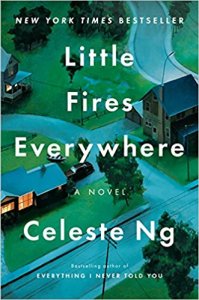
Little Fires Everywhere – Celeste Ng

littlefires“Sometimes you need to scorch everything to the ground and start over,” Mia tells Izzy in Celeste Ng’s second novel Little Fires EverywhereI read Ng’s first novel Everything I Never Told You a couple years ago and I love that book. So much. Little Fires Everywhere is also excellent. There is no doubt that I will buy and read whatever Ng writes going forward.

Shaker Heights, Ohio is America’s first planned community with rules determining what colour your house can be painted and where schools are placed so that children don’t have to cross any major streets.

The underlying philosophy being that everything could – and should – be planned out, and that by doing so you could avoid the unseemly, the unpleasant, and the disastrous.

Elena Richardson believes in the defining principles of Shaker Heights and, in fact, that’s the way she runs her household and her life. Her three oldest children Lexie, Trip, Moody seem to tow the family line. Her youngest, Izzy, is more of a problem child and when the novel opens “Everyone was talking about […] how Isabelle, the last of the Richardson children, had finally gone around the bend and burned the house down.”

What would compel Izzy to commit such an act?  Meet Mia and Pearl. They’ve just moved into the Richardson’s rental property. Mia is an artist and Pearl her intelligent fifteen-year-old-daughter. When Pearl and Moody become friends, the two families’ lives intersect. In the Richardsons, Pearl sees “a state of domestic perfection” and in Mia Izzy has someone who understands her and listens to her.

Little Fires Everywhere is a book about motherhood and it asks important questions about what it means to be a mother. Are you a mother because you’ve given birth? Is it a choice? Is a relationship between a mother and their child automatic or is it something that must be cultivated beyond mere biology? What happens if you give up a child? Do you have the right to change your mind?

Free-spirited Mia worries that her daughter is perhaps being unduly influenced by the Richardsons and wonders “if it was right for her daughter to fall under the spell of a family so entirely.” She and Pearl have always been vagabonds, moving from place to place in search of inspiration for Mia’s photography. Now she has promised Pearl that they will stay put.

In Mia, Izzy finds a sort of surrogate mother, someone who listens to her complaints about the state of her world and asks her what she intends to do about it. “Until now her life had been one of mute, futile fury” but Mia encourages her to consider her options.

This is a book that is very female-centric. We don’t spend a lot of time with the men, but that’s okay, the women are fascinating. Their hopes and dreams, some derailed by circumstance, others by choice, are worthy of close inspection. I loved my time in Shaker Heights. Little Fires Everywhere is filled with stymied, passionate, damaged, beautiful and complicated characters, and like Everything I Never Told You there is something about the way Ng tells a story that just keeps you turning the pages to get to the end. Then, you want to start all over to spend more time with her magnificent characters.

Highly recommended (and not just by me. The accolades are endless.)

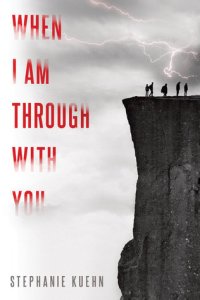
When I Am Through With You – Stephanie Kuehn

throughwithuCharm & Strange  was my introduction to Stephanie Kuehn’s work and I have been a fan ever since. When I Am Through With You is her latest YA offering and it’s a layered and tense thriller.

The narrator of the story, Ben Gibson, is a high school senior.  From the very beginning, readers know that something has gone horribly wrong Ben’s life.

This isn’t meant to be a confession. Not in any spiritual sense of the word. Yes, I’m in jail at the moment. I imagine I’ll be here for a long time, considering. But I’m not writing this down for absolution and I’m not seeking forgiveness, not even from myself. Because I’m not sorry for what I did to Rose. I’m just not.

Rose is (was) Ben’s girlfriend. She chose him, not the other way around. She is an exotic combination of her French Peruvian heritage, a “girl with bright eyes and brown skin and very short hair.”

…Rose was my first everything. First kiss, first touch, first girl to see me naked and lustful without bursting into laughter (although she was the first to do that, too). We did more eventually. We did everything. Whatever she wanted, Rose dictated the rhyme and rhythm of our sexual awakening, and I loved that. I never had to make up my mind when I was with her.

Ben is an engaging narrator, even though the reader might consider him unreliable. Kuehn wisely keeps her cards close to her chest, unspooling Ben’s backstory carefully. Why does he suffer from debilitating migraines? Why does he feel like his life is on the road to nowhere? What happened to Rose?

Much of the action happens in the middle of the book. Ben is helping his teacher, Mr. Howe, lead a camping trip out in the wilderness. Rose and her twin Tomas, Duncan (the high school drug dealer), Clay ( a quiet , studious kid), Archie (the wild card), Avery (Ben’s childhood friend), and Shelby (volleyball goddess) are the other campers. It’s kind of like the Breakfast Club of orienteering. Out of their natural element (with the exception of the teacher, who isn’t really front and centre, but manages to be important nonetheless), alliances fray and a combination of bad luck, bad decisions and bad weather cause total chaos and panic.

When I Am Through With You wasn’t at all what I was expecting. I knew to expect great writing, and I knew that the characters would be smart and prickly – something I’ve come to expect from Kuehn. This book asks you to  consider the moral choices these characters make. Ben is unrepentant, but he is also sympathetic. I felt tremendously sorry for him throughout the novel. It’s not all introspection, though. There are some truly heart-racing moments in this novel, and its propulsive plot will keep you turning the pages.